
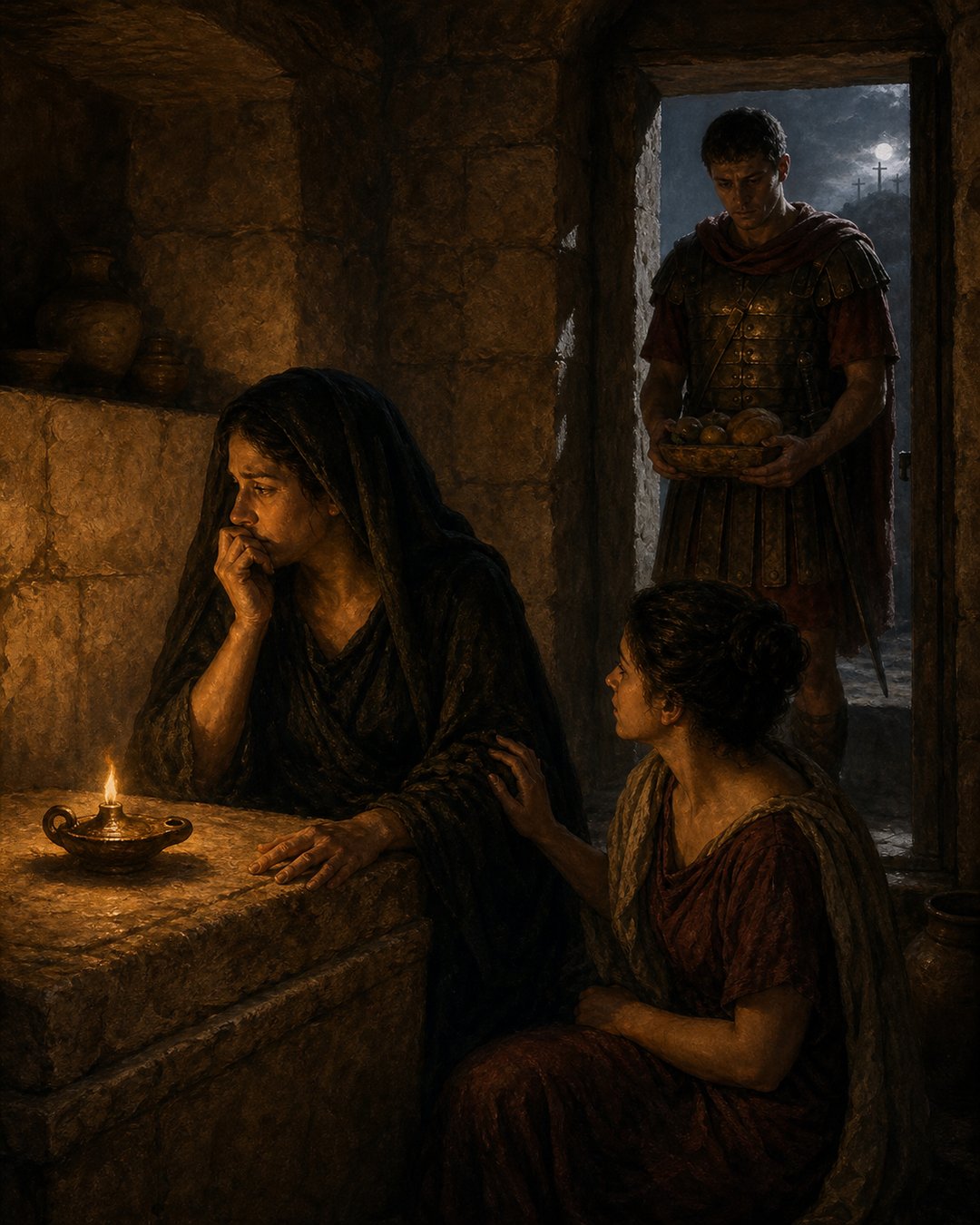
A lamp burned beside a coffin while an entire city praised the woman who refused to leave it. Petronius’s Ephesian widow had followed her husband into the tomb, rejected food and held her vigil into a fifth day. Her grief had become a public marvel before a soldier guarding nearby crosses noticed the light among the graves.
What follows is not a report from an Ephesian magistrate’s archive. It is a story inside the Satyricon, built for reversal. The widow’s reputation, the soldier’s duty and the tomb’s meaning all change as different people look at the same place. By the end, a missing corpse has turned private appetite into a public puzzle, and the woman celebrated for refusing life devises the tale’s most ruthless way to preserve it.
The city turned mourning into a spectacle
The narrator begins with reputation rather than bereavement. The married woman at Ephesus was supposedly so famous for chastity that women travelled from neighbouring states to look at her. Her husband’s death then gave that reputation a visible test. Ordinary gestures in the procession were not enough. She followed the body into the burial vault.
There she kept watch day and night. Parents and relatives tried to move her. Even magistrates came and failed. The story pushes every recognised source of persuasion toward the tomb and sends each away defeated. By the fifth day without nourishment, the widow’s refusal had become the city’s single agreed example of marital devotion.
A maid stayed beside her, sharing the tears and replenishing the lamp. That practical detail matters. The widow appears to withdraw from society, yet her performance still requires another person to maintain its light. The grave is private enough for extremity but visible enough for Ephesus to form an opinion about it.
Roman rules could place the dead beyond the ordinary space of the living. The requirement for burial beyond the city gives Petronius a marginal landscape where execution, military surveillance and family intervention can collide within a few steps.
A guard followed light into the vault
Nearby, the provincial governor had ordered robbers crucified. A soldier’s task was to watch the crosses and prevent relatives from removing a body for burial. His duty is the opposite of the widow’s chosen vigil. She protects one corpse from separation through grief; he protects other corpses from reunion with their families through force.
On the following night he saw light among the tombs and heard sobbing. Curiosity drew him down. At first the figure inside appeared supernatural. Then the coffin, tears and scratches on the woman’s face made the scene legible: this was a mourner, not an apparition.
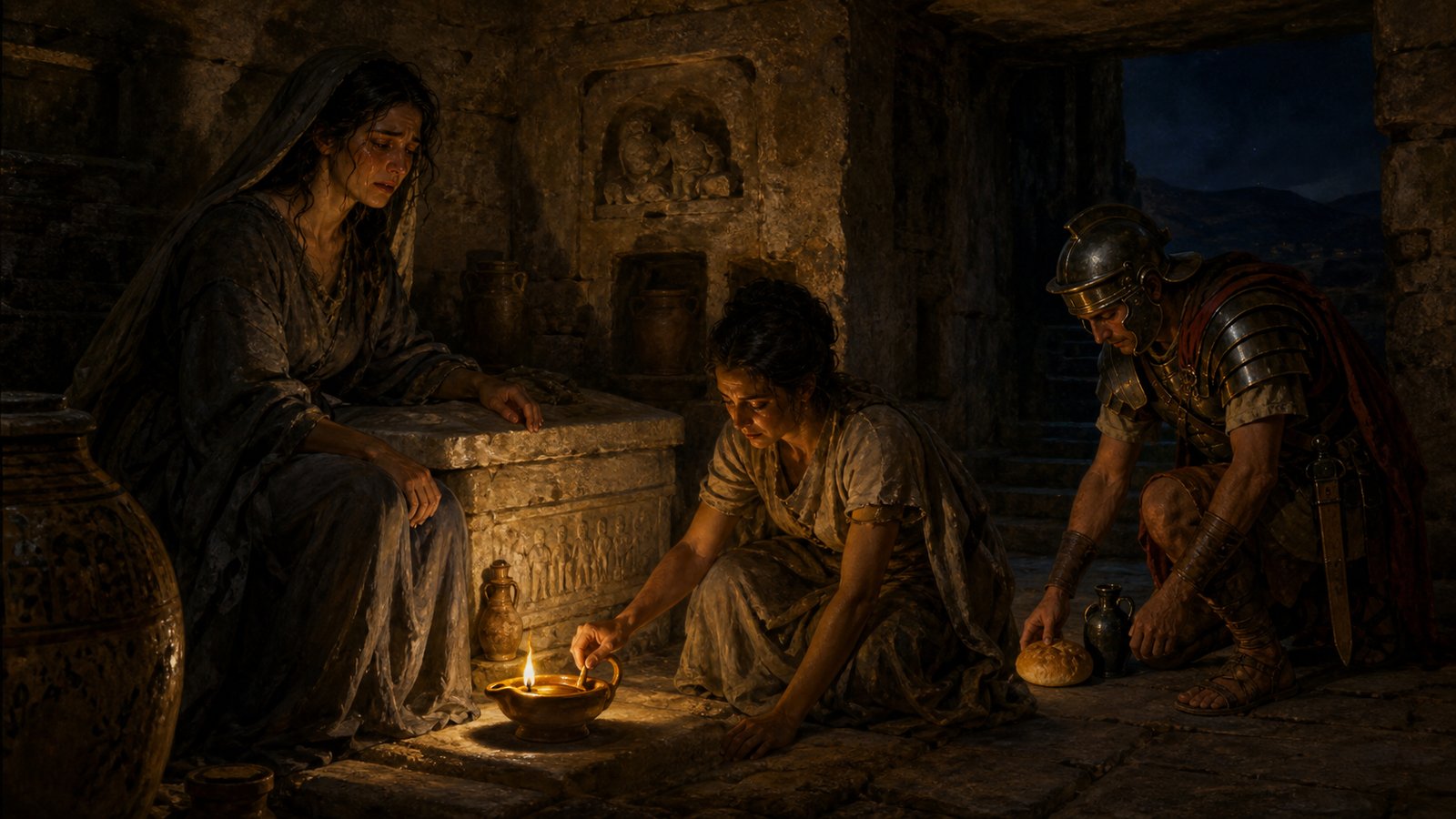
The soldier brought his small ration into the vault and offered the familiar claim that death comes to everyone. The widow answered sympathy by intensifying her grief. She tore at her hair and placed it on her husband’s breast. Words do not defeat the performance because its force is physical: fasting, damaged skin, loose hair, sleeplessness and proximity to the corpse.
The story’s first hinge arrives through smell rather than argument. The maid accepts the wine and food. Once refreshed, she changes roles from companion in mourning to advocate for survival. She asks what benefit can come from dying of hunger and invokes the duty to remain among the living.
Food altered the audience before desire altered the vow
The mistress eventually follows the maid. After days of abstinence, she eats eagerly. Petronius makes this turn deliberately bodily. The story does not present a philosophical refutation of grief; it lets hunger, wine and another person’s example reopen the world outside the coffin.
The soldier then repeats the structure of his first campaign. Having persuaded the widow to live, he courts her. The maid again speaks in support. The narrator compresses the result into victory language: the guard wins both objectives, first food and then intimacy.
The lovers remain in the closed vault for three nights. To an outsider, the shut door can still sustain the old reputation. Anyone approaching might assume that the exemplary wife had finally died over her husband’s body. Inside, however, the soldier brings delicacies after dark and the burial chamber has become a hidden household.
This is Petronian territory. In Trimalchio’s deceptive dinner, food repeatedly makes appearances unreliable. The Ephesian tale uses a smaller menu but a sharper concealment. The meal revives the widow while the closed tomb encourages the city to imagine that devotion has killed her.
The absent body made secrecy impossible
The soldier’s visits have a cost. While he is absent from his watch, relatives of one crucified man remove the body and perform the burial rites. At dawn, the guard sees an empty cross. The story’s objects now accuse him more powerfully than a witness could. A missing corpse proves that the task entrusted to him has failed.
He expects military punishment and refuses to wait for it. The soldier tells the widow that he will use his own sword and asks her to make room in the vault for another dead man. Their refuge can no longer hide desire without receiving its consequence.
The widow’s reply is the tale’s hardest reversal. She says she cannot look upon the corpses of the two men dearest to her at the same time. The phrase momentarily places husband and lover within one language of affection. It then introduces a choice: she would rather hang the dead than kill the living.
She orders her husband’s body lifted from the coffin and fixed to the vacant cross. The substitution answers the soldier’s practical danger because the post will no longer stand empty. It also destroys the visible object around which the widow’s famous constancy had been organised.

A public wonder replaced a public example
The ending moves outside the tomb once more. The soldier uses the expedient, and the next day people wonder how a dead man reached the cross. They see the result without the private sequence that produced it. Their confusion closes a story that began with their confidence.
At first, Ephesus supposedly agreed on what the widow meant: she was a unique example of chastity and love. At the end, the same community faces a corpse in an impossible place. Reputation has not been corrected by complete knowledge. One public interpretation has simply been replaced by another public mystery.
That structure is why the tale should not be read as a straightforward claim about what Roman widows usually did. Its people are arranged for satirical pressure. The widow must be exceptionally celebrated, the soldier must have one sharply defined duty, the maid must switch sides first, and the removed body must create a deadline. Each element narrows the path toward the final exchange.
The story’s cruelty lies in how neatly the exchange works. The husband’s corpse becomes material for saving the new lover. The soldier’s neglected post recovers its appearance of order. The widow avoids a second death in the vault. Only the audience remains unable to explain what it sees.
Petronius therefore turns constancy into a problem of staging. The lamp, ration, locked door, coffin and empty cross do more than decorate the story. They determine who can know what, and when. The city praises an image maintained by a maid and a lamp; the lovers exploit a door; the relatives exploit an absent guard; the widow exploits a corpse.
By refusing to tell the episode as history, we can see its ancient mechanism more clearly. The Ephesian matron is a literary trap assembled from hunger, desire, duty and spectatorship. Once one body disappears, every private choice must leave a public shape. The final joke is not that the city learns the truth. It is that the city sees the evidence and invents wonder instead.
Sources
Petronius, Satyricon, 111–112