
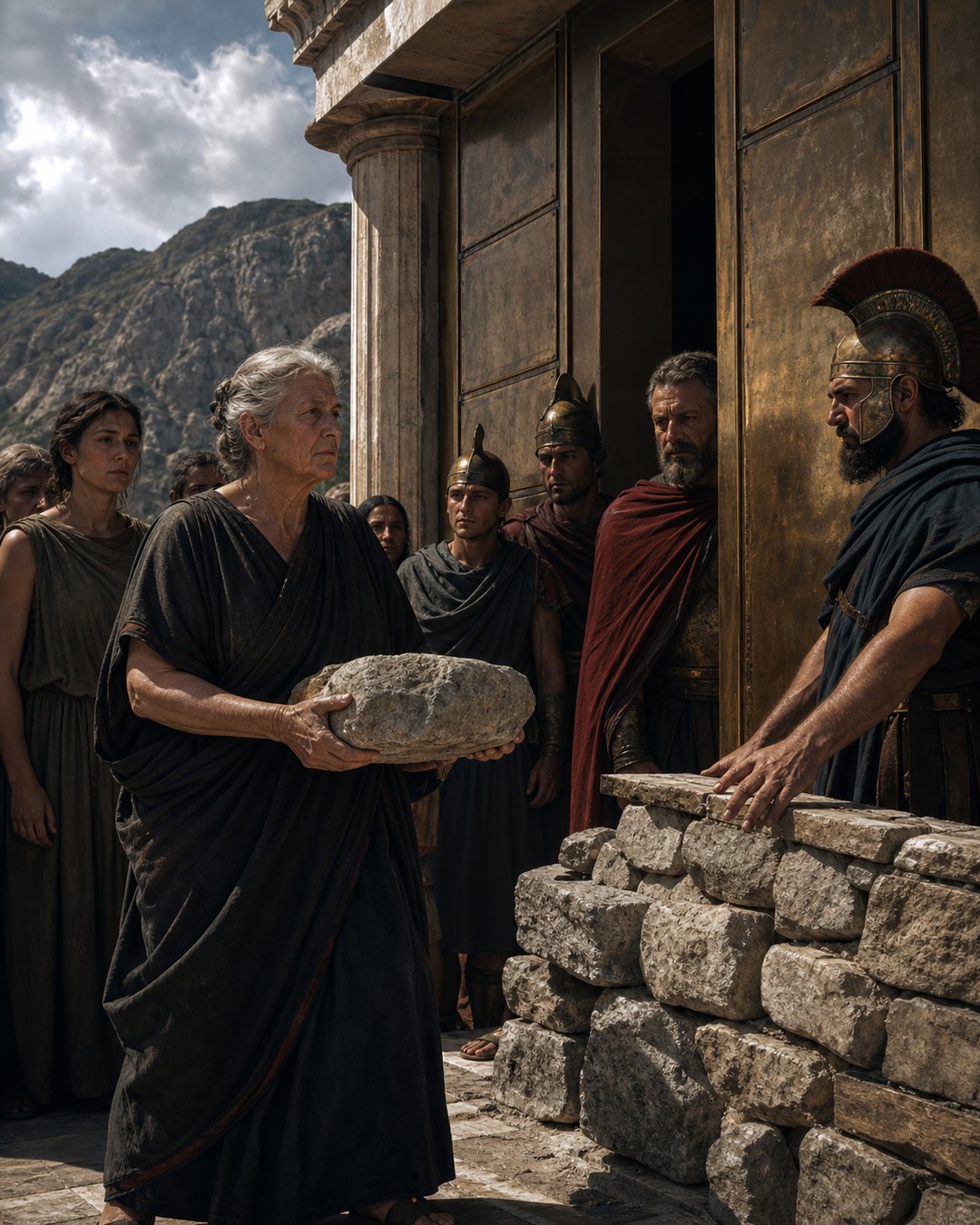
Pausanias was only a few steps ahead of the ephors when he reached the sanctuary of Athena Chalkioikos. The Spartan authorities intended to arrest him, but the sacred boundary interrupted ordinary seizure. He entered the precinct and took shelter in a building connected with it.
The ephors answered without dragging him from the goddess’s protection. They blocked the entrance. Cornelius Nepos adds that they removed the roof so exposure would hasten the end. Then he gives the detail that makes the scene almost unbearable: Pausanias’s elderly mother, once she learned of her son’s guilt, was among the first to bring a stone to the doorway.
That stone belongs to one ancient biographical tradition, not to Thucydides’s earlier narrative. Yet both accounts preserve the same grim mechanism. Sanctuary saved Pausanias from immediate hands only to turn his refuge into a prison. The authorities controlled the threshold, waited until he was nearly dead and carried him out before his corpse could violate sacred ground.
An absent messenger turned a letter into evidence
The final pursuit began with a man from Argilus whom Pausanias trusted with a letter. Thucydides says the messenger became suspicious because none of the previous men sent on the same business had returned. He broke the seal carefully, read the message and found an instruction that threatened his own life.
The discovery changed the relationship between commander and subordinate. Pausanias believed he was sending a disposable carrier. The Argilian instead brought the matter to the ephors. Suspicion that had surrounded the regent could now be converted into words the magistrates might hear for themselves.
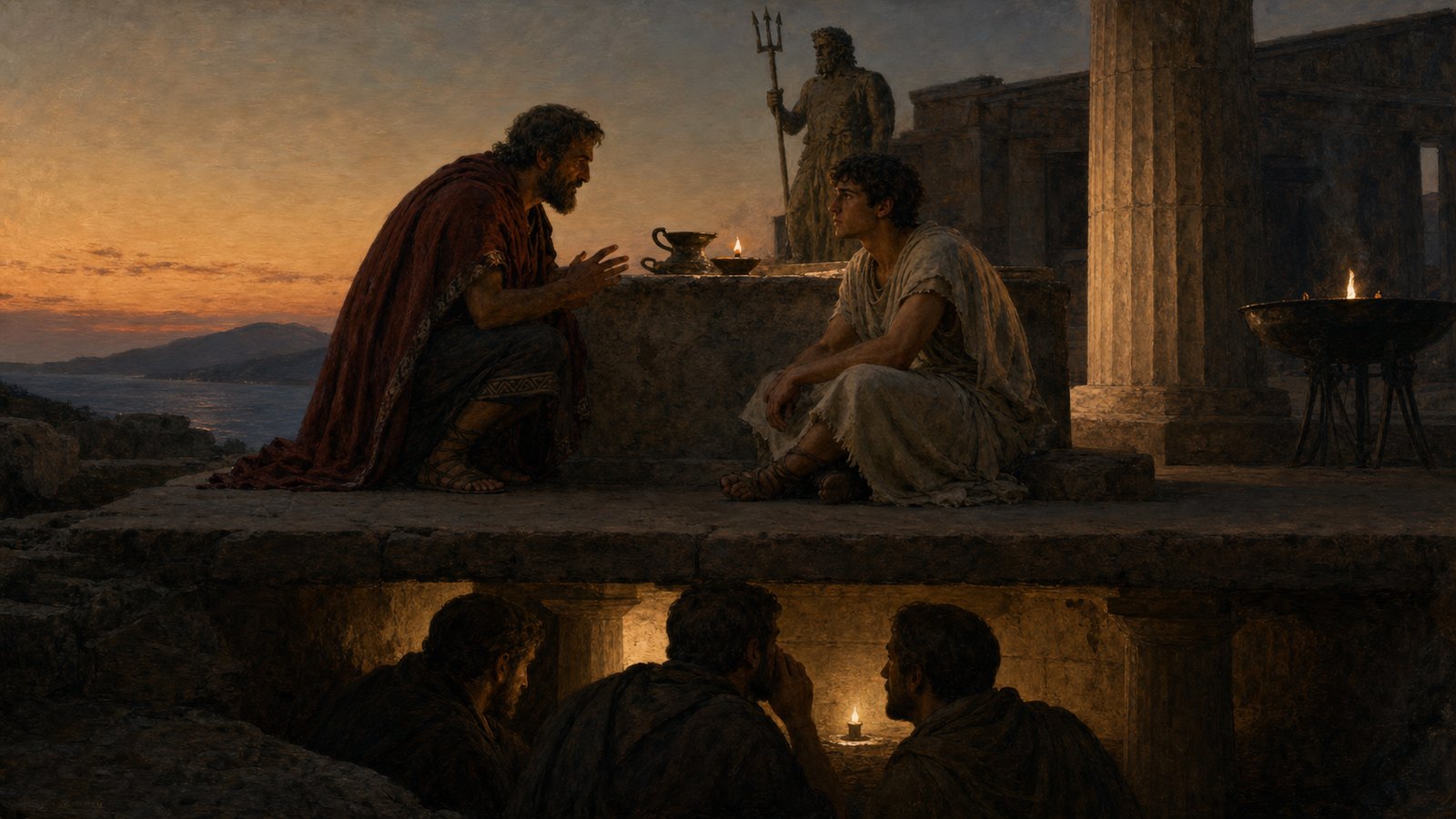
Nepos places the informer at the temple of Neptune at Taenarum, seated at the altar as a suppliant. The ephors did not violate that refuge to seize him or stage a public confrontation. They prepared a concealed underground chamber close enough to overhear what happened next.
Pausanias arrived in anxiety and asked why the man had taken this sudden step. The messenger disclosed what he knew from the letter. Pausanias begged him not to betray someone who had treated him well and promised a generous reward if he helped him escape the danger. Hidden listeners now possessed more than a suspicious document; they had heard the regent respond to its contents.
The ephors waited for a place where arrest could be lawful
The sacred altar at Taenarum shaped the investigation. Nepos says the Greeks considered it impious to violate the place. The informer used that protection to make contact while the ephors listened without laying hands on either man. Evidence was gathered beside sanctuary rather than by breaking it.
Afterward, the authorities decided that arrest in Sparta would be better. Their caution suggests the problem was not simply whether Pausanias was dangerous. The method of taking a celebrated regent mattered. An act that looked like sacrilege or factional vengeance could damage the case it was meant to complete.
On the road, Pausanias believed he had won the messenger back. Then one ephor’s expression warned him. Nepos says he perceived the design against him just as arrest was about to occur. The contest narrowed to a short physical race between a man seeking sacred ground and officials seeking to reach him first.
Pausanias won by only a few steps. Athena Chalkioikos—Athena of the Brazen House—offered a boundary the ephors would not openly cross. Thucydides is precise that he entered a structure within the precinct; Nepos compresses the setting into the goddess’s temple. The distinction changes the architecture but not the central dilemma.
A doorway became the instrument of punishment
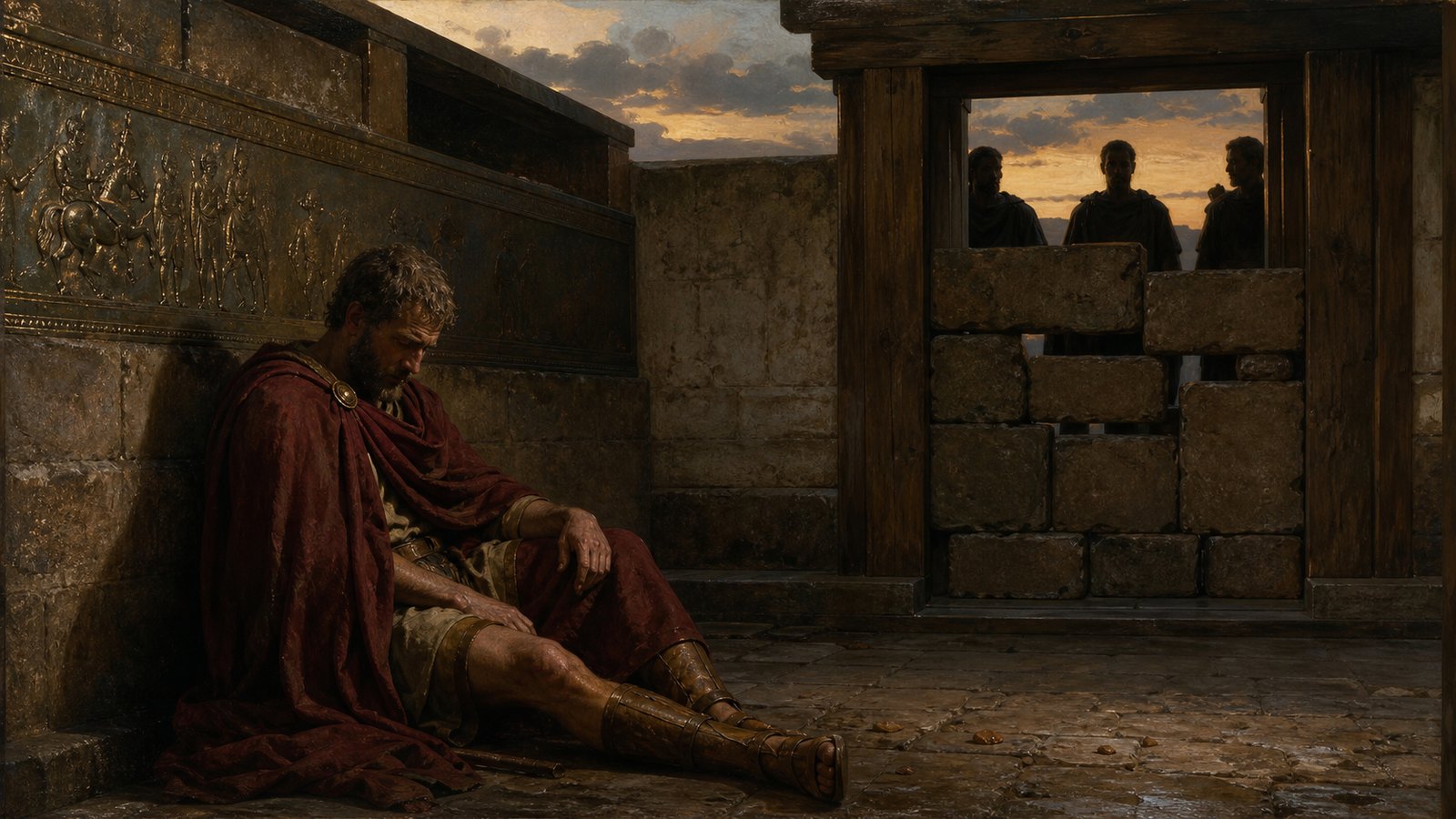
The authorities could guard the exit without entering. Thucydides says they took off the building’s roof and blocked the doors. Nepos likewise makes obstruction the immediate response. A sacred refuge normally protected a suppliant from force, but Pausanias could not turn that protection into food, movement or escape.
Walls that had kept pursuers out now kept the refugee in. The doorway became the active part of the sentence. No executioner crossed the threshold with a weapon. Instead, stone, timber and watchfulness converted time into pressure while responsibility could be described as confinement rather than direct killing. Doorways elsewhere organized sacred constraint in a different register: one knot could stop Jupiter’s priest at the door because binding and passage carried ritual consequences.
Nepos’s report about the mother intensifies that civic choreography. Elderly though she was, she allegedly came among the first and placed a stone at the entrance. The tale makes family participation authenticate public judgment: the person expected to plead for the son instead helps close his only route out.
Ancient readers did not have to treat every detail identically. Thucydides does not supply the mother’s action. Nepos introduces it with “it is said,” marking inherited report. The responsible conclusion is therefore not that her stone is established by two independent narratives, but that later biography used it to express the severity of Spartan loyalty.
The dying man crossed the sacred line one last time
The ephors still faced a religious limit. If Pausanias died inside, the body itself could pollute the protected place and make the authorities responsible for a death on sacred ground. Thucydides explains that they watched until he was at the point of expiring, then carried him outside while life remained.
Nepos says he was half dead when removed and breathed his last immediately. The timing was exact in principle even if no clock measured it. Too early, and the captive might revive or escape punishment. Too late, and the sanctuary would contain a corpse produced by the siege.
This last transfer reversed the first. Pausanias had crossed inward by his own speed to stop arrest. He crossed outward in the hands of his enemies because he no longer had strength to choose. Sacred geography governed both moments, first protecting his body and then requiring its removal.
The episode resembles Rome’s own concern with boundaries, though the institutions were Spartan. A clod carried distant land into a Roman court because procedure needed a disputed place represented within reach. At Athena’s precinct, officials solved the inverse problem: they controlled a body they would not lawfully seize in the place where it sat.
Burial reopened the argument after death
Death did not end the problem. Nepos records disagreement over whether the body should go to the place reserved for criminals. The majority opposed that treatment, and Pausanias was buried away from where he died. The conflict between disgrace and former distinction continued into the disposition of his remains.
A Delphic response later required another change. Nepos says the body was exhumed and buried at the very spot where Pausanias had ended his life. The sanctuary boundary that officials had managed so carefully during the siege returned as a question of burial and divine instruction.
Pausanias had once commanded the allied Greeks at Plataea and possessed immense prestige. His end allowed ancient writers to frame a reversal from public glory to suspected betrayal, from commander to trapped suppliant. Yet the most revealing details are procedural rather than theatrical: a compromised messenger, concealed listeners, a warning glance, a short race, a blocked opening and removal before the final breath.
Spartan authority did not overcome sanctuary by pretending it did not exist. It made the refuge’s own edges do the work. Nepos’s mother with her first stone turns that mechanism into a moral image. Whether remembered fact or sharpened tradition, her act says what the wall was meant to prove: at the doorway of the Brazen House, Pausanias stood without a family exception to the city’s judgment.
Sources
Thucydides, History of the Peloponnesian War, 1.132–135.
Cornelius Nepos, Pausanias, 4–5.