
A single banquet could alter the arithmetic of a Roman farm. Varro says that Quintus Hortensius served roast peacock when he entered the college of augurs. Guests praised the luxury, other hosts copied it, and a bird once kept chiefly for display acquired a profitable second destination: the dining room.
The prices in Varro’s account explain why breeders paid attention. An egg could fetch five denarii and a grown bird fifty. Marcus Aufidius Lurco was said to receive sixty thousand sesterces a year from peacocks. Those figures belong to a writer interested in profitable husbandry, but his point is larger than boasting. Fashion had created a market worth engineering.
That engineering reached from wooded islands to hidden nests and foster hens. Peacock production was not simply a matter of owning beautiful birds. The keeper had to control mating ratios, find concealed eggs, move them without breaking incubation, identify them at hatching, and feed delicate chicks by stages. The banquet supplied demand; disciplined reproduction supplied the birds.
Hortensius put a display bird on the menu
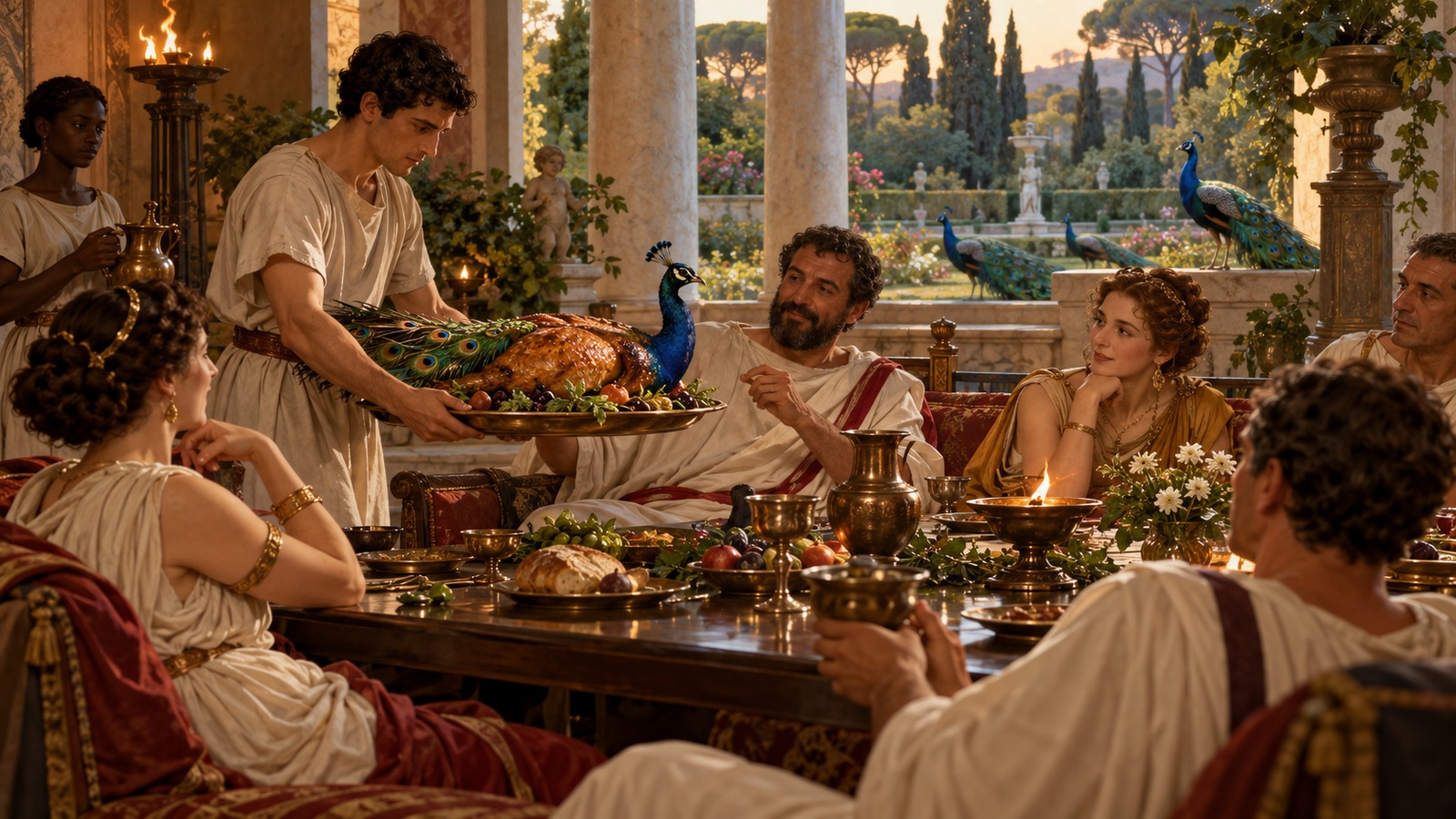
Varro treats commercial peacock keeping as a recent development. He names Hortensius’s inaugural banquet as the turning point. The host was becoming an augur, one of Rome’s priests concerned with public signs, yet the detail remembered by agricultural tradition was culinary: a roasted peacock was carried to the table and admired as something lavish.
Imitation made the experiment consequential. A single eccentric dish would not sustain an industry. Once wealthy diners began expecting the same novelty at other banquets, demand moved beyond Hortensius’s household. Hosts who wanted to rival one another needed suppliers capable of delivering mature birds reliably rather than occasionally.
The peacock was suited to this transformation because its value already rested on spectacle. Its size, brilliant train, and courtship display made it visually distinct before anyone tasted it. Serving it converted living ornament into edible status. The tail could advertise the bird in a park; the roasted body could advertise the host at dinner.
Varro does not tell us how ordinary diners judged the meat. He records elite approval and market response. That distinction matters. The price did not need to reflect nutrition or flavour alone. It could reflect scarcity, novelty, and the social memory of the banquet that had made the dish fashionable.
Roman food markets repeatedly joined prestige to production. the famous old wine that thickened like honey gained meaning from age and rarity as much as thirst. Peacocks followed a different path: they became valuable because breeders could reproduce a luxury that guests had learned to recognize.
Five denarii for an egg changed the flock
Varro gives two prices: five denarii for an egg and fifty for an adult bird. Ten egg prices therefore equalled the stated value of one grown animal, before losses, feed, labour, and time were considered. A breeder could sell reproductive potential or carry the risk through to maturity.
The reported annual income of sixty thousand sesterces from Lurco’s flock places the enterprise far above a household sideline. Whether every year reached that sum is less important than what the anecdote signals. Agricultural readers were expected to believe that peacocks could form a separate revenue stream worth planning around.
Demand also altered the purpose of the flock. If peacocks were only ornaments, the keeper might favour a few magnificent males. A food market rewarded a larger and more regular crop. Varro recommends one male for five hens, a ratio that turns the dramatic male display into one step in a breeding schedule.
The males spread their trains during courtship, but beauty alone did not produce saleable stock. Too many males could mean unnecessary feed and conflict; too few could leave eggs unfertilized. The recommended balance treated the flock as a productive unit rather than a collection of trophies.
High prices magnified every loss. A hidden egg left too long in the nest, a chick fed incorrectly, or a bird taken by a predator represented not just missing plumage but missing revenue. Luxury at the table produced close attention in the enclosure.
An island served as fence, range, and roost
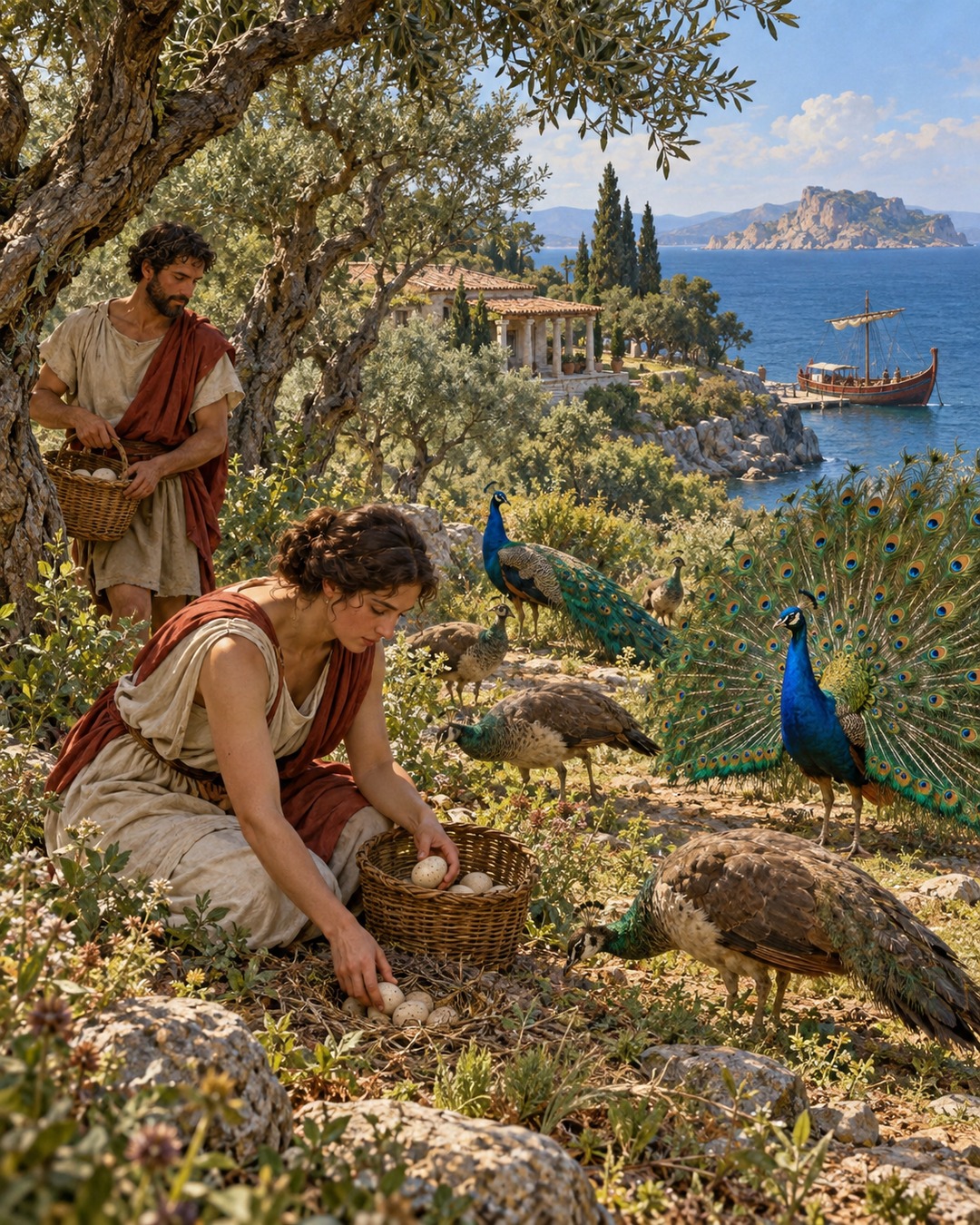
Varro describes small wooded islands as especially suitable for peacocks. He names one near Samos and Planasia off the Italian coast. Water provided the outer boundary, while trees offered the elevated places the birds used at night.
The arrangement reduced the need for an ordinary wall. A keeper could allow a flock room to forage and move while the surrounding sea discouraged wandering. The island did not eliminate management, but it made geography perform part of the work.
Woodland mattered within that watery perimeter. Peacocks were expected to take to trees to sleep. A bare rock would contain them without meeting that behaviour. A useful island therefore combined separation, ground for feeding, and branches for refuge.
This is not the same design as the water-ringed Roman snailery. Snails needed narrow channels that broke their crawling route and spray that maintained humidity. Peacocks needed a much larger landscape whose water edge contained mobile birds while its trees supported roosting. The common material answered different bodies.
Island flocks also made the operation visible. Visitors approaching by boat could see valuable birds moving through a bounded grove. The breeding ground itself became a display of possession. Commerce and theatre were not opposites when the product was famous for being seen.
Yet the island’s apparent freedom concealed routine work. Feed still had to arrive. Eggs still had to be found. Chicks still required shelter and measured food. Natural boundaries lowered one category of labour while leaving the reproductive chain dependent on human timing.
Hidden eggs moved beneath ordinary hens
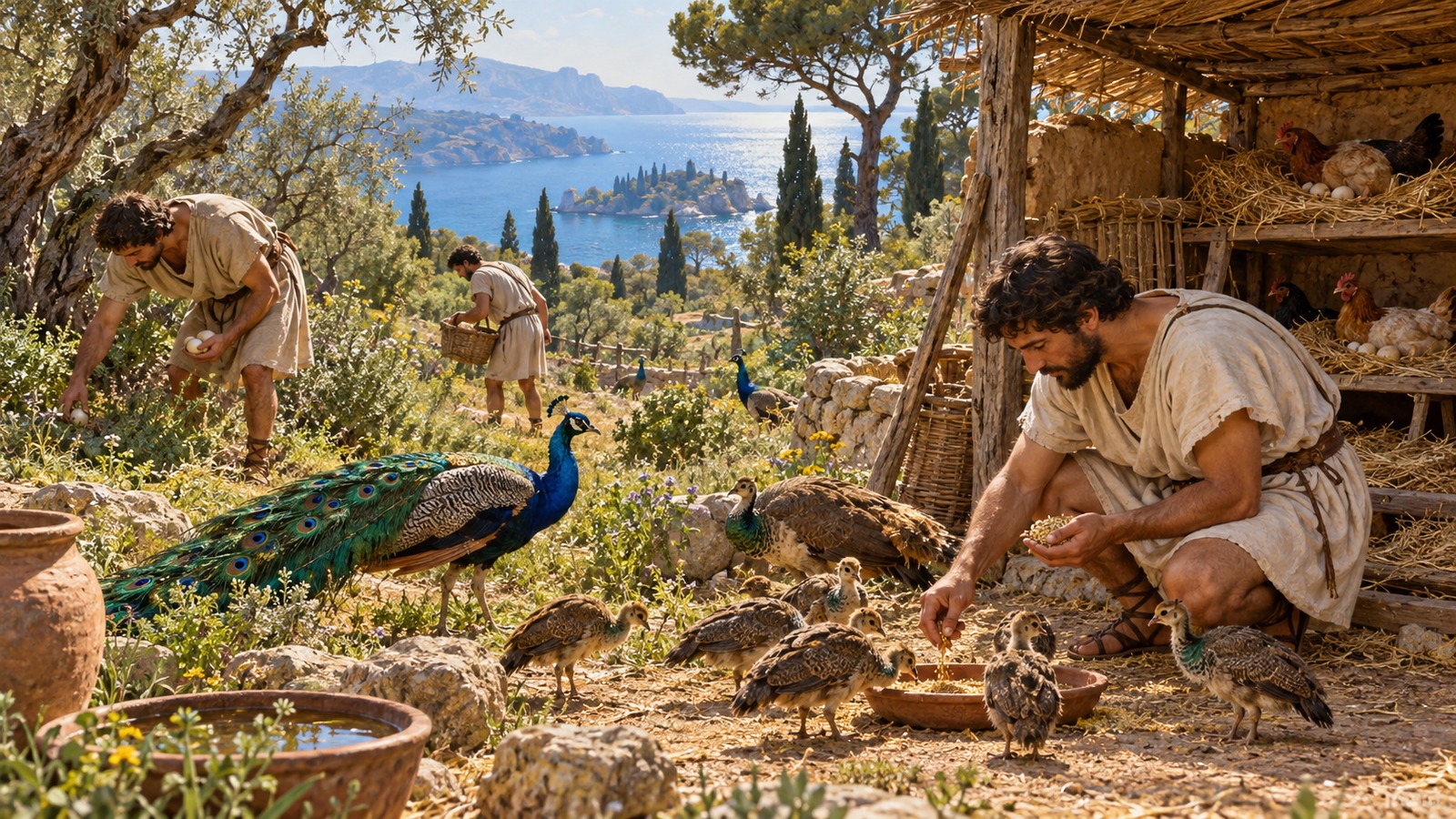
Peahens concealed their nests, so keepers had to search for eggs rather than wait at a known box. Varro says a hen generally laid three in a clutch and could produce three clutches when the eggs were removed. Collection was therefore also a way of encouraging further laying.
The expensive eggs were not left entirely to peahens. Domestic hens served as foster incubators. Varro’s sequence is precise: the hen first sat for nine days on her own eggs, proving that she had settled into incubation. Peacock eggs then replaced the originals gradually.
No foster hen was to hold more than nine eggs. Gradual substitution avoided a sudden disruption and kept the clutch within a manageable size. The process used a familiar barnyard bird as biological infrastructure for a more valuable species.
Marking the peacock eggs solved the next problem. When shells began to open, the keeper needed to distinguish the valuable chicks and eggs from those of the foster hen. The mark was a small piece of information carried directly on the object rather than trusted to memory.
Hatching did not end the risk. Varro describes staged feeding. Chicks first received a measured gruel of barley in wine, then wet barley meal. Locusts appeared with their legs removed, and only later did whole barley become suitable. Each change matched a developing animal rather than assuming that miniature birds could eat an adult ration.
The unusual ingredients should not distract from the management principle. Feed form, quantity, and timing were controlled. Removing locust legs reduced a difficult part of the prey; wet meal changed texture; delayed whole grain recognized the chick’s limited capacity. Profit depended on surviving the fragile interval between shell and flock.
Hortensius’s roast is memorable because it sits at the beginning of the story, but the business survived in less glamorous actions: searching grass, counting eggs, shifting a clutch, making a mark, preparing soft feed, and checking young birds. The public fashion lasted only if private routines worked.
Varro’s peacock chapter therefore describes a feedback loop. Banquets raised prices. Prices justified breeding. Breeding made more banquets possible. What looked like sudden culinary extravagance rested on an island, a ratio, a foster hen, and a keeper who knew which egg would hatch into fifty denarii.
Sources
Varro, On Agriculture, 3.6.