
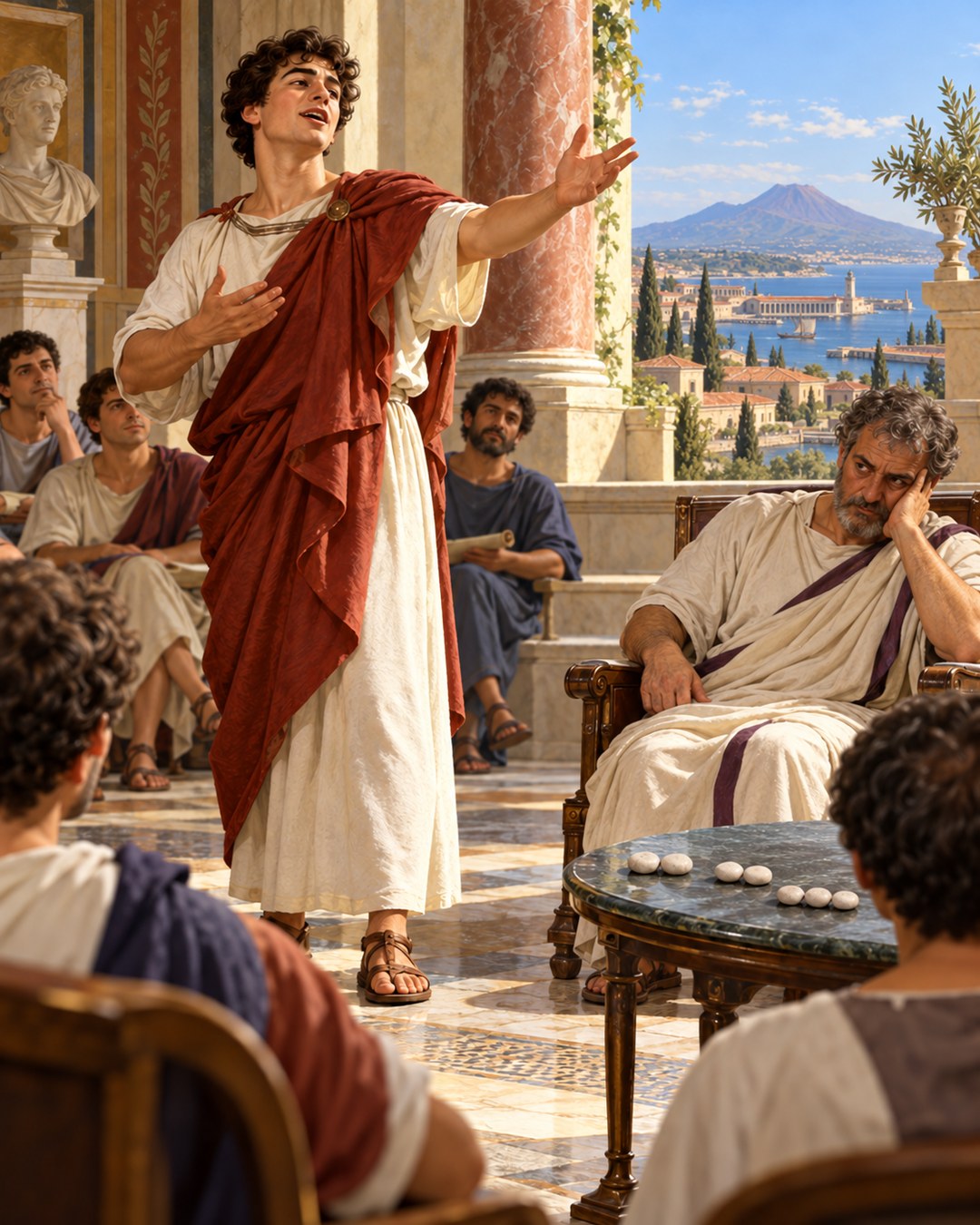
Seven judges heard one case. Two chose exile, two chose a fine, and three chose death. The rules required a majority. The three votes for execution formed the largest group, but three out of seven were still not a majority.
Aulus Gellius encountered this trap not in a court record but in a lesson about speaking. At Naples, a wealthy young student demanded a topic on which he could display his extemporaneous Latin. A pupil of the rhetorician Antonius Julianus gave him the divided verdict. The student did not pause over the arithmetic. He launched into a torrent.
The episode turns rhetorical education inside out. The young man believed speed and abundance would prove he was ready for the Roman bar. The problem actually tested whether he could recognize that its command and its votes did not fit. His performance pleased his own circle, yet made the experienced teacher blush. Before words could solve a case, judgment had to decide whether there was a case to solve.
A summer audience became an examination
Gellius places the encounter during the summer holidays. He and Antonius Julianus had withdrawn to Naples to escape the heat of Rome. The seasonal detail matters because this was not a scheduled courtroom appearance or a formal school exercise. It grew from the social world surrounding elite education.
The young man belonged to the wealthier class. Tutors were training him in both Greek and Latin, and his practical ambition was specifically Roman: he wanted command of Latin eloquence so that he could plead at the bar. Language study was therefore tied to a public career. A polished voice could become professional equipment.
He invited Julianus to hear a declamation. That request placed an established rhetorician in the audience and offered the student a valuable chance to be measured by someone beyond his usual admirers. Yet Gellius says his preliminary remarks sounded more arrogant and presumptuous than suited his age. The display began before the assigned speech.
The student then asked for subjects. One of Julianus’s pupils, already irritated by the challenge, supplied a test designed to expose haste. The Greeks called this kind of issue aporos, without a way through; Gellius suggests the Latin inexplicabile, insoluble.
The label did not mean that nobody could say anything about the scenario. It meant that its stated machinery blocked the demanded result. A disciplined speaker first had to identify that obstruction. The clever response could have been short: no proposed punishment had received four votes, so the premise requiring a majority had not been satisfied.
This differs from Taurus turning dinner into a measured question-and-answer lesson. There, conversation imposed order by limiting each guest’s contribution. At Naples, the absence of restraint became the lesson.
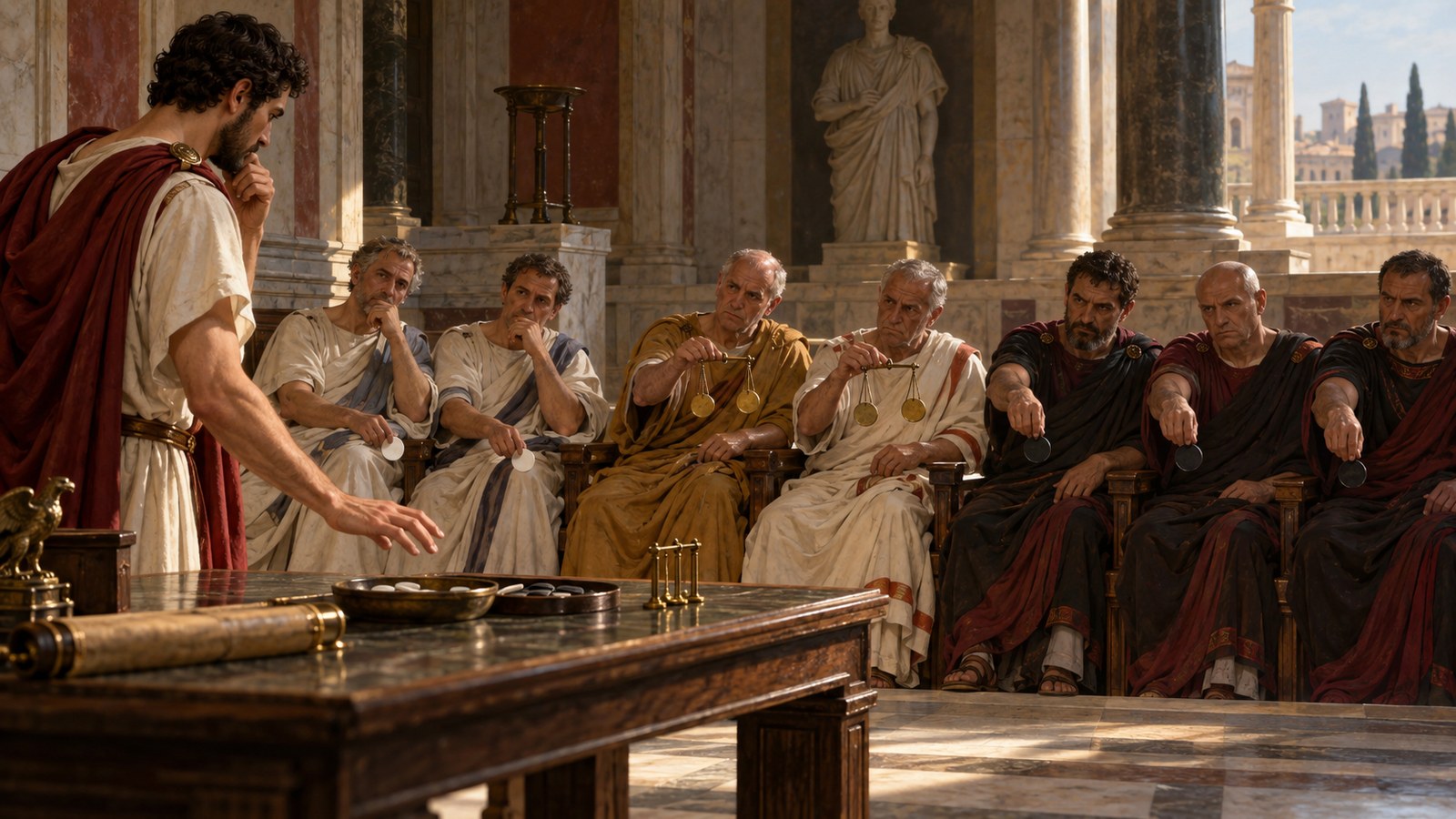
Three punishments divided seven judges
The exercise established seven judges and required judgment according to the majority of their number. It then distributed the votes with exact symmetry and one tempting imbalance. Two judges wanted exile. Two wanted a fine. Three wanted death.
Three exceeded either rival bloc, which made execution look like the winning answer. But a plurality is not a majority. Four votes would have been required to control a panel of seven. The exercise quietly invited a speaker to substitute “largest group” for the rule actually stated.
The fictional officials demanded execution according to the votes of the three, and the accused appealed. Those two actions gave the student obvious roles, urgency, and emotional material. He could defend life against death, uphold the apparent verdict, or argue about the judges’ intentions. Every dramatic route risked accepting the concealed error.
The arithmetical split also prevented a simple aggregation of the four non-capital votes. Exile and a fine were different sentences. Nothing in the problem said that their supporters had jointly voted against death in a way that produced one alternative judgment. The panel had not selected any single punishment by majority.
Gellius does not preserve a model legal solution from Julianus. His subject is the response to the trap, not a rule from Roman criminal procedure. The seven judges belong to a classroom hypothetical. Treating their vote as proof of an actual court’s appellate machinery would give the anecdote evidence it does not claim.
What it does preserve is a valuable distinction between argument and diagnosis. Before an advocate builds a speech around competing outcomes, he has to test whether the facts and rule can produce any of them. Eloquence cannot repair a missing fourth vote merely by speaking loudly around it.
The student mistook velocity for command
The young man began as soon as he heard the problem. He did not reflect. He did not wait to see whether another subject might be offered. Immediate speech itself became part of his claim to ability.
Gellius describes what followed as a flood: principles poured out at incredible speed, but their application was confused and meaningless. The image is not of silence caused by an impossible question. It is of verbal production continuing because the speaker never stopped long enough to recognize impossibility.
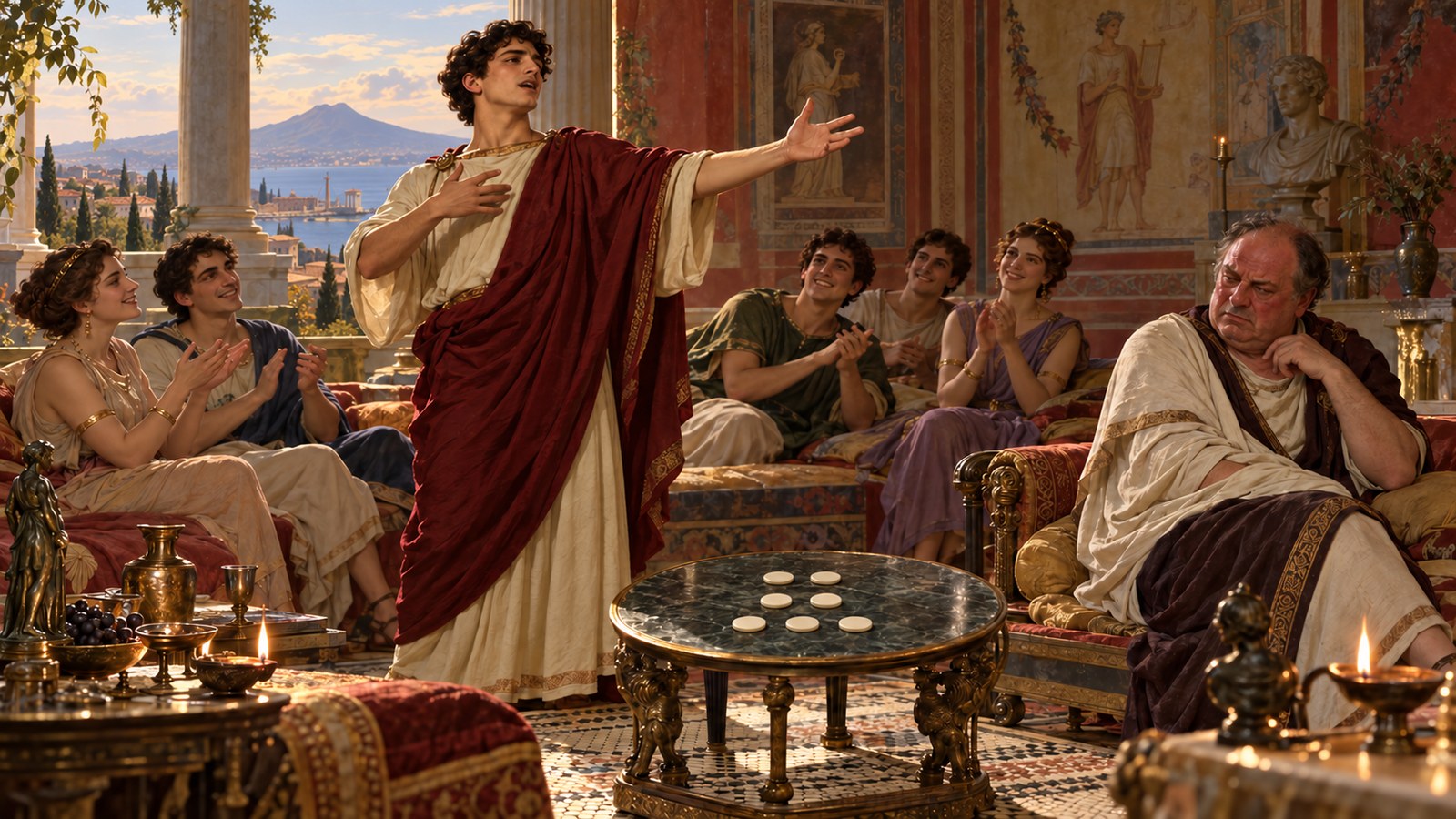
His companions applauded. Their approval is essential to the scene because it shows how the wrong measure of success sustained the performance. Fluency, duration, and confidence could sound like mastery to listeners already accustomed to admiring him.
Julianus reacted physically. He blushed and sweated from shame and embarrassment while the speech ran through what Gellius calls many thousands of lines of drivel. The teacher was not impressed by endurance. He experienced the spectacle as a failure of the educational culture gathered around the student.
The contrast recalls Musonius’s claim that a philosopher’s best applause was thoughtful silence. In both episodes, noisy approval can indicate that an audience has rewarded the surface of instruction rather than its effect.
Roman declamation trained invention, arrangement, and delivery through imaginary cases. This anecdote adds a prior discipline: refusal to be hurried by the invitation to perform. A speaker ready for the bar needed not only sentences at command but a brake on sentences when the premise failed.
“Without controversy” delivered the real verdict
When the student finally ended, his friends followed Julianus and asked what he thought. The rhetorician did not provide a lecture. He answered with a compact joke: they should not ask; without controversy, the young man was eloquent.
The phrase worked in two directions. In ordinary praise, it could mean that the student’s eloquence was beyond dispute. In the context of declamation, it also meant he was eloquent when there was no valid controversy—no properly constructed issue capable of supporting the performance he had just given.
Julianus’s brevity corrected the student’s excess by example. The teacher needed only a few words to identify what thousands of lines had missed. Form and judgment became inseparable: the concise verdict succeeded because it was fitted to the defect.
The joke did not deny that the young man possessed verbal speed. It reclassified that ability. Fluency detached from analysis was not the professional readiness he imagined. An advocate could produce principles, emotional appeals, and polished periods while still failing at the first task of reading the case.
The seven-judge puzzle survives because it makes that failure countable. Two, two, and three are not obscure technicalities. Any listener can add them and ask where the majority went. The student’s torrent grew around a vacancy visible in seven small votes.
Gellius’s Naples scene thus preserves an educational warning rather than a courtroom rule. An impossible prompt exposed an undisciplined speaker; friendly applause disguised the collapse; and an experienced rhetorician restored proportion with one sentence. Roman eloquence began, in this story, with knowing when not to begin.
Sources
Aulus Gellius, Attic Nights, 9.15.