
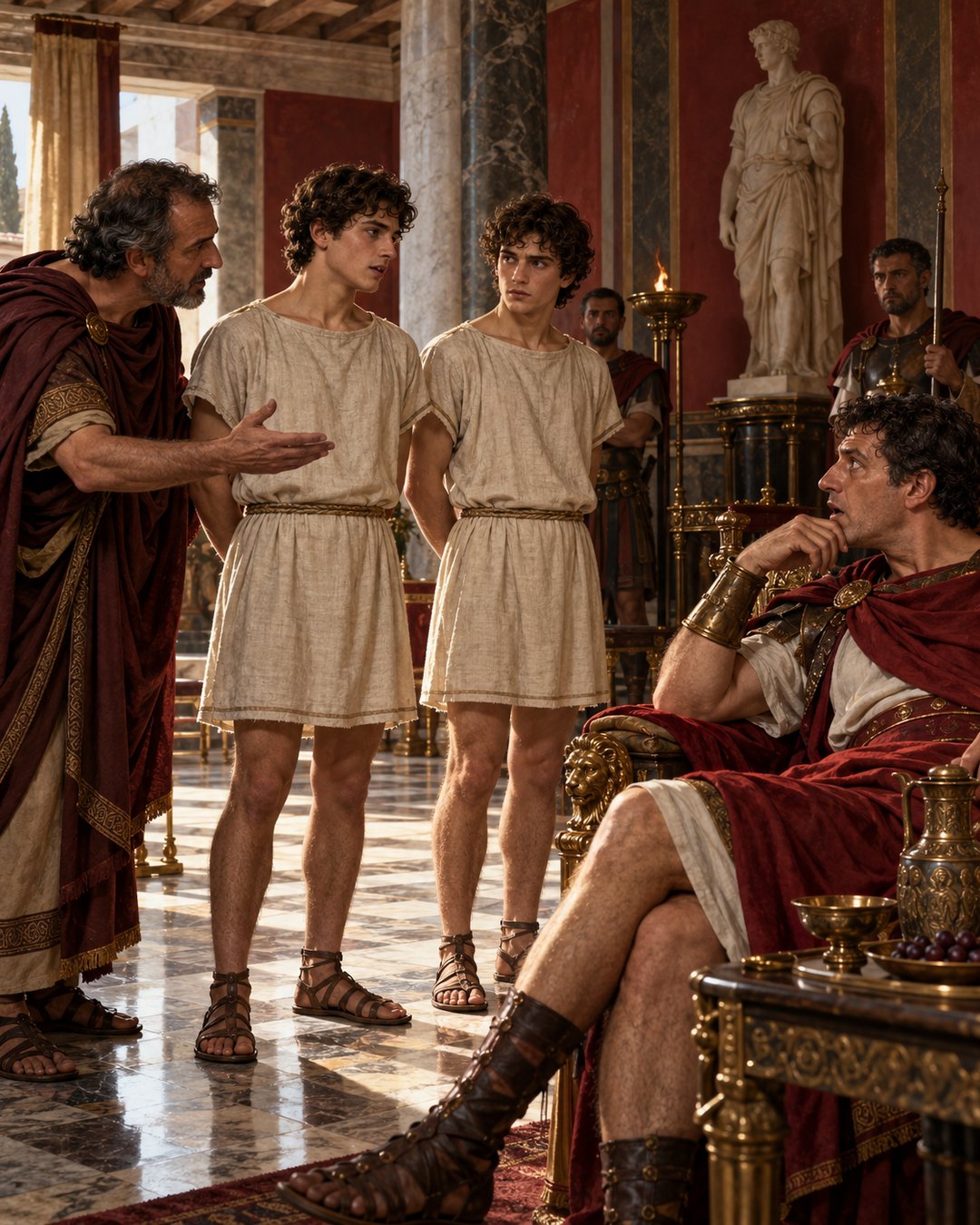
The sale looked convincing until the two boys spoke. Toranius had presented them to Mark Antony as twins: exceptionally handsome, almost impossible to distinguish by sight, and priced accordingly. Their voices carried different origins. One had come from Asia, the other from a region north of the Alps. Speech broke the story that appearance had sold.
Pliny the Elder tells the episode as a display of resemblance and quick wit. It is also an account of human beings treated as expensive property. The fraud depended on the coercive Roman market in enslaved people, where a buyer could complain about identity as if disputing the description of any costly object. Toranius escaped Antony’s fury not by denying the false claim, but by changing the valuation. True twins, he argued, were ordinary beside two unrelated people who looked the same.
Roman resemblance could attach itself to a public name
Toranius appears at the end of a sequence about likeness. Pliny had just catalogued Romans whose faces recalled cooks, performers, gladiators, and enslaved people. Pompey’s father carried the surname Menogenes because he resembled his cook. He already had another label, Strabo, connected to the appearance of his eyes.
A Scipio acquired the name Serapio from resemblance to an enslaved man held by a dealer in pigs. Other elite men were compared with stage performers. Pliny even describes a Sicilian fisherman who resembled the proconsul Sura not only in his face but in his open mouth and tongue-tied stammer. A likeness could move across status boundaries and become socially adhesive.
These comparisons were not neutral modern observations. They could reduce a powerful man by tying him to someone whom Roman hierarchy placed far below him. They could also turn a body into a public reference point. A face, a gape, or a defect in speech became memorable because someone else reproduced it.
This context explains why Toranius’s merchandise seemed remarkable. Rome already enjoyed stories in which nature copied a recognizable person. The dealer offered a more controlled spectacle: two young people displayed as copies of each other. He attached a family explanation to their resemblance because “twins” made the visual coincidence legible at a glance.
Toranius sold a family story with two bodies
Pliny identifies Toranius as a dealer in enslaved people and places the sale after Antony had become one of the triumvirs. That political timing matters. Antony was not merely a wealthy private buyer. He belonged to the three-man regime that wielded extraordinary power after Caesar’s assassination.
The two boys were described as exceptionally handsome and so similar that Toranius passed them off as twins. The claim transformed resemblance into kinship. To the buyer, the pair could appear naturally matched rather than assembled by a trader from different regions.
Pliny does not give the boys’ names. He gives their origins only when those origins expose the fraud: one was from Asia, the other from north of the Alps. Their biographies survive as market evidence. The structure of the anecdote itself shows the violence of the transaction. Toranius and Antony act, bargain, complain, and argue; the enslaved youths reveal the truth simply by speaking.
The price was 200,000 sesterces. Pliny has Antony emphasize it when he protests. Cost magnified the insult because the purchase had joined beauty, rarity, and a claimed biological relationship. A cheap deception might have been dismissed. This one had been sold as a possession suited to the highest political rank.
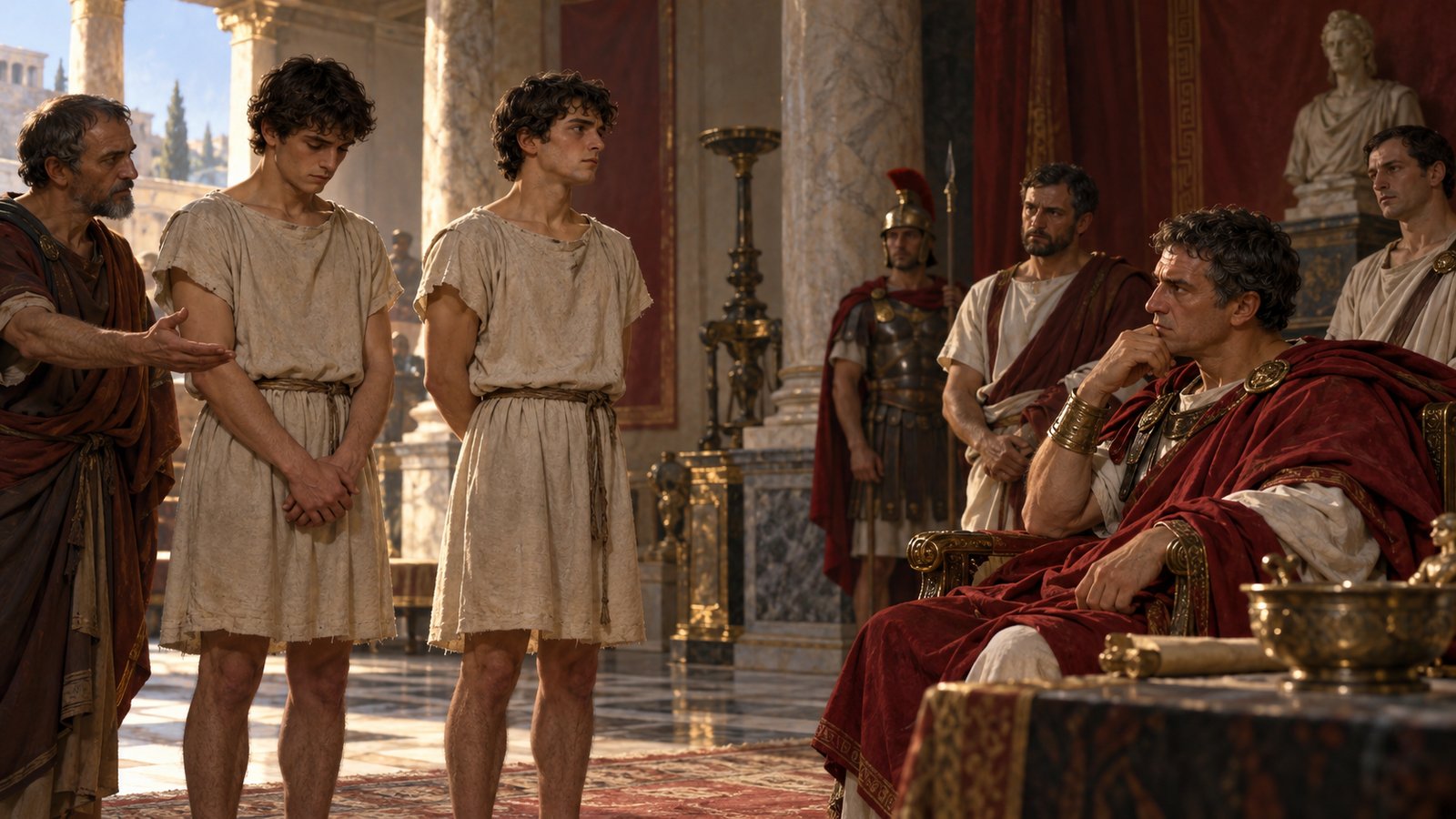
Their speech supplied the fact that faces concealed
The boys’ speech disclosed the fraud later. Pliny does not explain whether accent, language, vocabulary, or pronunciation first raised suspicion. His compressed sentence needs no such detail. Their voices were different enough to undo the dealer’s claim of shared birth.
That contrast gives the anecdote its mechanism. Sight created an apparently complete answer: the pair looked alike because they were twins. Sound introduced histories that the display had suppressed. The buyer learned that bodies selected for resemblance could still carry evidence of distant places and separate lives.
Roman writers often use speech to expose status, education, origin, or pretence. Here it interrupts a visual commodity. The moment resembles the way a hidden detail can reverse an elite performance in the story of Antony’s borrowed catch. Yet the stakes are darker. A joke about a fish embarrasses a host; this discovery concerns two enslaved human beings whose identities had been repackaged for sale.
Antony responded with fury, threats, and abuse. Pliny’s language makes the dealer’s danger clear. A triumvir who felt cheated possessed far more than an ordinary customer’s remedies. The complaint over price therefore opened into a contest of rhetoric under extreme inequality: two enslaved youths beneath both men, and a trader attempting to manage the anger of a ruler.
The dealer preserved the price by reversing the complaint
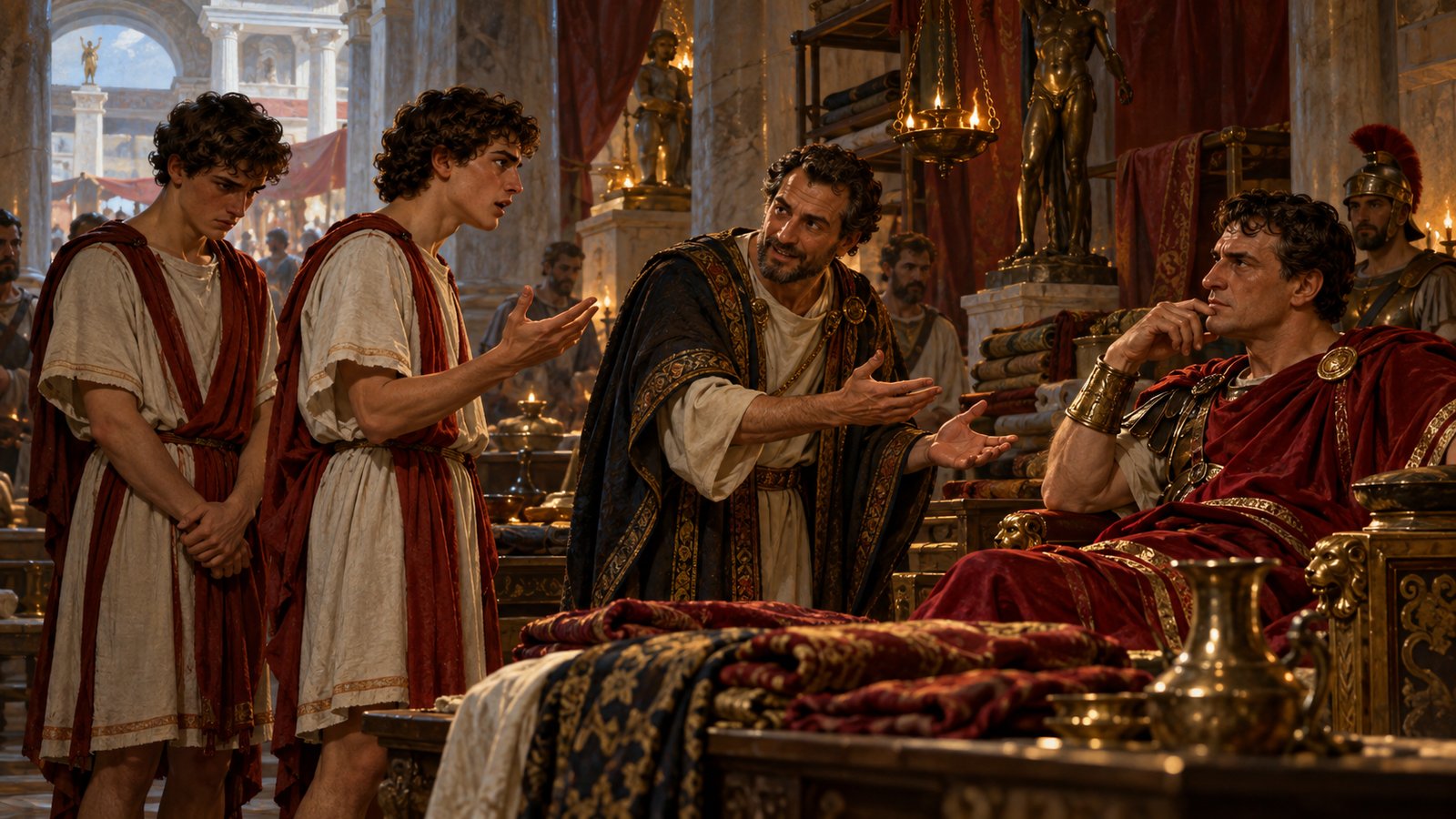
Toranius did not insist that the boys were twins. He accepted the decisive fact and argued that Antony had misunderstood its effect on value. There was nothing remarkable, he said, about twin brothers looking alike. Nature was expected to produce that resemblance.
Two people from different regions who matched each other so closely were another matter. Their lack of kinship made the visual coincidence rarer. The defect in description became the dealer’s reason for charging so much. He moved the buyer from the category of fraud to the category of wonder.
The manoeuvre worked because it preserved what Antony had wanted from the purchase: exceptional possession. The pair no longer demonstrated twinship, but they could still be presented as something almost impossible to find. Toranius’s rhetoric gave the buyer a way to keep both the acquisition and his sense of rank.
Pliny says anger yielded to admiration. Antony came to regard no other property as more suited to his station. That ending is not a fair resolution for the boys, whose legal and personal position did not improve. It is the resolution of a sales story told from the perspective of men who possessed and priced them.
The broader Roman law of property could attach elaborate consequences to household status, as the account of an enslaved steward named guardian in a will makes clear. Toranius’s anecdote catches an earlier moment: identity is manipulated before the household relationship even begins.
Its sharpest irony is that truth did not cancel the transaction. Speech proved the dealer’s claim false, but a more flattering explanation kept the purchase desirable. The episode survives because Toranius understood that price was not anchored only to fact. It could also be anchored to the buyer’s wish to own something no one else possessed.
Pliny’s polished ending leaves major questions unanswered. He does not say what languages the two young men used, how long Toranius had trained or displayed them together, or whether either could challenge the description attached to him. Their speech matters only when Antony hears it as evidence about his purchase. The source therefore gives us a precise mechanism while withholding the lives most damaged by it.
Reading the anecdote carefully means keeping both features in view. Toranius’s reversal is rhetorically clever, and the coercive market makes that cleverness possible. Antony can convert exposure into amusement because he retains ownership. The boys’ voices reveal the truth but do not grant them control over what happens next.
Sources
Pliny the Elder, Natural History, 7.54–56.