
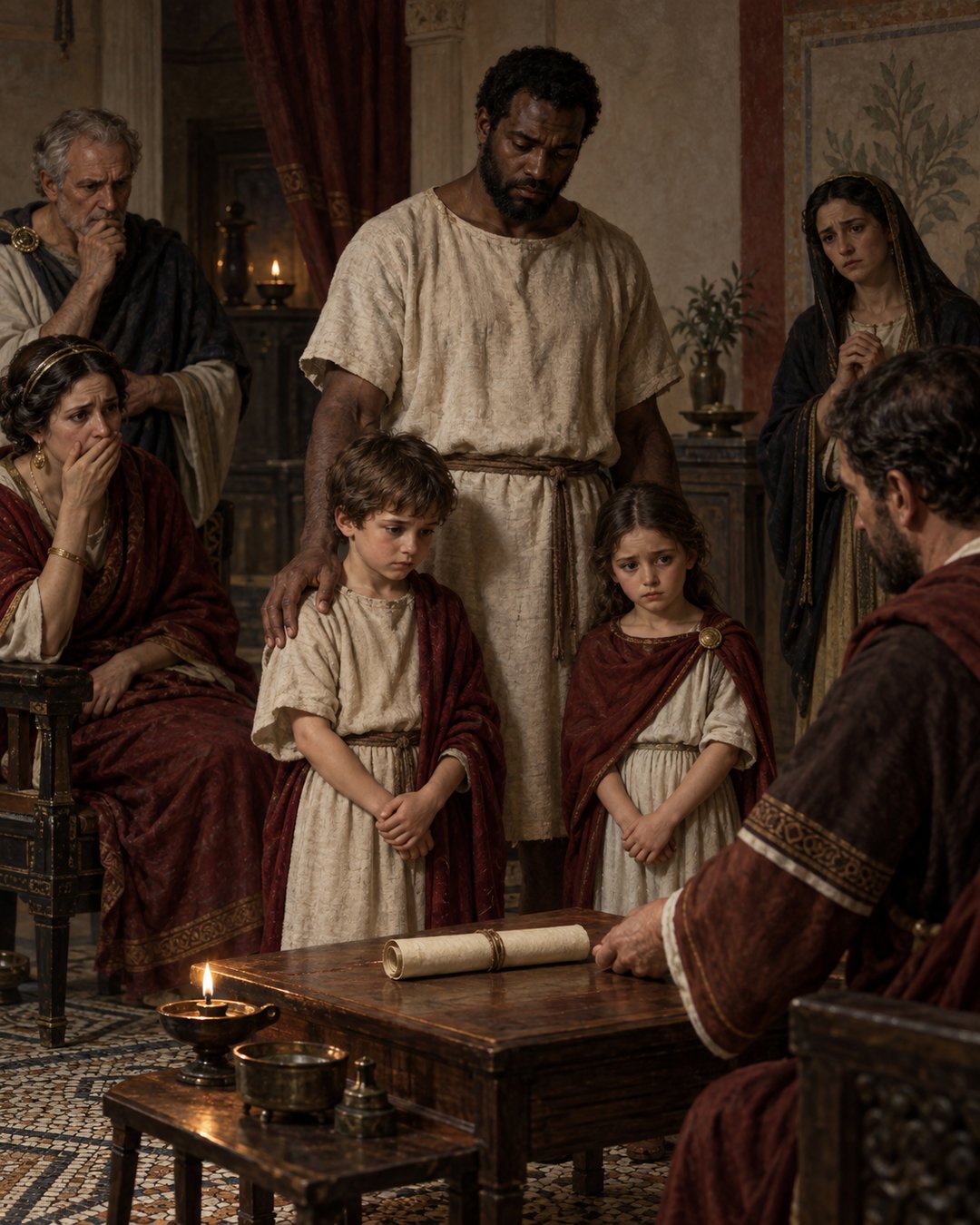
The will named an enslaved member of the household as guardian of the dead man’s young children. It did not separately grant him freedom. That omission created an immediate problem: guardianship was a civil office exercised over a free child, while an enslaved person lacked the independent status needed to perform it.
Justinian’s Institutes gives an arresting solution. If a testator appointed his own enslaved person guardian, freedom could be presumed even when the will never expressly conferred it. The appointment itself carried the missing manumission. Yet that rescue did not operate automatically in every similar-looking case. It failed when the testator had made the appointment under the mistaken belief that the person was already free.
The distinction turns a short rule into a study of how Roman jurists read documents. They were prepared to supply a legal consequence necessary to fulfill a deliberate choice. They were not prepared to repair a choice built on a false understanding of the appointee’s identity. Around that distinction, ownership, kinship, age, timing and even the exact nouns used for descendants controlled what happened to a child after the household head died.
Guardianship Began with the Child, Not the Estate
The Institutes, compiled under Justinian in the sixth century, introduces guardianship as authority over a free person too young to defend himself. It derives the guardian’s title from protection and defense. The office was therefore not presented as a one-task commission to manage a parcel of land or conclude a lawsuit. A later rule states directly that a guardian could not be appointed for only one transaction because the responsibility attached to the person.
A parent could appoint guardians by will for children in his power who had not reached puberty, whether sons or daughters. The document reached beyond children already born. An afterborn child could be included if that child, had birth occurred during the testator’s life, would have stood in his power and among the family heirs.
Grandchildren exposed a boundary. A grandfather could not simply impose a testamentary guardian if his death would place them under their own father’s power. The question was not only whether the grandfather cared for them or mentioned them. It was where family authority would stand at the precise moment of death.
This legal setting makes the enslaved guardian rule less whimsical than it first appears. The appointment addressed continuity for a vulnerable free child. If the chosen household member could not hold the office because of slavery, the will either had to change that status or lose the choice.
The Appointment Supplied Its Own Missing Freedom
The Institutes first says that a person under someone else’s power could be appointed guardian just as an independent person could. It then confronts the harder case. A man could name his own enslaved person guardian and grant liberty at the same time. If he failed to write an express manumission, freedom was presumed to have been tacitly conferred.
The rule did not announce that every favorable duty implied freedom. It tied the inference to an appointment that could not otherwise work. The testator had selected this person to protect free children through a continuing civil office. Treating the appointment as meaningful required the appointee to emerge from slavery.
That is a different route from the public ceremonies that could make an enslaved Roman free. Here the decisive act sat inside a testament and became effective through the law’s reading of the appointment. The household head was dead; the document had to carry intention across that break.
The human consequences should not be softened by the neatness of the rule. The appointee had lived as property within the household he was now expected to help govern for its young heirs. Freedom and obligation arrived together. The text preserves no voice from such a person, no account of whether the role was desired, and no simple conversion of legal liberty into social equality.

A Mistaken Belief Could Defeat the Rescue
The same passage draws a severe line. Tacit freedom was not presumed if the testator appointed the person while erroneously believing that person already free. In that case, the document did not contain an incomplete plan to free an enslaved guardian. It contained a plan built on a mistake about existing status.
That difference reveals the legal engine. When the testator knowingly selected his own enslaved person for an office requiring freedom, the contradiction pointed toward an implied manumission. The two parts of the will could be reconciled. When he believed the person already free, there was no hidden decision to manumit for a jurist to recover. Supplying freedom would invent a choice rather than complete one.
Ownership mattered as much as belief. An unqualified appointment of someone else’s enslaved person was void. The testator could not free property belonging to another household by implication. He could, however, appoint that person with the qualification “when he shall be free.” The office then waited upon a change of status controlled elsewhere.
Oddly, the Institutes says that this “when free” wording was ineffective for the testator’s own enslaved person and made the appointment void from the beginning. The formulas were not interchangeable decoration. Different ownership relationships demanded different legal constructions.
Every Word Positioned the Future Household
Other rules in the same title show similar attention to conditions. A guardian could be appointed from a certain time, for a certain time, conditionally, or even before the heir was instituted. An appointee who was a minor could not act until twenty-five. A person the translation describes as a lunatic had to recover faculties before acting.
Family labels also carried consequences. A guardian named for “sons” or “daughters” was understood to cover afterborn members of those groups. But “sons” did not silently include grandsons. The broader word “children” could do so. One noun altered which future descendants received protection.
If the will supplied no effective guardian, the framework did not leave the child without a legal route. The Institutes says the Twelve Tables assigned guardianship to the nearest agnates, relatives connected through males. Omission therefore shifted the source of authority from the testator’s named choice to a statutory kinship order.
The concern with legal parentage and household position also appears in the legal mechanism that moved an adopted heir between Roman families. In both settings, sentiment alone did not locate a person. Civil status determined who stood in whose power, who could inherit, and who could act for a child.
The enslaved steward at the center of the rule makes that machinery visible because his appointment forced several categories to collide. He was selected as a protector but classified as property. The will pointed toward an office, while his current status blocked the path. Tacit manumission was the legal bridge—but only where the document showed that the testator knowingly needed one.
No surviving vignette tells us how a particular child reacted when such a guardian stepped forward after the will was opened. The Institutes offers doctrine, not a household diary. Its compressed distinctions nevertheless expose a tense scene behind the rules: bereaved children, competing relatives, property awaiting control, and an enslaved appointee whose own status depended on how the dead man’s words were understood.
The law did not merely ask what the will said. It asked what had to be true for a deliberate appointment to operate, what the testator knew, who owned the appointee, and which family relationships would exist after death. A missing grant of freedom could be supplied. A mistaken belief could not. In that narrow divide, one line of a Roman will determined both who protected the children and whether their guardian entered the role as a free man.

Sources
Justinian, Institutes, 1.13–15.