
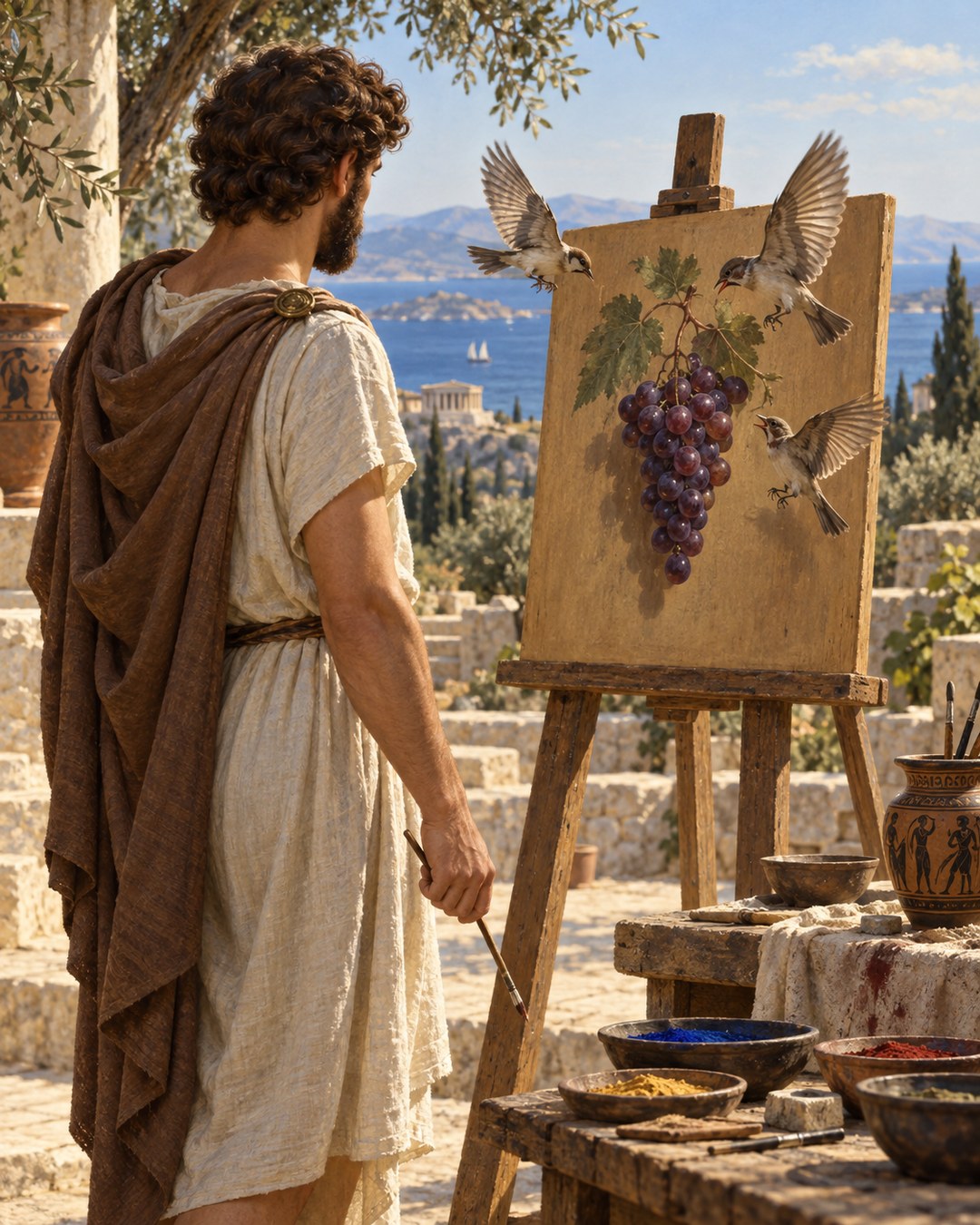
Birds flew toward the grapes Zeuxis had painted. For an artist seeking proof that pigment could imitate the visible world, the reaction looked like a verdict delivered without flattery. The birds did not know they were judging a picture. Their mistake seemed to prove the grapes had crossed from representation into presence.
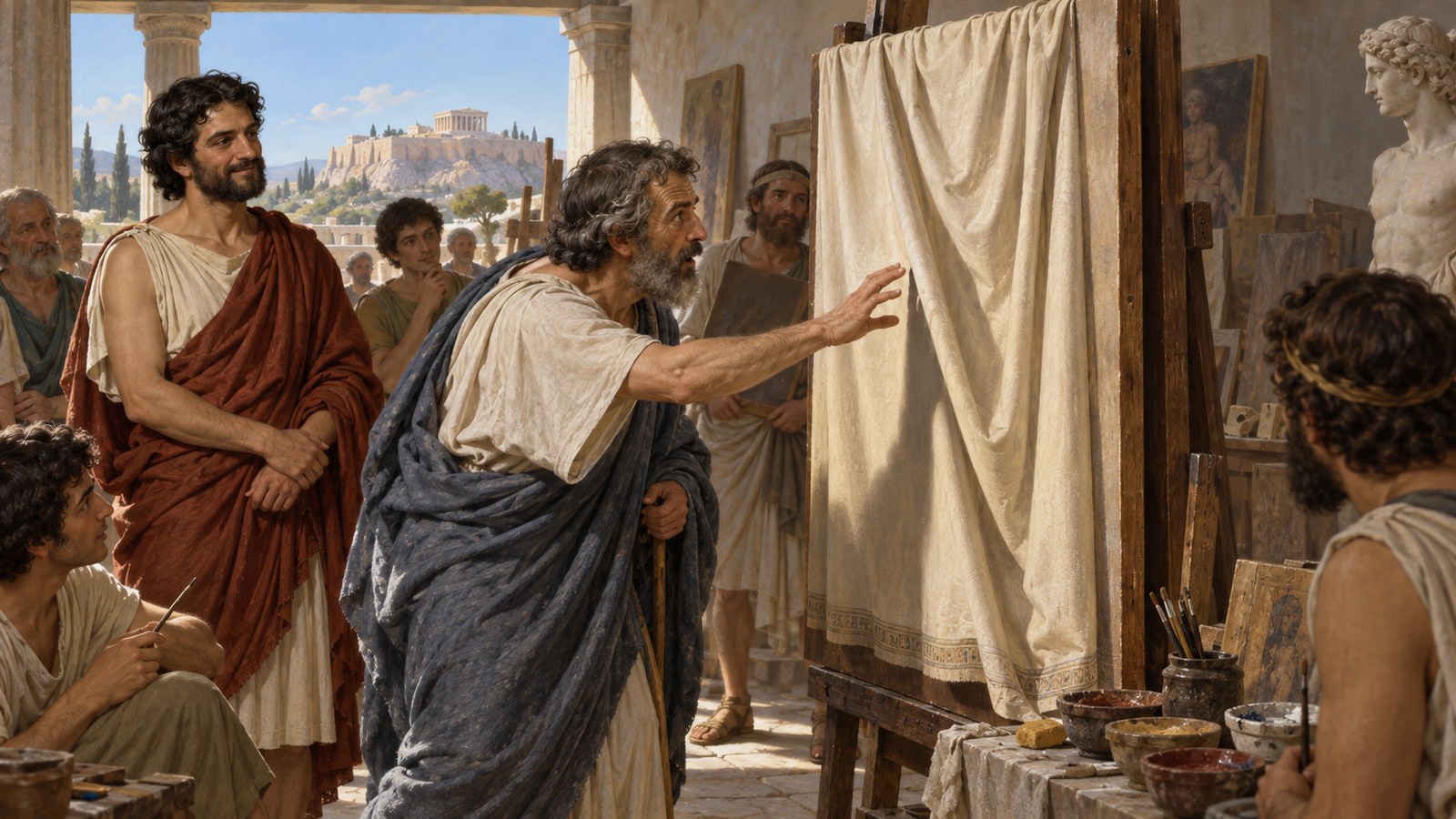
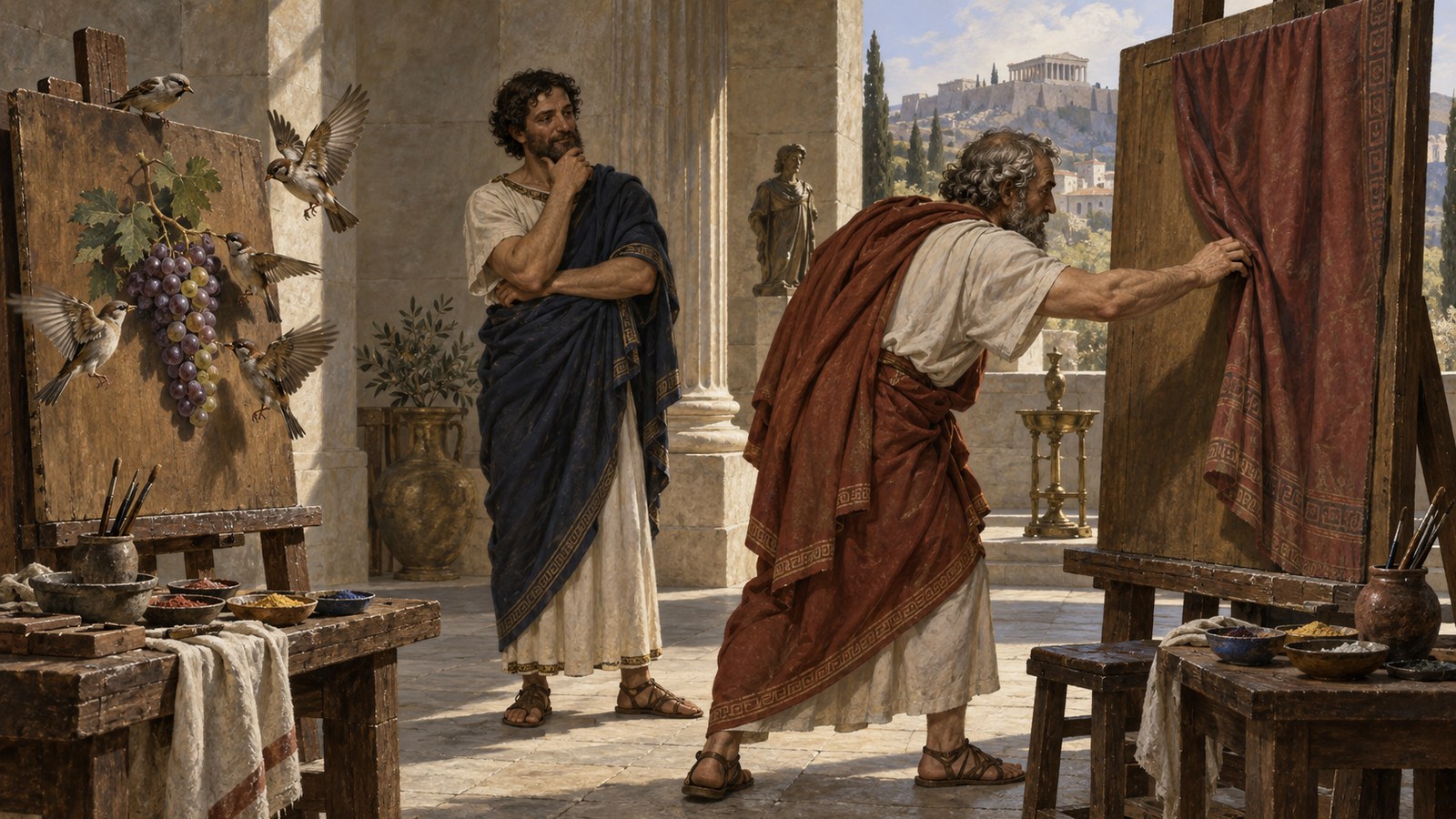
Then Zeuxis faced Parrhasius’s entry. A curtain appeared to cover the rival picture, so Zeuxis asked for it to be drawn aside. Nothing moved. The curtain was the picture. According to Pliny the Elder, Zeuxis surrendered the prize with a precise distinction: he had deceived birds, but Parrhasius had deceived an artist.
The contest survives as a story, not as two panels available for inspection. Its force lies in the sequence of actions Pliny reports. First an animal reaches for painted food. Then a trained human tries to operate painted fabric. The second error does not merely repeat the first with a different viewer. It reveals how expectation can become part of an image’s machinery.
The Birds Supplied a Verdict Nobody Had Rehearsed
Pliny places Zeuxis among the painters who brought the brush to great glory. He dates the artist to 397/396 BCE while noting that some writers put him too early. Zeuxis belonged to a field of rivals that included Timanthes, Androcydes, Eupompus and Parrhasius.
Wealth and self-presentation were already part of the portrait. Pliny says Zeuxis displayed his name in gold on his robes at Olympia. Later he gave paintings away on the claim that no price could equal their value. The grapes therefore enter a biography shaped by confidence, reputation and the problem of deciding what exceptional skill was worth.
Birds offered an attractive answer because they were outside that market. A patron might praise an expensive work, and a rival might dispute it. Birds approaching fruit appeared to respond only to what they saw. Their appetite supplied an involuntary measure of resemblance.
But the test was narrow. The birds did not assess composition, invention, durable materials or the meaning of the scene. They responded to one painted object as a possible meal. Their error certified a specific illusion while leaving the rest of painting untouched.
The Curtain Made Zeuxis Complete the Illusion
Parrhasius did not answer with more appetizing fruit. He painted a curtain. Zeuxis arrived proud of the birds’ verdict and understood the apparent fabric as a temporary cover. His request to draw it aside supplied the decisive movement: the viewer attempted to advance from the thing he thought he saw to the artwork behind it.
The trick depended on a familiar convention. Curtains conceal and reveal. A covered panel promises a second visual event once the cloth moves. Parrhasius’s image borrowed that expectation, turning the supposed obstacle into the whole work. Zeuxis failed because he looked through the painted object instead of at it.
Pliny allows him a graceful recovery. Zeuxis recognizes the mistake and yields the prize, explaining that Parrhasius deceived an artist while he deceived birds. The sentence ranks viewers, but it also ranks constructions. Grapes provoke approach. The curtain creates an absent picture in the viewer’s mind and makes him request access to it.
A scheduled Lost Eagles piece on how Pausias made a black ox show its length head-on follows another painter solving a problem of vision. Parrhasius’s reported solution is different: he did not make depth legible inside a difficult body. He made the viewer invent depth behind a surface.
A Child Carrying Grapes Exposed the First Test’s Limit
Pliny gives Zeuxis another encounter with birds. The artist painted a child carrying grapes, and birds again flew toward the fruit. This time Zeuxis did not simply accept the reaction as praise. He became angry with the picture and used the birds’ behavior to diagnose a failure.
His reasoning was direct. If the child had been painted as successfully as the grapes, birds should have feared the human figure and stayed away. Their approach proved that one part of the image convinced them while another did not. A response that once crowned the painter now divided the work into success and weakness.
This sequel matters because it prevents the grapes contest from becoming a simple ancient boast about perfect realism. Zeuxis can interpret animal behavior critically. The same event—birds approaching painted fruit—changes meaning when the fruit appears beside a figure that ought to alter their behavior.
The imagined test is relational. Grapes are not judged in isolation; the child changes what believable grapes should cause a bird to do. Zeuxis’s complaint treats realism as a system in which one convincing element can expose another element that has failed to govern the scene.
Parrhasius’s Outlines Help Explain the Painted Threshold
After the contest, Pliny praises Parrhasius for proportions, faces, hair and mouths, but he gives special emphasis to outlines. Other artists, he says, could paint the bulk and surface within a figure. The rare refinement was to make the boundary turn convincingly, suggesting forms that continued behind what the viewer could see.
That praise cannot prove how the lost curtain looked. Pliny nevertheless places the anecdote beside an account of Parrhasius as a painter of edges that implied hidden continuation. A curtain consists of boundaries, folds and overlaps. Its visible surface persuades partly by making the eye infer fabric curling away from view.
The earlier story of Apelles and the missing sandal loop turns viewing into correction: a shoemaker identifies an error within his craft, then exceeds that expertise. Zeuxis’s mistake operates in reverse. His expertise makes the deception more valuable because the painted curtain recruits the expectations of someone who knows how pictures are presented.
Neither contest gives modern readers a neutral measurement of ancient painting. Pliny writes centuries after the lives he describes, collecting reputations, sayings and marvels into a history of art. The birds and curtain are evidence for what Romans told about great Greek painters, not a surviving experiment that can be repeated.
Even so, the narrative distinguishes several kinds of looking. Birds detect possible food. Zeuxis anticipates a covered artwork. Parrhasius anticipates Zeuxis anticipating that cover. The winning image succeeds not by reproducing the most complicated object, but by placing a simple object exactly where habit makes it actionable.
Zeuxis’s surrender is therefore more than modest applause for superior brushwork. He acknowledges that his own confidence became evidence. The birds crossed the distance to painted grapes. Zeuxis crossed a more dangerous distance—from seeing folds to assuming that something waited behind them.
Pliny leaves his hand at the false curtain. That unfinished gesture is the contest’s real display. Grapes looked edible; fabric looked movable. Parrhasius won because the painter supplied the final action himself. The judge’s own expectation completed a picture that pigment alone could not move.
Sources
Pliny the Elder, Natural History, 35.61–68.