
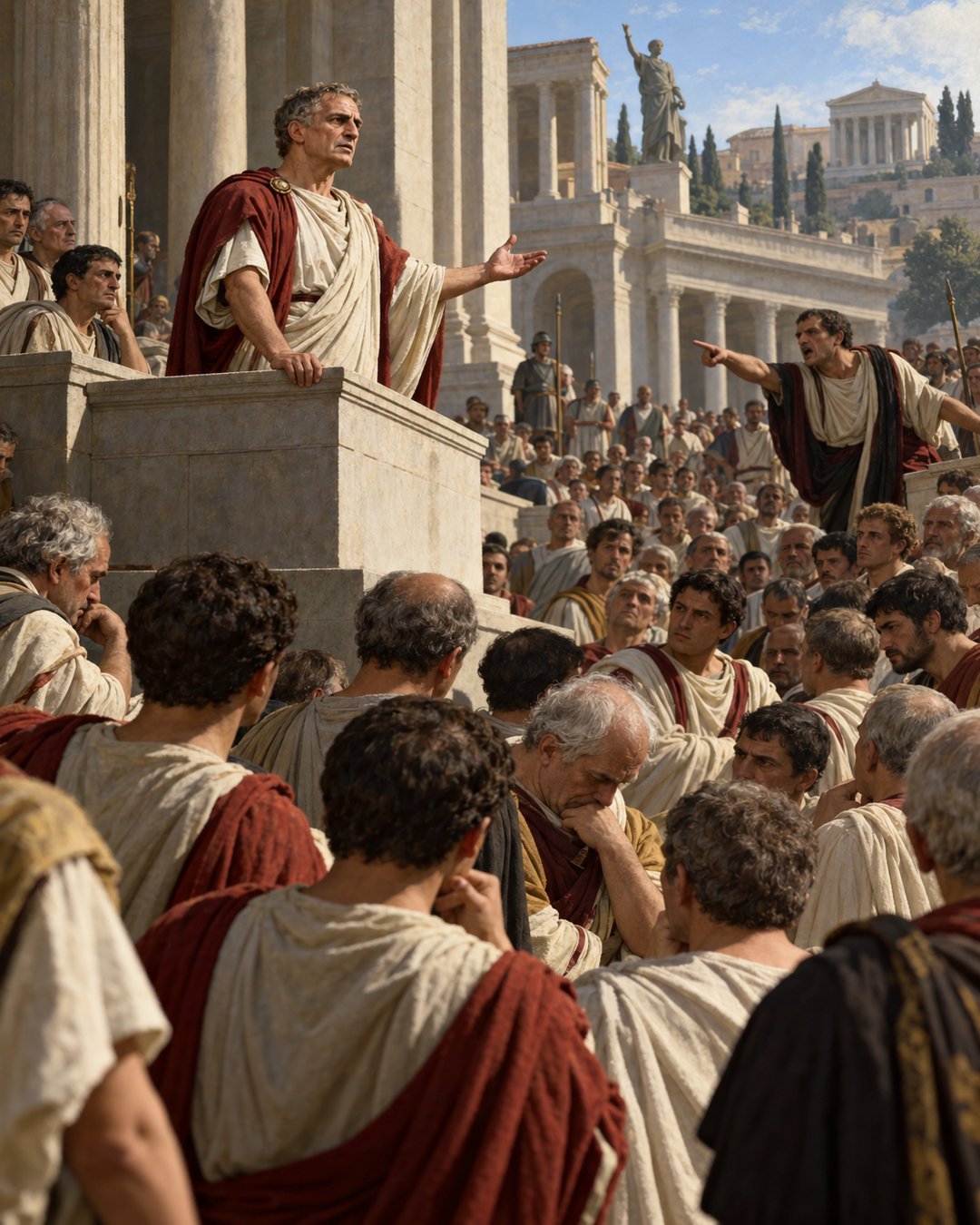
“Honour” seems built to approve. Yet Aulus Gellius found a Roman speech in which worse honour meant injury, not diminished praise. Quintus Metellus Numidicus accused an opponent of treating the Roman people more shamefully than he had treated Metellus himself, and the old phrase carried the force of wrong.
Gellius uses that odd expression to recover a larger fact about language. Several Latin words that later settled into a familiar positive or negative sense had once ranged across both. Their moral direction came from the sentence around them.
The rare case of honos is especially revealing because modern expectation pulls so strongly the other way. To understand it, a reader must stop translating one word and begin reconstructing an argument.
A positive word had not yet chosen a side
Gellius begins with words whose older flexibility was already well known to learned readers. Weather, health, deed, device, favour, and activity could each be qualified toward good or bad. The noun itself named a field; context supplied the verdict.
That arrangement is easier to recognize when an English equivalent also remains open. “Weather” may be fair or violent. “Health” can be strong or poor. An “act” may deserve praise or punishment. The surrounding adjective, consequence, or story completes the meaning.
Gellius adds trial, drug, and contagion to the list. In his account, older usage had not confined them to the dark associations that later speech encouraged. A drug could heal or harm; contact could transmit an influence without the word itself announcing whether that influence was welcome.
His point is historical, not a claim that every writer used every term identically. Ordinary usage moves. A broad word can narrow until one side feels natural and the other sounds impossible.
That warning belongs beside the older reproach hidden inside Roman “elegance”. There a negative label became guarded praise. Here an apparently positive noun still has enough room to name a wrong.
The task is therefore not to select the most familiar dictionary gloss. It is to ask what contrast the ancient sentence is building, who is harmed, and what consequence the speaker attaches to the term.
Metellus made the crowd part of the injury
Gellius turns to Quintus Metellus Numidicus and a speech titled On His Triumph. The preserved lines are political. Metellus addresses the Roman people and insists that the affair injures them more deeply than it injures him.
His calculation begins with scale. The whole people are more important than one individual. By the same measure, an opponent who entangles the people in injustice inflicts a greater insult on them than on the man who directly suffers.
Metellus then adds an ethical asymmetry. Honest people would rather endure wrong than commit it. Suffering injustice can leave a person injured, but making oneself the agent of injustice damages the actor’s standing as well.

That is why the crowd cannot treat the dispute as someone else’s grievance. The opponent wants Metellus to suffer while the citizens perform the wrongful act. Metellus would keep a complaint; the people would inherit reproach.
The speech turns victimhood and responsibility in different directions. The person who loses may preserve moral standing. The body that authorizes the loss may gain power in the moment but acquire blame.
This public reversal resembles the legal distinction between summoning and arresting in a tribune’s power: a small verbal boundary decides who acts, who is acted upon, and where responsibility rests.
“Worse honour” is decoded by its neighbour
After speaking of greater insult and injury, Metellus says the opponent has shown the people “worse honour” than he has shown Metellus. Taken alone, the phrase might suggest an inferior ceremony, a smaller distinction, or praise delivered badly.
Gellius does not leave the reader with those possibilities. He explicitly says the phrase has the same meaning as the injury and insult mentioned immediately before it. The speech supplies its own gloss.
This is a powerful form of evidence because it does not depend on a speculative root. Parallel clauses describe the same political mechanism from adjacent angles. One names the action as injury; another names it as worse honos.
The adjective “worse” does not merely reduce a positive quantity. It directs a neutral or double-sided noun toward harmful treatment. The combination works because honos had not yet become incapable of carrying that direction.

Gellius calls this use rare. Rarity matters. A reader should not flatten every occurrence of honour into injury, any more than one unusual construction should erase the word’s familiar associations with office, esteem, and distinction.
Instead, the example teaches a controlled suspicion. When a normal gloss produces nonsense, the local structure may preserve an older range. Repetition, paraphrase, and consequence can recover it.
The speech made injustice heavier than defeat
Gellius closes by identifying a Socratic principle in Metellus’s formulation: it is worse to do injustice than to suffer it. The observation connects lexical history to the moral engine of the speech.
Metellus is not claiming that injury has no cost. He is arguing that the moral burden falls differently from the immediate loss. A harmed individual receives grounds for complaint. Citizens induced to harm him become answerable for the decision.
That distinction allows the strange phrase to do political work. “Worse honour” names treatment that degrades the giver or agent, not merely the recipient. It exposes a civic body being manoeuvred into a role it should refuse.
The argument also explains why Metellus compares the people with himself rather than simply demanding sympathy. If the crowd sees only his loss, it may calculate whether he deserves relief. If it sees its own threatened complicity, the question becomes what kind of public actor it will be.
Gellius preserves no full transcript here, and the fragment cannot reconstruct every circumstance of the triumph dispute. The surviving wording supports a narrower conclusion: Metellus paired injury, insult, injustice, complaint, and reproach so tightly that his rare use of honos becomes legible.
That restraint is important. Ancient word histories tempt broad claims from vivid exceptions. Gellius instead offers a specimen and labels it uncommon. The safest reading follows him: the word could carry this force, the speech demonstrates it, and context tells us when.
A later reader who automatically translates honour as praise would reverse the sentence’s pressure. Metellus was not disappointed by an insufficient compliment. He was warning the people that an opponent wanted to use them as the instrument of a wrong.
The oldest meaning is not always the truest meaning, and etymology does not overrule use. What survives in this passage is more concrete: an audience, a threatened act, and two neighbouring descriptions of its harm. Gellius lets those pieces restore a lost possibility.
One word had room for esteem and injury. Metellus chose the darker side, and the sentence around it made the choice unmistakable.
The passage also separates civic importance from personal prominence. Metellus does not magnify himself to strengthen the accusation. He makes his single person smaller than the assembled people, then argues that this difference increases their danger. The opponent’s design harms Metellus once, but it asks a larger body to carry out the harm and live with the reproach.
That architecture explains why a lexical note belongs in a political history. The unusual noun is not decoration. It helps Metellus describe reciprocal treatment between citizen and community. Honour can name what one party shows another; once the treatment becomes wrongful, the same relational frame can be qualified as worse and made to signify injury.
Gellius’s comparison also models how fragments should be read. The speech’s title and speaker supply a setting, but the decisive evidence remains verbal and local. Greater insult, greater injury, worse honour, injustice, complaint, and reproach form a chain. No isolated English equivalent should be allowed to break it.
Sources
Aulus Gellius, Attic Nights 12.9, quoting Quintus Metellus Numidicus.