
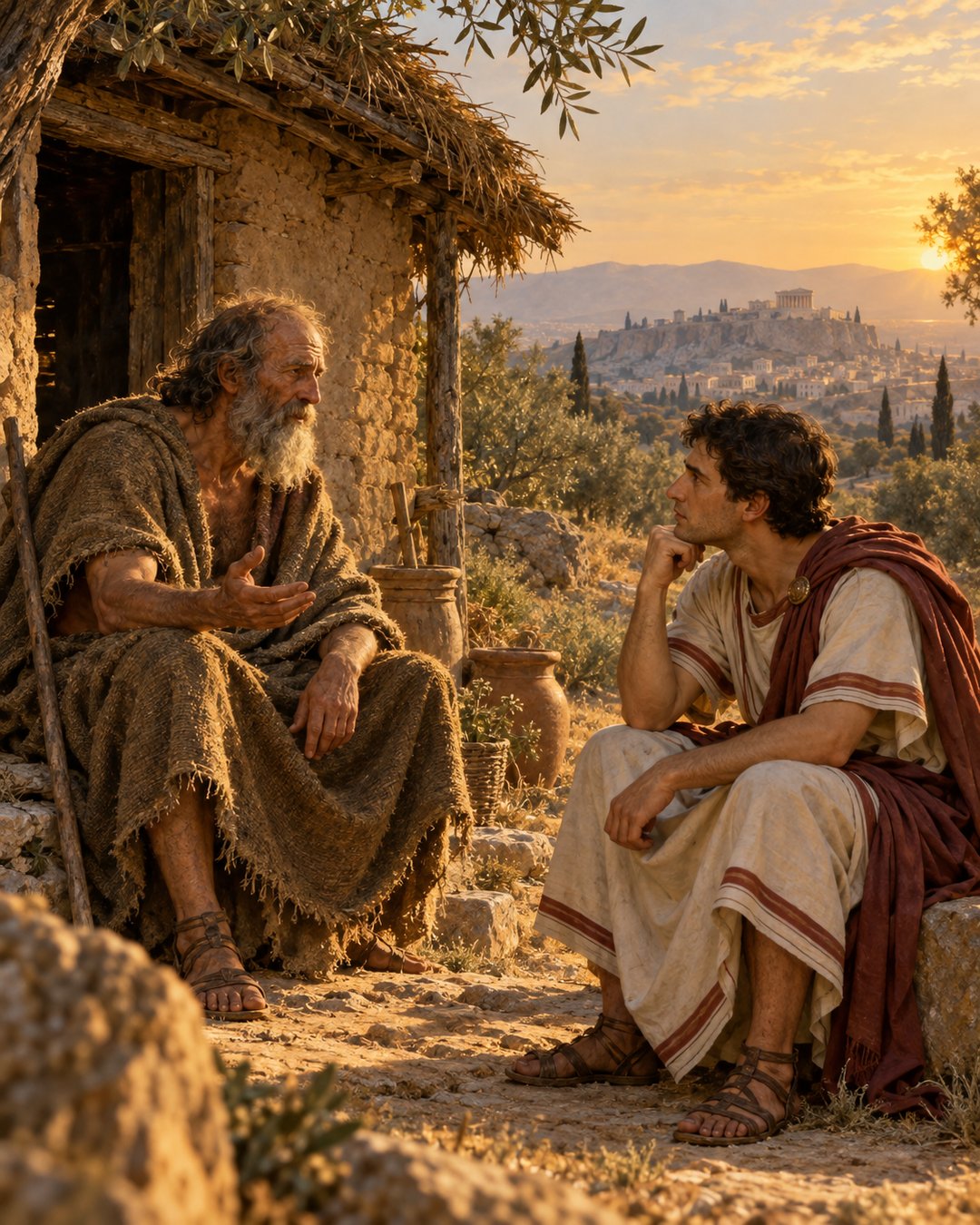
Outside Athens, the philosopher Peregrinus lived in a hut and offered Aulus Gellius a test of conduct with every witness removed. Suppose neither human beings nor gods would ever know what you did. Would wrongdoing become safe?
Peregrinus answered that a wise person would still refuse it. Justice, honesty, and duty should govern action before punishment or disgrace enters the calculation. Yet he also knew that not everyone possessed that discipline. For them he kept a second argument: time makes concealment unreliable.
Gellius preserves the lesson in only a few paragraphs, but its structure is exact. Inner motive comes first. Fear of eventual exposure is a fallback, not the definition of virtue.
The lesson began beyond the city
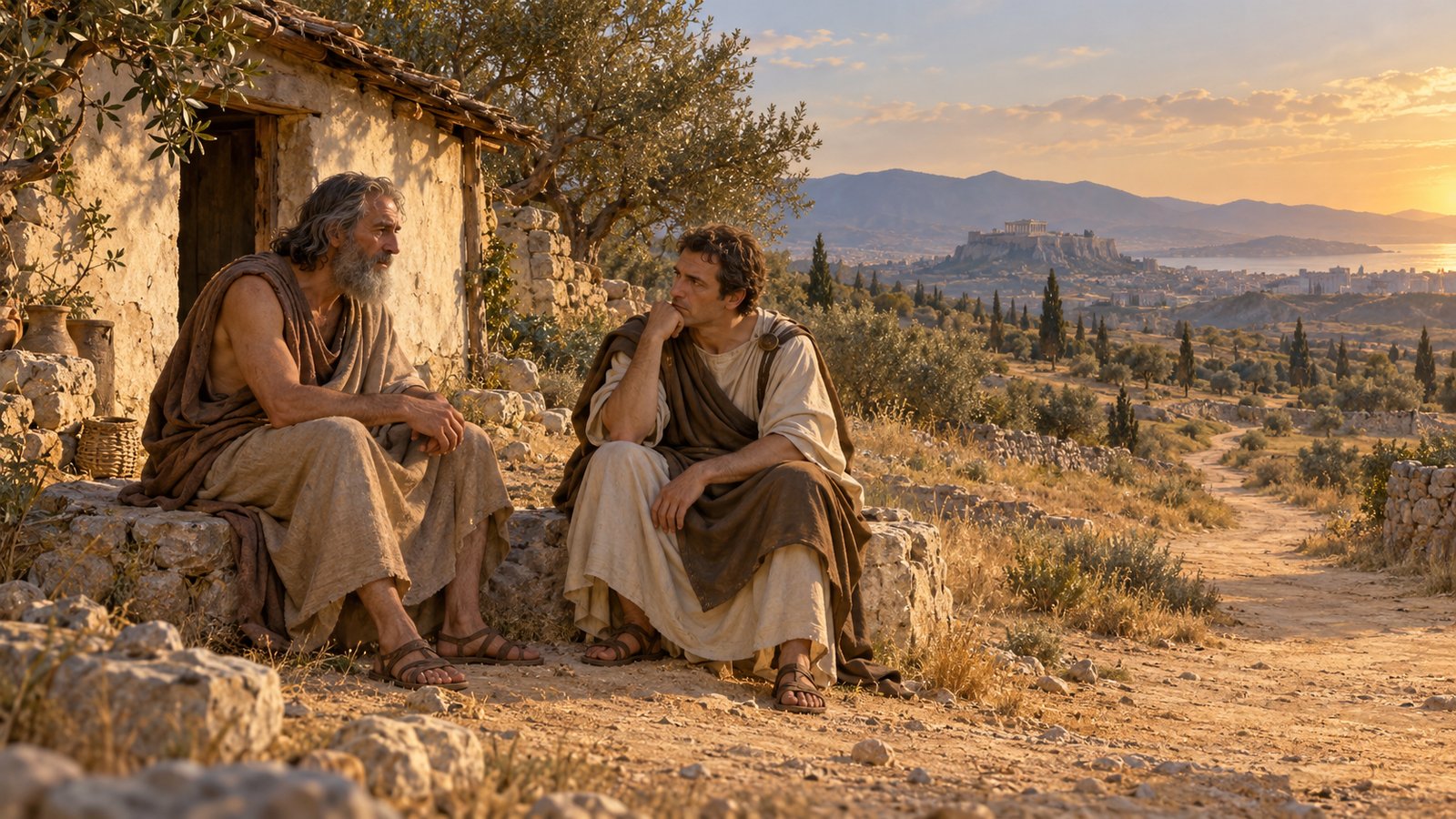
Gellius locates Peregrinus in Athens but not in a lecture hall or civic office. The philosopher lived in a hut outside the city. Gellius visited him repeatedly and remembered many statements that seemed useful and noble.
That setting strips away institutional machinery. No magistrate sits nearby, no accuser presents evidence, and no written law is quoted. The question concerns what remains when public supervision disappears.
Gellius describes Peregrinus as dignified and steadfast, and notes the later surname Proteus. He does not use this brief chapter to narrate the philosopher’s entire disputed life. The memory is bounded to one teaching heard in person.
The scene differs from the Roman debate over whether punishment should correct, deter, or answer an offence. Peregrinus begins earlier, at the private moment when an act is still optional and apparently invisible.
His thought experiment removes two common audiences at once. Neither gods nor people will know. A person cannot fear divine notice, public shame, prosecution, or damage to reputation. If restraint survives, it must rest on something other than discovery.
The hut therefore becomes a severe moral laboratory. Poverty of setting is not proof of wisdom, but it makes the lesson’s lack of external enforcement physically vivid.
Duty had to work before fear
Peregrinus says the wise person abstains from wrong through love of justice and honesty and through a sense of duty. Each motive directs attention toward the act itself rather than its audience.
Justice asks whether another person receives what is due. Honesty asks what kind of conduct can be owned without disguise. Duty binds the actor to an obligation even when no reward follows.
This is stronger than merely predicting that crime will be discovered. If certain secrecy made the act acceptable, then apparent virtue would be only risk management. Peregrinus refuses that foundation.
He also separates punishment from disgrace. Punishment is an imposed consequence; disgrace is a social judgment. Both depend on some form of knowledge. The wise person’s restraint must be able to operate without either.
The claim resembles Chilo’s conflict between a judicial oath and private mercy, but the mechanism is different. Chilo faced competing duties inside a formal decision. Peregrinus asks whether duty exists when no one can audit it.
Gellius does not report a catalogue of prohibited acts. “Wrongdoing” remains general so the distinction between motive and surveillance can stand in the foreground.
Concealment tempted the undisciplined
Peregrinus then changes audiences. Some people, he says, are neither naturally disposed nor sufficiently trained to restrain themselves by will. Their choices respond more strongly to perceived opportunity.
For them, concealment does more than hide a completed act. The hope of remaining unseen alters the decision beforehand. Expected impunity lowers the imagined cost and makes wrongdoing easier to choose.
This second part is practical rather than ideal. Peregrinus does not suddenly claim that fear produces wisdom. He asks what can slow a person who has not reached the first standard.
The answer is to weaken confidence in secrecy. If nothing stays hidden for very long, then the private advantage is unstable. A witness may speak, evidence may surface, circumstances may change, or the actor may reveal what was meant to remain buried.

Gellius’s wording contains an uncomfortable detail. People who expect exposure will act more reluctantly and more secretly. The teaching does not promise universal reform. Deterrence can reduce confidence while also encouraging greater care in concealment.
That qualification prevents a sentimental reading. Peregrinus recognizes that external fear manages behaviour imperfectly. It may inhibit an act, but it may also refine the attempt to hide it.
The first standard therefore remains essential. Only love of justice changes the reason for acting. Fear of discovery changes the calculation.
Time supplied a witness without becoming virtue
Peregrinus recommends lines attributed to Sophocles: do not try to conceal, because Time sees, hears, and reveals. The image gives duration the senses of a witness.
Time does not literally observe in the chapter. The personification compresses a pattern: circumstances continue after the actor’s plan ends. Secrets require every later condition to remain favourable, while disclosure needs only one break.
Gellius adds another remembered saying from an old poet whose name escapes him: Truth is the daughter of Time. His admission matters. He preserves the phrase without inventing an attribution he cannot supply.
Both images convert uncertainty into caution. They do not establish that every hidden wrong was historically exposed. Peregrinus’s practical point needs less than that. A person tempted by impunity must reckon with the inability to control the future.
The two levels of the lesson should not be collapsed. If Time alone prevents wrongdoing, the actor remains willing whenever secrecy looks secure. If duty governs, even perfect concealment changes nothing.
That order also clarifies why Peregrinus addresses weaker discipline separately. Ethical teaching can name an ideal while still acknowledging intermediate restraints. A community may need sanctions and reputational consequences even when its philosophers insist that good conduct should not depend on them.
Gellius presents no response from his listeners and no dramatic conversion. He records a compact argument that stayed with him after repeated visits. Its force lies in arranging motives from strongest to weakest.
First comes the person who loves justice enough to act without witnesses. Then comes the person whose confidence must be unsettled by the long life of evidence and memory. Last comes Time, not as the source of goodness, but as the enemy of an easy secret.
The hut outside Athens held no court. Peregrinus nevertheless supplied two judges: duty within the actor, and an unpredictable future beyond the actor’s control.
There is also a difference between being unseen and being unaccountable. Peregrinus’s first wise person accepts accountability without an observer. The second kind of person imagines that accountability begins only when knowledge reaches someone able to punish or shame. The poem about Time attacks that imagined boundary by stretching the life of an act beyond the moment of concealment.
Gellius’s own memory quietly reinforces the point. A conversation held at a modest hut survives because a listener retained it and later wrote it down. Peregrinus could not control where the words would travel, just as the hypothetical wrongdoer cannot control every later witness. The chapter itself is an example of time carrying something private into a wider audience, though here the thing revealed is instruction rather than guilt.
None of this requires claiming that every secret emerges. The practical deterrent depends on risk, while the ethical ideal does not. Peregrinus’s hierarchy remains stable even if a concealed act never becomes public: duty still condemns it, and uncertainty still makes confidence in impunity irrational.
Sources
Aulus Gellius, Attic Nights 12.11, preserving a discourse of Peregrinus Proteus and lines attributed to Sophocles.