
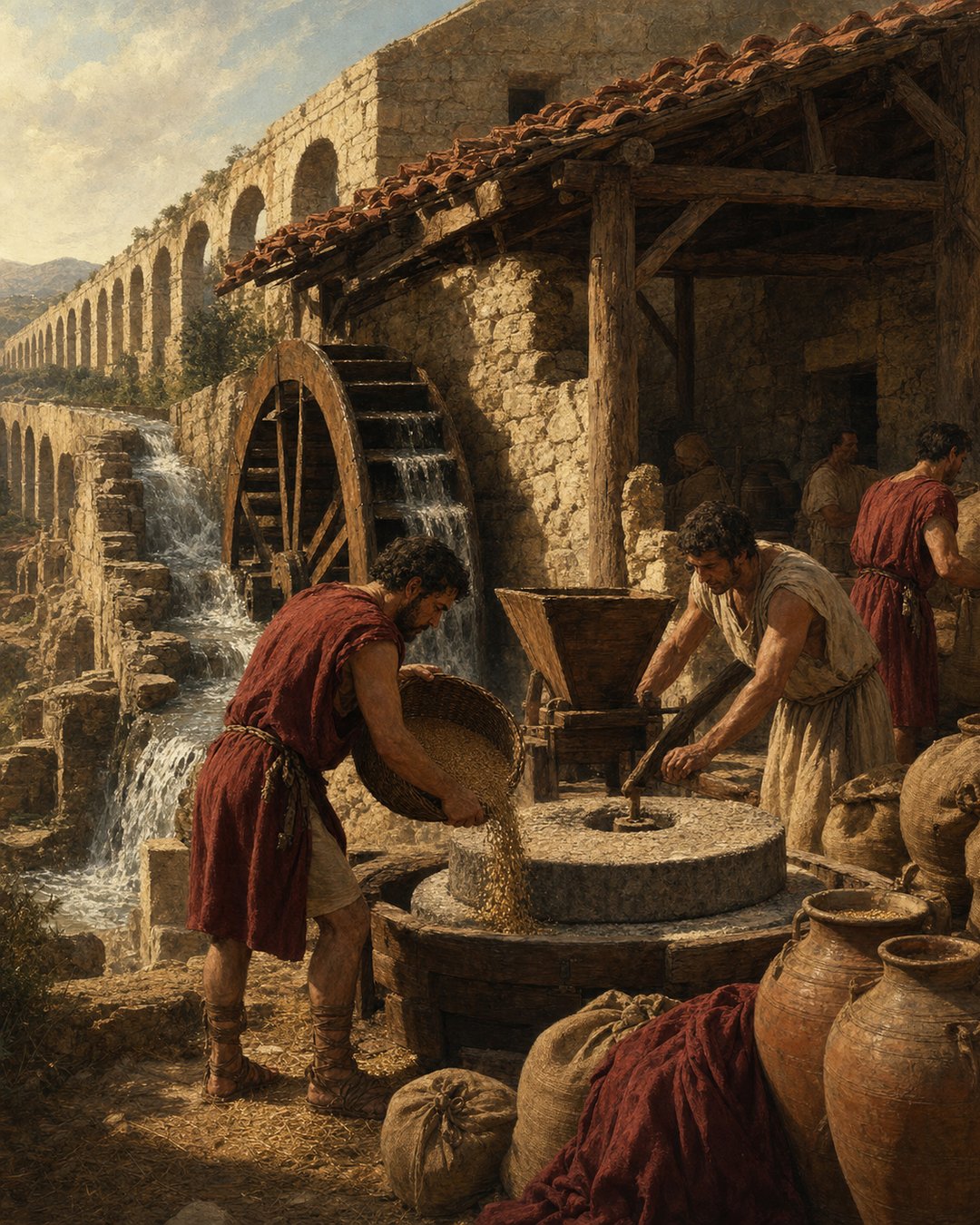
A Roman loaf began long before anyone smelled bread. It began with grain that had to be crushed, measured, moved, and trusted. That work could be done by hands, animals, or a machine that turned flowing water into pressure.
Roman watermills made grain less dependent on muscle because they joined natural force to a visible chain of labor. Water moved the wheel, the wheel moved the stone, and the stone made flour before the city ever saw the finished food.
The millstone made food mechanical
Mola names the mill or millstone, and the word points to a basic truth: grain becomes useful through repeated pressure. Grinding was not glamorous, but it was one of the hidden foundations of urban confidence.
The millstone made that foundation visible. A person could see grain poured, stone turning, flour collecting, and workers managing the process. Food security took the form of a heavy object in motion.
Water changed the labor equation
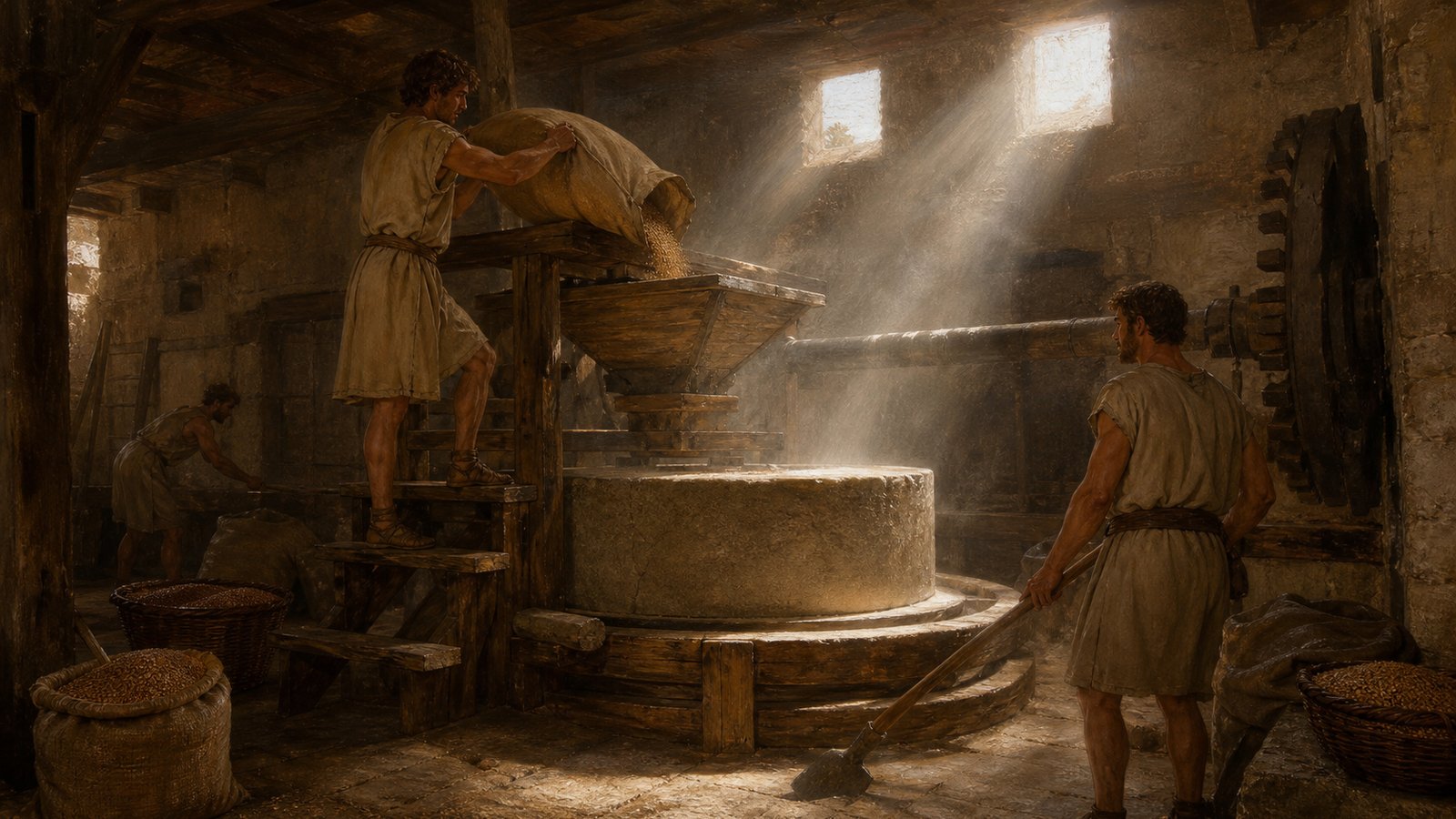
A water-driven mill did not abolish human work. Someone still carried sacks, watched the flow, cleared jams, and moved flour. But the hardest repetitive pressure could be shifted onto wheel and current.
Imagine the concrete scene: cold water striking wooden paddles, an axle creaking, flour dust catching sunlight, and a worker tying a sack while the stone continues turning. Muscle has not vanished, but it is no longer alone.
Infrastructure made nature useful
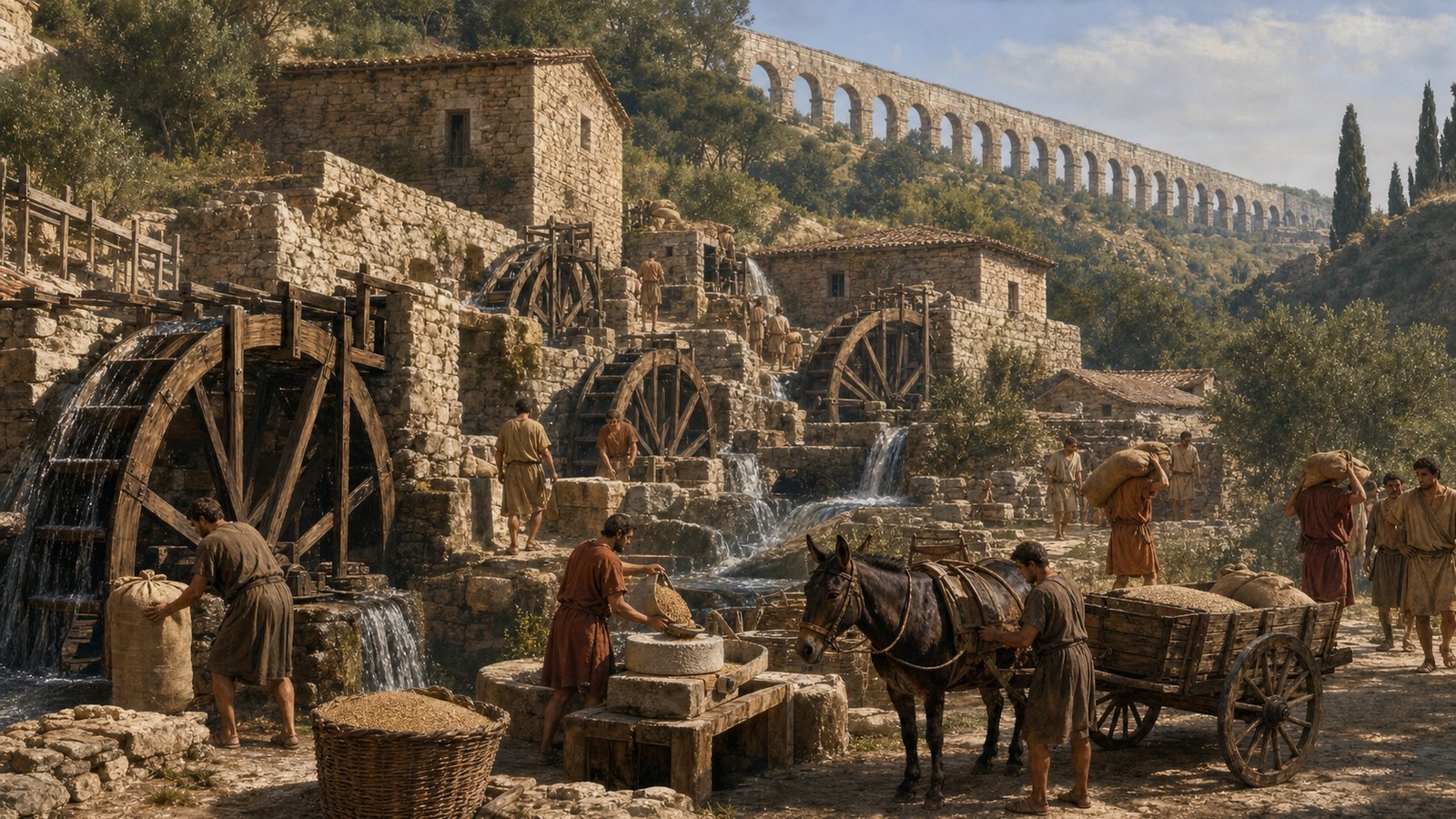
Roman building often turned difficult landscapes into controlled routes. The same imagination that made bridges and channels useful could make water serve grinding. Flowing water became practical only when directed through a built system.
That is why the mill belongs to infrastructure history as much as food history. It joined stonework, carpentry, grain supply, and daily need in one place where the force of water could be inspected.
Records followed the sacks
Tabulae remind us that Roman work needed memory. Sacks, shares, deliveries, obligations, and accounts could not be left to flour dust and verbal promises.
A mill produced more than flour. It produced claims: whose grain, how much, when processed, what owed, and what delivered. Written records helped the turning stone enter the world of trust.
The noise of grinding carried public meaning
The sound of a mill was a public signal. It meant work was happening before bread appeared, before a baker sold anything, and before a household ate.
Grinding made supply audible. In a city nervous about food, the steady movement of grain through mills mattered because it suggested that invisible systems were still working.
The detail that matters is not that Romans suddenly escaped labor. They did not. The point is that a mill concentrated many forms of labor into a place where force, material, and management could be seen together.
Water power gave grain processing a rhythm different from a single exhausted body. A current could keep pressing while people adjusted sacks, cleared flour, checked stones, or argued over accounts.
That rhythm made the mill feel reliable when it worked and frightening when it failed. A stopped wheel was not a small inconvenience. It meant the chain between grain and bread had broken at a visible point.
The mill also made inequality visible. Owners, workers, haulers, customers, and officials might all meet around the same food process without sharing the same power over it. Flour dust could settle on very different social ranks.
Still, the machinery gave ordinary people a way to understand supply. They did not need to see an entire grain fleet to know that food was being transformed. They could hear and smell the local stage of the process.
The sensory world was intense: wet stone, creaking wood, rough grain sacks, sweat, flour on arms, and the low grinding sound that turned kernels into powder. These were the bodily signs of a system in motion.
A watermill also gave natural force a civic face. Water in a channel is landscape; water striking a wheel is organized work. Rome repeatedly valued that transformation from raw movement into governed usefulness.
This helps explain why the mill belongs beside roads, aqueducts, and harbors in a history of Roman order. Each made movement dependable by making it visible and repeatable.
The millstone did not care about imperial rhetoric. It cared about pressure, rotation, and feed. Yet those simple mechanics supported the larger political fact that cities needed bread and bread needed processing.
A bakery could be the public face of food, but the mill was one of its muscular hearts. The counter sold confidence only after the stone had done its quiet violence to grain.
The public meaning of the mill came from this gap between humble work and enormous consequence. If grain could not be processed, the promises of empire shrank quickly into hunger.
The watermill therefore made a hidden dependency easier to see. People could look at wheel, channel, stone, sack, tablet, and worker and understand that bread was not a gift. It was a chain.
That chain was fragile enough to need attention and strong enough to change labor when it held. A running mill suggested that nature, tools, records, and workers were cooperating for the city’s stomach.
This is why the Roman watermill deserves more than a footnote. It shows power not as ceremony, but as controlled motion repeated hour after hour until grain became flour.
Rome often made authority visible through monuments. The mill made necessity visible through work. It taught that survival could depend on a wheel turning in a dusty room beside moving water.
The watermill also changed how dependence could be imagined. A household might experience hunger privately, but flour production required a chain of visible work: water controlled, stone maintained, sacks moved, and accounts preserved.
This chain made trust more practical. A customer or official did not need to accept a vague promise that grain was being prepared. The working wheel, the powdered stone, and the filled sack made progress visible.
Because a mill gathered noise and dust in one place, it also gathered responsibility. If the stones were badly set, if water was diverted, or if sacks disappeared, the failure had a location and a set of people attached to it.
That local accountability mattered in a food system where anxiety could travel quickly. Bread was political because hunger was social. The mill sat between field, warehouse, bakery, and crowd.
The Roman genius here was not pure invention but integration. Wood, stone, water, grain, labor, and record-keeping had to be made to cooperate repeatedly. The result was ordinary only because the system kept working.
A worker in the mill understood that food security was physical before it was rhetorical. The weight of a sack, the rasp of stone, and the wet shove of water against the wheel were all parts of public order.
The watermill therefore gives us a less theatrical image of Roman power. It was not a general on a platform. It was controlled motion doing the same necessary task again and again.
When that motion continued, grain became flour with less dependence on exhausted arms. When it stopped, the city could learn how much invisible confidence had rested on a turning wheel.
Sources & Further Reading
- Smith Dictionary, Mola
- Smith Dictionary, Pons
- Smith Dictionary, Tabulae