
The Roman Proof That Fit In A Palm
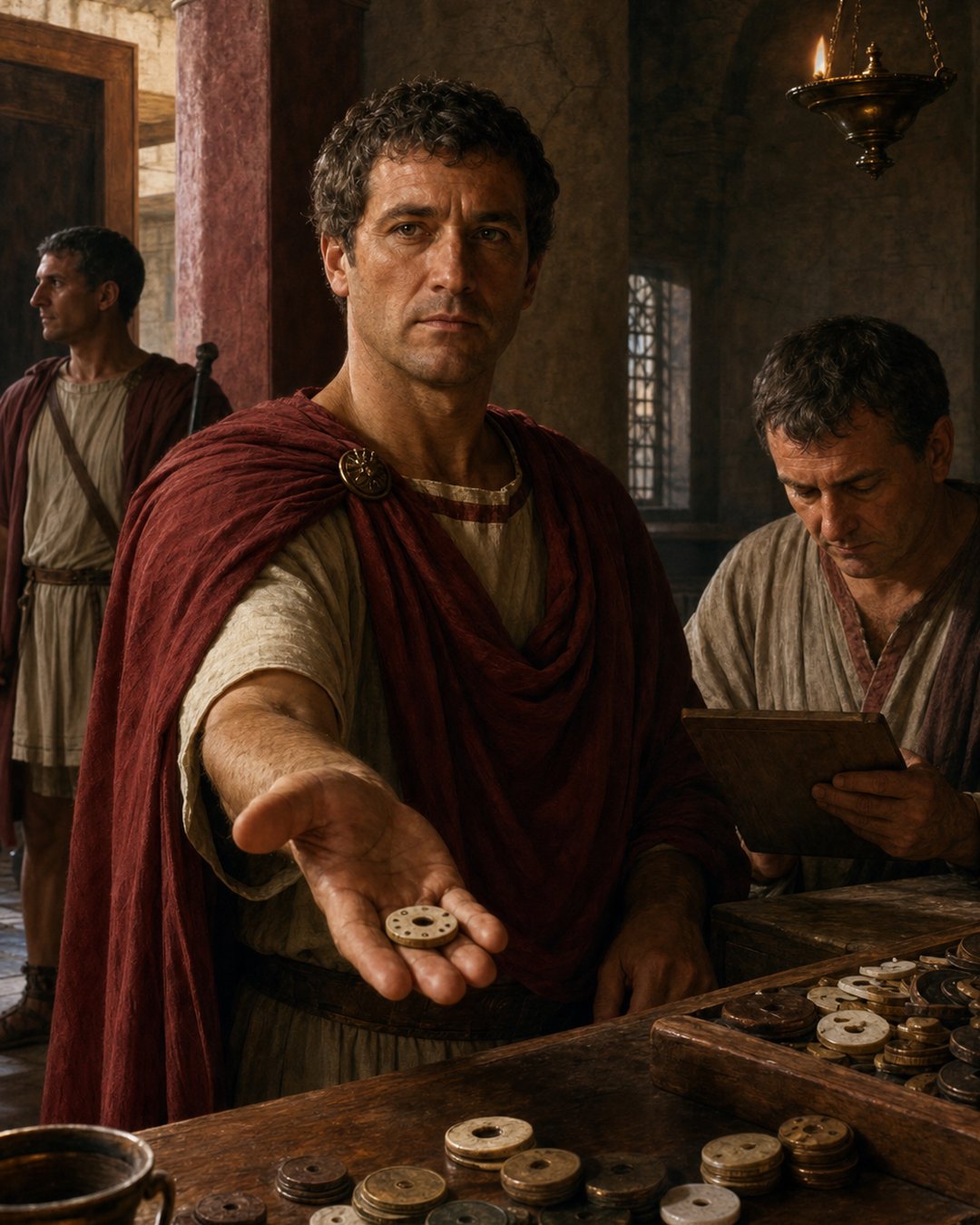
Not every Roman claim needed a speech, a witness list, or an inscription cut deep into stone. Sometimes the proof was small enough to rest in a dirty palm. A tessera could be a token, ticket, counter, or little tablet-like object; the important point is that it let a person carry recognition through a crowded world. At a doorway, counter, distribution point, or guest’s threshold, a small object could stand between confusion and acceptance.
That smallness is the historical clue. Rome loved monumental visibility, but it also depended on tiny portable signs. A token did not explain the whole system. It did not tell the life story of the person holding it. It simply made one question answerable in public: does this object match a right, allocation, invitation, password, or bond that someone else agrees to recognize? In a city of crowds, queues, strangers, and unequal access, that was enough to matter.
A Token Turned Recognition Into A Procedure
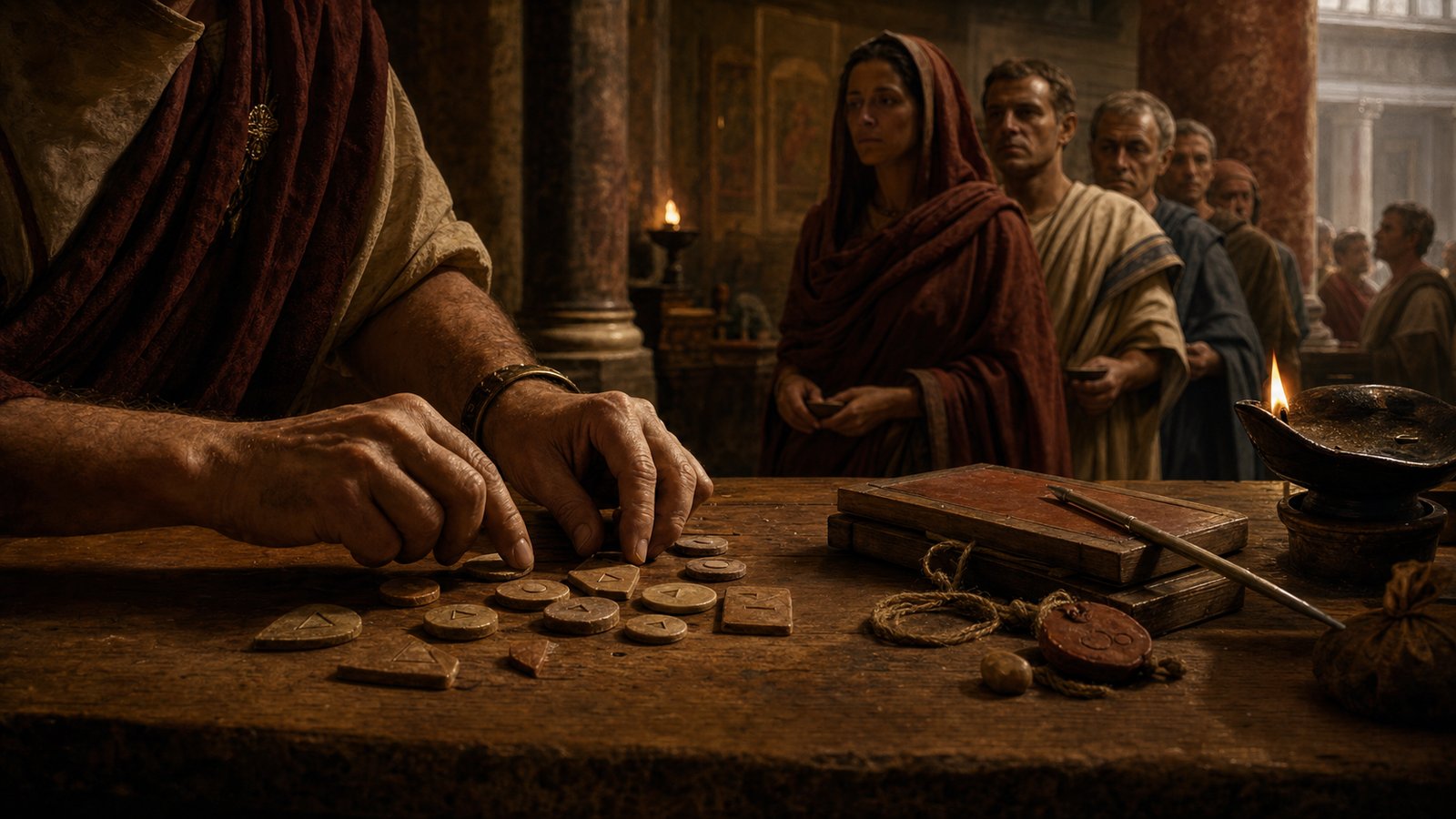
The power of a tessera came from procedure, not magic. Bone, wood, ivory, metal, or another durable material could become meaningful only when people treated it as a sign. The holder presented it. The clerk, attendant, host, or gatekeeper checked it. The person controlling access accepted or rejected the claim. The object slowed the moment down just enough for a public decision to happen.
Picture the concrete scene: a basket of plain tokens on a counter, a hand extending one from a sleeve, a doorkeeper leaning forward, and a clerk glancing from the object to a tablet or list. The token is tiny, but the ritual around it is not. It gives the decision a visible center. The person without status can still point to something. The person with authority can point back to the agreed rule.
Small Objects Moved Through Crowds Better Than Decrees
A public inscription could tell a city what was supposed to be true, but it could not walk with a citizen through a crowd. A tessera could. That made it useful in the messy middle ground between law and lived routine. A distribution, admission, password, or recognized bond all needed to survive contact with many bodies moving through limited space. The token compressed the claim into something that could be carried, shown, handled, and returned.
This is why tesserae belong beside tablets, seals, and styli in the history of Roman administration. They were not only personal trinkets. They were part of a broader habit: making invisible relationships visible through inspectable objects. A wax tablet could hold a note; a seal could protect a packet; a stylus could cut temporary words into wax. A tessera did a neighboring job. It made recognition portable.
Hospitality Could Become An Object
The most revealing use is the tessera hospitalis, the hospitality token. Hospitality can sound warm and private, but Romans could give even that relationship an object. A bond between hosts, families, or communities became something that might be shown later, remembered across distance, and recognized by someone who had not watched the original agreement happen.
That matters because memory changes when it has a thing attached to it. A welcome no longer depends only on one person’s recollection or mood. It can be represented by a durable piece small enough to carry and specific enough to trigger recognition. The token does not replace trust; it gives trust a handle. It lets a relationship travel without becoming only a story told by the traveler.
Gatekeepers Made The System Real
A token by itself is only material. The system becomes real when someone else accepts it. That means tesserae also reveal the importance of gatekeepers, attendants, clerks, hosts, and distributors. These people are easy to miss because they do not always appear in heroic narratives, but they were the human edge where recognition became action. They decided whether the small object opened a path.
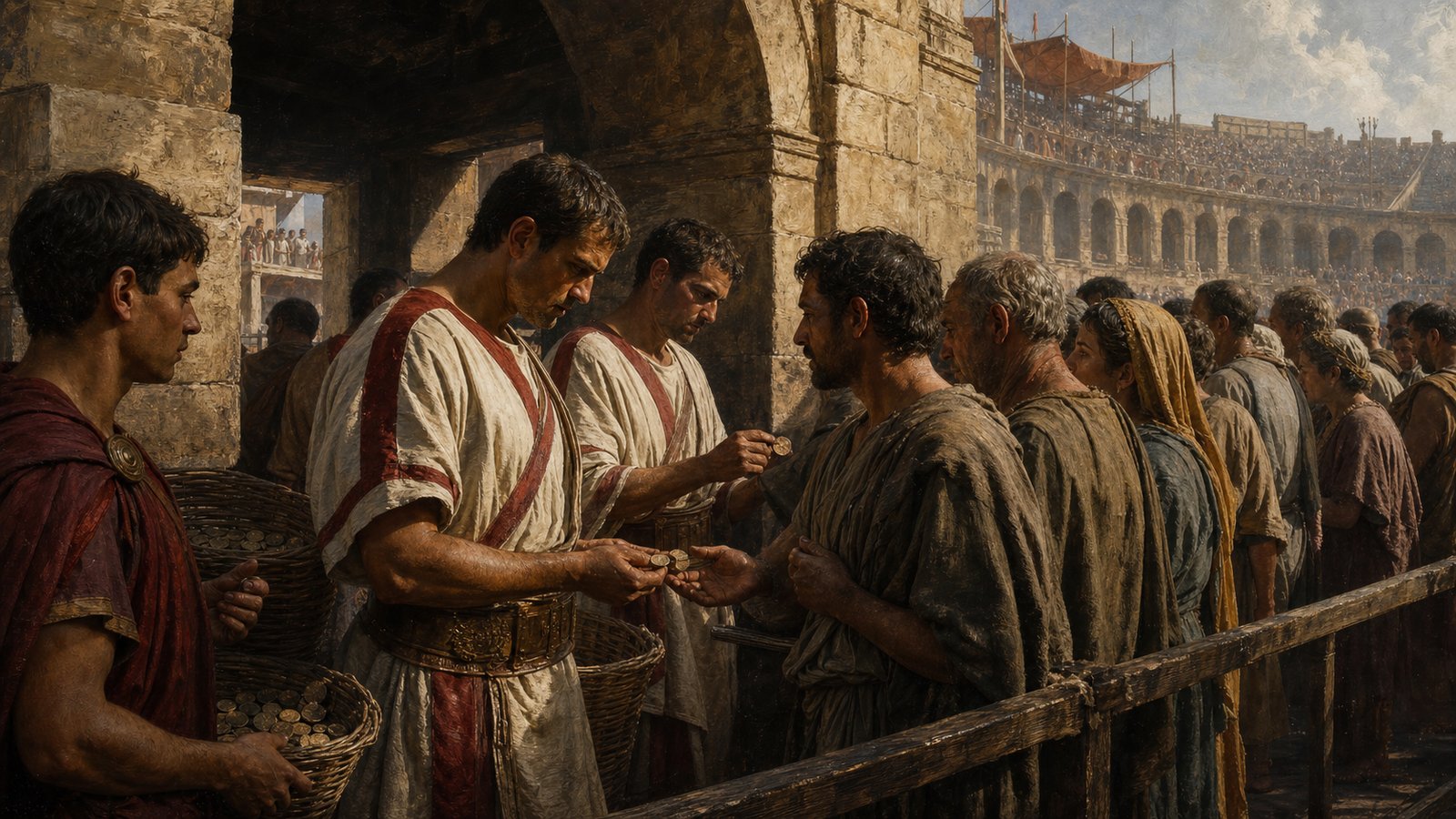
Imagine an amphitheater entrance or public counter: stone shade, dust, impatient voices, a basket scraping on wood, the brief flash of a token between fingers. The crowd wants movement, but movement depends on checks. The person holding the token is not asking the whole city to remember him. He is asking one official moment to recognize one object. That is why the procedure is powerful.
Why Portable Identity Felt Public
Tesserae made identity public in a limited but practical sense. They did not create modern identity documents. They did something older and more immediate: they connected a body in front of a gate or counter to an entitlement that others had already agreed to honor. The object stood in the gap between private claim and public recognition.
This helps explain why the smallest Roman things can expose large systems. A coin carries an emperor’s face into a market. A seal protects a message. A tablet turns memory into a surface. A tessera turns permission, hospitality, admission, or distribution into a thing that can be held up in front of another person. The empire did not only operate through commands from above. It also operated through repeated little recognitions at human scale.
The sensory world of the token was modest: bone worn smooth by fingers, metal warmed in a palm, a wooden counter darkened by oil and hands, a stylus waiting beside wax, a doorway half-blocked by a guard. Yet those details were exactly where order became visible. Rome’s public life needed such small interruptions because crowds without procedures become noise.
That is the lesson of the tessera. Authority can be carved into marble, but it can also be passed across a counter. A tiny object could not guarantee justice, fairness, or honesty. It could, however, make a claim inspectable at the crucial moment when a stranger needed recognition. In that sense, Roman identity was sometimes not a grand title at all. It was a small token, carried through the crowd, waiting for the right hand to accept it.
The token also reminds us that Roman order was not always loud. It often worked by reducing a complicated social fact to a manageable gesture: show the object, let another person inspect it, wait for the nod or refusal. The gesture could be quick, but it carried the weight of earlier agreements, stored supplies, seating rules, guest-friendship, or controlled entry. A person might not know the whole bureaucracy behind the token. He only needed to know that this small thing was supposed to speak for him at the right place.
That made tesserae especially useful in settings where memory had to survive scale. Crowds are bad at remembering individuals, and busy officials are bad at hearing long explanations. A token created a shortcut without making the shortcut invisible. Everyone nearby could see the exchange happen: hand, object, counter, checker, decision. The physicality mattered because it gave recognition a public trace, even if the trace lasted only a few seconds before the next person stepped forward.
Seen from that angle, tesserae belong to Rome’s everyday technology of trust. They did not eliminate exclusion, mistake, or fraud; no object could do that. But they gave Romans a repeatable way to turn identity, entitlement, and relationship into something that could cross a threshold. The smallest object in the room could decide whether the person holding it remained just another face in the crowd or became someone the system was ready to recognize.
Sources & Further Reading
- Smith Dictionary, Tessera
- Smith Dictionary, Stilus