
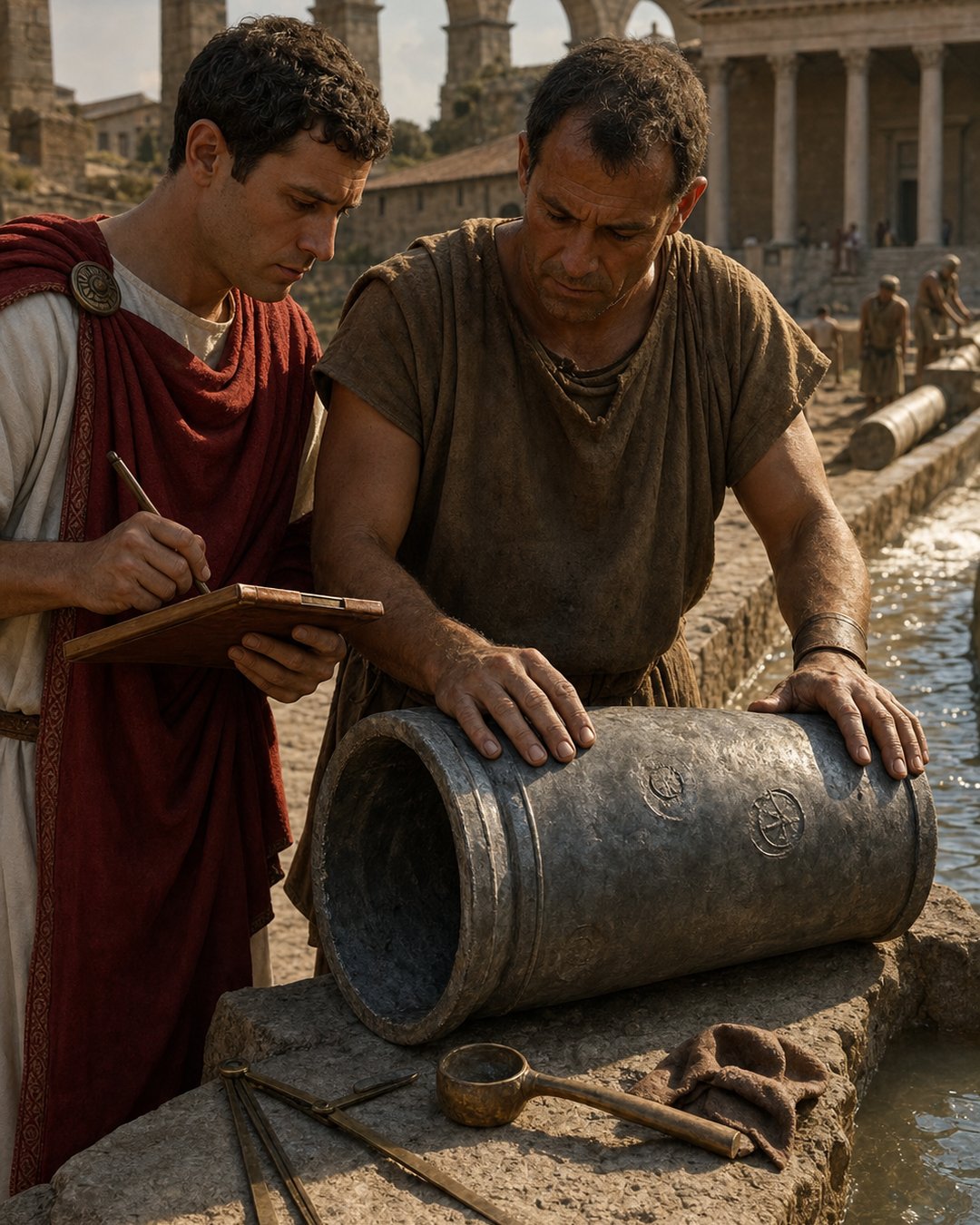
A Water Right Needed A Visible Edge
Roman water could look like a gift of engineering: arches on the horizon, channels entering the city, fountains running in public space. But the political question began at the edge where water left the shared system and entered a pipe. A right to use water had to become visible somewhere, or it remained too easy to confuse with theft, favor, accident, or silence.
Lead pipes made that edge physical. A fistula was not only a tube. It was a place where permission could be inspected, abuse could be hidden, and public supply could become a private stream. Frontinus, writing as curator aquarum, understood that Rome’s water system depended on administration as much as masonry. Flow had to be watched because flow could be diverted.
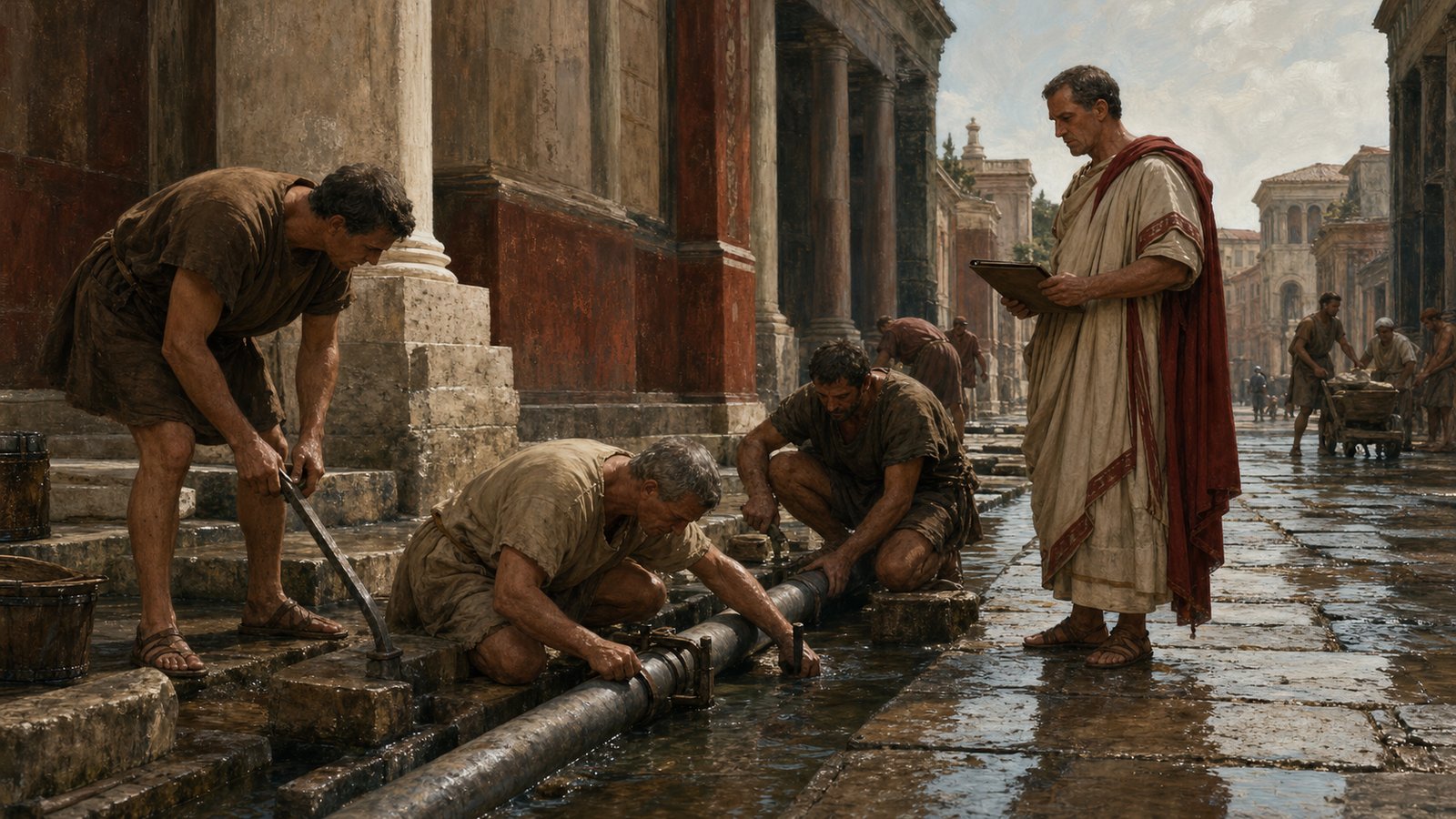
The Pipe Turned Permission Into Hardware
A granted water connection is an invisible fact until it enters the world as hardware. The pipe gives the claim weight, diameter, direction, and a place in the wall or street. It lets an official ask practical questions: where does this line begin, where does it lead, how much water should pass through it, and who benefits?
Picture the concrete scene: wet stone under sandals, a lead pipe exposed beside a curb, a workman’s hand on the seam, and a clerk pressing a stylus into a wax tablet. The water itself keeps moving, but the pipe slows the dispute down. It gives the argument a surface.
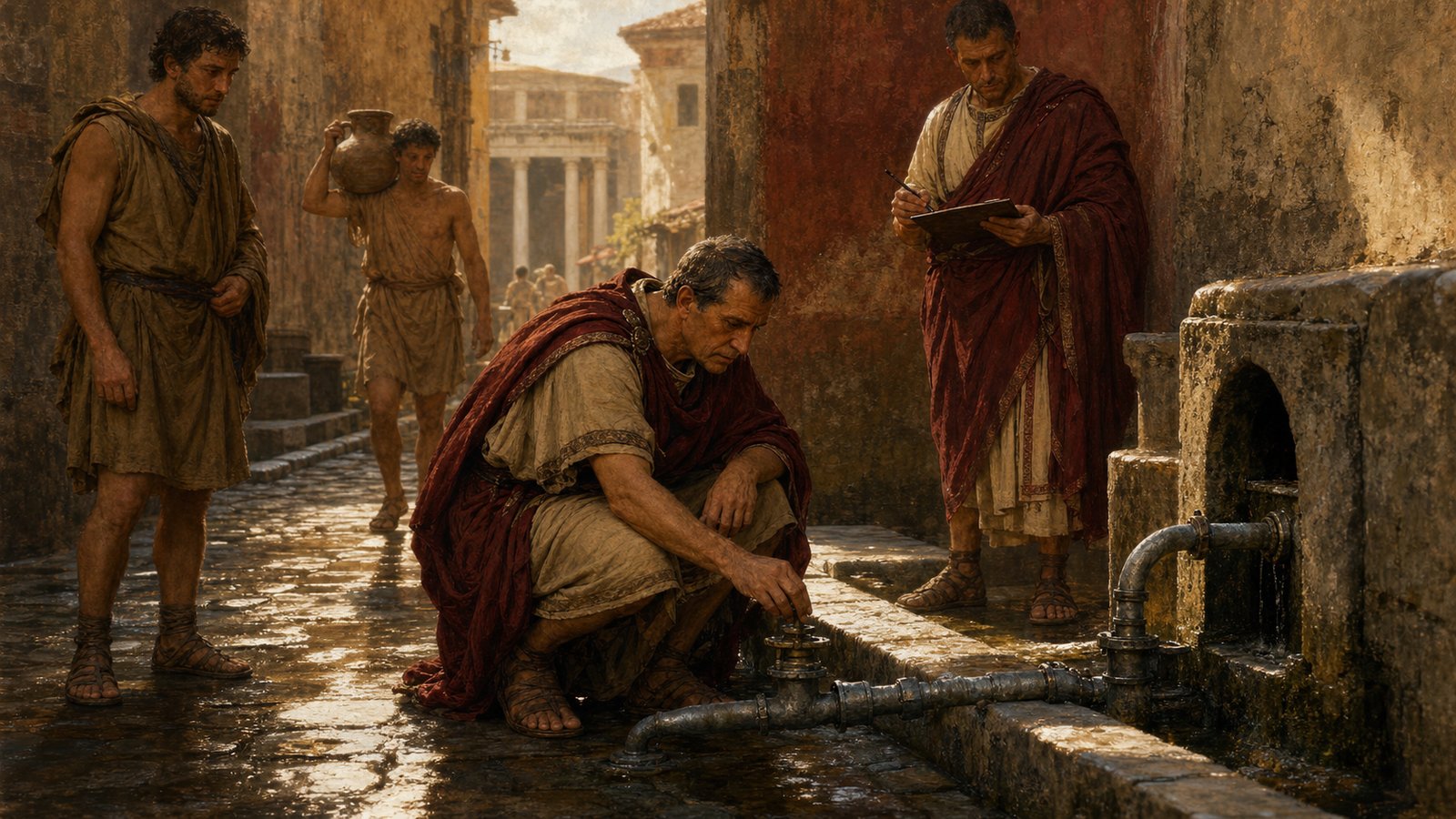
Frontinus Saw Abuse In The Connections
Frontinus did not treat Rome’s aqueducts as monuments that simply worked because they were impressive. His account is full of attention to misuse, repair, supervision, and loss. That is what makes lead pipes historically revealing. They were the small points where grand supply met human opportunity.
Unauthorized tapping, manipulated outlets, and private arrangements mattered because public water was continuous. A stolen statue can disappear once; a hidden water connection can steal every hour. The pipe could therefore become a quiet form of privilege, taking public flow and making it serve a narrower circle.
Measurement Made The Invisible Public
Water is hard to govern because it does not stay still. Roman administrators needed objects and measures that could make flow arguable. A branch line, outlet, reservoir, or pipe gave officials something to compare against records and permissions. Without a visible edge, the system would depend on trust where inspection was needed.
This is why the pipe belongs beside tablets and seals in Roman administrative history. The tablet remembered a decision. The seal protected an object or message. The pipe embodied an entitlement in metal. Each made an invisible relationship harder to deny.
A Small Opening Could Change A Public System
The scale is the surprise. A single pipe does not look like a crisis beside the massive aqueducts that fed Rome. Yet a small unauthorized opening could change the distribution of water because it touched a continuous system. The problem was not only that one person gained. It was that the shared order became less trustworthy.
Imagine an inspector crouching near a household line while a citizen waits in the doorway and a servant holds a jar. The scene is not dramatic in the way a battle is dramatic. It is dramatic because the decision decides whether a private convenience is recognized, limited, or exposed as an abuse of public supply.
Why Water Ownership Had To Be Seen
Lead pipes made water rights visible because Roman water was both material and social. It was liquid in a channel, but it was also privilege, permission, maintenance, and public confidence. A pipe could not prove fairness by itself. It could, however, show where fairness needed to be tested.
The sensory world mattered: grey lead warmed by sun, water noise in stone, damp mortar, bronze tools, wax tablets, sealed notes, and the slight metallic smell around a repair. These details were not decoration. They were the places where administration touched the body.
That is why Frontinus is so useful. He forces us to see infrastructure as a moral and administrative system, not just a technical one. The aqueduct arches may win the eye, but the pipe at the street corner reveals the daily struggle over who may use the water and under what rule.
A Roman could admire the aqueduct from a distance. The official had to care about the connection close at hand. Grand supply became public order only when the small outlets could be checked, repaired, and brought back into line with recognized rights.
The lead pipe therefore made a hidden dependency visible. Rome’s confidence in running water depended on the humble fact that flow could be traced through objects. A stream in a channel was not enough. The city needed points where the right to draw from that stream could be seen.
It also revealed how public goods become political at the smallest scale. A fountain, bath, house, workshop, or garden might all depend on water whose route began in a system claimed as public. The moment a line branched away, the question became social: who was entitled to this flow?
The pipe gave that question a material witness. It could be measured, repaired, widened, narrowed, sealed, or removed. None of those actions settled every dispute, but they kept the dispute from dissolving into rumor.
Seen this way, Roman water administration was a daily practice of making movement accountable. The aqueduct brought water near; the pipe decided where near became somebody’s use. That small transition carried more power than it first appears.
The lesson is not that Rome invented modern utility regulation. It is that Romans already understood a basic problem of shared infrastructure: when a resource moves continuously, rights must be made visible at the points where people touch it.
Lead pipes did that work with blunt material force. They turned permission into metal, privilege into a line through stone, and suspicion into something an inspector could put a hand on. Rome’s water rights were visible because, at the crucial edge, they had a shape.
There was also a social rhythm to the inspection. Workers uncovered the line, the official compared what he saw with what had been allowed, and the household or bath owner had to endure the public awkwardness of being checked. The pipe brought a private convenience into a civic scene.
That scene helps explain why infrastructure could never be only engineering. The water ran through stone and lead, but it also ran through relationships among magistrates, contractors, watermen, neighbors, and privileged users. Each connection asked whether the shared supply was still being treated as shared.
A visible pipe did not make corruption impossible. Frontinus would not have worried about abuse if the system were clean by default. What the pipe did was give reform a target. A hidden favor could be exposed as a line, an opening, a join, or a suspicious flow that someone could measure and challenge.
This made the material record powerful even when it was humble. A dented length of lead beside a curb could carry more administrative meaning than a polished public speech. It showed where water, rights, and enforcement met.
The result was a Roman form of accountability at street level. The city’s grand water supply remained impressive only if its little exits could be controlled. Every pipe connection was a reminder that public abundance can be drained away by private shortcuts unless the shortcuts are made visible.
Sources & Further Reading
- Frontinus, De aquaeductu
- Smith Dictionary, Fistula
- Smith Dictionary, Aquaeductus