
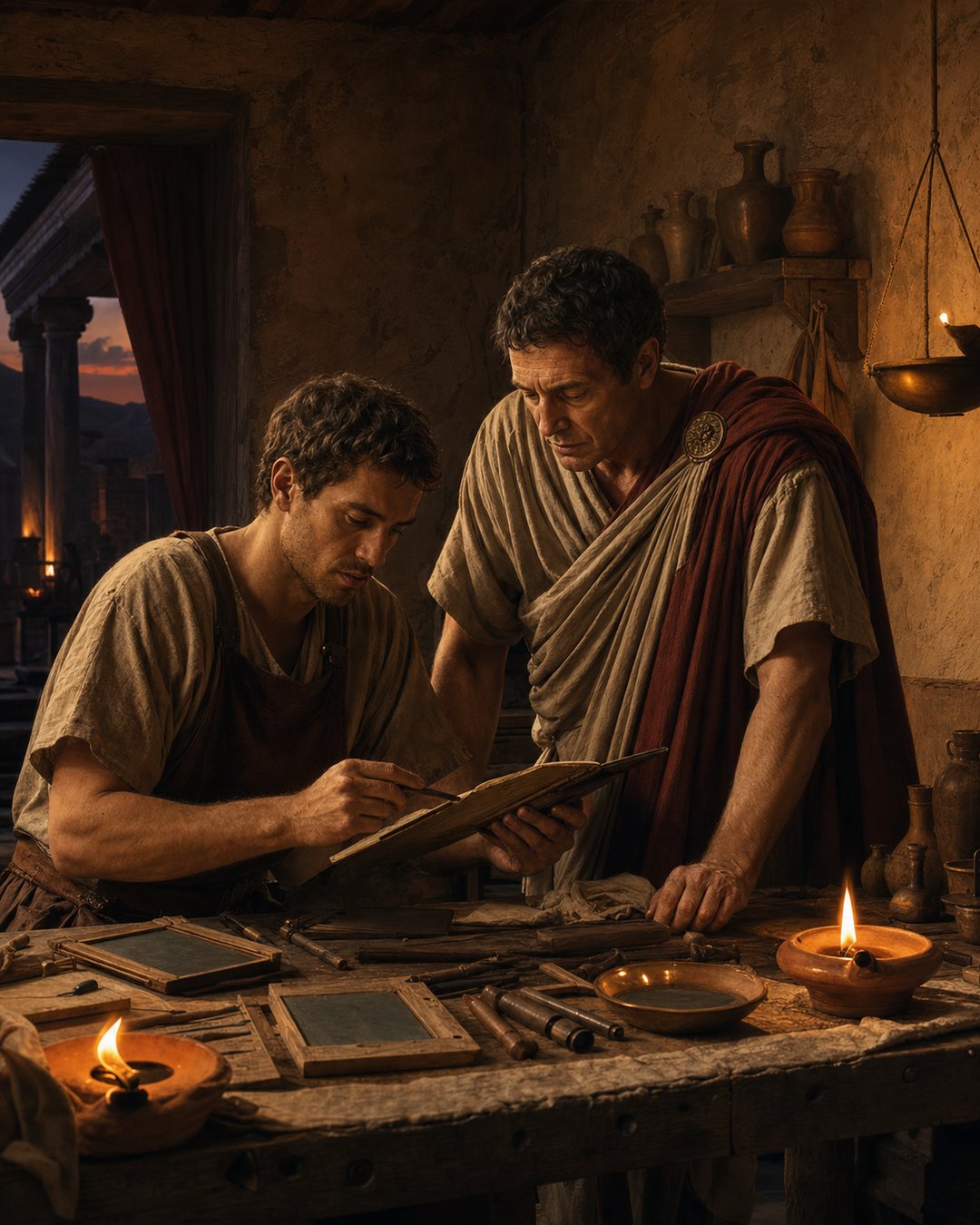
A Roman night was not empty just because the sun had gone down. Work could continue, accounts could be checked, goods could be sorted, and a household could keep moving, but only inside the limits of a small flame. The oil lamp made those limits visible.
A lucerna was not dramatic infrastructure like an aqueduct or road. It was smaller, dirtier, easier to overlook: a reservoir, oil, wick, smoke, heat, and the need for someone to keep it useful. Yet that small object changed what people could inspect after dark.
A Small Flame Extended The Working Day
The most basic fact about a Roman oil lamp is also the most important. It created artificial light by feeding a wick from an oil reservoir. That does not sound like power until we imagine the alternative: work ending when daylight disappeared, or moving only by the uncertain glow of a doorway, brazier, or moonlit court.
Lamplight did not abolish darkness. It carved holes in it. A person could lean over a table, check a tool, read a tablet, sort coins, mend cloth, or watch a threshold because the flame made a small area legible. The result was not a bright modern room. It was a negotiated extension of the day.
That negotiation mattered because evening work was often practical, not ceremonial. A shopkeeper could count what remained. A steward could compare notes. A craft worker could finish a task that had to be ready by morning. The lamp turned time into a resource that could be spent, watched, and managed.
Light Needed Materials, Not Just Desire
The lamp also reminds us that night work depended on supply. Someone had to have oil. Someone had to trim or place the wick. Someone had to notice smoke, weak flame, spilled oil, or the danger of leaving fire too near cloth, wood, or straw. Artificial light was a convenience with a maintenance bill.
That is why the object deserves more attention than it usually receives. The lamp did not simply sit in the background of Roman life. It connected agriculture, trade, household storage, pottery or metalwork, and daily attention. If the oil ran low, the night became shorter. If the wick failed, the account or repair stopped being visible.
A candelabrum or lamp-stand changed the problem again. Raising a flame could make it useful to more than one person, or bring light to a table instead of a single hand. Even a simple support turned light into a shared tool. The room began to organize itself around where the flame could reach.
The Table Became A Night Office
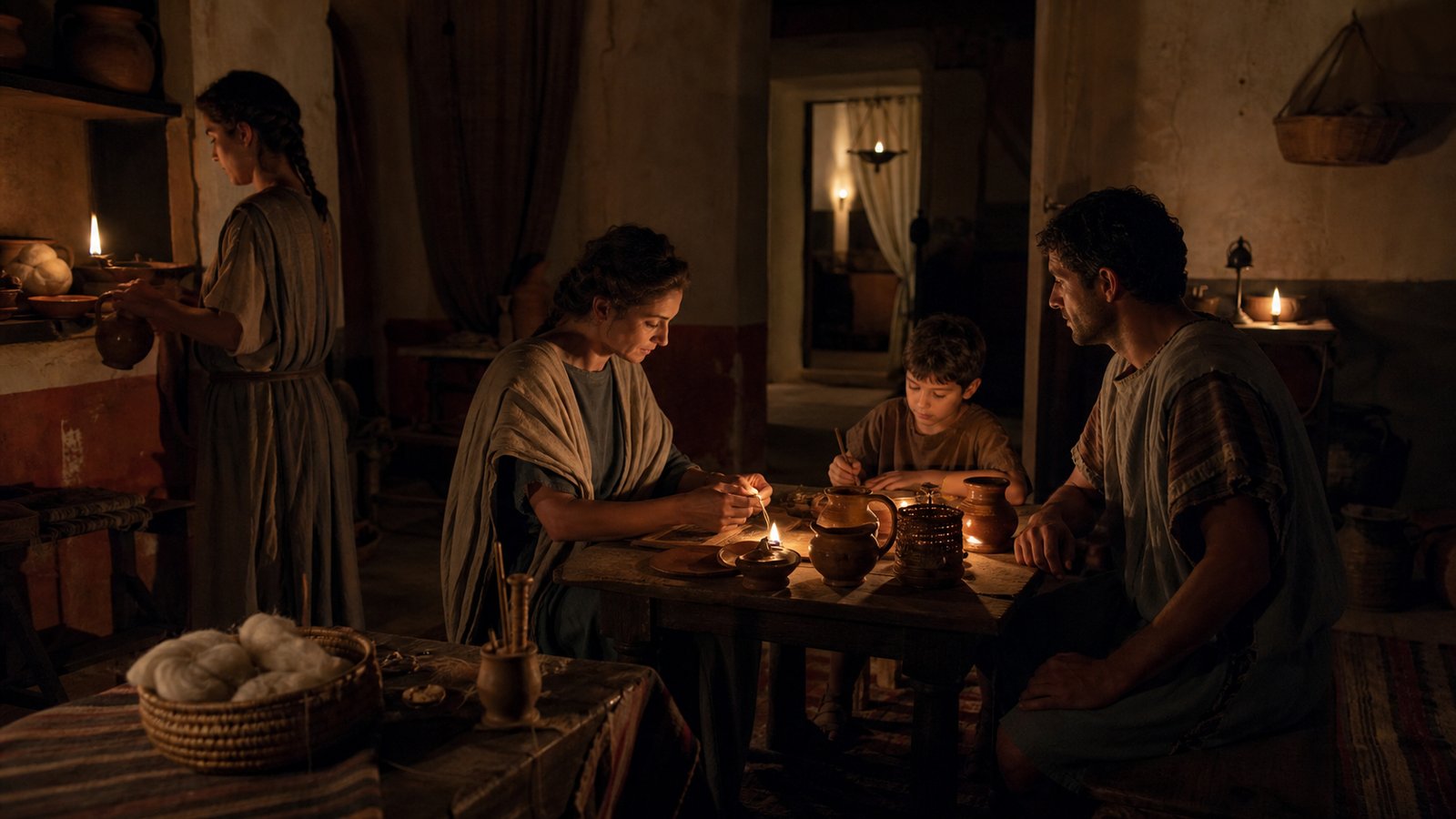
The Roman mensa, an ordinary table, became more than furniture when a lamp sat beside it. It could hold tablets, tools, food, cloth, coins, weights, cups, or a small pile of goods waiting to be counted. At night, the table and the lamp formed a working partnership.
This is where tabulae matter. Writing tablets made accounts and obligations portable, but they still had to be seen. Lamplight let a steward, merchant, patron, or household member bring memory back to the surface after sunset. The marks on wax or wood needed the flame before they could become useful again.
The scene was physical. A hand tilted the tablet toward light. A face moved closer. Shadows from fingers and stylus crossed the surface. Oil smell mixed with dust, food, wool, or metal. The lamp made administration intimate, because records had to enter the same small pool of visibility as the body reading them.
Shops And Streets Used Darkness Differently
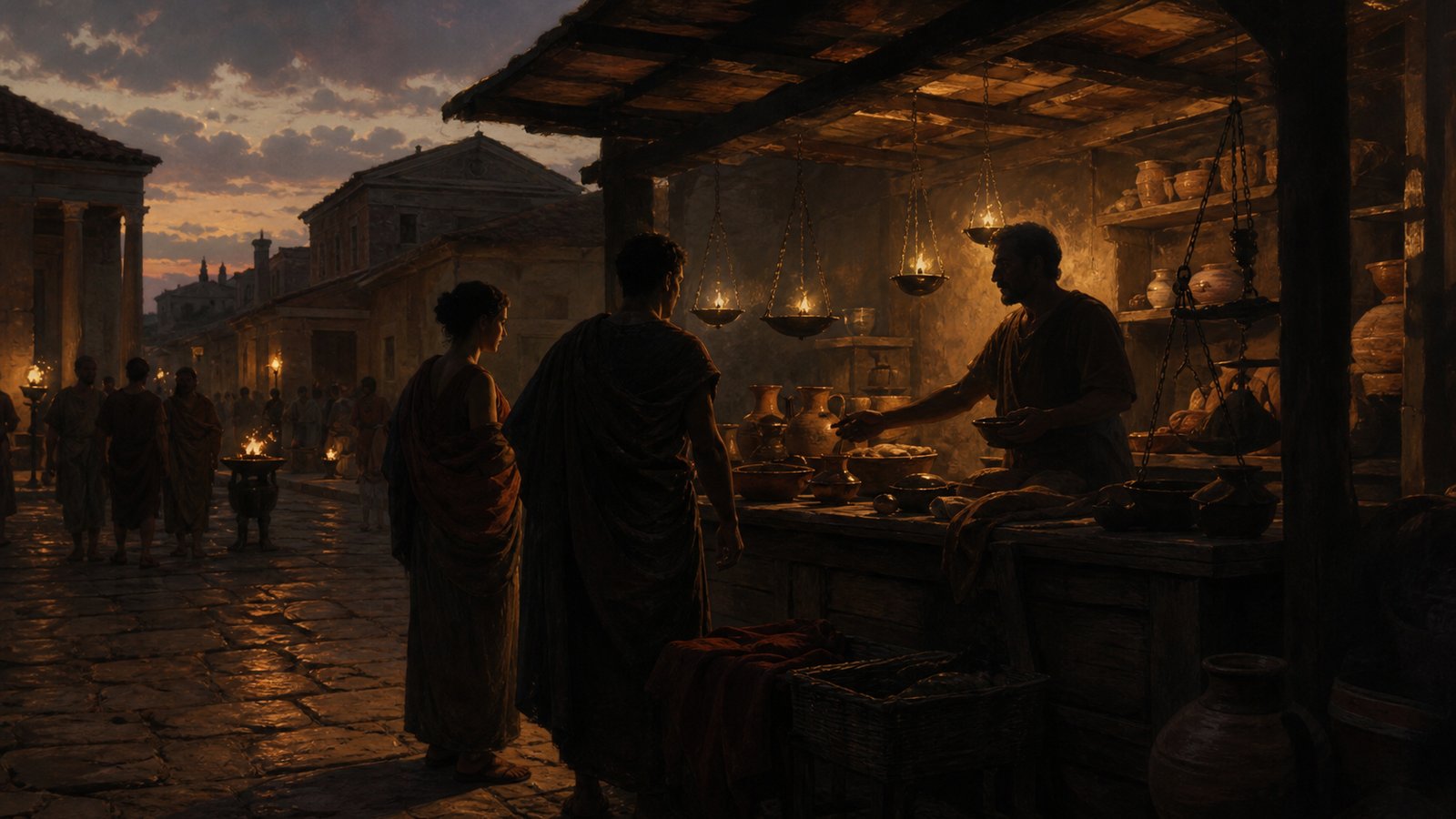
In a street stall or workshop, the lamp could make business appear deliberate after dusk. It told a passerby where the counter was, where the vendor stood, and where the goods could be inspected. Trade did not become safer merely because a lamp burned, but the flame gave buyer and seller a shared point of attention.
That shared point mattered for trust. A coin, measure, loaf, tool, or cloth edge had to be seen before it could be argued over. In daylight, the street itself helped with that work. At night, the lamp had to take over a small part of the street’s authority.
The limits were obvious. Everything outside the glow became less certain. Faces became harder to read. Objects could vanish into shadow. Smoke and flicker changed what seemed clear. Roman lamplight made night work possible by also showing how partial visibility was.
Control Of Light Was Control Of Attention
The person who placed the lamp controlled more than brightness. He or she decided what could be inspected, who had to come close, and where the room’s attention gathered. That made lamplight social. People leaned toward the same flame because the flame decided what counted as visible.
In a household, that control could reinforce order. A steward checking tablets under a lamp was not only working late; he was making oversight continue. A slave or freed worker finishing a task by lamplight was not only using technology; he was living inside someone else’s schedule. The lamp extended supervision as well as labor.
In a shop, control of light could also shape persuasion. Goods placed near the flame looked more available than goods behind it. The counter became a stage, and the lamp marked the part of the stage where buyer and seller had to focus.
Night Visibility Was Fragile Evidence
The lamp’s fragility is the point. A Roman oil lamp made night work visible, but never effortless. Its flame was small, smoky, hungry, and local. It created evidence only while oil, wick, container, surface, and human attention cooperated.
That cooperation gives the object its historical importance. Rome’s daily life was not made only by large public systems. It was also made by small devices that let people extend counting, repair, trade, and supervision into hours that darkness tried to close.
The oil lamp therefore belongs in the same story as roads, tablets, doors, and storehouses: it made a human activity inspectable. A task near the flame could be seen, corrected, witnessed, and remembered. A task outside the flame returned to uncertainty. In that narrow circle of light, Rome bought a few more usable hours from the night.
The social result was subtle but real. A master could ask why a tablet had not been checked. A vendor could ask a customer to look again at the object on the counter. A worker could keep a tool in hand because the flame still held. The lamp made excuses and responsibilities easier to see for a little longer.
It also made fatigue visible. Eyes narrowed, shoulders bent, and people gathered close because the light was limited. Night work had a posture: faces angled down, hands brought inward, bodies pulled toward the same small source. The lamp shaped the room by making everyone negotiate with its weakness.
That weakness keeps the story human. Roman lighting was not a simple conquest of darkness. It was a managed compromise between oil, flame, smoke, objects, and tired people. The achievement was not brightness everywhere, but enough light in the right place for the next account, bargain, repair, or household instruction to continue.
Sources & Further Reading
- Smith Dictionary, Lucerna
- Smith Dictionary, Candelabrum
- Smith Dictionary, Tabulae
- Smith Dictionary, Mensa