
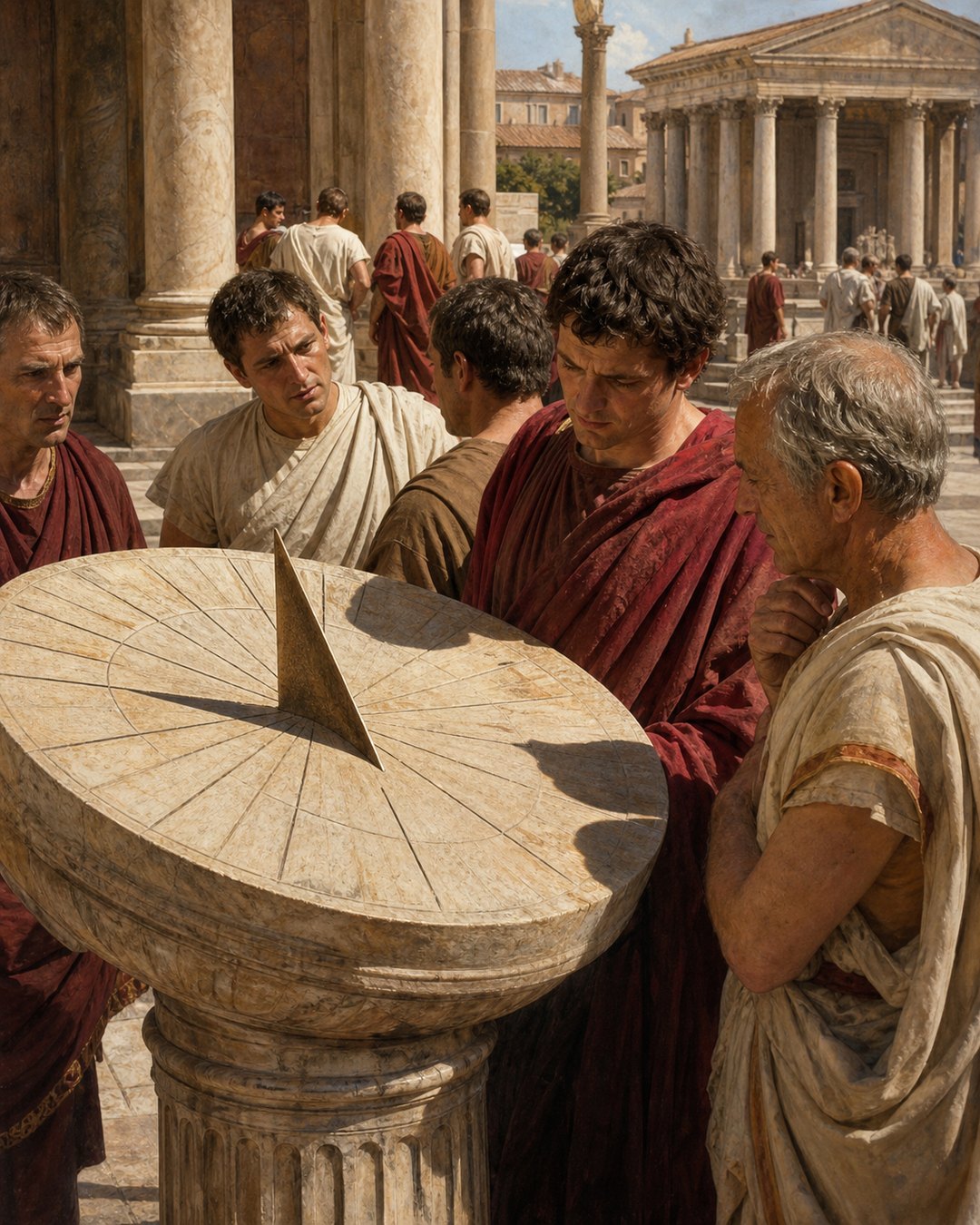
A Roman waiting in a forum did not glance at a row of identical digits. He watched a shadow. A bronze point or stone edge cut across lines carved into a dial, and the sun slowly moved that mark while business, meals, hearings, and appointments gathered around it. Time appeared as light touching prepared stone.
The display looked firm, but the hour itself was elastic. Romans commonly divided daylight into twelve parts, so a summer hour lasted longer than a winter one. Clouds could erase the reading, night ended it completely, and a dial made for one latitude could mislead at another. Public time began with geometry, then remained dependent on weather and witness.
Twelve hours did not mean twelve equal measures
The Roman daylight day ran from sunrise to sunset and was conventionally divided into twelve hours. That familiar number can hide an unfamiliar experience. Because daylight expands and contracts through the year, each of those parts changed length. A sixth hour in summer occupied more measured minutes than a sixth hour near midwinter.
People did not need to calculate the modern duration every time they named an hour. The sequence located activity within the visible day: early morning, the approach to noon, afternoon, or the final light. An hour described a share of available sunlight before it described an abstract quantity detached from sunrise.
This elasticity matched a society whose work followed physical conditions. Markets opened in morning light, builders faced summer heat, and travel became more dangerous after dark. Seasonal hours did not cause those changes; they provided a public vocabulary for arranging obligations inside them. The clock and the body answered the same sun.
The system also produced ambiguity. Two people could agree that an appointment belonged in the third hour yet still rely on different local readings or a rough estimate. Precision existed, but it was not uniform to the minute. Roman punctuality was often coordination around a phase of daylight rather than obedience to an invisible mechanical grid.
The gnomon turned sunlight into a mark
Every sundial required something that interrupted light. A gnomon projected from the dial and cast a boundary between brightness and shade. As the sun crossed the sky, that boundary moved. The instrument did not store time or generate motion; it translated celestial motion into a line that eyes could follow.
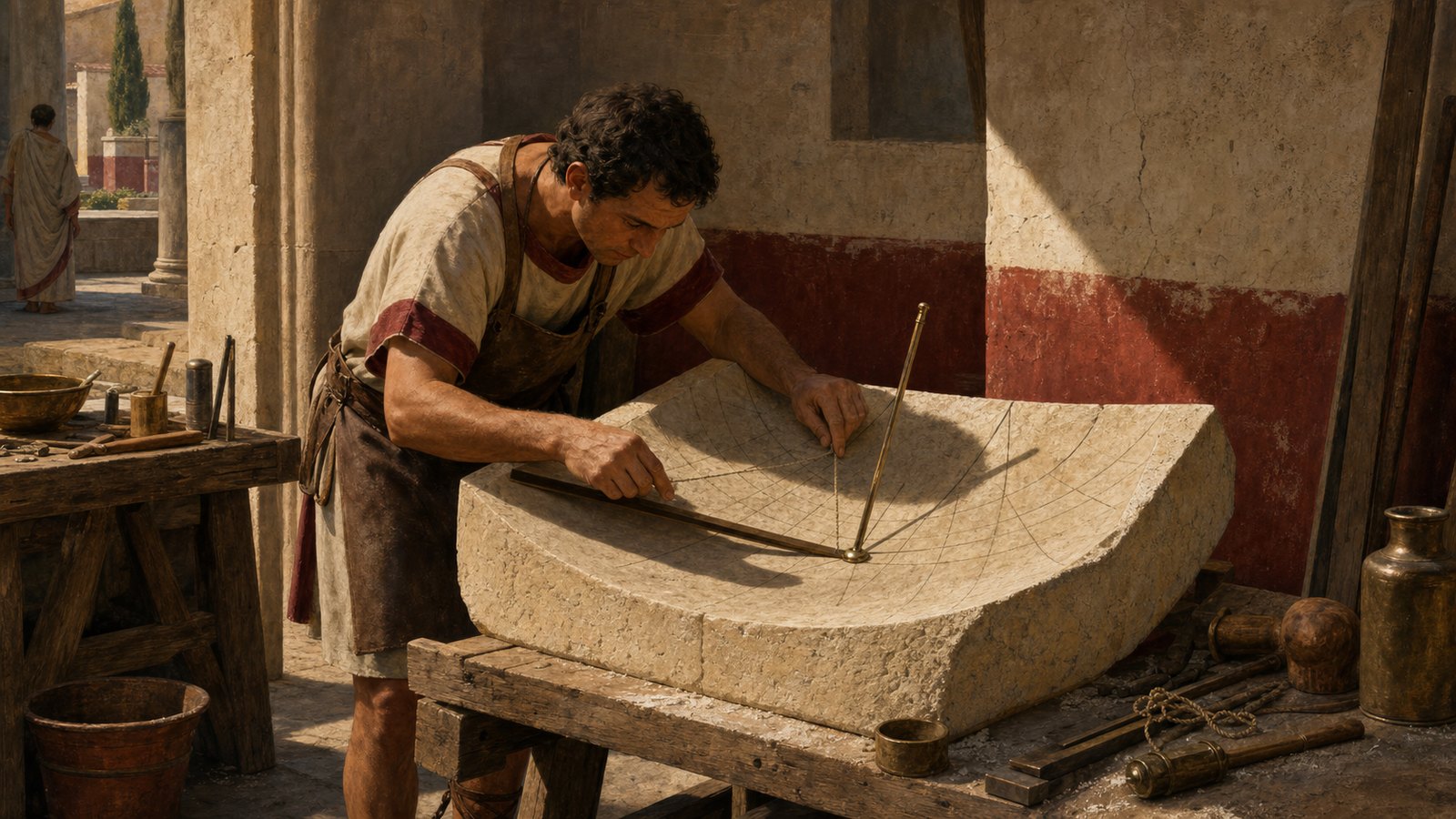
On a flat dial, hour lines spread around the gnomon. On a concave scaphe or hemispherical dial, the shadow traveled across a hollowed surface whose curves represented the sun’s changing path. The object joined sculpture to calculation. Its final simplicity depended on choices about angle, orientation, and geometry made before installation.
Vitruvius devoted part of Book 9 to the sun, the analemma, and types of dials. His discussion reminds us that builders treated timekeeping as an architectural problem. The dial had to meet the sky correctly, just as a doorway met a wall or an aqueduct met a gradient. A beautiful object pointed badly remained a bad clock.
The shadow made each reading immediate. Dust could settle in the grooves, stone could weather, and a bronze pointer could bend, but when the edge of shade crossed a known line, the observer saw the claim directly. Public solar time gained authority from a physical event repeated above everyone’s head.
A captured dial could tell the wrong time
An ancient anecdote preserved in the tradition of Roman timekeeping describes an early public dial brought from Catana in Sicily. It was displayed in Rome, yet the geometry belonged to another place. The mismatch reportedly endured for decades before a dial calculated for Rome provided a better standard.
The story is memorable because it exposes the local nature of a device that seems universal. The same sun illuminated Sicily and Rome, but latitude changed the shadow’s route. Moving a dial without adapting it was like moving a survey line while pretending the landscape had not changed. Stone carried assumptions about place.
A citizen did not need advanced astronomy to notice practical error. Noon shadows, market routines, and other indicators of the day could disagree with the imported lines. Repeated use turned technical mismatch into public knowledge. The community became a long experiment in which daily observation tested an official object.
This makes the corrected dial more than an upgrade. It represented civic calibration: geometry aligned with local sky, and shared practice aligned with a more reliable marker. Rome could appropriate an instrument as booty, but possession alone did not make it accurate. Time refused to become Roman until measurement respected where Rome stood.
A public dial collected strangers around one shadow
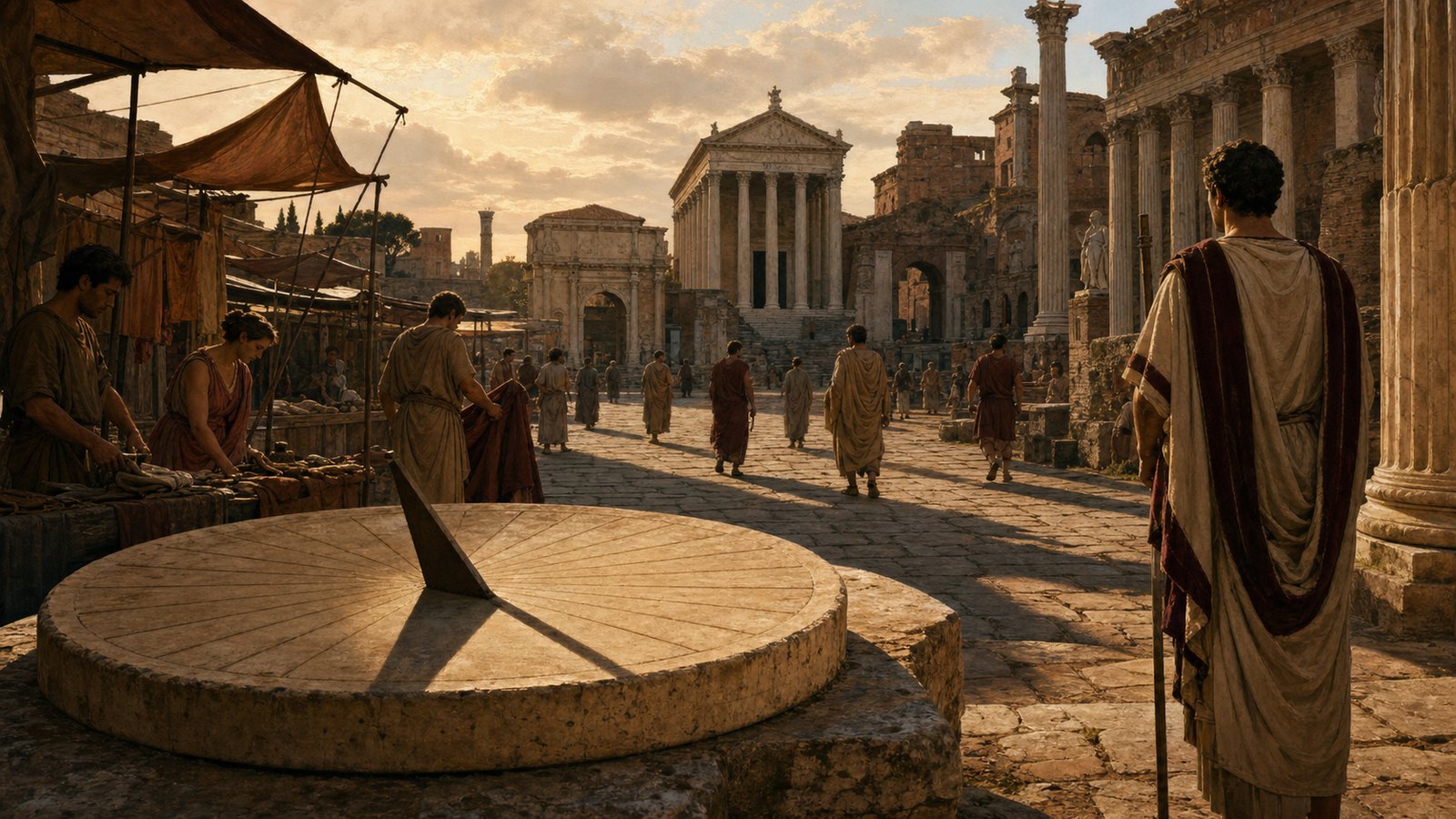
Placed in a forum, bath complex, sanctuary, or other busy setting, a dial served people who did not know one another. Litigants, merchants, messengers, laborers, and clients could consult the same surface. Its value increased because access did not depend on owning a private instrument or trusting one household’s servant.
That common view linked solar time to Rome’s public calendar. The calendar declared which day and legal character applied; the dial located activity inside the daylight of that day. One organized recurring civic sequence, while the other made the sun answer a smaller question: how far has today advanced?
The display also invited conversation. A person might ask someone nearer the stone to read it, complain that a speaker had kept an audience too long, or estimate how much light remained for a journey. Time entered exchange because the evidence was visible. The dial’s shadow became a small shared fact in a crowded place.
Public access did not erase hierarchy. Some people controlled hearings, meals, labor, and gates; others waited for them. A master could tell a client to return at a named hour, and an official could define when business ended. The common clock synchronized unequal lives, giving powerful people another way to distribute everyone else’s day.
Cloud and darkness exposed the bargain
A sundial worked only when direct light produced a readable shadow. Thick cloud softened the edge until the hour lines became uncertain. Night removed the mark altogether. The limitation was obvious to every user, which prevented the instrument from pretending to be independent of nature. Its silence had a visible cause.
Water clocks answered part of that weakness. Controlled flow could measure duration indoors, during speeches, or when sunlight failed. The contrast with Roman water clocks is revealing: one clock asked the sky for position, while the other let liquid accumulate or escape through a prepared vessel.
Neither method delivered modern uniformity without maintenance. A water opening clogged or changed flow; a sundial shifted if its gnomon bent or its mounting moved. Users had to inspect instruments and interpret results. Timekeeping remained craft, not merely possession. Reliability lived in calibration, care, and comparison.
The paired technologies also served different questions. A dial located the community within daylight. A water clock could limit how long an advocate spoke or mark an interval after sunset. Roman time therefore became a toolkit. People selected light, flow, bells, routine, or human announcement according to the problem at hand.
The moving shadow kept civic time honest
A surviving dial is easy to treat as decoration because its users and sunlight are gone. Restore the sequence and it becomes active: morning shadow enters the surface, crosses lines, shortens near noon, lengthens, and finally leaves. Each day redraws the same instrument without producing exactly the same seasonal path.
That repetition trained observation. A frequent user recognized not just an hour line but the speed and direction of change. Someone arriving just before a marker could watch the shadow approach it. Time was not a sudden click. It was a slow visible crossing whose uncertainty narrowed as the edge touched the groove.
The instrument made authority answerable to nature. An official could name an hour, but he could not command winter daylight to equal summer. A badly placed dial could be exposed by the sky itself. The Roman solution was not to eliminate variation, but to draw it carefully enough that a community could coordinate around it.
Roman sundials made an hour change with the season because they divided what the sun actually offered. Their shadows disciplined public life while displaying the limits of that discipline. Stone, bronze, geometry, latitude, cloud, and human agreement all met on one surface, and civic time advanced only while the light allowed everyone to see it.
Sources & Further Reading
- Vitruvius, On Architecture, Book 9
- Smith Dictionary, Horologium
- Sundial overview and references