
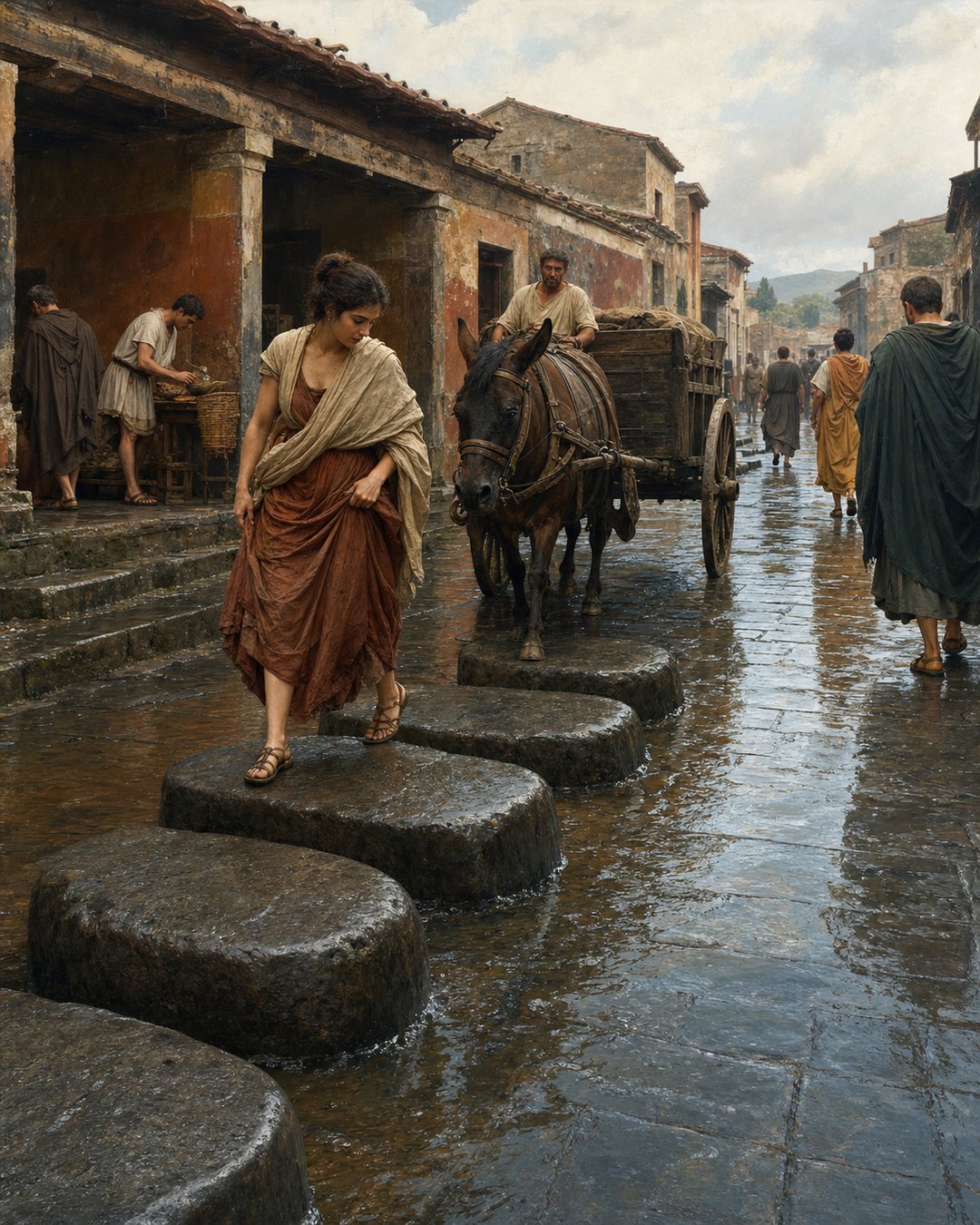
After rain, a Pompeian street did not become an empty ribbon of clean stone. Water followed the lower carriageway, carrying mud, animal waste, spilled food, and workshop debris between high sidewalks. A pedestrian approaching from one side faced a shallow urban channel rather than a modern curb and painted crossing.
Pompeii answered with rock. Large blocks rose from the carriageway to roughly sidewalk height, spaced far enough apart for cart wheels to pass. A person could step across above the runoff, but every crossing imposed choices on feet, hooves, axles, and traffic. These stones made the street crossable by refusing to make it simple.
The street had two different levels
Pompeian sidewalks stand visibly above many carriageways. That height protected doorways and pedestrians from some of the water and grime moving along the center. It also created a break: to reach the opposite side, a walker had to descend into the lower lane and climb again unless a raised crossing bridged the difference.
The carriageway was not only for vehicles. It acted as drainage space when rain fell or water was thrown from buildings and fountains. Its worn blocks received cart wheels, hooves, sandals, refuse, and runoff. The street was infrastructure precisely because it tolerated uses that a clean ceremonial surface could not.
Raised sidewalks changed how frontage worked. A shopkeeper stood above the lane with goods and customers near the threshold, while carts occupied the lower channel. The curb created a small platform for looking, waiting, bargaining, and avoiding traffic. Yet every platform needed points where ordinary movement could cross the stream below.
This vertical arrangement made the street legible. Edge, lane, threshold, and crossing were marked by stone rather than paint. Users learned where to pause and where to step. The design did not separate every traveler safely, but it gave repeated physical form to expectations that strangers could recognize without an official directing them.
The blocks formed a bridge without closing the road
A crossing stone was broad enough to receive a foot but low enough for a careful person to step onto from the sidewalk. Several stones could span a wider carriageway. Their upper faces created a broken bridge: stable points above the wet lane, with open intervals between them rather than one continuous barrier.
Those intervals mattered because carts still needed the street. If the crossing had been a solid raised wall, wheels would strike it. Spaces let wheels travel through while pedestrians used the tops. The same structure therefore solved one movement problem only by preserving a path for another kind of movement.
The compromise demanded alignment. A driver approaching the stones could not choose any line across the street. Wheels, axle width, animal, and load had to meet the available gaps. A pedestrian likewise chose a sequence of blocks instead of strolling diagonally. Fixed rock organized motion by narrowing the acceptable routes through one crowded point.
That organization was never abstract. A wheel could clip an edge; a nervous mule could hesitate; a person carrying a jar could lose balance. Rain polished stone and made every step more deliberate. The crossing helped because it reduced one risk—entering the runoff—while concentrating attention on foot placement and traffic.
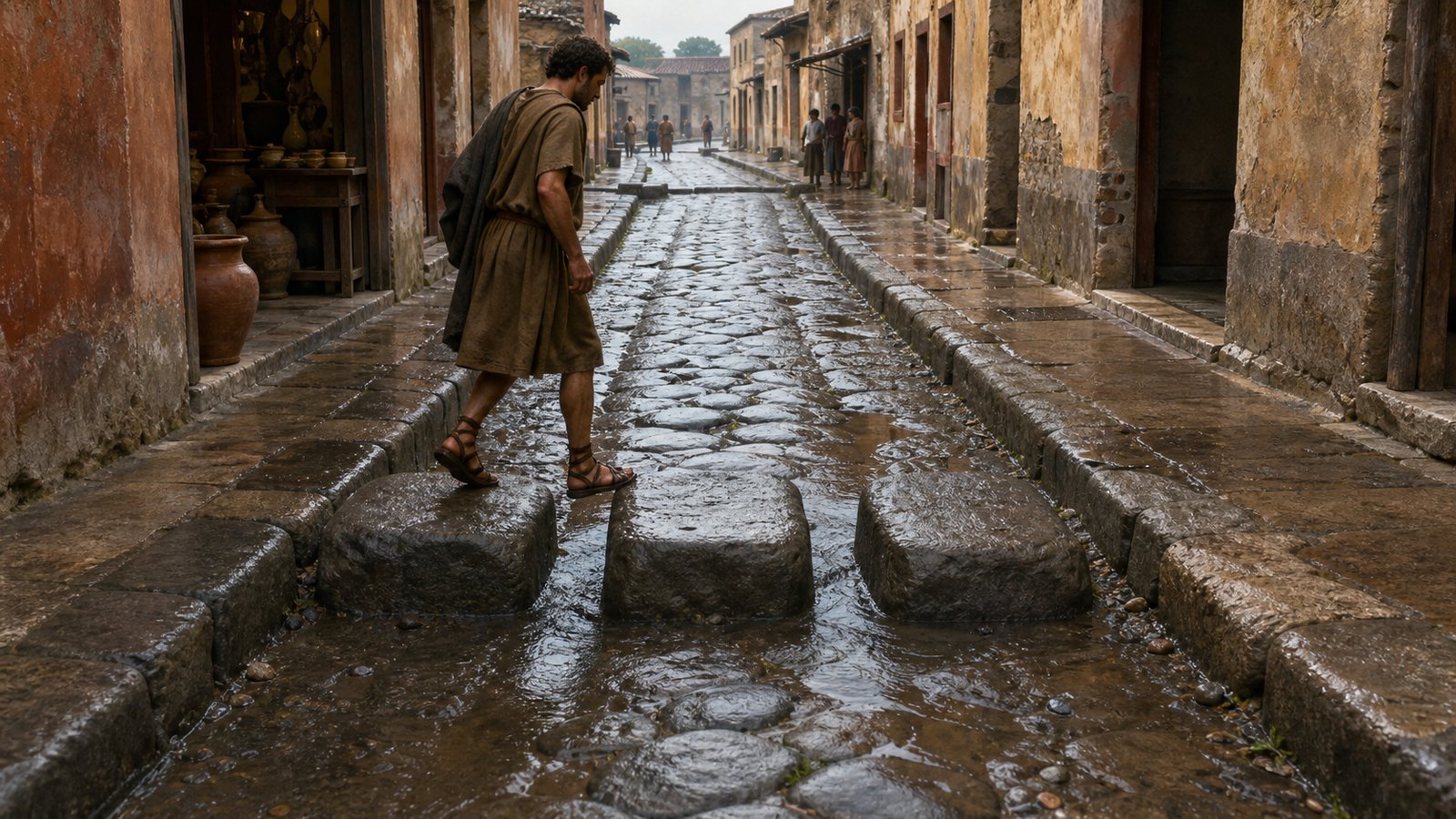
Wheel ruts preserve repeated decisions
Grooves worn into Pompeian paving show that wheeled traffic repeatedly followed particular lines. Not every rut was created by a stepping-stone crossing, and scholars debate what individual traces can prove, but the street preserves an unmistakable history of wheels bearing weight across stone over many journeys.
Near a fixed obstacle, repetition becomes especially informative. Drivers learned which approach worked, and later drivers inherited both the visible gap and the wear left by predecessors. A route could become easier to follow because use deepened it. The city’s traffic pattern was written gradually by iron, timber, stone, and loaded axles.
Ruts were helpful until they became restrictive. A deeply guided wheel resisted turning, and mismatched spacing could make passage awkward. Traffic design therefore emerged from interaction between planned blocks and unplanned wear. Builders supplied geometry; use edited the surface after every cart rolled through.
The evidence brings imperial transport down to street scale. Roman roads connected power across distance, but the final approach to a bakery or house still required a driver to judge one wet crossing. Networks worked only because innumerable local obstacles remained negotiable.
Crossing put pedestrians and carts into conversation
A pedestrian on top of a stone stood briefly inside the vehicle lane. The raised position offered cleaner footing but not complete separation. Someone had to notice an approaching cart, decide who would pass first, and perhaps wait on the curb. Street order depended on attention as much as construction.
Noise supplied warning. Hooves struck paving, wheel rims rattled, animals snorted, and drivers called. Water added its own movement along the guttered lane. A person stepping out from a shop could often hear traffic before seeing around other bodies or hanging goods. The crossing was a point where those signals mattered.
Loads changed the negotiation. An empty cart could stop or turn more easily than one stacked with amphorae. A porter carrying a chest crossed differently from a child or an unburdened citizen. The stones offered equal physical positions, but people reached them with unequal speed, balance, authority, and ability to demand space.
The scene belonged beside Pompeii’s active tabernae. Shops drew customers to street edges, deliveries pushed carts toward thresholds, and conversation spilled onto sidewalks. A crossing did not sit outside commerce. It helped the moving city pass through the very places where business made movement dense.
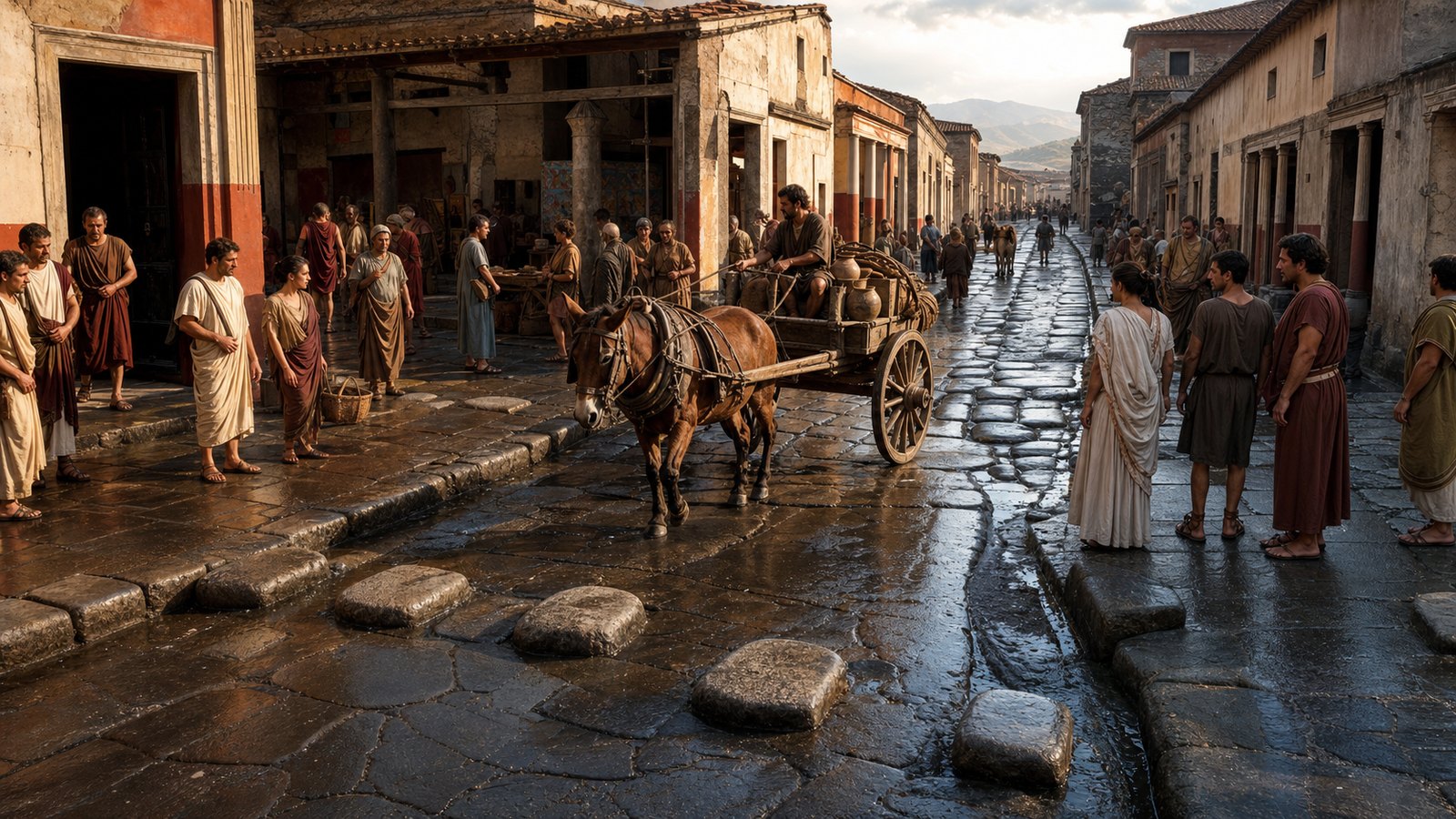
Runoff made cleanliness a route problem
It is tempting to describe the lower street as an open sewer in every moment, but the reality varied with weather, location, cleaning, fountains, animals, and household activity. The safer claim is physical: the carriageway collected material that pedestrians often preferred not to step through, especially when flowing water spread it.
Raised stones answered contact rather than purity. They did not clean the street or remove waste. They let a sandal avoid the lower surface at selected points. This distinction matters because Roman urban engineering often managed consequences locally. A crossing made filth passable without pretending the source had vanished.
The design also protected clothing. Long hems, leather soles, and carried goods could be splashed or soiled during a descent. A sequence of dry upper faces shortened exposure. The benefit was mundane, repeated, and immediately understood. Successful infrastructure sometimes announced itself not through grandeur but through an avoided wet foot.
After a storm, the stones became more legible because water clarified the levels. Runoff moved around their bases while pedestrians gathered at their ends. The crossing revealed the street’s hydraulic logic in miniature: high sidewalks, low channel, interruptions, gaps, and gravity all directed the path of water and bodies.
The eruption froze a moving system
Vesuvius buried Pompeii in 79 CE and preserved street blocks, ruts, curbs, thresholds, and building fronts in an extraordinary urban relationship. The stones survive without the water, noise, animals, and impatience that gave them purpose. Archaeology invites us to restore motion carefully without inventing a single typical day.
One crossing can be measured, photographed, and compared with another. Width, stone count, gap placement, neighboring entrances, and wear differ across the city. Variation warns against imagining one universal Roman traffic code. Pompeii’s streets were built and altered through local needs even while sharing recognizable solutions.
The stones make ordinary users visible through constraints. We rarely know the name of a person who balanced on a block, but the height shows the step required and the gap shows where a wheel could pass. Anonymous movement left dimensions behind. Design preserved a record of bodies because bodies had to fit it.
Pompeii’s stepping stones made the street crossable by turning conflict into geometry. Water needed the low lane, shops needed access, carts needed gaps, and walkers wanted clean footing. No user received the whole street. The crossing worked because stone assigned each movement a narrow place and asked everyone to negotiate the rest.
Sources & Further Reading
- World History Encyclopedia, Pompeii
- Pompeii overview and archaeological references
- Roman roads overview and references