
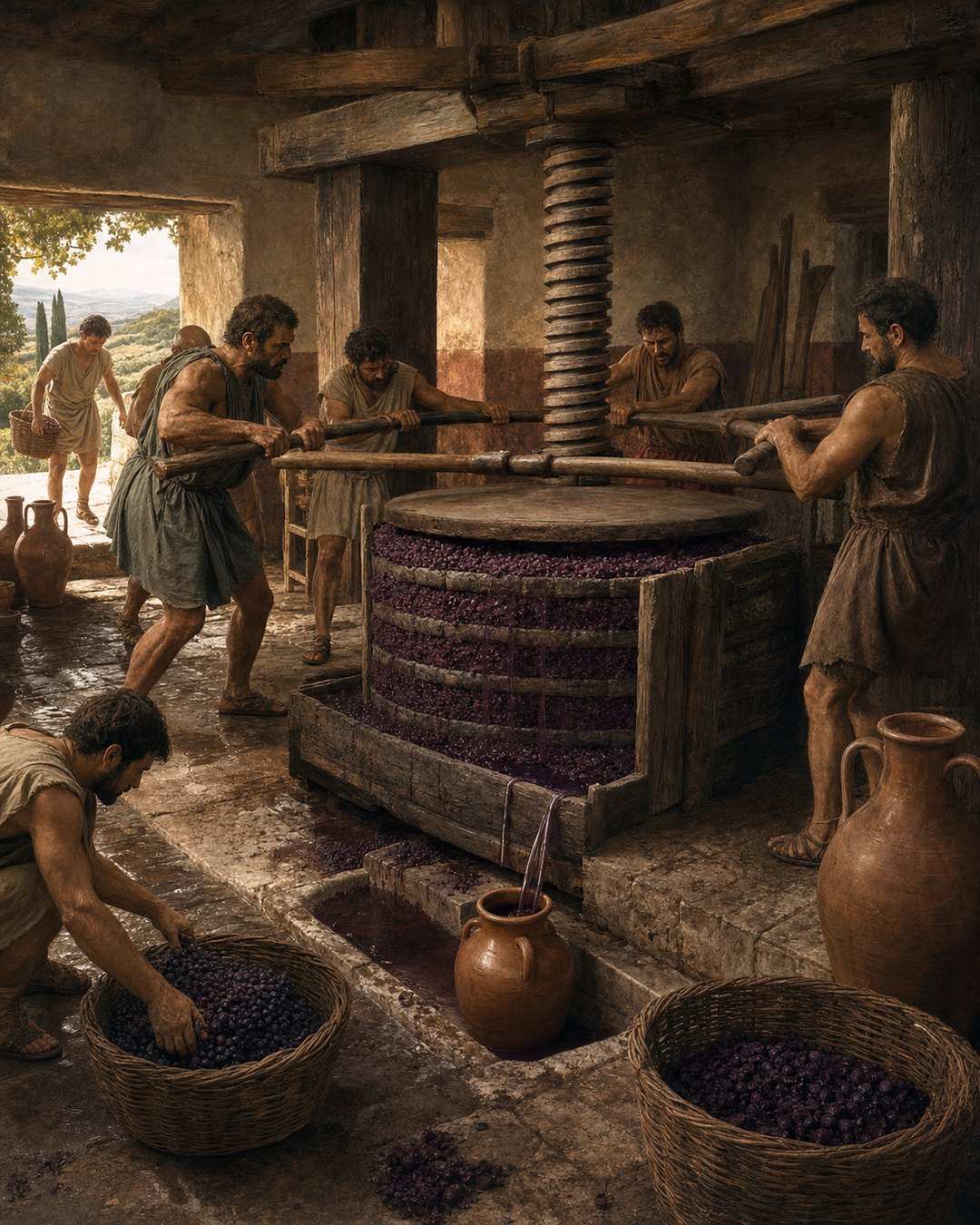
Workers walked a bar around a wooden screw or hauled hand-spakes through part of a circle. The screw turned many times but advanced only a little. Below it, a beam descended or a plate tightened onto grape marc or prepared olive material. Rotation became a short, forceful linear movement, and liquid found its way out while the solid mass resisted.
This mechanism deserves more care than the familiar story of one brilliant invention replacing a primitive machine. Pliny the Elder described rope-driven lever presses, lever-and-screw arrangements and a compact direct-screw form. Archaeology shows that these solutions overlapped and varied by region. The screw’s achievement was narrower and more interesting: its thread let workers approach, hold and renew pressure in small increments, using a rigid structure to push back against the harvest.
The thread traded distance for a harder downward movement
A motion screw is a helical inclined plane wrapped around a shaft. When its male thread turns inside a matching female thread, relative rotation produces travel along the axis. The pitch determines how far the screw advances in one revolution. In an agricultural press, a worker’s hands could cover a broad circle while the working end moved only a short distance toward the fruit.
Roman press screws were generally large wooden components. EXARC’s survey distinguishes fastening screws from motion screws, which transmit mechanical power, and identifies V-form threads in direct vertical presses for wine and oil. A usable agricultural thread needed a corresponding nut and enough regularity to keep advancing under load rather than jamming or tearing its wooden ridges.
The principle resembles the rotation in the Roman water screw, but the job is different. A water screw moves pockets of liquid along a helix. A press screw makes the threaded shaft and nut move axially relative to each other. That short travel is then delivered to a beam or plate, where a strong frame prevents the mechanism from merely pushing itself apart.
Roman workshops built two different arguments around the screw
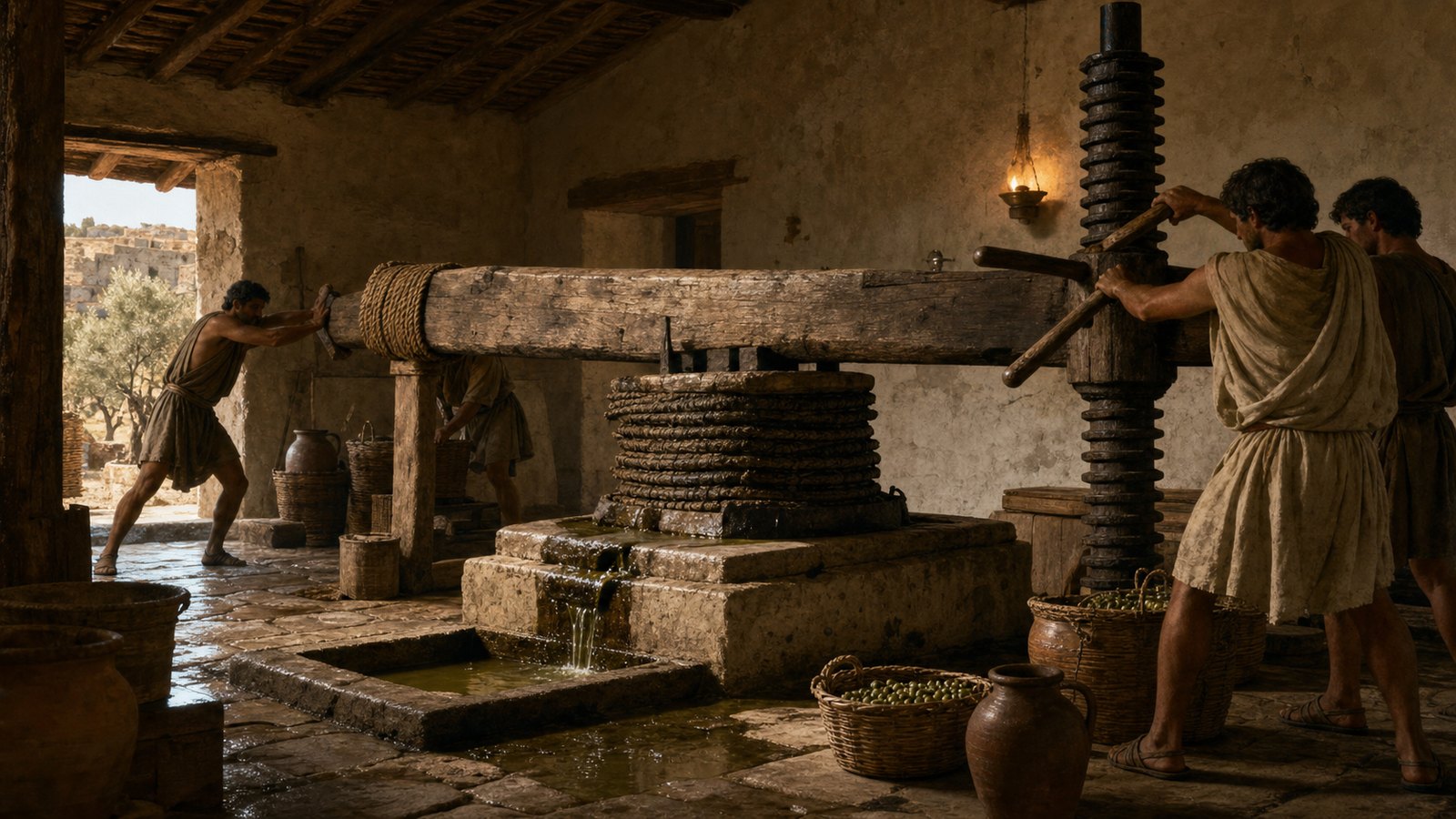
In a lever-and-screw press, the screw did not usually bear straight onto the fruit. It controlled a long press beam. Pliny describes arrangements in which a threaded rod helped lower and raise that lever; one version involved a fixed mechanism, while another raised boxes of stone with the rod. The screw became one element in a chain connecting hands, counterweight, beam and pressing surface.
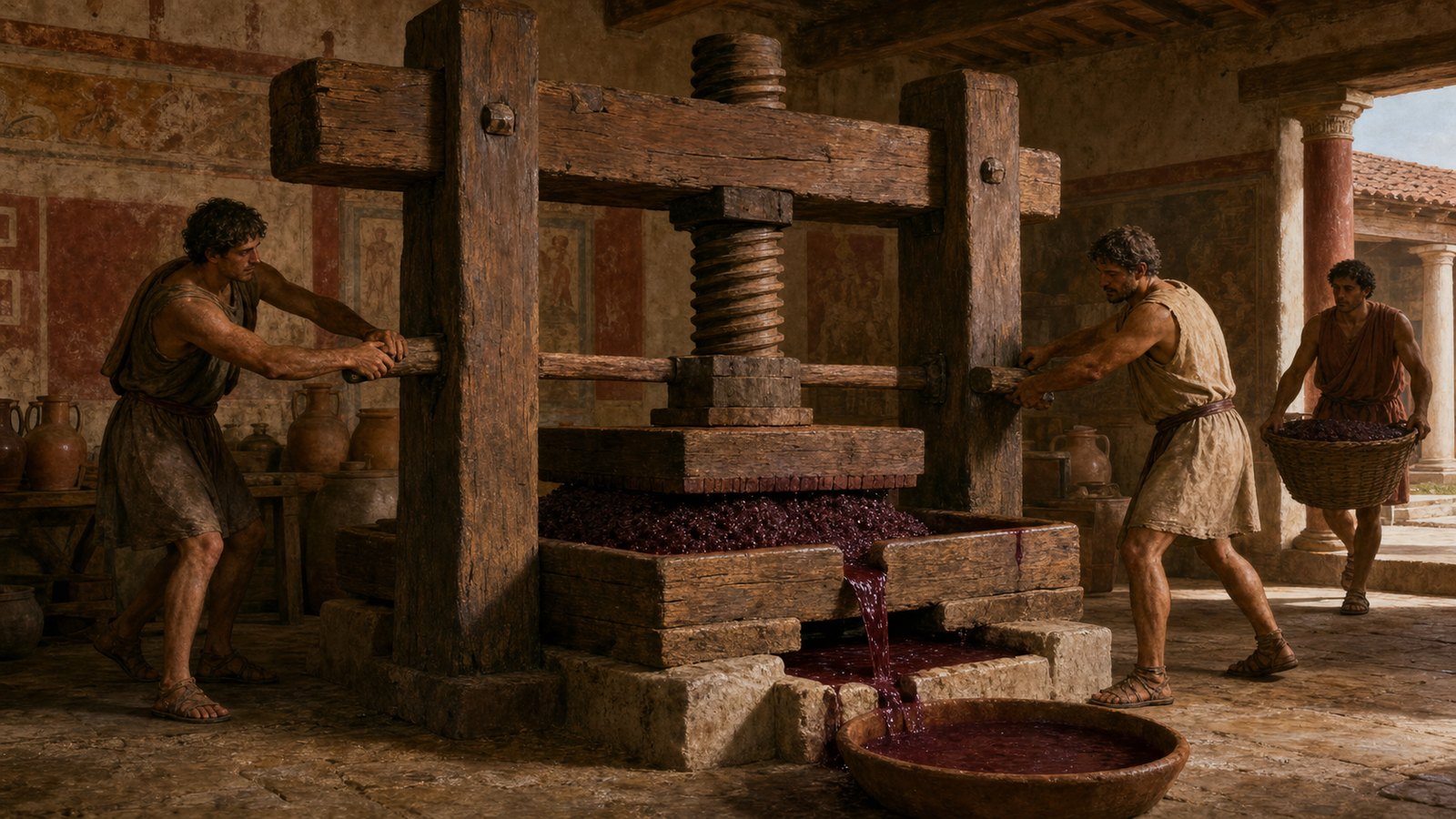
The direct-screw layout removed the long beam. A shorter central screw acted on a board or plate placed above the pressed material. Museo Galileo notes that reconstructed screw presses may have one central shaft or two parallel vertical shafts within a wooden structure. The direct arrangement could occupy a smaller building, but compactness did not automatically make it the strongest answer.
Both layouts required something massive and well joined to react against the load. Force directed downward onto fruit creates an equal demand on the upper crosspiece, uprights and bed. The press was a system, not an isolated screw. Good threads accomplished little if the nut split, the frame spread, the beam twisted or the press bed failed to guide liquid away.
Pressure began only after the harvest had changed form
Grapes could be trodden before their remaining solid matter went under the press. Burton and Lewit explain that Pliny’s vinacea, or marc, included skins, pips and stalks together with juice still held among them. Pressing targeted what treading had left behind. It treated the harvest as a porous mass from which more liquid could be expelled by reducing the spaces inside it.
Olive processing likewise separated crushing from pressing: the fruit first had to become a paste that could release oil and watery juice under load. The screw did not grind intact olives merely by descending. Its role was to compress prepared material, often contained or layered so solids stayed together while liquid escaped. Grapes and olives differed as materials, yet both demanded a path for liquid and a way to keep fragments from spreading beyond the pressing surface.
The products then entered other equipment and longer routines. Wine could move toward fermentation and storage in the huge ceramic vessels explored in the Roman dolia article; oil required settling and separation after pressing. The screw press was decisive at one boundary, between a wet solid mass and a collectable flow, but it was never the whole production process.
Each pause in the flow asked for another turn
At first contact, the plate met a relatively loose load and liquid could run readily. As the mass compacted, its thickness fell and resistance changed. A fixed screw position did not guarantee identical pressure throughout the cycle. The scholarly reassessment of Pliny cites Hero’s observation that direct-screw pressure was neither automatically continuous nor always equally strong: operators had to add turns from time to time to renew it.
That detail restores workers to the machine. They watched the runoff, felt resistance at the hand-spakes and decided when another partial revolution was worthwhile. Tightening too little left liquid in the mass; demanding movement after the load had become stubborn increased stress on thread, nut and frame. The operating rhythm was consequently a conversation among flow, effort and the condition of wooden components, not a single dramatic pull followed by passive waiting.
Release mattered too. Once a pressing was finished, the screw or lever had to rise far enough for the spent material to be removed and a new charge arranged. Reversible threaded travel made controlled reopening possible. The same handle path that had approached the load could retreat from it, while the press structure stayed in place for another batch.
The smaller press did not erase the long beam
Older histories often arranged Roman presses as a tidy sequence: rope and lever, then lever and screw, then a supposedly superior direct screw. The evidence is less linear. Burton and Lewit stress that direct-screw presses did not replace lever presses across the Empire, and that lever forms remained dominant in many settings. A screw could make operation easier or more secure in a particular design without guaranteeing more output or faster pressing everywhere.
Scale and space changed the choice. Pliny emphasized the smaller press, shorter screw and smaller press building of the direct form. A long lever-and-screw installation demanded more room but used beam length to magnify force. A compact direct press saved that footprint while giving up the long lever’s advantage. The appropriate machine depended on crop, desired capacity, available structure, labor, local building practice and the cost of maintaining large accurately threaded wood.
The archaeological map is correspondingly diverse. The Oxford Roman Economy Project records more than 750 oil and wine presses at over 140 sites, while researchers caution that provincial traditions did not all follow one route. Like the Roman workshops behind other crafts, pressing installations embodied local knowledge. “Roman screw press” names a family of mechanical choices, not a single standardized model shipped unchanged to every estate.
A slow rotation made crushing pressure manageable
The screw’s value lay in control as much as force. A worker could divide the descent into fractions of a turn, stop while liquid drained, then tighten again as the mass settled. The thread held the geometry of that movement in the machine. Operators could return to the same circular path and know that rotation would alter the axial position.
Yet every gain remained physical and finite. Human or animal effort supplied the input; friction consumed part of it; wood carried compression, tension and shear; the frame reacted against the load. The machine concentrated work at the plate because its users traveled farther around the screw than the plate traveled downward. Its impressive pressure was therefore an exchange governed by geometry and construction, not a mysterious multiplication without cost.
A Roman screw press turned a harvest into a sequence of readable states: loose material, first contact, free flow, compacting mass, renewed pressure and release. That sequence joined an abstract helix to the practical judgment of people watching wine must or olive liquid leave the bed. The screw did not conquer every rival design. It gave Roman producers a durable way to make a small descent deliberate, repeatable and crushingly effective.
Sources & Further Reading
- Paul Burton and Tamara Lewit, “Pliny’s Presses: the True Story of the First Century Wine Press”
- David Sim and Chris Legg, “The Production of Roman Metal Screw Threads,” EXARC Journal
- Olive Oil and Wine Presses Database, Oxford Roman Economy Project
- “Screw press,” Museo Galileo