
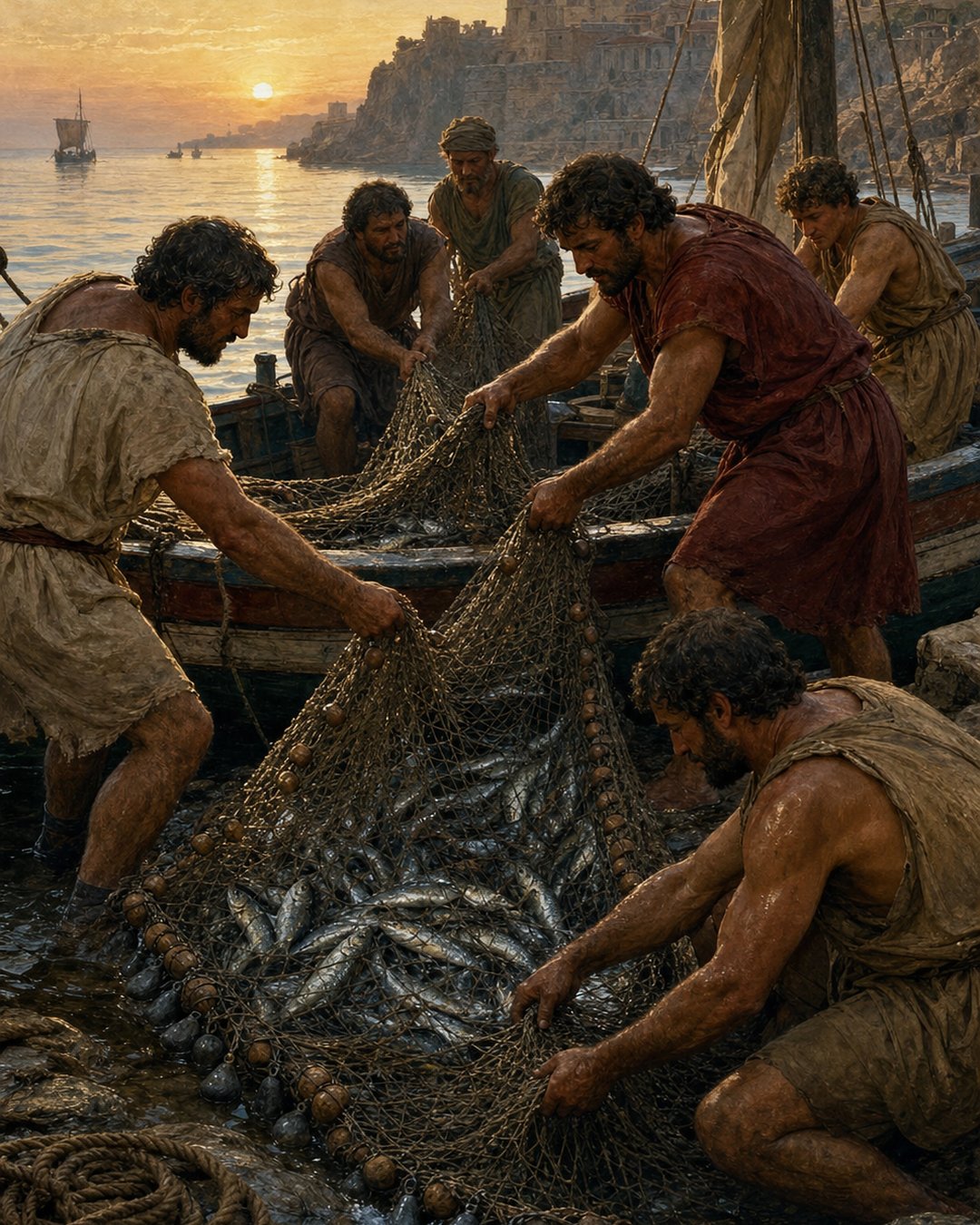
Before sunrise, a Roman fishing crew could already be handling hundreds of decisions hidden inside one dark shape in the water. The net had to open rather than tangle, its upper edge had to float, its lower edge had to sink, and the boat had to move so current and wind helped the mesh instead of folding it uselessly beneath the hull.
The Mediterranean supplied fish, but it did not hand them to the market. Fishermen learned shorelines, depths, seasons, weather, and the habits of particular species. They made and repaired fiber lines, attached cork floats and lead weights, carried baskets and hooks, and coordinated bodies in a confined wooden boat. A successful haul began long before the first silver flash appeared.
Roman art, texts, fish bones, hooks, net weights, harbors, salting installations, and market evidence preserve parts of this work. The picture is varied rather than uniform: a person angling from a rock, a small coastal crew, and a larger commercial operation solved different problems. Their common task was to turn moving water into a temporary, measurable workplace.
A Net Was Built from Repeated Knots
Fishing mesh converts many weak lengths of fiber into one broad catching surface. Each knot fixes the distance to its neighbors, creating openings small enough to restrain the intended catch while allowing water to pass. If the mesh were solid cloth, dragging it would demand far greater force and the current would push it out of shape.
Plant fibers had to be spun into cord, knotted to consistent dimensions, joined into panels, and inspected constantly. Salt water, abrasion, rocks, struggling fish, and storage while damp all damaged the material. A tear ignored at the quay could widen under load and release the catch at the moment the crew worked hardest.
The repetitive craft parallels the tension management in our article on Roman looms, but a net was judged in water rather than on a frame. Its geometry had to remain useful while the entire surface flexed, twisted, sank, and rose.
Floats and Weights Gave the Mesh a Vertical Shape
Cork attached along the headline supplied buoyancy. Stone, ceramic, or lead weights along the lower line pulled downward. Between them, the net formed a wall, pocket, or encircling curtain according to its design and handling. The balance mattered: too little weight let fish escape beneath; too much could drag the gear into the bottom.
Archaeologists often recover sinkers more readily than fiber because metal, stone, and fired clay survive after cord decays. Rows of perforated or folded weights can indicate net fishing, though a loose weight outside context does not reveal the complete rig. The vanished mesh must be reconstructed from durable edges and comparative practice.
This is a useful reversal. The visually dominant part of the tool is usually lost, while its small attachments remain. A museum case of lead pieces can look unimpressive until we imagine each one spaced along many meters of wet cord, collectively holding the lower boundary where the fisherman intended it.
The Boat and Crew Moved as Part of the Tool
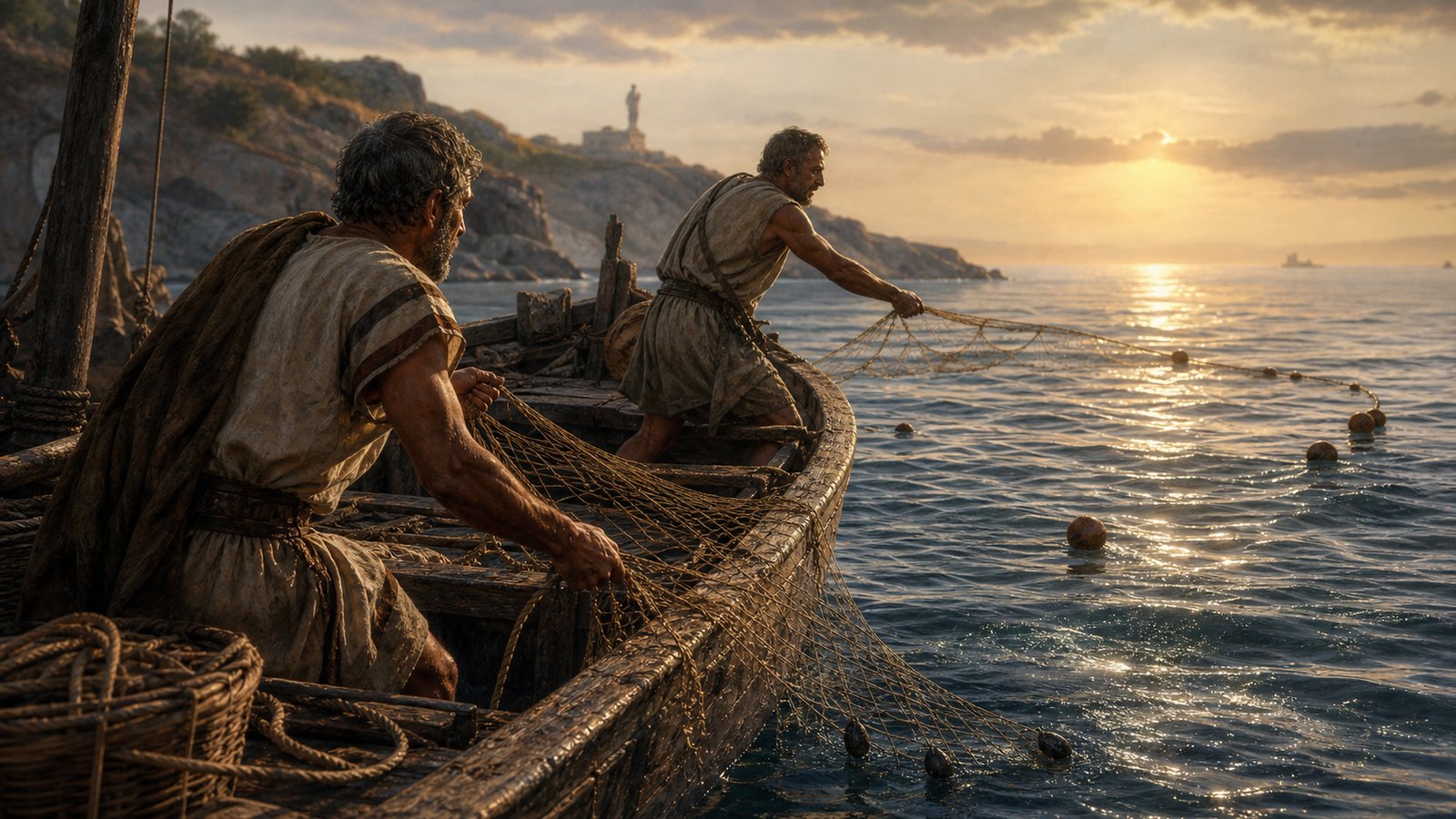
A casting net used from shore or a boat demanded a spread that opened in the air and settled around fish. Other nets were set, dragged, or drawn between points. Roman terminology and images do not always allow one exact modern label, but they consistently show that deployment mattered as much as material.
On a small boat, one person could manage heading and oars while others paid out line, watched floats, and prevented coils from snagging feet. Hauling reversed the sequence under greater weight. Wet mesh, catch, weeds, and water created a shifting load that could unbalance the hull if everyone pulled without coordination.
The active stopping described in our article on Roman anchors has a smaller cousin here. Boat position was never passive. Wind and current continuously altered the relation between crew, gear, seabed, and fish; correction was part of every stage.
Hooks Solved a Different Capture Problem
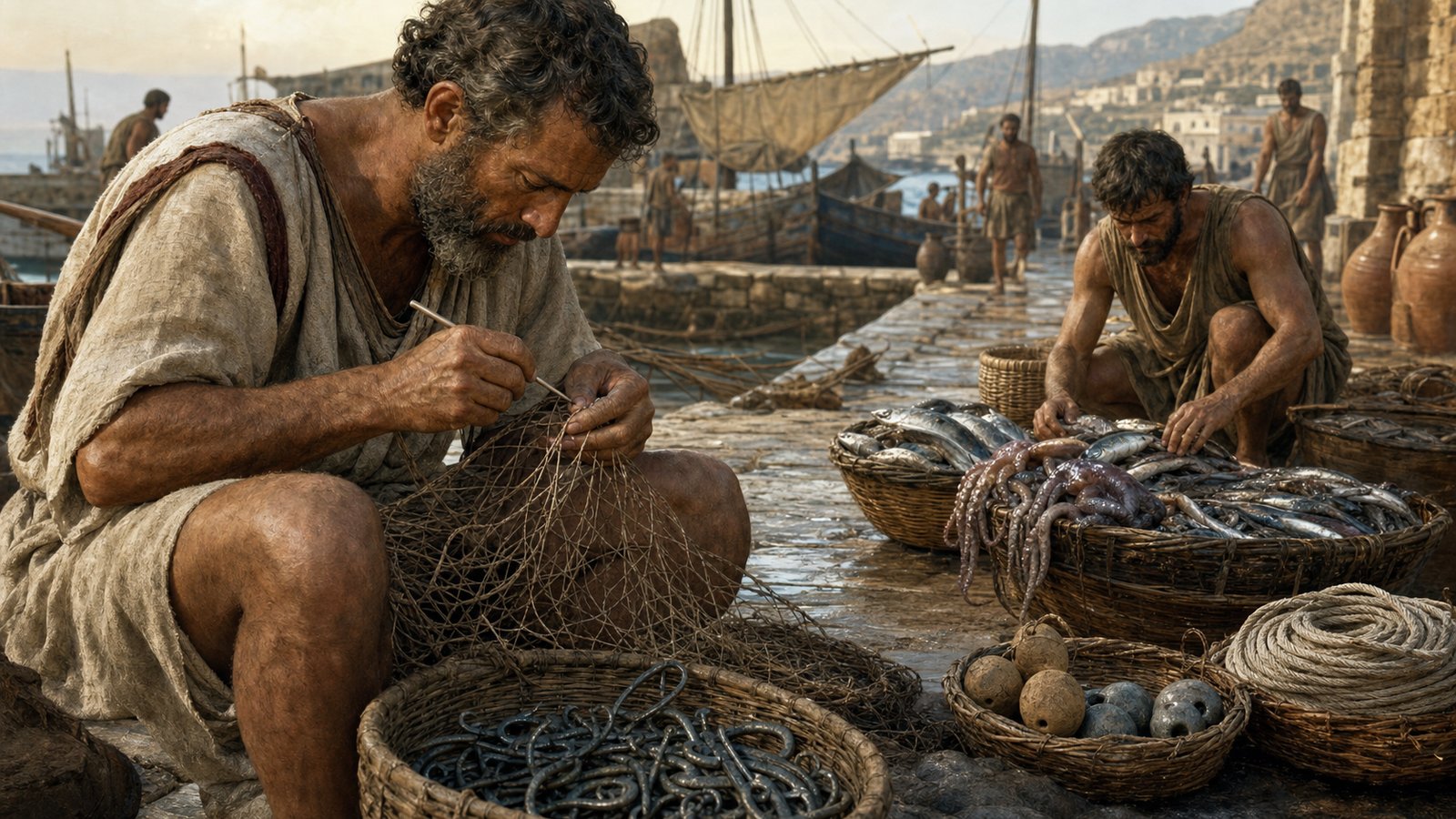
Bronze and iron hooks allowed fishermen to target individual fish with line and bait. Shape, size, point, and the strength of the line had to suit the quarry. A hook could work from shore, pier, or boat and required far less fiber than a large net, but it exchanged broad coverage for patience and selective skill.
Surviving hooks vary from tiny forms for small fish to robust examples capable of holding larger animals. Their resemblance to modern hooks makes them immediately legible, yet context still matters. Corrosion changes points, lines disappear, and an isolated hook cannot tell us the bait, depth, season, or person who used it.
Net and hook were not rival technologies. A household or crew could use several methods as weather and opportunity changed. Traps, baskets, spears, and gathering in tidal or shallow zones expanded the repertoire. Local expertise meant knowing which method fit this piece of coast today, not defending one tool in every condition.
The Catch Began Spoiling as Soon as It Left the Water
Fresh fish linked capture to speed. Heat accelerated decay, so crews sorted the haul, removed damaged or unwanted material, and moved saleable fish toward households, cooks, taverns, and markets. Coastal communities could eat fish quickly; distant consumers required salting, drying, smoking, or processing into sauces.
The famous fermented sauce discussed in our article on garum used parts of the marine harvest in a durable, transportable product. It should not make every Roman fishery look like a sauce factory. Fresh table fish, preserved fish, bait, and local consumption created overlapping markets.
Species and status shaped price. Large or unusual fish could become elite display foods, while small fish fed ordinary demand or entered preservation. Literary stories about extravagant purchases reveal moral theater as much as typical diets. Bones and processing sites provide a less dramatic record of repeated catches moving through communities.
Fishing Knowledge Lived in Places and Seasons
A fisherman had to read signs that rarely survive in an artifact: bird activity, water color, a wind turning offshore, the approach of a seasonal shoal, the roughness above a reef, or the depth at which a species fed. Memory tied those observations to decisions about departure, gear, and risk.
The Roman Mediterranean was connected but environmentally diverse. Atlantic coasts, lagoons, rivers, lakes, rocky islands, and sheltered bays supported different techniques. Imperial trade could move preserved products far away, yet capture remained intensely local. A net designed and handled for one shoreline might perform badly on another.
Fishing also carried danger disproportionate to the size of many boats. Sudden weather, overloaded gear, night work, sharp hooks, entangling line, and a rocky landing could turn routine labor into emergency. The sea was a source of food only while crews continually managed the possibility of becoming part of its losses.
The working calendar reached onto land. Calm hours could be spent mending rather than sailing; a damaged boat demanded timber and pitch; missing sinkers had to be replaced before the next set. Families and neighbors could participate in cleaning catch, carrying baskets, repairing cord, or selling fish. The boat’s visible crew belonged to a wider coastal labor system whose busiest moments followed the hull back to shore.
A Roman net therefore deserves to be seen as more than a rustic prop. Fiber, knots, cork, sinkers, rope, hull, human timing, and ecological memory formed one temporary machine. When the crew hauled it aboard, they were not simply collecting nature’s surplus. They were closing a carefully built shape in water.
Sources & Further Reading
- World History Encyclopedia, “Food in the Roman World”
- Encyclopaedia Britannica, “Fishing Tool”
- World History Encyclopedia, “Fishing”
- The Metropolitan Museum of Art, “Fishing in the Ancient Mediterranean”