
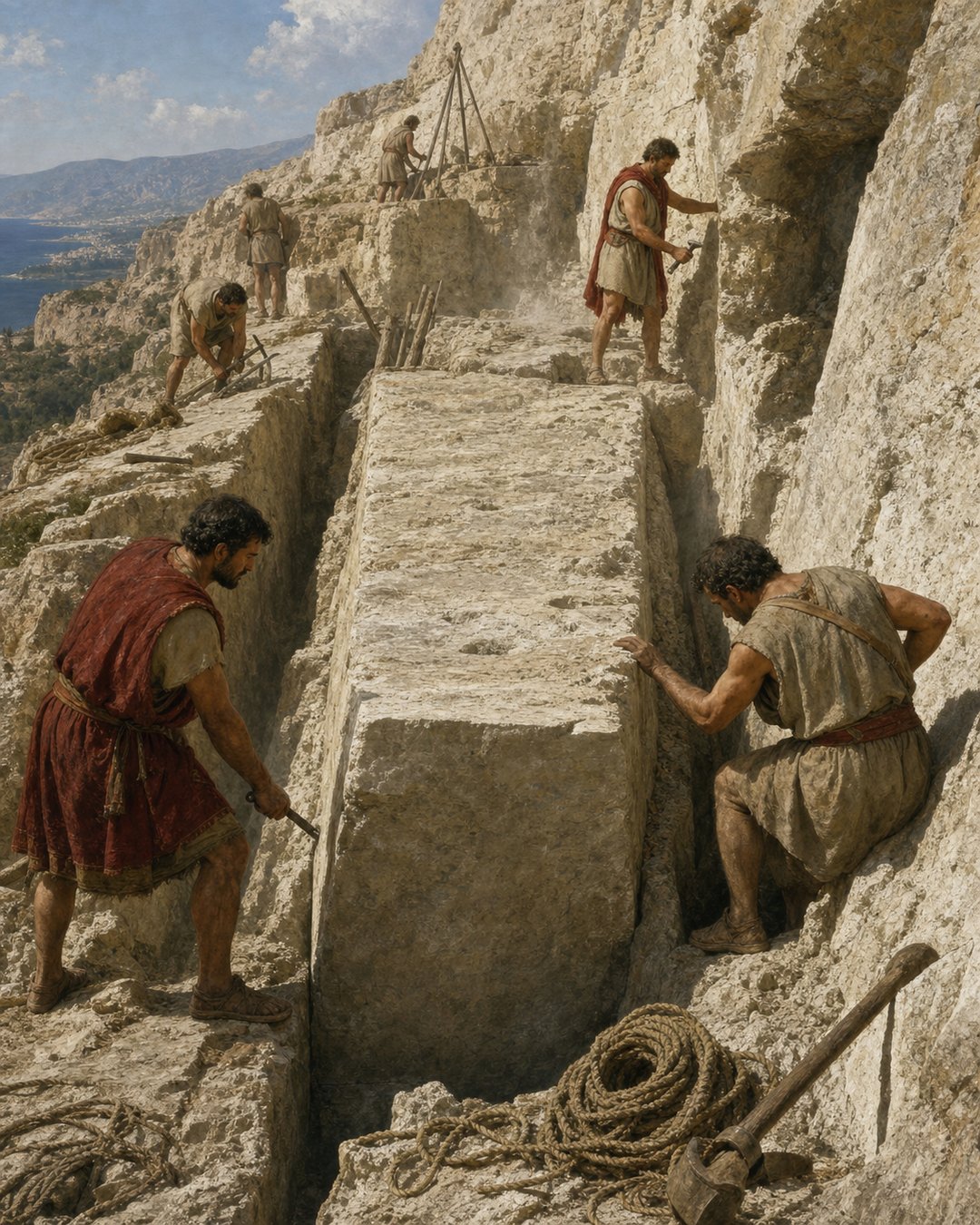
A Roman quarryman faced a problem larger than any finished column. The useful stone was still joined to a hillside, and every cut invested labor in a block that might crack the wrong way. Before carts, cranes, masons or architects could claim it, workers had to persuade a chosen volume of rock to separate along planned boundaries rather than its own hidden weakness.
The operation began with judgment. Bedding, color, grain, old fractures and the sound under a hammer helped determine where effort might produce a sound block. Channels isolated its sides; picks and chisels deepened the separation; rows of wedges concentrated pressure along a line. Once the stone broke free, rough dressing removed needless weight and exposed defects before an expensive journey began.
This was not brute strength applied to a mountain. It was controlled fracture followed by controlled movement. The quarry converted geology into dimensions, surfaces and attachment points that later crews could understand. A temple front might make stone look inevitable, but every block carried the memory of a moment when nobody yet knew whether the rock would leave the bed whole.
The Face Had to Be Read Before It Was Cut
Quarrying started by selecting stone, not striking at random. Sedimentary layers offered bedding planes; volcanic and metamorphic rocks presented different grains, joints and faults. Weathered surfaces could conceal a fresher interior, while a hairline flaw could travel deep enough to ruin a long architectural member. Experienced workers learned to treat the face as evidence of how the rock had formed and how it might fail.
Ancient authors distinguished building stones by locality and performance. Vitruvius discussed selecting materials with attention to how they endured weather and load. His architectural advice does not provide a daily quarry manual, but it confirms that stone was not interchangeable. A block suitable for an interior veneer might be a poor choice for an exposed lintel.
The geological decision continued after selection. Quarry crews planned around the shape required downstream. A column shaft, paving slab and wall block demanded different proportions and tolerated different imperfections. The standardized ambition visible in Roman building supply began here as a practical conversation between natural seams and ordered dimensions.
Channels Drew the Future Block Inside the Mountain
Workers isolated a block by cutting narrow trenches along intended sides. Picks removed larger chips; point chisels focused blows; iron tools had to be sharpened repeatedly as stone blunted their edges. The channel needed room for the tool and the worker’s hand, yet every extra finger-width represented rock removed without entering the finished building.
Tool marks preserved on abandoned faces show repeated strokes and staged extraction. Negative spaces can reveal blocks that left the quarry, while half-finished cuttings preserve the sequence more clearly than successful work. Archaeologists therefore read a quarry as both industrial landscape and ledger: faces, spoil heaps, roads, unfinished pieces and tool scars record decisions the final monument hides.
Depth mattered. A shallow outline produced no release, while uneven channels encouraged a fracture to wander. Workers kept the intended block connected at selected points until they were ready to split it. The rock was gradually transformed from continuous bed into an object with three visible boundaries and one remaining attachment.
Wedges Turned Small Hammer Blows into a Long Crack
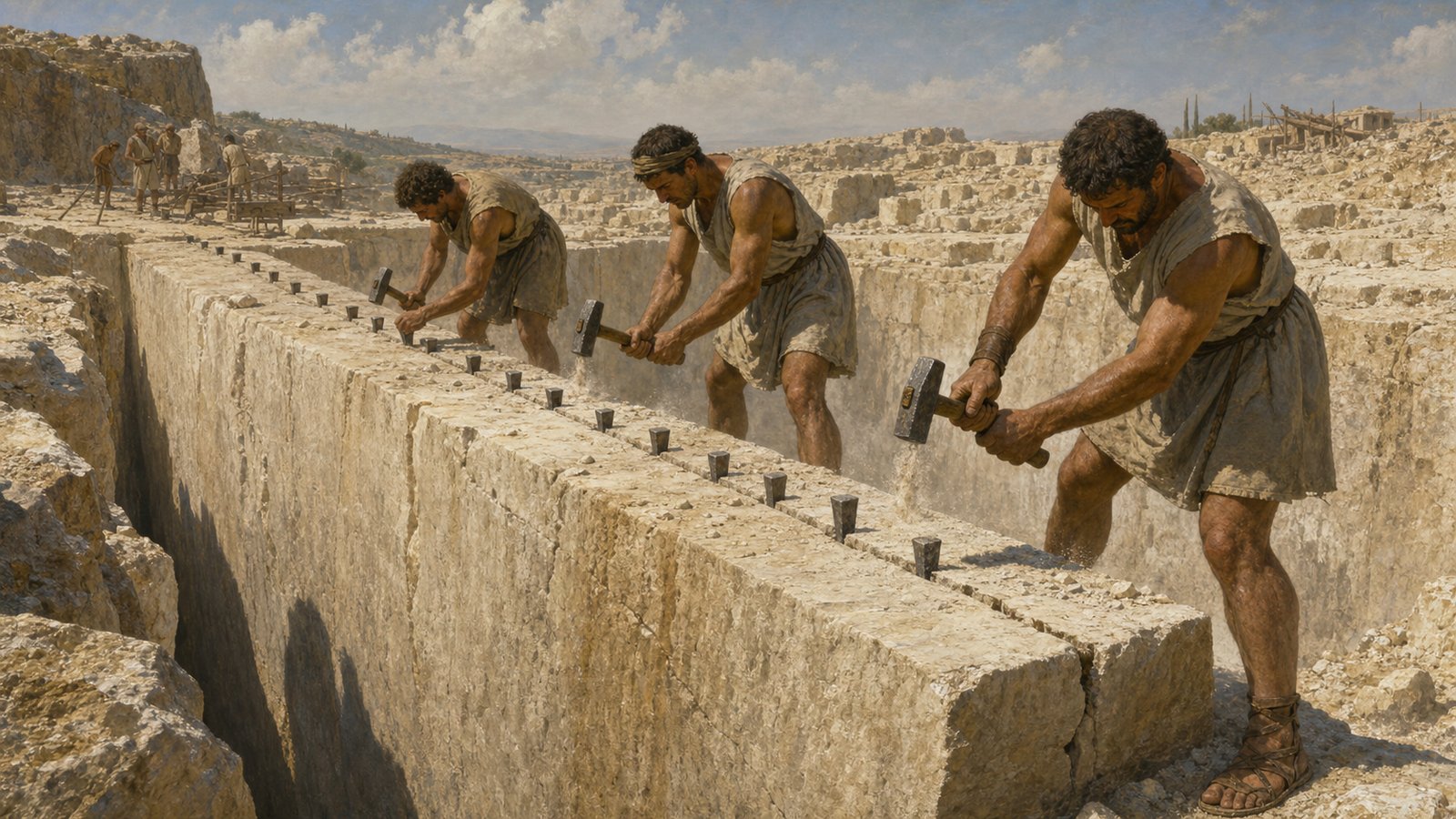
A row of prepared slots allowed wedges to distribute force along a chosen line. Each hammer blow pressed metal or dry wooden elements against the sides of a hole. Worked in sequence, the wedges built tensile stress through stone that resisted direct compression. The goal was not to pulverize the bed but to make one crack connect the slots.
The method rewarded patience and rhythm. Driving one wedge too hard could start a local fracture toward the valuable center. Moving along the row let pressure accumulate more evenly. In some traditions wooden wedges could be wetted so swelling added gradual pressure, though the exact method varied with stone, period and quarry. Iron wedge marks provide firmer archaeological evidence than a universal recipe.
This conversion of modest repeated effort into a much larger effect resembles the mechanical logic of Roman screw presses. The machines were different, but both controlled where force entered a resistant material. Skill appeared in the fracture line: a clean release preserved months of possible value; a bad one converted the same labor into rubble.
The First Dressing Happened Before Transport
A freshly detached block carried projections, rough crust and sometimes a margin of questionable stone. Quarry dressers squared major surfaces and removed obvious excess before haulers paid to move it. They could leave protective bosses or extra material where later finishing required certainty. Final polish belonged closer to installation, after transport had introduced its own chips and scars.
Rough dressing also tested the result. New blows could expose a hidden cavity, fossil band or fracture missed at the face. Discovering that weakness beside the quarry was cheaper than finding it after a sea voyage. Rejected and unfinished blocks scattered through ancient quarry districts show that extraction did not guarantee acceptance.
Masons marked or organized pieces so their intended role survived handoffs. Not every mark has one meaning; some indicate crews, measurements or assembly positions. Together with dimensions, they made the block legible to people who had never seen its place in the bed. The quarry was already preparing information as well as stone.
Sockets, Sledges, and Roads Began the Block’s Second Problem
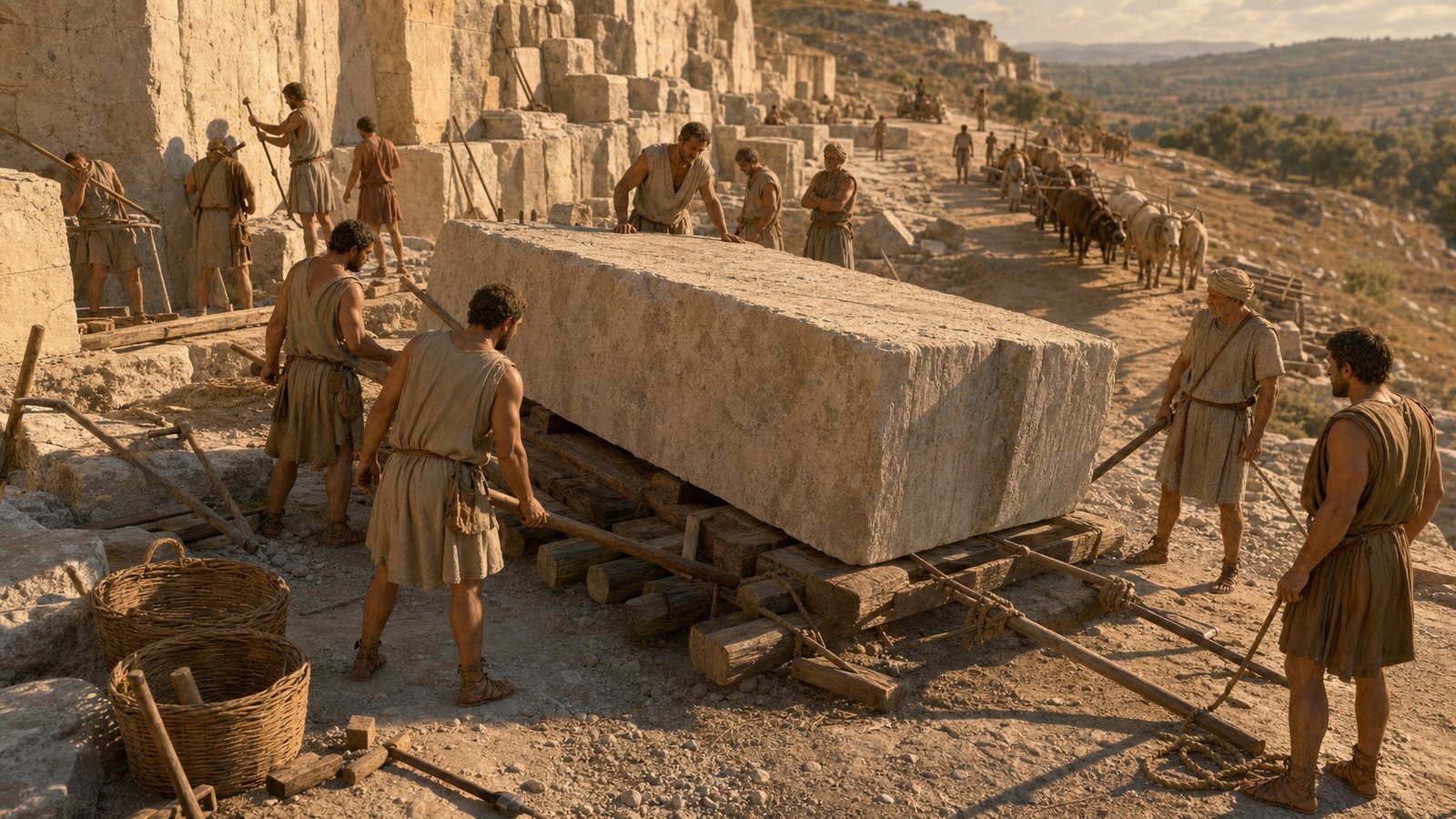
Once free, the stone became a transport load. Levers raised it enough to insert rollers, cribbing or a sledge. Ropes and lifting attachments had to grip without damaging edges. Lewis holes and other sockets could accept metal fittings for controlled lifting, but their form and use depended on context and the stage of dressing.
Quarry roads favored manageable gradients because stone punished every rise and sudden turn. Teams of people and draft animals pulled while others checked movement with ropes, chocks and levers. The Roman crane could multiply lifting power at a building site, yet it still depended on a block arriving with sound attachment points and dimensions within its capacity.
Distance reshaped cost. Local stone could supply ordinary walls in large volume; colored marbles and prestigious stones justified elaborate routes to river or sea. The empire’s celebrated material variety therefore rested on unglamorous infrastructure around quarry faces: ramps, tracks, loading grounds, animals, timber and crews trained to stop a moving mass.
The Monument Concealed the Riskiest Decision
At the building, joints and polish encouraged viewers to see architecture rather than extraction. Columns appeared to stand naturally in ordered ranks. In reality, each successful piece was the survivor of selection, channeling, splitting, dressing, hauling and lifting. Waste remained at the quarry so finished Rome could seem composed entirely of usable stone.
The system had hard limits. Tools wore out, transport failed, blocks cracked and quarry labor was physically dangerous. Workers included enslaved, condemned and free skilled people in different places and periods; one label cannot describe every crew. Expertise remained indispensable because coercion could supply bodies but not automatically the judgment required to preserve valuable material.
A Roman quarry split a mountain into movable blocks by changing the scale of the problem. Workers did not lift the hillside. They drew one object inside it, directed a crack around that object, removed weight, provided grips and negotiated every meter toward transport. Imperial stone began not with grandeur but with a controlled refusal to let rock break wherever it pleased.
Sources & Further Reading
- Vitruvius, On Architecture, Book II
- Encyclopaedia Britannica, “Quarrying”
- World History Encyclopedia, “Roman Architecture”
- Wikipedia, “Quarry”