
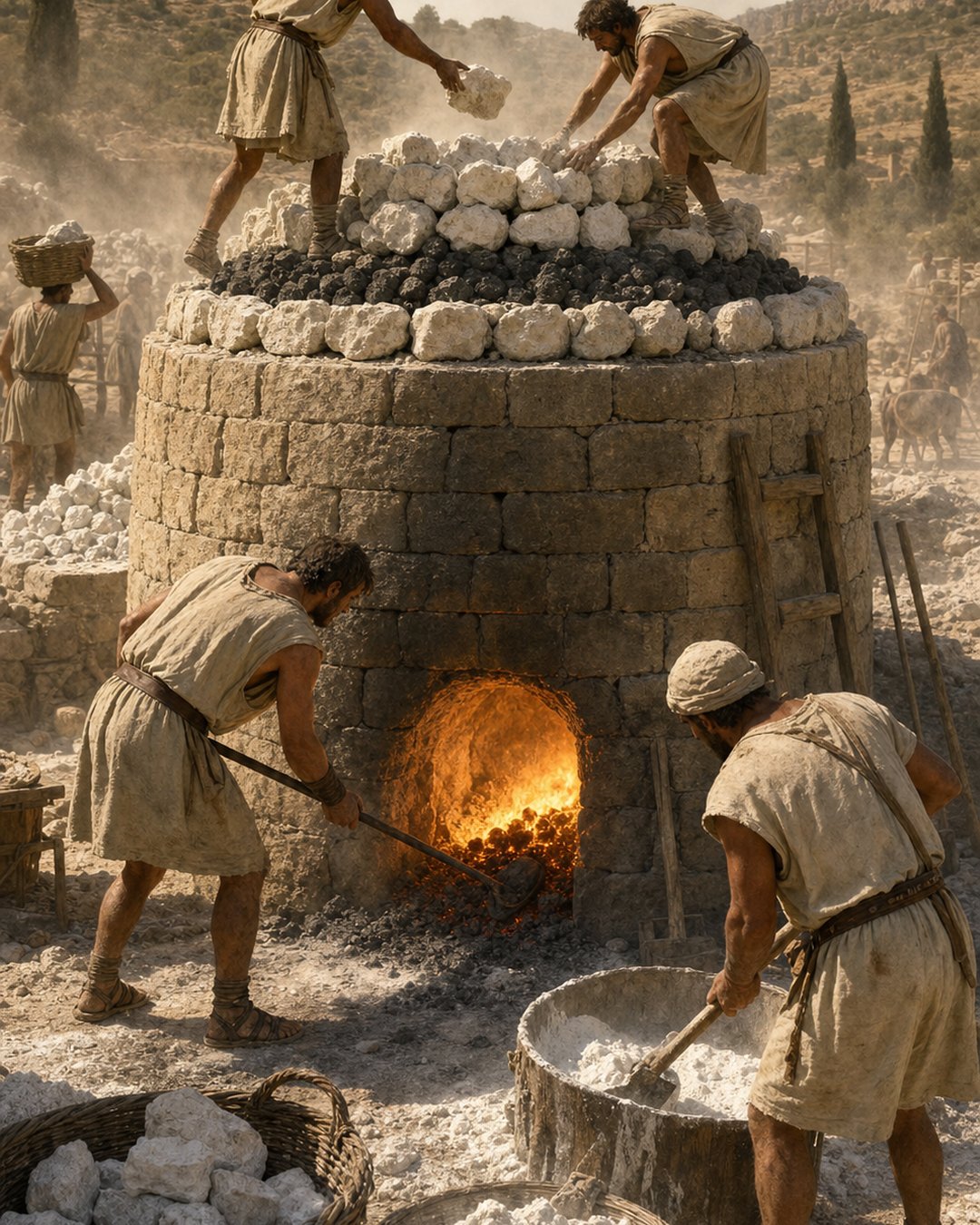
A Roman wall could begin with a material that seemed to contradict itself. Hard limestone entered a kiln. After prolonged heat, the pieces emerged lighter, pale and chemically hungry. When workers added water, the burned stone cracked, steamed and collapsed into a soft mass. Only after that violent change could it help bind another wall together.
Lime production sat between quarry and building site. It required suitable stone, enormous quantities of fuel, a kiln that held heat while still drawing air, and crews able to judge a process hidden inside a masonry chamber. Too little firing left dead cores. Too much mishandling after firing wasted fuel or burned workers.
The finished mortar concealed this chain. Once plaster dried or masonry joints were dressed, nobody saw the kiln smoke, hot draw hole or hissing slaking pit. Yet Roman construction at scale depended on workers who could make stone temporarily lose its familiar solidity and return as a binder.
The Kiln Began with Stone That Could Survive the Recipe
Lime burners needed carbonate-rich stone, commonly limestone. Quarry selection mattered because clay, silica and other impurities changed firing behavior and the character of the product. Pieces also needed manageable size. Huge blocks heated unevenly, while fragments that were too fine obstructed airflow or fell through a charge.
This was a different decision from cutting architectural blocks. A quarry crew seeking a column preserved a large sound mass; a lime burner wanted pieces whose interior could be reached by heat. The same landscape might therefore supply dressed stone, rubble and kiln feed, but those outputs followed separate standards.
Vitruvius discusses lime as a fundamental building material and distinguishes stone after it has been burned. His account is brief compared with a modern chemical manual, yet it places lime preparation before mortar performance. Roman builders understood through practice that the binding material had to be manufactured, not merely dug from the ground.A burner could also sort the feed after breaking it. Similar-sized pieces encouraged similar heating times, while dusty fines were better kept from choking the spaces between larger stones. Uniformity at loading reduced the number of deceptive pieces that looked finished outside but remained raw within.
Air Had to Move While Heat Stayed Inside
A lime kiln needed draft. Fuel consumed oxygen below, and hot gases rose through the stone charge. Openings near the base admitted air and allowed operators to tend the fire or remove product. The surrounding masonry and earth reduced heat loss, turning repeated fuel loads into sustained high temperature rather than a series of campfires.
Kilns varied with period, place and production scale. A simple intermittent kiln could be loaded, fired, cooled and emptied as one cycle. More continuous arrangements allowed charge and fuel to enter above while burned lime was drawn below. In either case, the geometry had to prevent cold pockets and uncontrolled collapse.
The draft principle resembles the controlled airflow described in our article on Roman bellows, but the kiln stretched that control over hours or days. One blast did not matter by itself. Operators had to keep a large body of stone inside a useful heat zone.Loading patterns helped preserve that zone. Fuel and stone could not be thrown into one dense heap without regard for gas paths. The crew built a permeable charge whose voids functioned like temporary flues, then watched settling for signs that those passages had narrowed.
Calcination Made the Load Lighter and More Dangerous
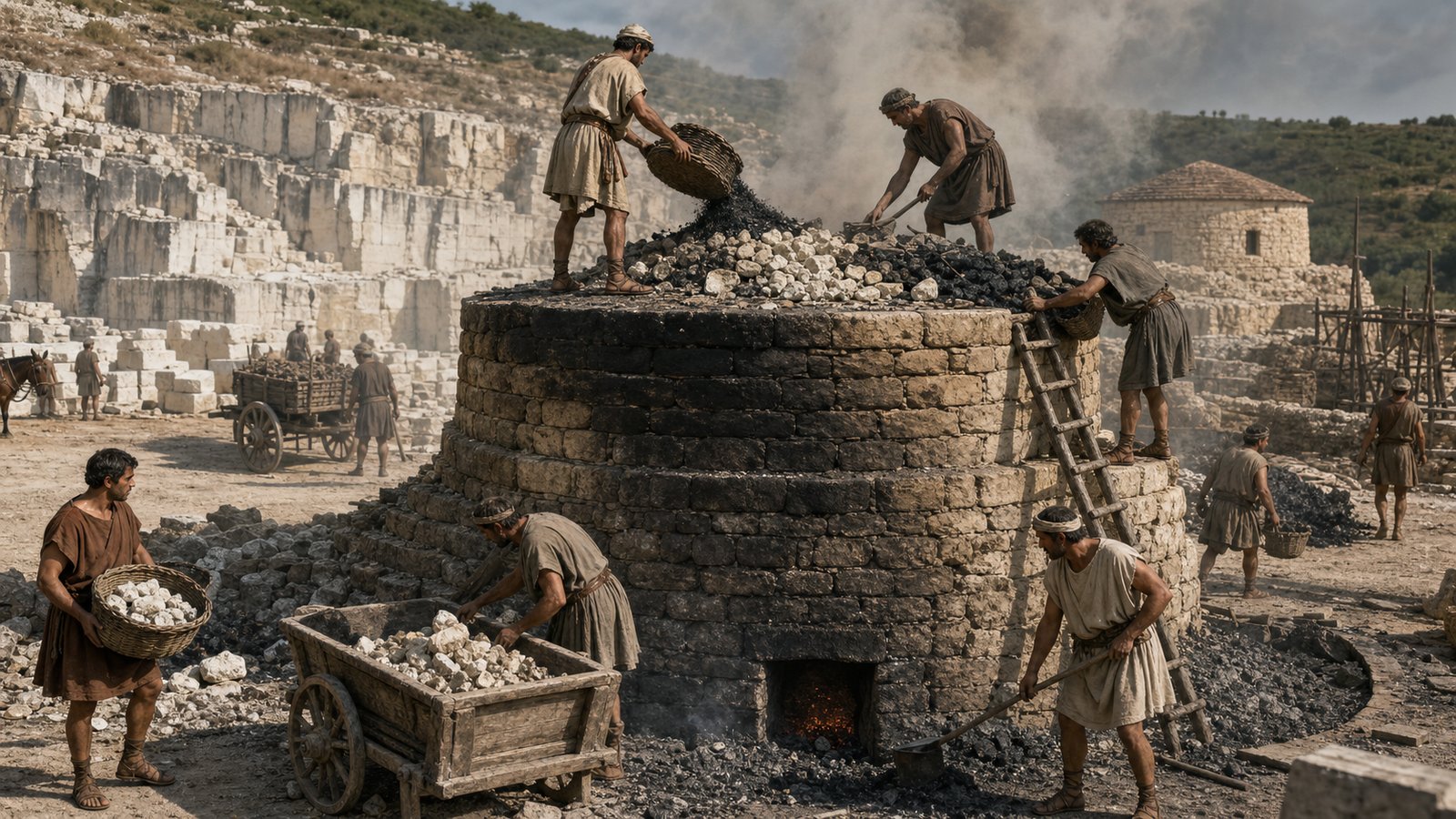
At sufficient heat, calcium carbonate released carbon dioxide and became calcium oxide, or quicklime. The change reduced mass without preserving the old material’s behavior. A piece could retain the rough shape of limestone while its chemistry had altered, making visual judgment alone unreliable.
Firing had to reach the center. Underburned lumps contained unconverted cores that later behaved poorly in mortar or plaster. Excessive heat could also produce dense material that slaked reluctantly. Burners watched flame, smoke, settling and the appearance of drawn pieces, using accumulated craft knowledge where instruments were absent.
Fuel consumption connected lime to woodland, transport and labor. Charcoal or wood had to arrive dry enough to burn effectively, and smoke made the kiln an industrial landmark. Monumental building therefore reached beyond the city wall into quarry roads and managed fuel supplies long before a mason lifted a trowel.The draw opening exposed workers to a second danger after heat. Fresh quicklime eagerly absorbed moisture from damp air, so storage had to remain dry and protected. A badly covered pile could partly slake itself unpredictably, leaving crusts and lumps before the planned basin reaction.
Slaking Turned Quicklime into a Boiling Paste
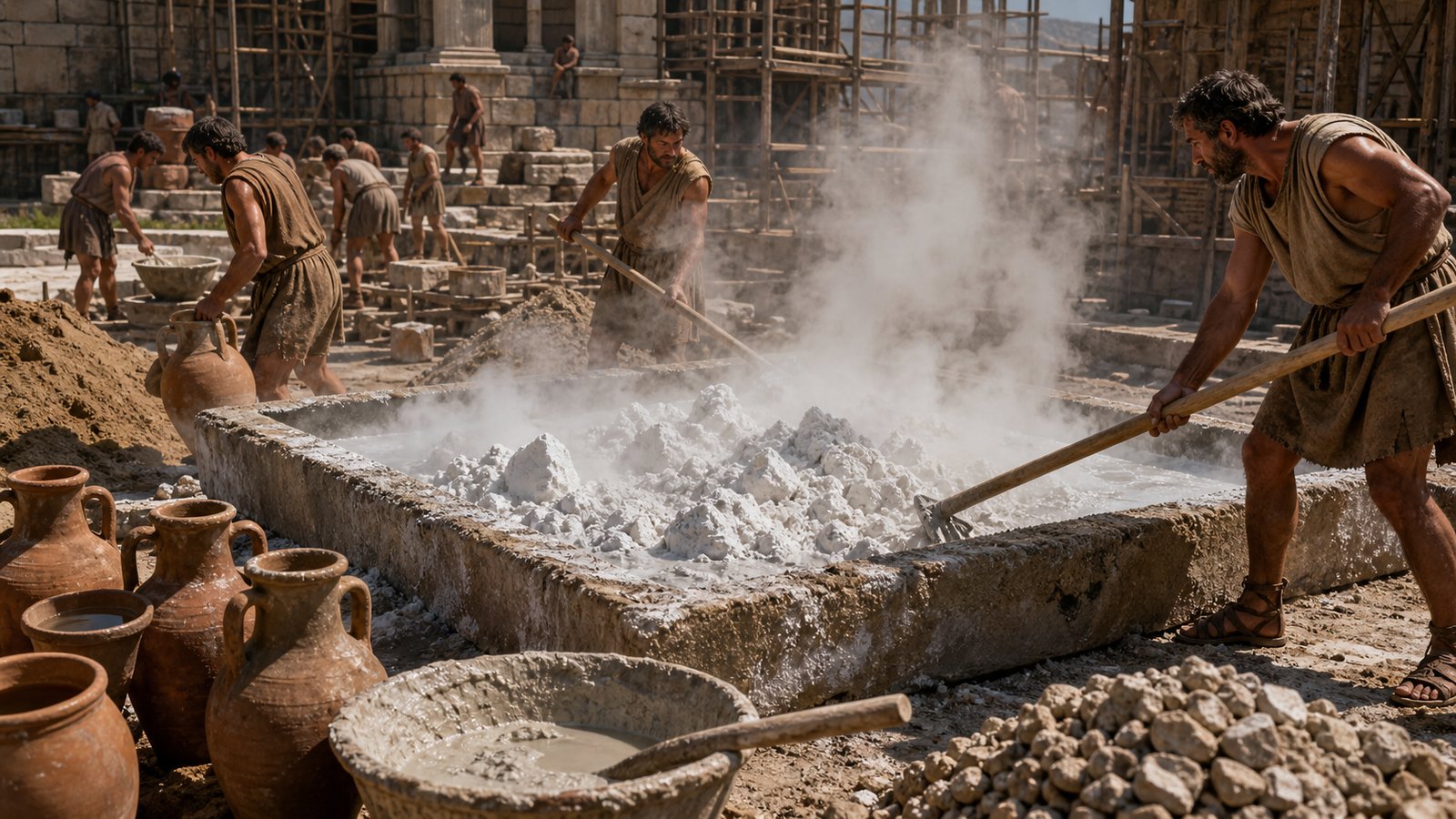
Quicklime reacted strongly with water. In a slaking pit or prepared basin, workers added controlled amounts while the pieces heated, cracked and disintegrated into calcium hydroxide. Steam and dust made the scene physically unmistakable. Water was not simply thinning a powder; it was entering a heat-releasing chemical transformation.
Too little water left unslaked particles. Too much at the wrong stage could make handling difficult or wash material away. Workers protected skin and eyes as far as ancient practice allowed, because caustic lime burned tissue. The long tools and deliberate distance visible in practical lime work were responses to a material that could injure without flame.
Well-slaked lime could be matured as putty so remaining particles completed their reaction. That patience mattered especially in plaster, where a late-expanding lump might break an otherwise smooth surface. Preparation continued after the dramatic hiss had ended.Slaking also changed volume. The crumbling mass expanded into a much finer material, so pits and containers needed room rather than being filled to the edge. The worker judged a changing substance by heat, sound, texture and the disappearance of hard cores beneath the tool.
Sand and Pozzolana Decided What the Binder Could Do
Lime alone was not the finished mortar. Builders mixed it with sand and other aggregate, controlling shrinkage and creating a workable mass. Proportion, grain cleanliness and moisture affected how the mixture spread, gripped masonry and hardened. A wall crew needed consistency from batch to batch even when raw materials varied.
Volcanic ash and other reactive materials could produce hydraulic behavior, allowing mortar to harden in damp conditions and contributing to Roman concrete. The mechanism explored in Roman concrete therefore depended on an earlier lime-burning chain. Pozzolana did not remove the need to calcine and slake the binder correctly.
Mixing was also logistical. Lime putty, aggregate and water had to meet near the point of use without blocking movement through a construction site. Laborers turned heavy batches while masons judged workability. The chemistry became architecture only through repetitive organization.Aggregate was not inert in every practical sense even when it did not react chemically. Sharp grains, rounded sand, dust and salts changed handling and bond. Washing or rejecting poor material protected the expensive lime from being blamed for failures that began in the sand pile.
The Wall Slowly Took Carbon Back from the Air
Ordinary lime mortar hardened partly as calcium hydroxide reacted with carbon dioxide and returned toward calcium carbonate. The full process was slow and depended on air reaching the material. Thick, wet or sealed work behaved differently from a thin plaster exposed to circulation.
This return did not recreate the original quarry block. Aggregate, pores, joints and workmanship shaped the finished fabric. Yet the broad cycle gave Roman lime its remarkable narrative: limestone released carbon dioxide in the kiln and the binder gradually absorbed some again as masonry cured.
A Roman lime kiln made stone behave like water only for a working interval. Burned limestone became reactive, slaked lime became spreadable, and mortar flowed into irregular joints before hardening. The finished wall looked stable because a hazardous industrial process had first made its binder willing to change.Repair centuries later can reveal the sequence in section: pale binder surrounding darker aggregate, distinct plaster coats, and joints pressed around rubble. Those traces are the cooled record of decisions made while lime was hot, caustic, wet and urgently workable.
Sources & Further Reading
- Vitruvius, On Architecture, Book II
- Encyclopaedia Britannica, “Lime”
- Wikipedia, “Lime kiln”
- World History Encyclopedia, “Roman Architecture”