
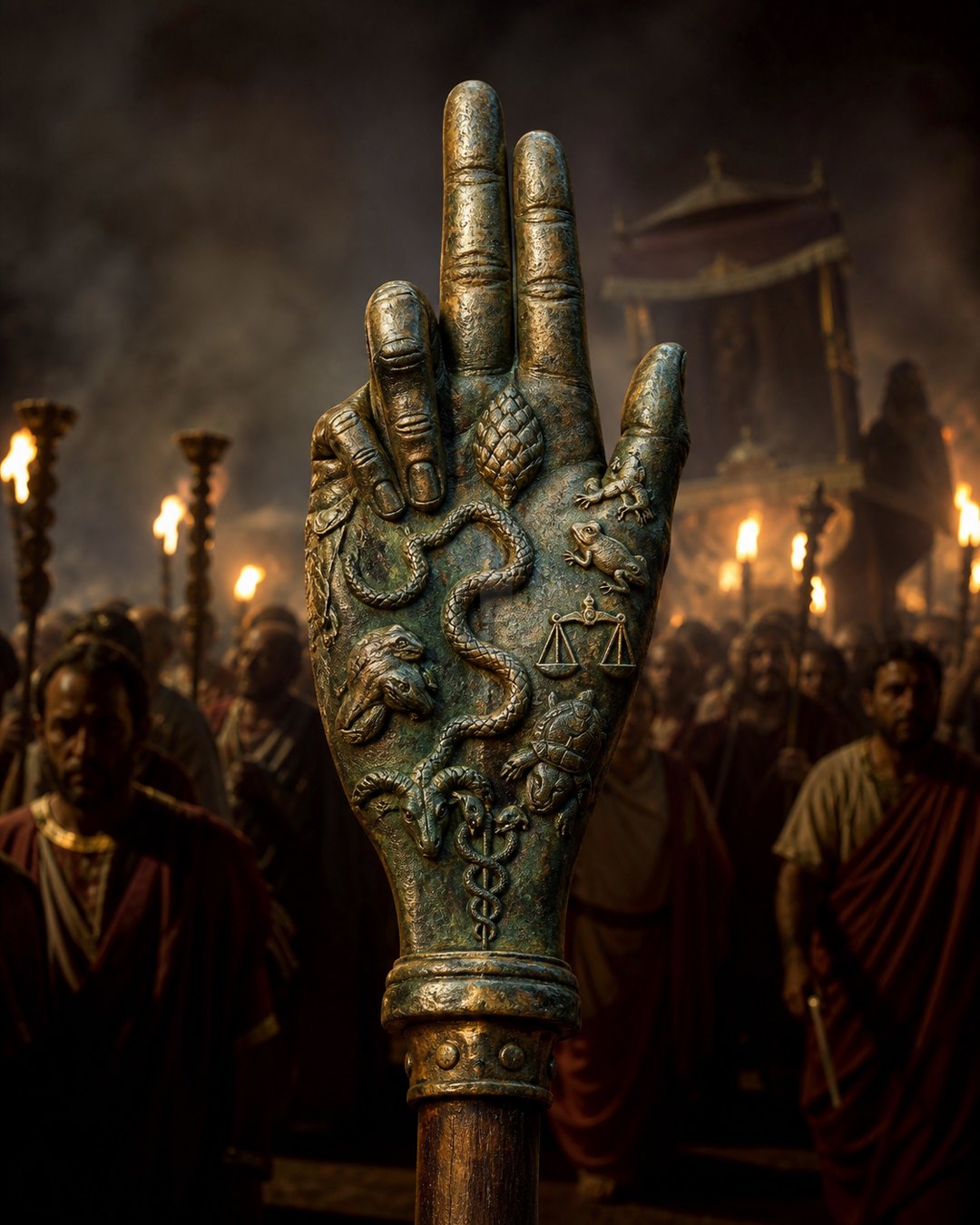
A bronze right hand in the Vatican Museums rises only 9.9 centimetres, yet its surface is crowded like an entire sanctuary. A snake climbs it. A pinecone, ram’s head, loaf, scales, tortoise, frog, winged caduceus and lizard occupy the palm and fingers. A tiny bust of Hermes watches from among them. The object is not a random cabinet of curiosities; it belongs to the cult of Sabazios.
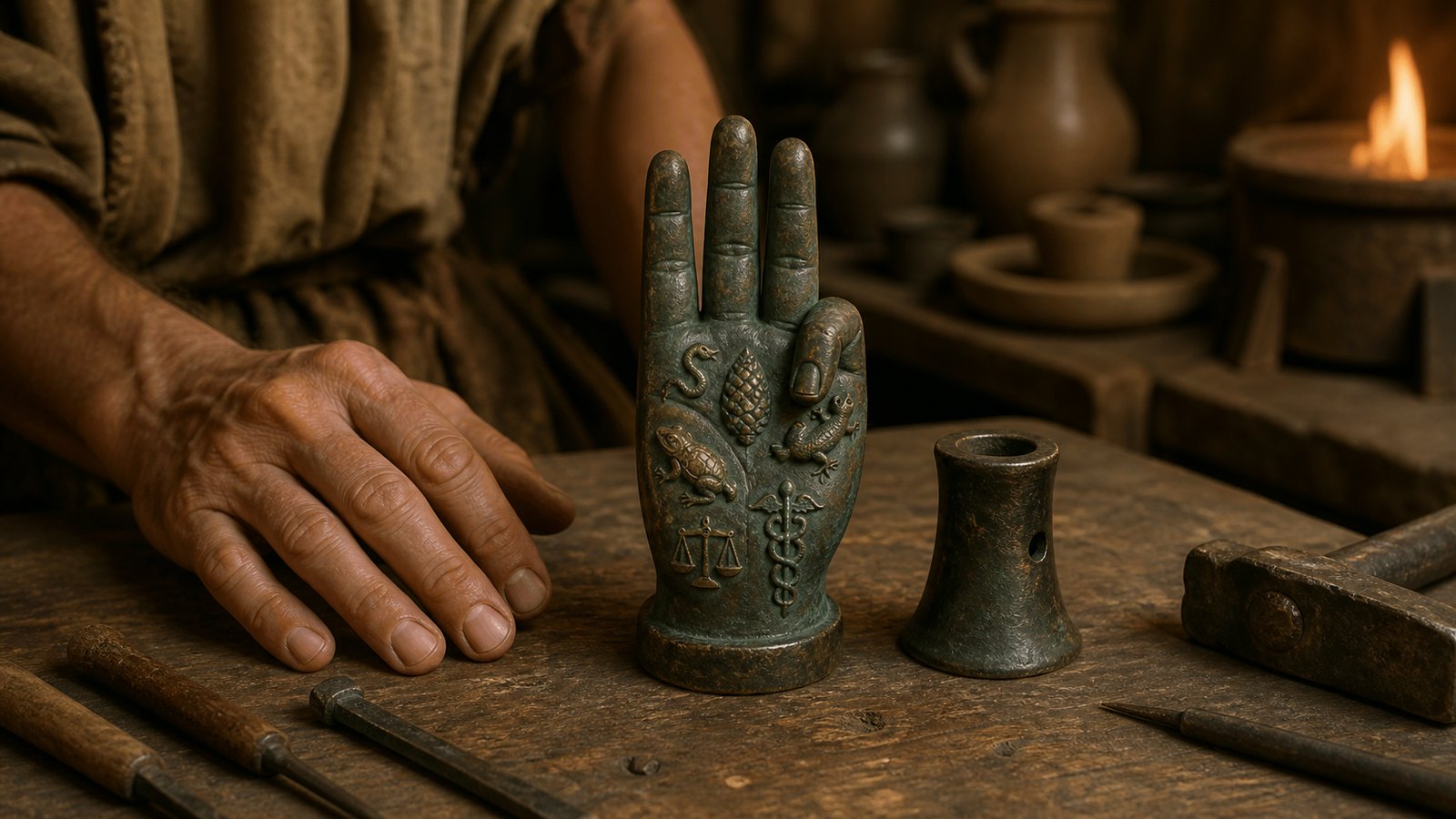
The fingers hold a deliberate pose, with some extended and others folded. A socket or attachment could place such hands on staffs for processions, although examples could also stand in sanctuaries or domestic worship. Raised above a group, the hand made divine presence move while its miniature creatures remained close enough to reward careful looking.
These objects invite easy decoding: pinecone equals rebirth, frog equals metamorphosis, scales equal judgement. Museum interpretations support those associations, but surviving hands vary, and the cult left limited written explanation. Their stronger evidence lies in the combination of gesture, movement and repeated underworld imagery—not in a modern key that pretends every symbol had one stable sentence.
Three Raised Fingers Made Knowledge Visible
The hand’s pose is often called the benedictio Latina, a name shaped by later Christian visual history. On Sabazian bronzes, however, the gesture predates that use. Susanne Berndt Ersöz traces related finger arrangements on earlier Greek pottery, where they appear with Hermes and later become associated with speech, instruction and knowledge transmitted through mystery initiation.
That earlier history changes how the object is read. The hand is not simply blessing an unseen worshipper. It can indicate a message being delivered or knowledge made available through ritual. In mystery cults, initiation separated those who had received particular experience and teaching from those who had not. A fixed hand gesture could display that difference without writing it out.
Hermes fits this logic. The god appears as a tiny bust and through the caduceus and tortoise on the Vatican example. As guide and psychopomp, he conducts movement across boundaries, including the boundary between living and dead. Ersöz connects that role with the mystagogue, the human guide who led initiates through sacred learning.
This concentrated gesture belongs beside the model liver that organized divine knowledge into material zones. Both objects make specialized understanding graspable. Yet the liver is a teaching map of a cosmic surface; the Sabazian hand performs instruction through the anatomy of speaking and pointing.
The Palm Became a Landscape of Creatures
The Vatican hand carries more than one visual family. A snake supplies the most prominent winding body. Nearby are a ram’s head, pinecone, vase, loaf and a minute creature that the catalogue cautiously calls an insect. Lower symbols include scales, tortoise, frog, Mercury’s winged caduceus and a lizard. Their small size forces the eye to move slowly.
The museum links the pinecone with fertility and rebirth, the frog with metamorphosis and the lizard with regeneration. Scales may refer to the weighing of souls before blessed afterlife, while Mercury’s signs strengthen the journeying, underworld dimension. These readings create a coherent eschatological field, but coherence does not make each image an alphabetic character.
Another hand from the Escombreras site near Cartagena carries its own group, including a ram, knife, lizard and beetle. Spain’s National Museum of Underwater Archaeology dates it to the late first century CE and describes Sabazios as Anatolian in origin, associated in the Roman world with Jupiter. Its serpent signifies annual renewal of life in the museum’s interpretation.
Variation is therefore part of the evidence. Makers selected, omitted and rearranged signs while retaining the recognizable hand and cult association. A worshipper could encounter a familiar symbolic environment without seeing an identical catalogue every time. The objects operate more like ritual constellations than mass-produced diagrams.
A Socket Turned Private Scale into Public Movement
The Vatican catalogue proposes several settings: fixed onto poles for processions, dedicated in sanctuaries or used in domestic worship. Ersöz likewise argues that bronze hands were probably attached to staffs and carried. The hollow or fitted base matters because it changes the hand from a miniature sculpture resting on a shelf into an elevated sign capable of entering collective space.
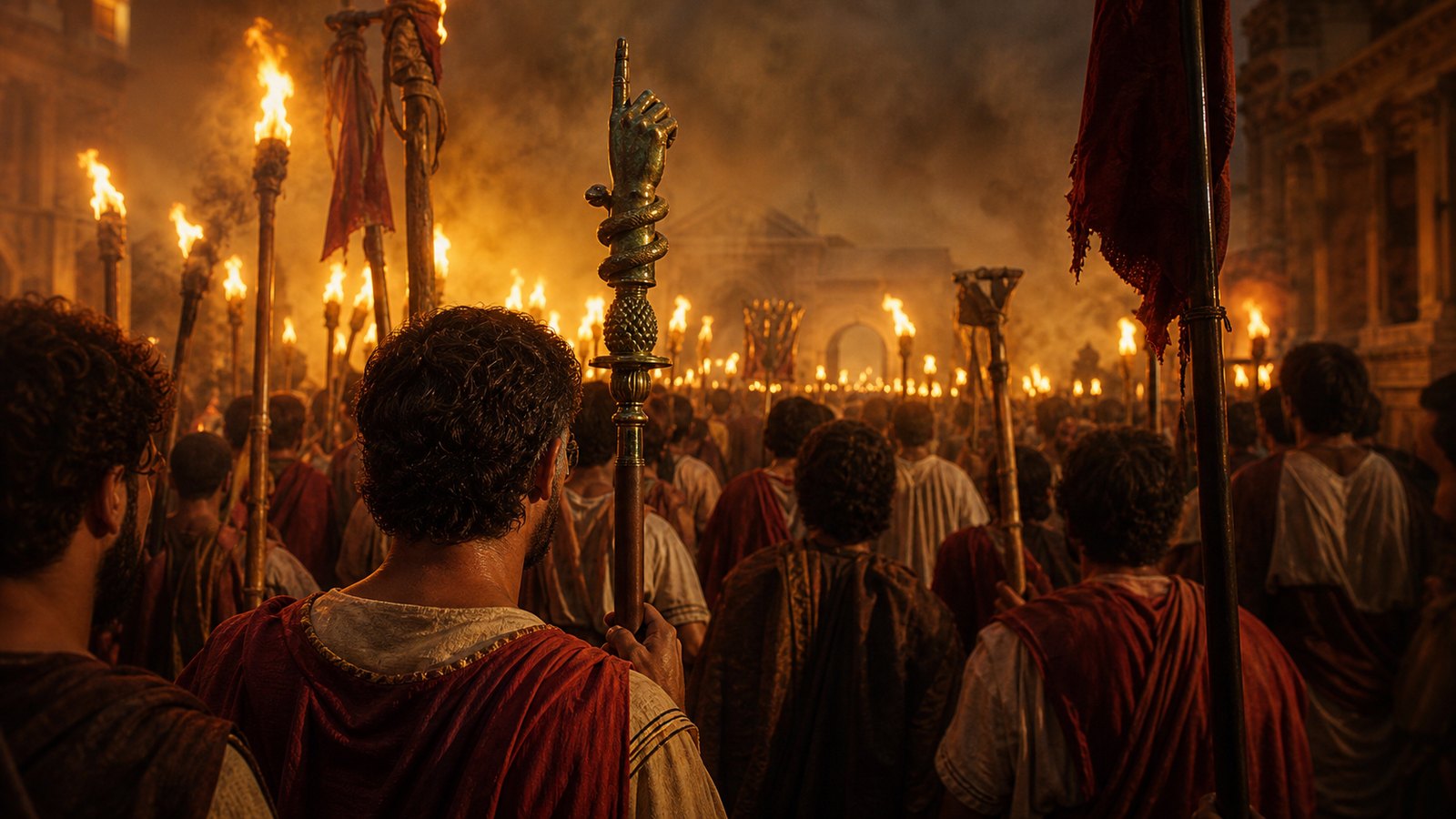
Imagine only what the construction permits. A staff raises the bronze above bodies. Walking gives the snake and tiny figures changing highlights. The fixed fingers remain legible at a greater distance than the smallest emblems, allowing gesture to announce the object before individual symbols can be examined. Movement creates two scales of encounter: public recognition and close interpretation.
Roman religion often depended on things being carried, worn, sounded, unveiled or placed. A cult was not merely a list of beliefs. Processions joined route, participants and objects into temporary sacred order. The Sabazian hand is especially direct because the object itself resembles the body part that points, swears, greets and directs.
That mobility differs from the enclosed dining rooms of Mithras worshippers. A Mithraic gathering concentrated experience inside a restricted room and repeated meal. A hand on a staff could mark sacred knowledge in motion. Both belonged to initiatory worlds, but their social choreography was not interchangeable.
An Anatolian God Acquired Roman Companions
Sabazios originated in Anatolia and entered Greek and Roman religious environments through long contact rather than one official act. In Roman contexts he could be linked with Jupiter, while Hermes or Mercury occupied a major place on the hands. Association did not erase the god’s identity. It allowed worshippers to understand unfamiliar power through established divine relationships.
The Spanish museum emphasizes transmission through the Roman army, and Ersöz argues that military channels probably helped spread the practice during the Early Imperial period. Soldiers moved between provinces, but they were not the only mobile people in the empire. Traders, enslaved people, officials, families and craftspeople also carried rituals and objects. The hands support movement; they do not provide a complete membership roll.
Dating shows geographic breadth across time. The Escombreras piece belongs to the late first century CE. The Vatican hand, found in 1858 in the Santa Colomba area of Monterotondo, is dated to the second or third century CE. Similar cult objects appearing in different western regions indicate repeated adaptation rather than a single workshop shipment that can explain every example.
Syncretism is often described as if gods were simply equated on paper. The hand shows a more physical process. Jupiter’s authority, Mercury’s guidance, an Anatolian divine name and creatures associated with renewal could occupy the same small bronze surface. Religious translation happened through composition, gesture and use, not only through theological statements.
No Surviving Hand Explains Every Sign
The material record is meagre compared with the confidence of many modern explanations. Bronze hands survive, but full ritual scripts, participant testimony and the spoken teaching around them largely do not. Ersöz’s study uses gesture history and recurring symbols to reconstruct likely meanings, while museum catalogues make associations explicit. Those are disciplined interpretations, not subtitles engraved by ancient worshippers.
The Vatican catalogue itself models caution by marking one tiny figure as an insect with a question mark and describing scales as something that could relate to judgement. Such phrasing matters. A corroded miniature can be hard to identify, and an identified animal may support several associations. Precision begins by distinguishing what can be seen from what it may have meant.
Still, uncertainty does not reduce the hands to mystery for mystery’s sake. Their repeated form proves that the gesture mattered. Staff mounting gives a credible processional function. Hermes, serpents and transformation imagery create a strong concern with guidance, renewal, initiation and passage. The safest interpretation is cumulative: many signs reinforce a ritual world even when no single sign supplies its grammar.
The hand’s power lies in that controlled density. It could be lifted above a procession as one bold silhouette, then examined as a population of animals, objects and gods. Publicly it announced affiliation; closely it offered layers of learned recognition. Snakes, frogs and pinecones did not need to become a written creed. Bronze made them travel together.