
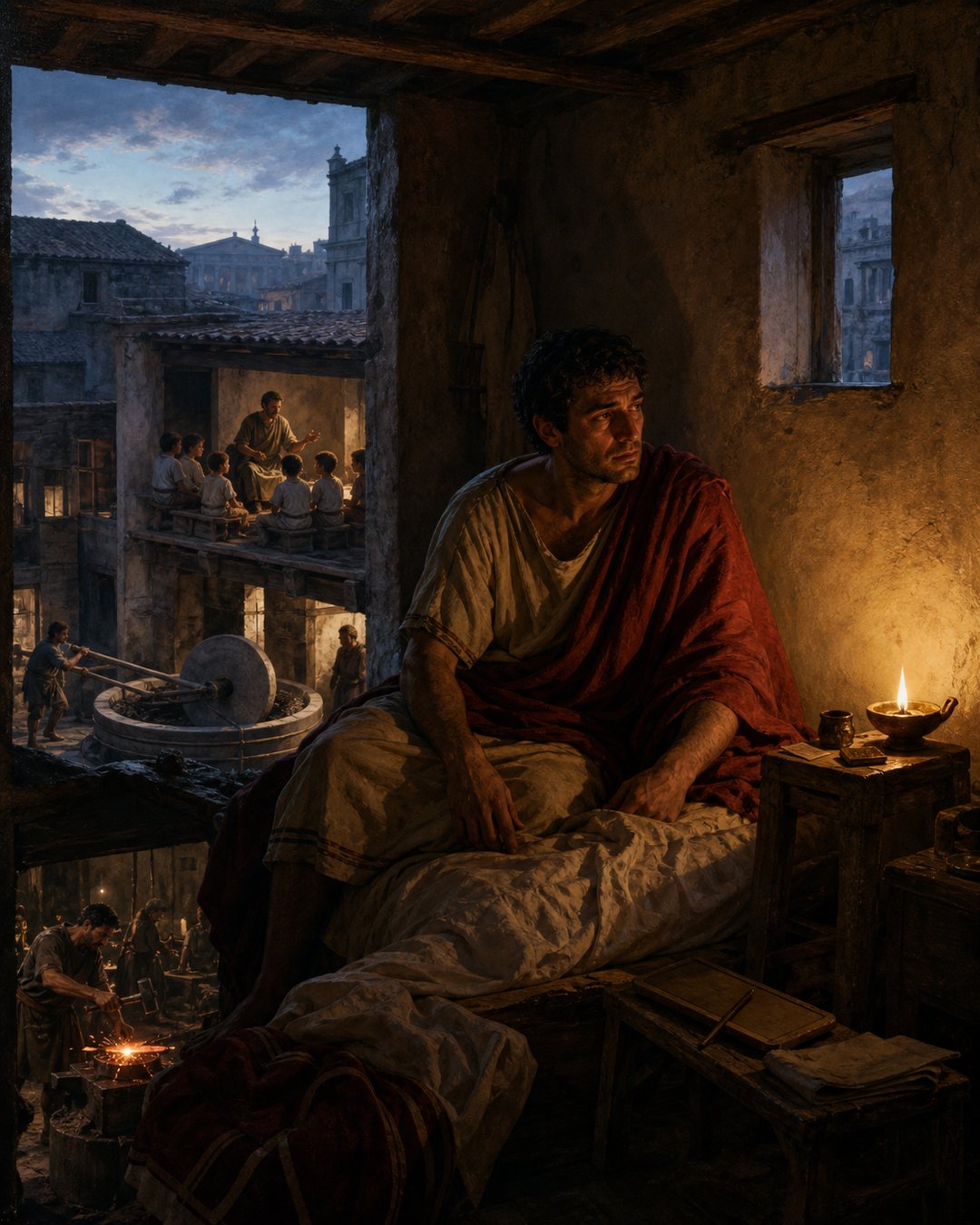
The schoolmaster began at dawn. Corn mills carried on through the night. Somewhere between them, bronze workers hammered, a money-changer rattled coins, a gold-beater struck stone, religious devotees shouted, sellers called and a passing crowd laughed close enough to wake the man in bed. Martial’s Rome did not need an alarm clock. It entered the room by force.
That is the comic pressure behind Epigram 12.57, addressed to a wealthy man named Sparsus. Martial explains why he repeatedly escapes to a small property at Momentum. His answer is not a pastoral hymn. It is an inventory of interruptions, arranged so that one trade, voice or ritual replaces another before silence can begin.
The poem is vivid, but it is not a municipal sound survey. Martial selects, sharpens and contrasts. He makes the poor writer’s lodging porous, then gives Sparsus depth, distance, private circulation and control over daylight. The joke therefore rests on more than noise. It asks who could buy the power to decide what entered a Roman room.
Morning Arrived as a Teacher’s Voice
Martial opens with a question from Sparsus: why does the poet so often go to his small estate at dry Momentum and its humble household? The wording establishes unequal properties before the catalogue begins. Martial presents his refuge as modest. Sparsus, by contrast, will later appear inside a domain grand enough to imitate the countryside while remaining in Rome.
The first urban disturbance belongs to schoolmasters in the morning. A teacher’s voice is not random background sound. It is scheduled labour, and its position at the start of the list gives the day an imposed beginning. Lessons useful to one household become unwanted wakefulness for another person separated by walls that do little to contain a voice.
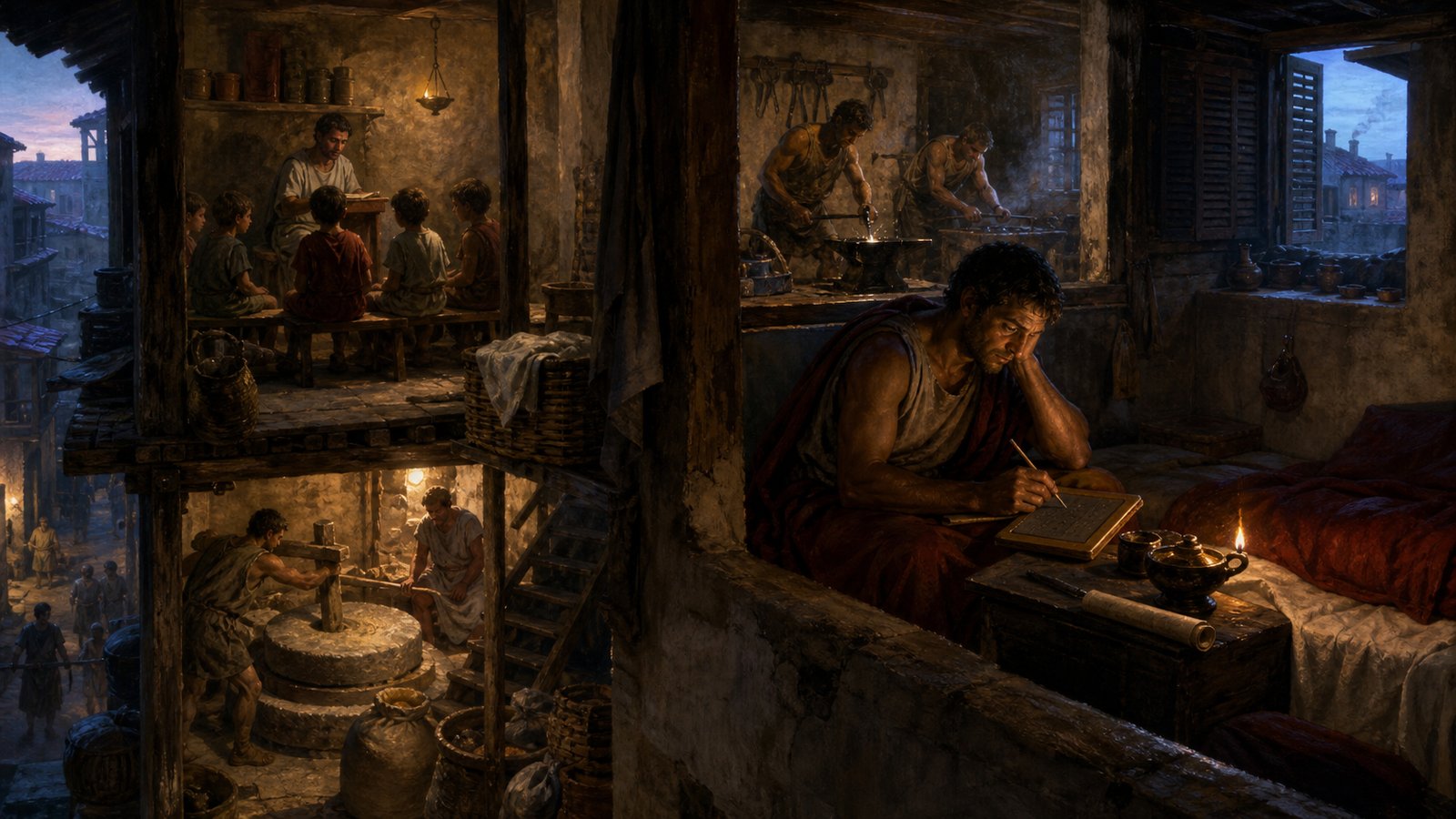
Martial says that a poor man in town has nowhere either to think or to rest. Those verbs matter together. Noise damages sleep, but it also damages the concentration on which a writer depends. His complaint turns housing into a workplace problem: the city follows him not only into bed but onto the page.
The line should not be converted into a claim that every Roman school operated beside every poor tenant. Epigram works by compression. Yet the complaint depends on a recognizable arrangement of activities at close quarters. Teaching, selling, making and sleeping can occupy the same audible neighbourhood because Martial lacks the space to put distance between them.
The Mill Owned the Night Shift
If the schoolmaster marks morning, corn grinders claim the night. Martial’s sequence denies the reader a quiet interval. Food production cannot simply stop because nearby residents want sleep. Grain has to become flour, and the poem hears that necessity as machinery and labour continuing after dark.
The sound makes a useful companion to Pompeii’s animal-driven hourglass mills. The archaeological machinery explains how repeated rotation crushed grain; Martial supplies a literary listener who experiences milling from outside the bakery. One account follows the mechanism toward bread, while the other follows its sound through a wall.
Bronze workers then hammer through day and night. The list is not arranged as a neat tour of trades. It behaves like insomnia: one source becomes noticeable, another takes over, and the sufferer starts counting categories because he cannot make any of them stop.
Martial’s poor man is therefore not opposed to work in the abstract. His own thinking and writing are work. The conflict is between incompatible activities packed into an environment where one resident cannot control the acoustic consequences of another’s livelihood. Bread, metal goods and education are useful; usefulness does not make their sounds restful.
Coins, Gold and Devotion Made Their Own Rhythms
The catalogue becomes more exact. A money-changer idly rattles piles of rough coins bearing Nero’s image on a dirty counter. Nearby, a worker beating Spanish gold strikes a worn stone with a bright mallet. Martial pairs money at two very different stages: currency handled in public and precious metal physically worked by repeated blows.
These details give the poem texture without turning it into an impartial street photograph. Rough coins, a dirty counter, worn stone and a shining tool are selected contrasts. Sound leads the scene, but Martial adds touch and appearance so that irritation acquires objects. The reader can imagine the irregular clatter of coins beside the measured impact of the mallet.
Religious performance joins commercial labour. Martial names the clamorous followers of Bellona, a Roman war goddess whose devotees could be represented through intense public ritual. He then compares Rome’s interruptions with the impossible task of counting all the hands striking cymbals during an eclipse, when noise was imagined as an answer to threatening magic.
The comparison expands one sleepless room to the scale of the city. It does not prove that an eclipse ritual occurred outside Martial’s window on the same night as every workshop. The poet is stacking sounds for force. The exaggeration is openly literary, and that openness is part of the evidence: Roman readers were expected to recognize noise as a credible language for urban overload.
Every Seller Needed the Street to Listen
Voices enter alongside tools. Martial hears a sailor carrying a piece of wreck over his shoulder and talking for attention. He includes a begging Jewish boy, described through a hostile Roman stereotype about his mother, and a bleary-eyed seller of matches. The passage preserves street types through a satirist’s contempt, not through their own testimony.
That distinction is essential. The poem offers evidence that Martial could make such figures legible to his audience; it does not license his prejudice as a transparent description of entire communities. The people he reduces to noises were pursuing money, pity or customers. His inability to sleep and their need to be heard occupy the same street from unequal perspectives.
A city seller without a permanent counter had to turn voice into visibility. The shouted offer travelled farther than the body. In Martial’s telling, it also crossed the final boundary of the house. He says laughter from the passing crowd wakes him and that all Rome stands at his bedside.
The image is deliberately impossible and socially precise. The crowd has not entered the room, but privacy has failed as if it had. The same street economy visible in Trimalchio’s performance of wealth through food and service looks different from below: status is also the ability to keep unwanted people, voices and labour at a distance.
Sparsus Could Close the City Out
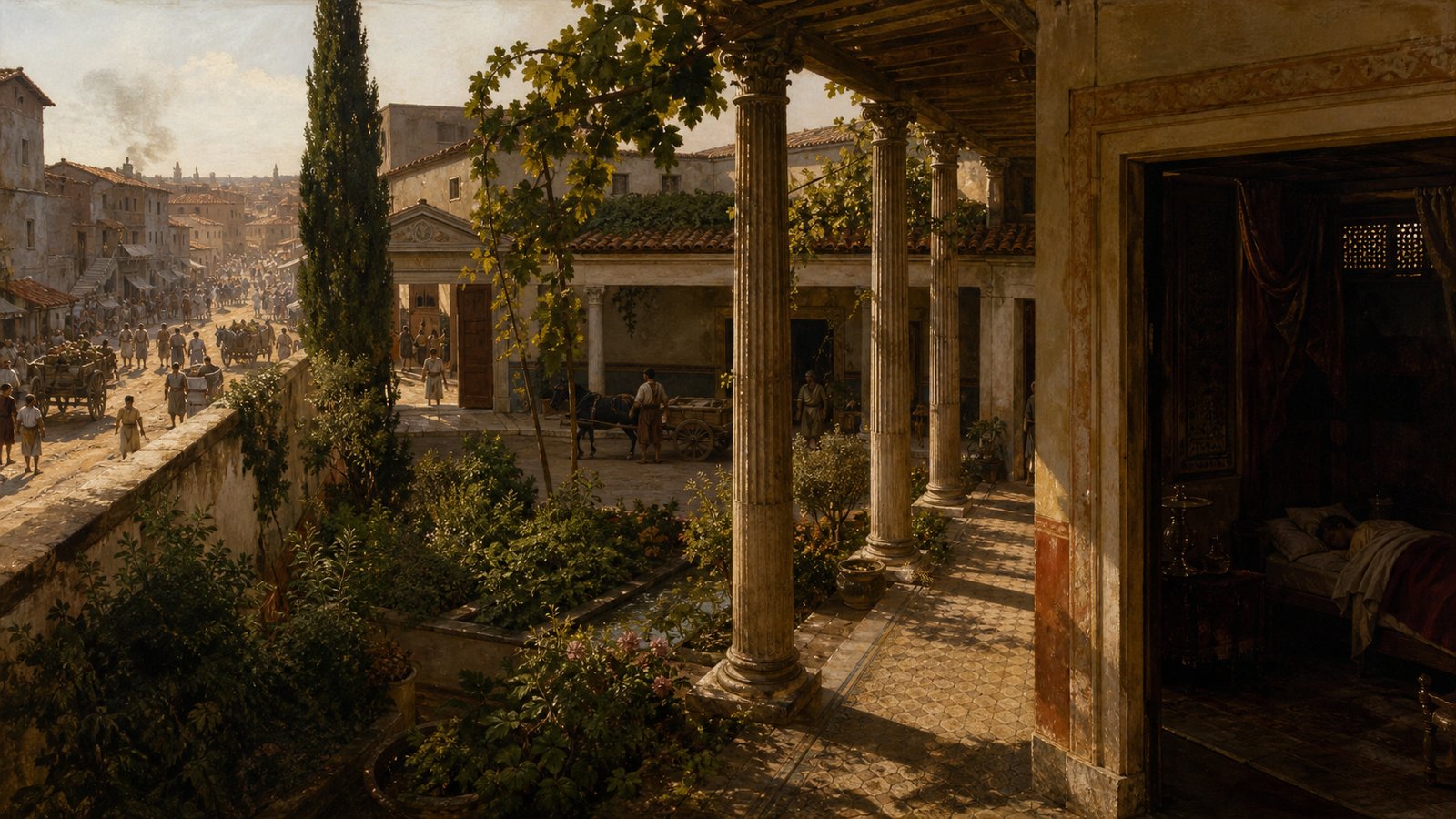
Martial now turns from his own porous lodging to Sparsus’s Petilian domain. The wealthy man enjoys what the poem calls countryside within the city. His property has vines and a vintage that Martial compares favourably with Falernian wine, but its decisive luxury is not agricultural scenery. It is controlled separation.
A private carriage drive keeps movement within the estate. Deep interior spaces preserve sleep from human voices. Daylight itself enters only when Sparsus chooses to admit it. Each feature answers something in Martial’s complaint: traffic is contained, speech is pushed away, rooms gain depth, and even morning loses the right to announce itself automatically.
This architecture changes the meaning of quiet. Sparsus does not inhabit a silent Rome. He inhabits a property capable of filtering Rome. Teachers can teach, mills can grind, workers can hammer and sellers can call elsewhere; private distance prevents those activities from becoming his personal timetable.
Martial ends by returning to Momentum whenever weariness overwhelms him. The escape is comic because his rural house is humble and the destination is described as dry, not luxurious. Yet it gives him what the city property market denies: enough space for thought and sleep.
Epigram 12.57 survives because its list is funny, specific and exhausting. Its deeper mechanism is contrast. The poet’s bed touches the crowd; Sparsus’s rooms retreat behind land, driveways and deliberate darkness. Roman noise becomes a way of hearing class, because silence belongs most securely to the person who can design other people out of earshot.