
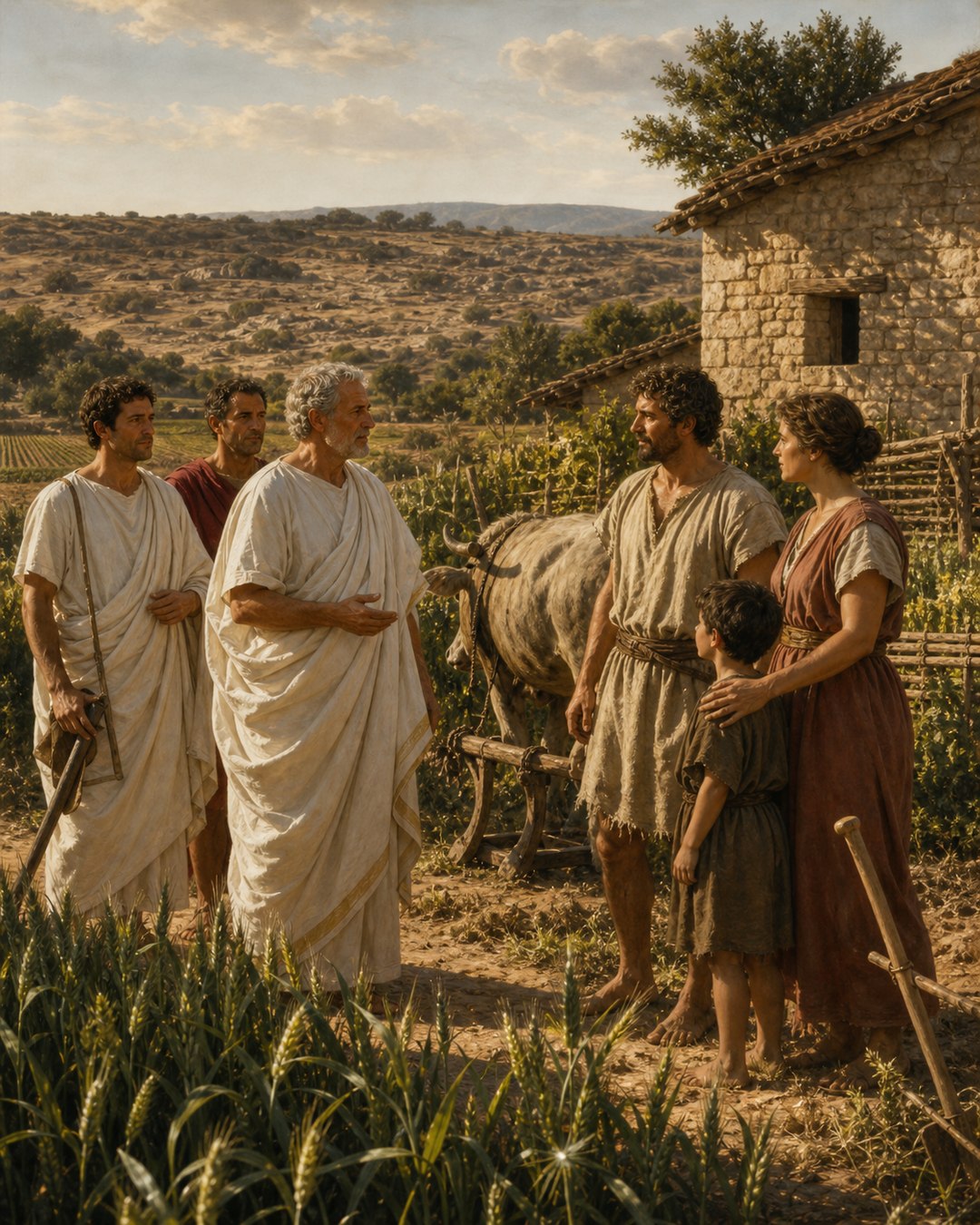
A field became a character reference. Plutarch imagines Numa walking beyond Rome, looking at furrows, boundaries and neglected ground, then deciding which citizens deserved trust.
The judgement began with a material transfer. Land acquired under Romulus was distributed among people in need. Numa divided the territory into districts, appointed overseers and patrols, and sometimes inspected the farms himself. Careful cultivators could be advanced to honour; careless ones were reproached.
This is politics conducted through soil. Poverty was treated as a cause of wrongdoing, farming as training in peace, and the visible condition of property as evidence about the person working it. Assistance, administration and moral scrutiny arrived together.
Plutarch’s Numa belongs partly to remembered early Rome and partly to a later author’s model of good kingship. The passage cannot serve as a cadastral report for the eighth or seventh century BC. It can show, with unusual clarity, how an ancient writer connected land, violence, labour and government.
Land taken by the spear was measured into obligations
Plutarch introduces the policy through Terminus, the god of boundaries. Public and private sacrifices marked places where fields were divided. In the earliest practice described by the author, those offerings were bloodless because a guardian of peace and witness of fair dealing should remain free from slaughter.
A boundary did more than tell two neighbours where to stop. Plutarch makes it a test of power. If respected, it restrained lawless appetite. If violated, it exposed injustice. Measurement converted possession from a vague result of force into a line against which later conduct could be judged.
That is why he contrasts Numa with Romulus. The first king, in Plutarch’s telling, did not want to measure his territory because a defined holding would reveal how much had been taken from others. Rome’s first ground was small; much of the later territory came through the spear.
Numa inherited that martial landscape and divided it. The act did not erase conquest, but it changed what conquered land was expected to do. Instead of remaining only a trophy of expansion, it became parcels with occupants, edges and productive duties.
The physical force of Roman boundary stones lies in this double life. A marker was a practical object in the ground and a statement about recognized limits. Plutarch’s narrative adds a political sequence: conquest created the territory, measurement restricted it, and distribution turned it into the basis of households.
Distribution answered poverty with a working claim
Plutarch says Numa gave the land to indigent citizens. His stated aim was to remove destitution, which the author treats as a pressure toward wrongdoing. The policy therefore begins as material relief, not as a lecture to people who lacked resources.
Yet the gift was not detached from expectation. Recipients were turned toward agriculture. Land became a livelihood only through repeated labour: opening soil, sowing, maintaining boundaries, protecting plants and bringing a harvest through uncertain weather.
Plutarch calls farming a “peace-potion.” The phrase is flattering but precise about the transformation he imagines. A farmer retained enough martial courage to defend his own property. What cultivation removed, ideally, was the soldier’s permission to seize the property of someone else.
Ownership redirected bravery. The citizen still possessed energy, toughness and attachment to place, but those qualities were anchored to a crop that could be lost if he spent the season raiding. Peace acquired a daily cost in missed work, damaged vines and untended animals.
This is not a neutral theory of rural life. It idealizes farmers and treats agriculture as a school of character rather than primarily a source of wealth. Real farms could generate debt, conflict and sharp inequality. Plutarch’s value lies in making the governing ideal explicit: provide land, make labour consequential and redirect violent capacity toward defence.
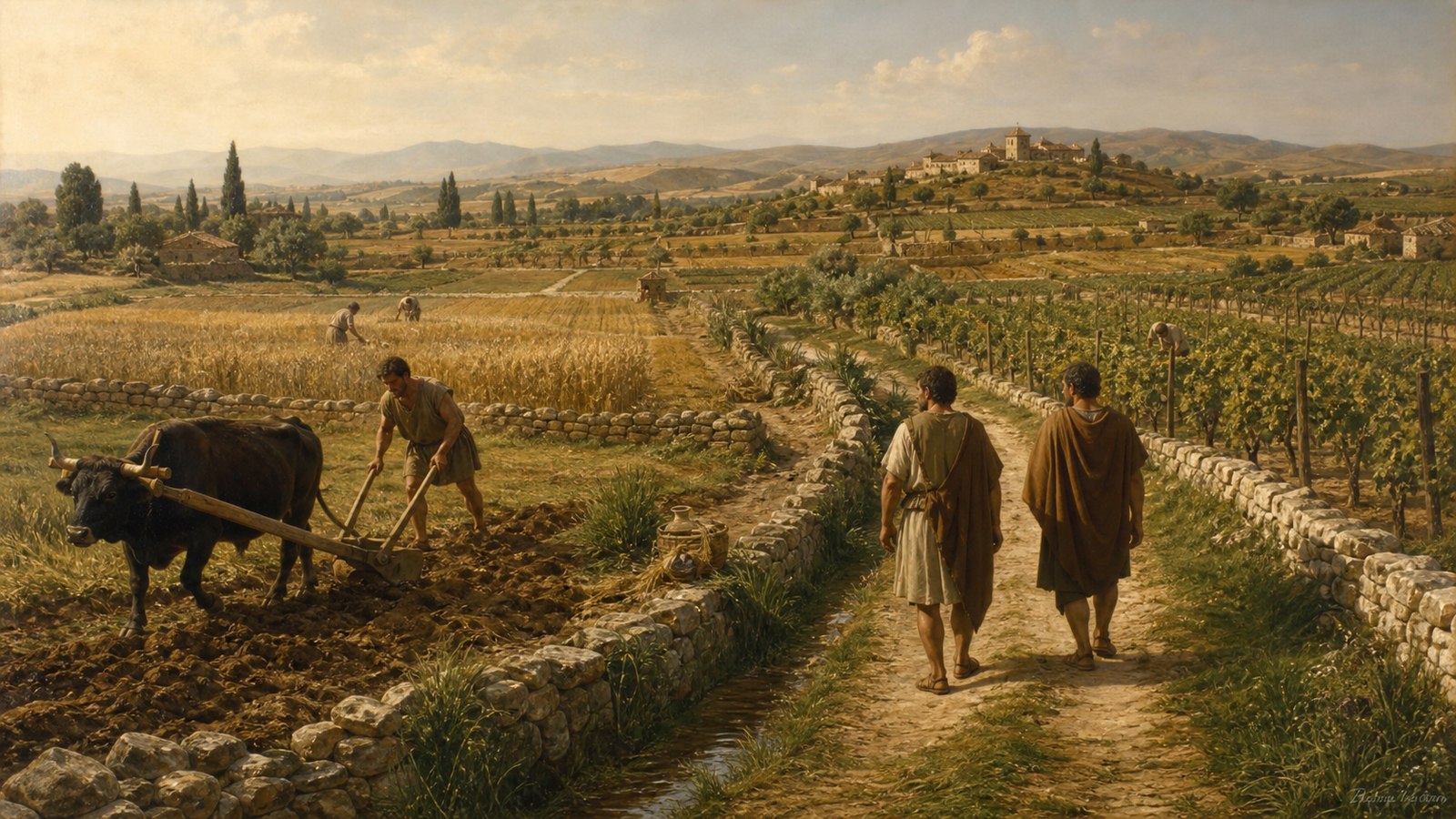
The pagi made the countryside visible to government
Distribution alone would have scattered claims across the landscape. Numa next divided the territory into districts called pagi. The district gave administration a scale between one farm and the whole Roman community.
Each pagus received overseers and patrols. Plutarch does not provide their daily roster or a surviving set of inspection forms, so it would be careless to invent one. His brief notice still identifies the functions that mattered to the story: local observation, movement across the district and a chain connecting remote fields to authority.
Boundaries organized space horizontally, separating one claim from another. Districts organized it administratively, grouping many claims under common supervision. The countryside was not left outside politics once land had been handed over. It was mapped into units that officials could traverse.
Numa sometimes travelled through them in person. That detail stages the king as an observer who leaves the city rather than waiting for reports. A farm presented itself through visible conditions: worked or idle ground, maintained or broken edges, crops advancing or weeds taking over.
Plutarch then turns appearance into reputation. The king judged character from the state of the farms. Productive care could lead to honour and trust. Indolence brought chiding and reproach intended to make the citizen more sensible.
The system therefore joined aid to surveillance. Receiving land answered poverty, but holding it placed work under inspection. The same field that fed a household also displayed evidence to neighbours, patrols and the ruler.
A cultivated field became a political biography
Reading a person from a farm is powerful precisely because it compresses many unknowns into one visible surface. A clean boundary and standing crop could suggest foresight, discipline and respect for shared order. Neglect could be interpreted as a moral failure.
But weather, illness, labour shortages and poor soil could produce the same outward damage as carelessness. Plutarch does not pause over those complications. His Numa sees the farm clearly enough to reward and rebuke. The confidence belongs to the ideal of exemplary kingship, not to an impartial modern assessment.
That limitation sharpens the political mechanism. Government did not merely count output. It converted agricultural condition into claims about worthiness. Honour and office could follow a favourable reading, which meant the field participated in a citizen’s public biography.
The approach contrasts with storage on a larger scale. Roman granaries made gathered surplus visible after cultivation. Numa’s inspections, as Plutarch tells them, made the process visible earlier. Furrows and maintained plots offered signs before grain entered a store.
The next chapter of the biography extends this preference for reorganizing identity. Plutarch says Numa divided the population by trades—musicians, goldsmiths, carpenters, dyers, leather-workers, braziers, potters and others—so the larger hostility between Sabine and Roman would be broken into smaller affiliations. Farms organized people across territory; trades organized them across the city.
Both stories replace an inherited division with repeated practices. A person could become legible as a cultivator within a pagus or as a worker within a craft body, rather than only as a follower of Romulus or Tatius. Peace was built by giving ordinary labour political structure.
Plutarch’s scene ends far from a battlefield. Its instruments are parcels, patrols, field condition, praise and shame. Yet conquest remains underneath, because the distributed territory had been won by force. Numa’s achievement in the story is not to make that origin disappear. It is to force captured land into a new civic argument: power should stop at boundaries, poverty should receive resources, and those resources should be cultivated under public eyes.
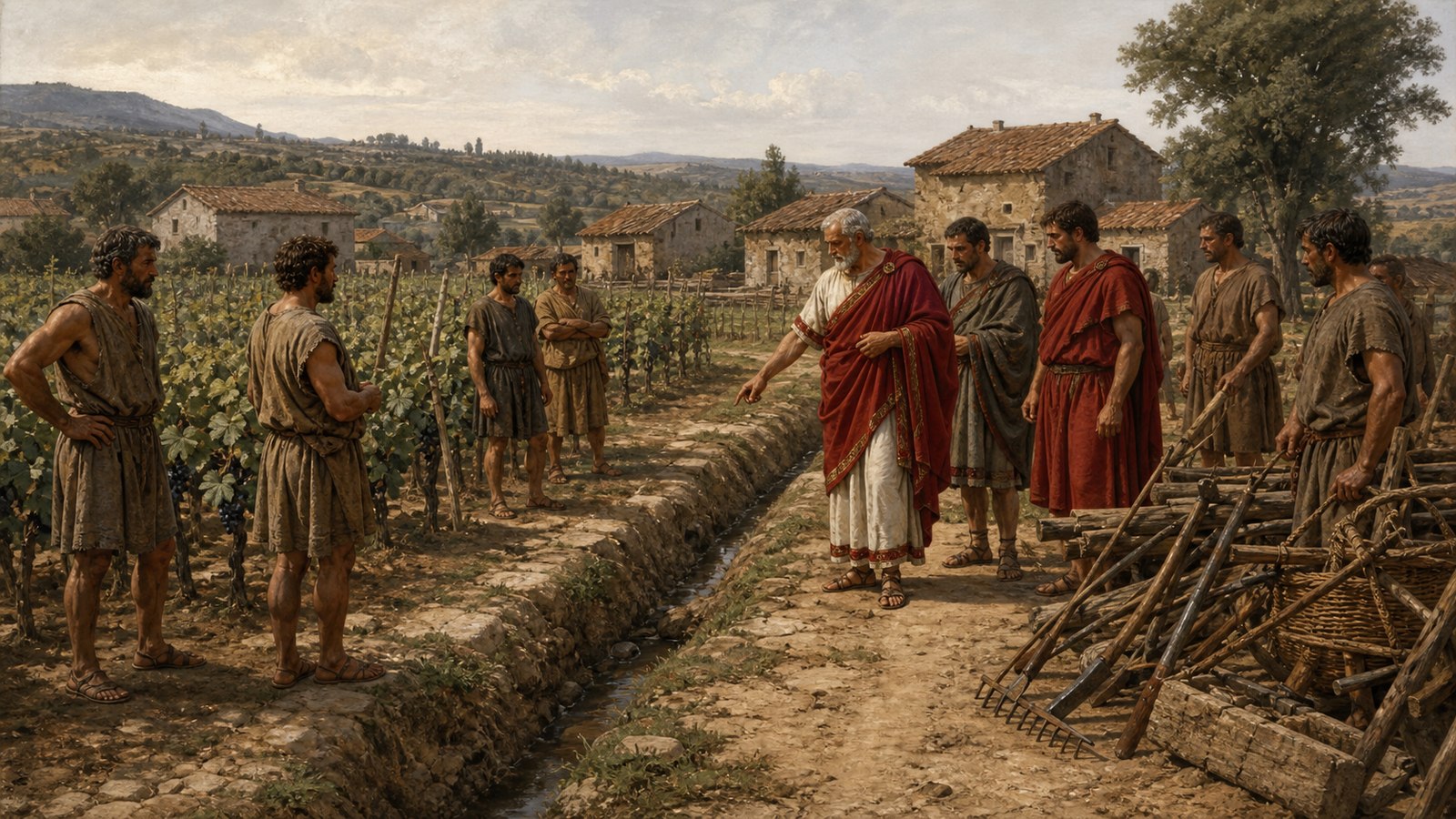
Visible cultivation could not explain every farmer
A ruler walking the districts could see repaired boundaries, worked soil and neglected plots. He could not see every cause behind them. Illness, weather, labour shortages or unequal resources could make two fields look like evidence of different characters when their cultivators had faced different constraints.
Plutarch’s formulation is revealing precisely because it compresses those complications. The inspected field becomes legible moral evidence in a biography of a lawgiving king. Good cultivation proves order; disorder in the land suggests disorder in the person.
The system could encourage upkeep while also rewarding what officials found easiest to observe. That tension belongs to many administrative tools: measurement improves reach, but the visible indicator can begin to stand in for the whole life it only partly records.
Sources
- Plutarch passage at LacusCurtius
- Plutarch in the Project Gutenberg translation
Plutarch, Life of Numa 16.1–17.3