
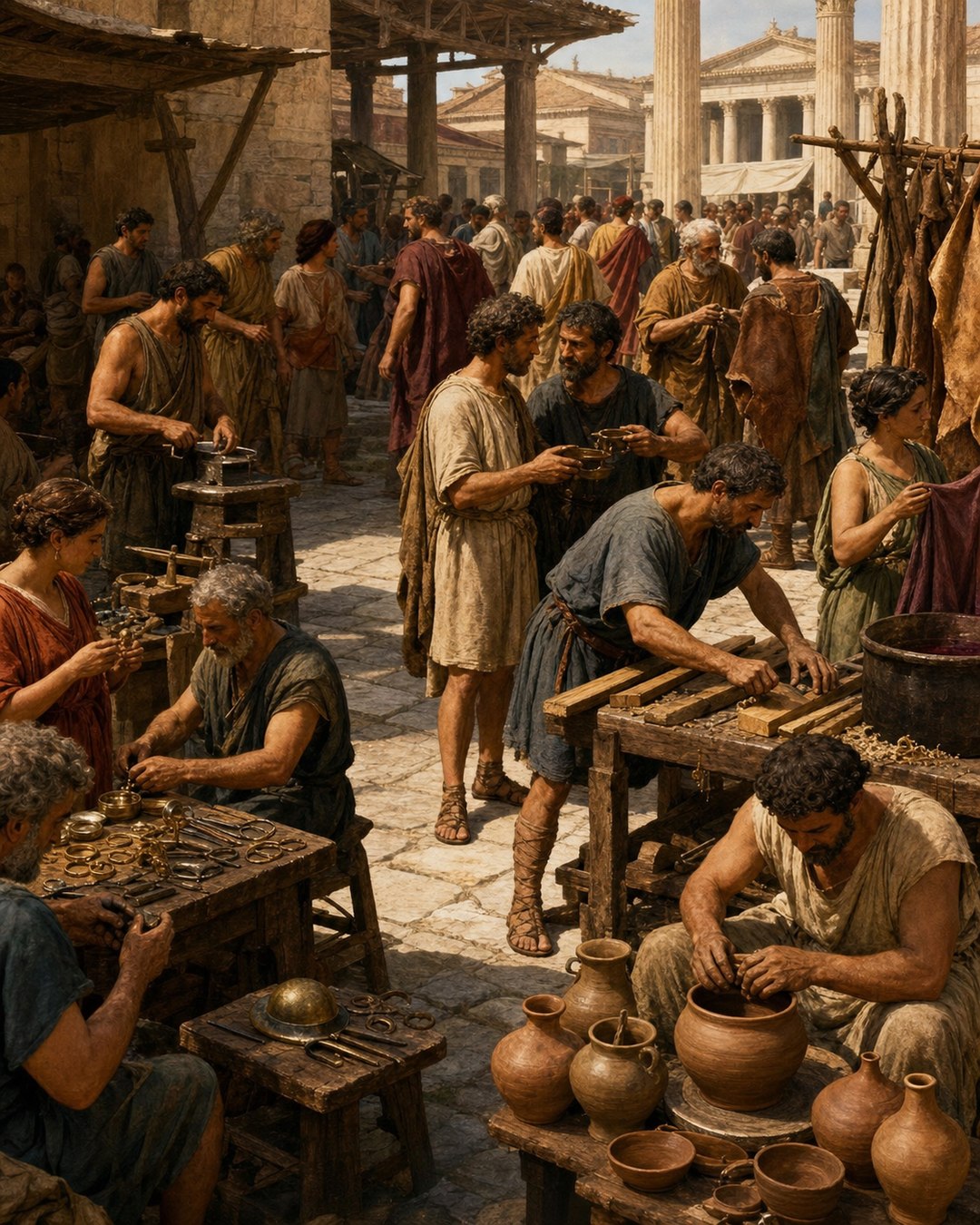
A potter did not stop remembering whether his family belonged to Rome’s original settlers or to the Sabines. Plutarch’s Numa tried something subtler. He gave the potter another group in which to act.
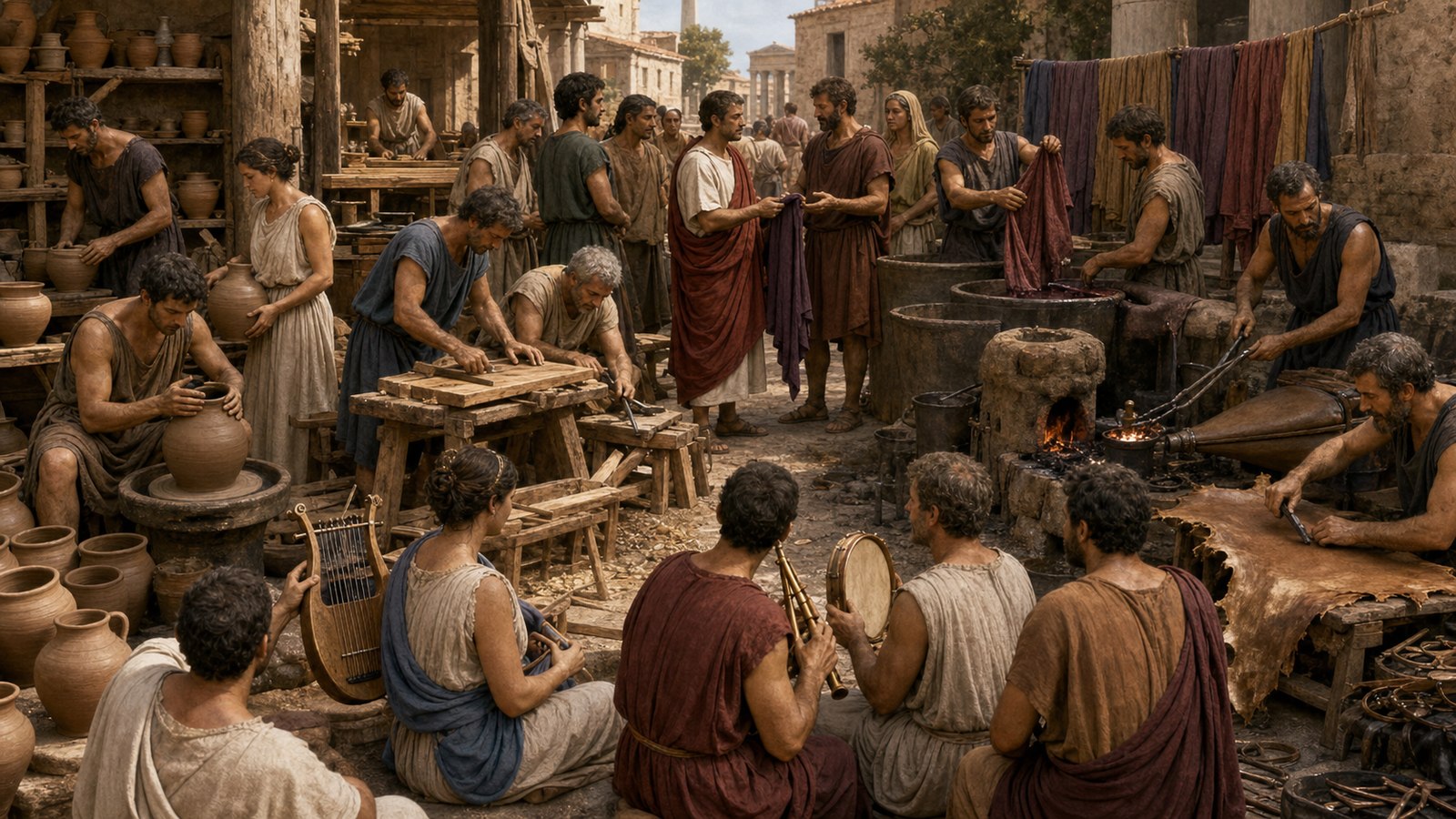
Musicians, goldsmiths, carpenters, dyers, leather-workers, curriers, braziers and potters became named bodies. Other occupations entered a ninth collective group. Each body received gatherings, assemblies and rites suited to it.
The scheme treated identity as a practical habit. Rome’s old camps had remained powerful because citizens repeatedly spoke and thought through them: Roman or Sabine, Romulus or Tatius. Numa’s answer was to multiply the occasions on which those same people would meet under different names.
Plutarch’s picture belongs to moral biography, not a surviving charter from early Rome. It cannot prove the exact constitution of eighth- or seventh-century craft organizations. It does preserve a sharp ancient theory of integration: a great binary division can lose force when daily work creates smaller affiliations that cross it.
Two founding populations still occupied one unsettled city
Plutarch introduces the reform after describing land, boundaries and agriculture. His Rome had grown through the uneasy combination of Romulus’s people and the Sabines associated with Titus Tatius. Political union had not produced a settled common identity.
The biographer says the city was supposed to consist of two tribes but lacked consistency. Its parts refused to blend or forget their differences. Collisions and contentions continued because every disagreement could reactivate the largest available distinction.
That distinction carried a story about precedence. One side could think of itself as the people who founded the city with Romulus. The other could remember that the Sabines had entered a shared settlement and shared rule after conflict. A quarrel about an office, obligation or honour could therefore become evidence in an older contest.
Numa’s challenge was not simply to announce that everyone was now Roman. A royal declaration would leave the social machinery of division intact. People still needed to buy, make, worship, gather and choose companions. If those activities continued inside the old camps, official unity would remain thin.
The account of how Roman language organized a household’s annual provisions shows ordinary categories carrying social consequences. Numa’s trade bodies worked at a larger scale. They supplied categories for people themselves, grounded in repeated tasks rather than ancestry alone.
Numa divided the binary instead of pretending it had vanished
Plutarch explains the strategy with a physical comparison. Hard substances that resist mingling can be crushed into smaller particles and then mixed more easily. The image is not gentle, and it should not be mistaken for a literal description of citizens. It makes the administrative logic visible.
One great line split the whole community. Numa created many lesser lines. A Sabine carpenter and a Roman carpenter now shared an occupational body, while a Roman potter and Roman goldsmith belonged to different ones. The new map crossed the old map instead of tracing it again.
This mattered because neither membership needed to disappear immediately. A person could retain family memory while also becoming recognizable through a craft. Over time, decisions made as a carpenter, worship conducted with carpenters and disputes settled among carpenters could give that affiliation its own weight.
The method did not eliminate hierarchy. Some crafts had more wealth, visibility or access than others. The passage says nothing about equal political power, enslaved workers or the many women whose labour sustained households and workshops. Plutarch is interested in a king’s harmonizing design, so the people at its margins are easy for his narrative to compress.
Even with those limits, the mechanism is distinct from forced sameness. Numa did not ask every difference to melt into one undifferentiated crowd. He tried to make the inherited opposition compete with several concrete memberships that were useful in daily life.
Eight named occupations gave the plan material texture
The list begins with musicians and goldsmiths, then moves through carpenters and dyers to leather-workers, curriers, braziers and potters. It sounds less like a philosophical diagram when imagined through materials: strings and pipes, precious metal, timber, vats of color, hides, bronze, clay and fire.
Each occupation demanded knowledge that outsiders did not automatically possess. Carpenters judged grain and joints. Dyers managed liquids, mordants and timing. Potters prepared clay and controlled a kiln. Bronze workers balanced heat with casting or hammering. Shared difficulty could create trust because members recognized the cost of bad work.
Plutarch does not say that these were the only jobs in Rome. He explicitly places the remaining trades in one body. The residual category prevented the named list from becoming an exclusion that recreated a population outside the system.
The distinction between leather-workers and curriers in the translation is revealing. A modern reader might collapse them into one generic leather trade, but the list preserves occupational edges. The reform multiplied social units precisely by noticing stages and specialties that a broad label would hide.
This was not merely a census. Counting workers would tell the king what existed. Forming bodies gave the count continuity. A craft identity could outlast one transaction and assemble people who might otherwise meet only as buyer and seller.
Meetings and rites turned labels into repeated behavior
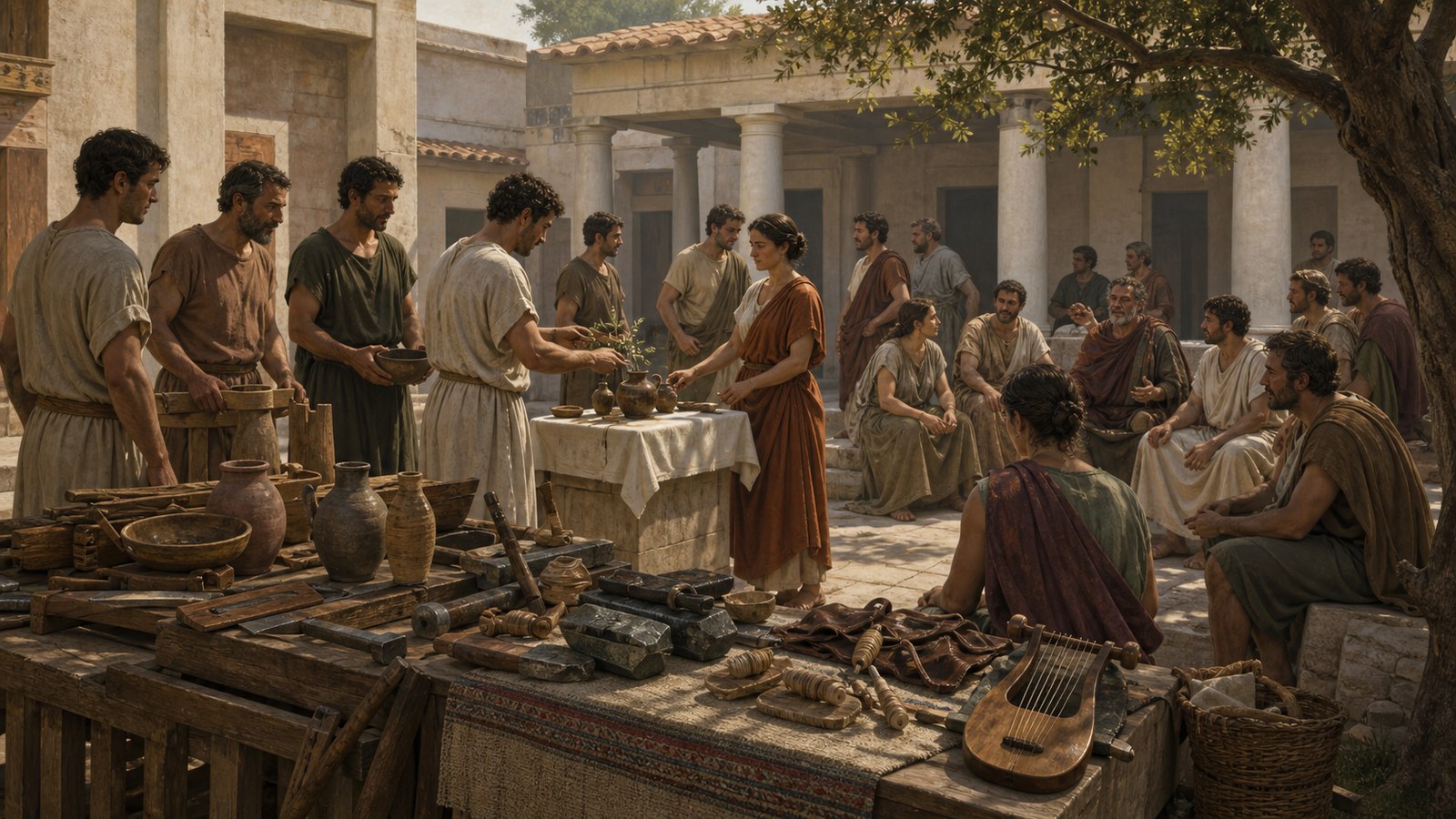
Plutarch adds three forms of activity: social gatherings, public assemblies and rites of worship appropriate to each body. Those details are the engine of his story. Without them, the occupations would remain names on a list.
A social gathering made room for familiarity. A public assembly gave the body a setting in which collective business could occur. Shared worship attached the group to a ritual calendar and required preparations that returned. Repetition converted classification into experience.
The arrangement resembles the way millers and working donkeys entered the observances of Vesta. Labour did not sit outside religion. Tools, animals, rest days and garlands could make an occupation visible as a community with sacred as well as economic rhythms.
These bodies also offered practical routes for negotiation. If supplies, standards, apprentices, funerals or obligations became disputed, members had occasions to recognize one another and speak collectively. Plutarch does not provide rules for those cases, so inventing a complete guild constitution would go beyond the passage. The important claim is smaller: meetings and rites made occupational solidarity performable.
That performance crossed ancestry. A rite attended by both Sabine and Roman potters did not require them to settle every inherited grievance first. It asked them to complete one shared act as potters. Integration could accumulate through such limited cooperation.
Harmony in the biography remained a political claim
Plutarch says the reform banished the practice of calling some citizens Sabines and others Romans, or followers of Tatius and Romulus. The conclusion is almost too complete. Social names rarely disappear because one ruler reorganizes meetings.
The smooth ending tells us how the episode functions inside the life of Numa. Romulus created and fought; Numa orders, divides and reconciles. A city that had been joined by conflict becomes governable through institutions attached to peaceable work.
That literary purpose does not empty the episode of insight. Its strength lies in recognizing that political hostility survives in repeated categories. If every issue is narrated through one inherited opposition, the opposition renews itself. New affiliations can interrupt that cycle when they create obligations and loyalties that do not align with the old line.
The trade bodies also expose the cost of governing through categories. Someone had to decide which occupations deserved separate names and which entered the remaining body. Classification could empower members while fixing boundaries around them. The same instrument that blended Rome could also rank or simplify its workers.
Plutarch’s final image is harmony produced by many divisions. That paradox is the point. Numa did not make difference disappear. He rearranged it until a carpenter’s meeting, a potter’s rite or a dyer’s assembly offered another answer to the question “Who are your people?”
The old names of Romulus and Tatius remained in Rome’s stories. In this account, however, they stopped organizing every present relationship. Clay, bronze, timber, cloth, music and leather supplied smaller worlds in which cooperation could become routine. Political blending began not with a single grand identity, but with work done and rituals repeated side by side.
Sources
- Plutarch passage at LacusCurtius
- Plutarch in the Project Gutenberg translation
Plutarch, Life of Numa 17.1–3.