
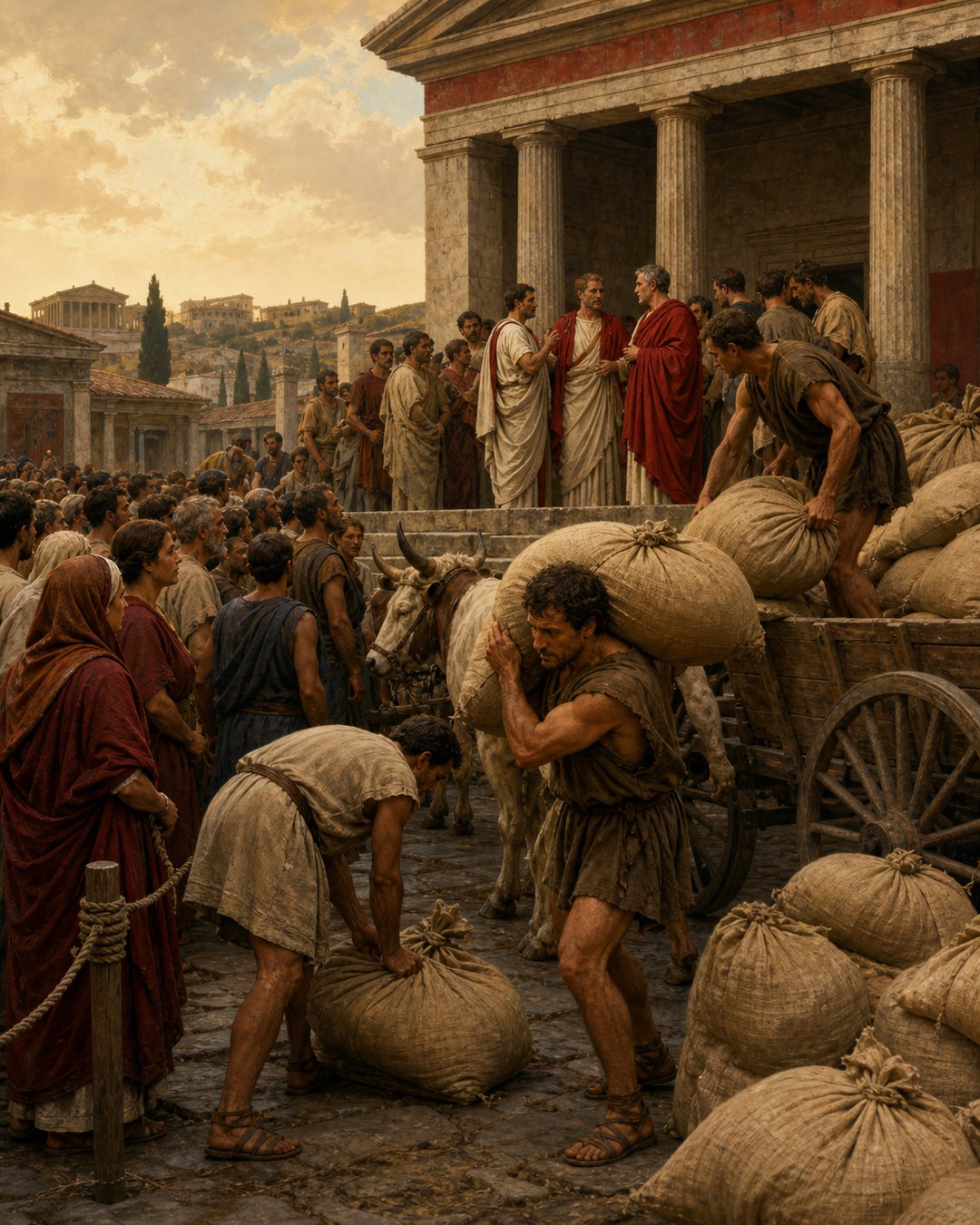
The sacks had reached Rome, but relief still had to pass through the Senate. Plutarch describes a city in which scarcity had sharpened an older argument over who could speak for the plebs. Grain bought in Italy arrived beside an equal quantity sent as a gift from Syracuse by Gelo. Outside the senate-house, people waited for a decision that was practical in the most immediate sense: what would the grain cost, and would the donated part be handed out without charge?
Marcius Coriolanus saw a different opportunity. In Plutarch’s telling, he did not treat the shipment as a neutral supply problem. He tried to make distribution conditional on a reversal of the plebeians’ recent political gains. The cargo therefore became leverage. A debate about food moved into a dispute about the tribunate, then out of the chamber and into the forum.
The Cargo Waiting Outside the Senate House
Plutarch is unusually careful about where the grain came from. A substantial share had been purchased in Italy. An equal amount had arrived as a present from Syracuse, where Gelo ruled. Those two streams created two expectations. Purchased grain might return to the market at a bearable price. Gifted grain could reasonably look like something to distribute free, and some senators advised exactly that.
The people gathered around the senate-house because the decision could not be separated from hunger. They were not watching a distant constitutional performance. The vote would determine whether households could obtain food and on what terms. Rome’s reliance on movement and storage made politics tangible, just as the arrival of grain ships could make imperial politics nervous in later periods. Here the hinge was smaller and more exposed: sacks, a chamber, and a crowd close enough to hear what followed.
Plutarch says people hoped the shipment would end both scarcity and discord. That pairing matters. Food was expected not merely to fill stomachs but to cool a civic conflict. The hope assumed that competent distribution could restore a measure of trust. It also meant that any senator who obstructed relief would be seen as choosing discord while the means of relief sat nearby.
A Food Question Became a Constitutional Weapon
Marcius attacked the senators who favoured the multitude. His speech widened the subject from this shipment to the entire balance of the republic. He called popular advocates demagogues and traitors to the aristocracy. He argued that concessions had nourished plebeian boldness and that the tribunate had grown too strong because it obtained what it wanted and resisted consular constraint.
The proposal was therefore more severe than refusing a free ration. Marcius urged the Senate to take the tribunate away. In his argument, grain was not owed relief but a bargaining position. Distribution would reward disobedience; withholding it could help recover authority. Material dependence was being converted into a test of constitutional submission.
Plutarch does not ask us to imagine a formal policy paper. He gives us a forceful speech in a chamber under pressure. Yet its mechanism is clear. Control the point at which food becomes accessible, attach a political demand to that access, and force opponents to choose between immediate need and institutional power. The shipment’s mixed origin made the maneuver especially abrasive. A royal gift intended for Rome could be folded into a domestic attempt to discipline Roman citizens.
The Chamber Could Not Contain the Speech
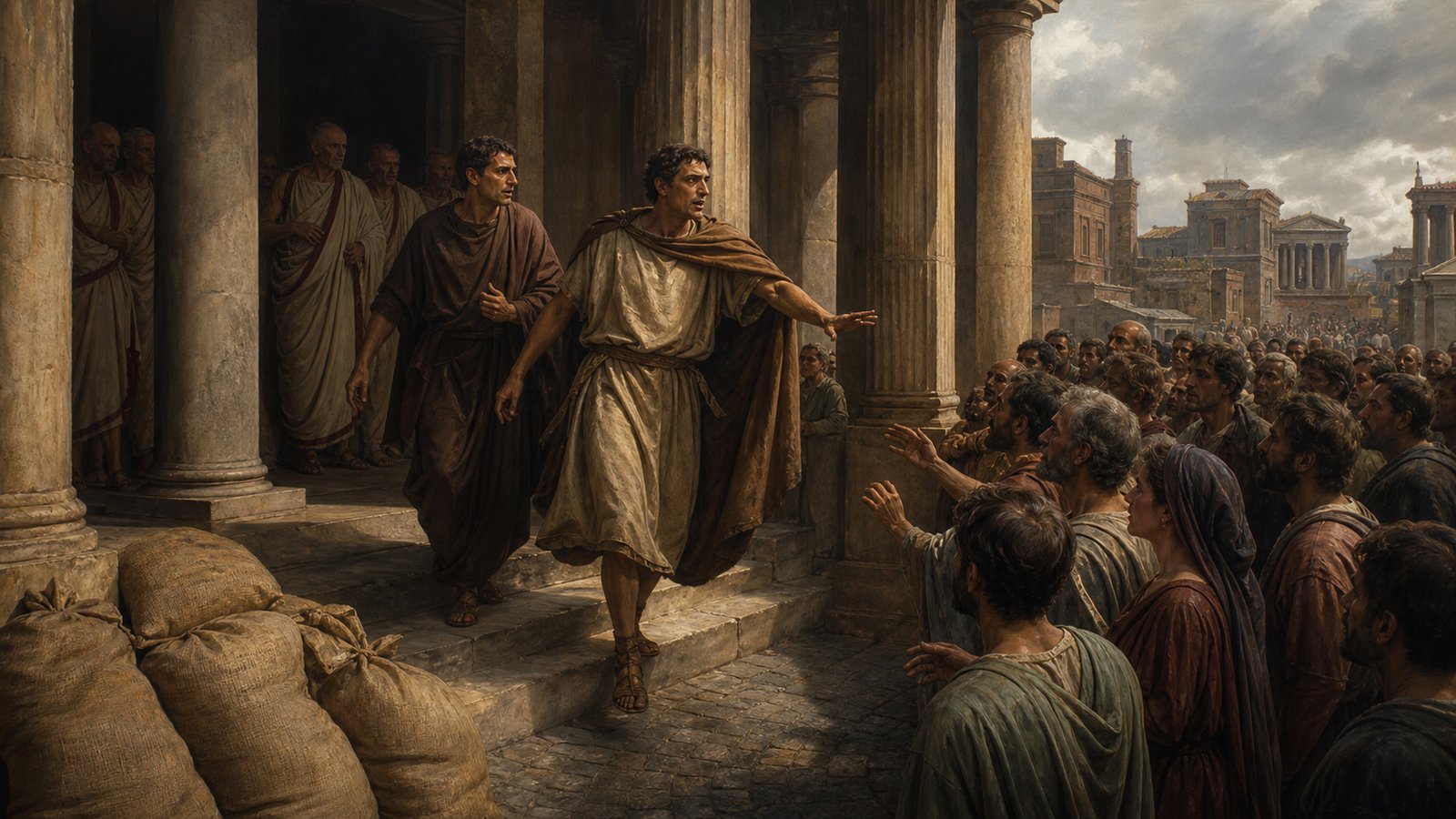
The younger senators and many wealthy men responded warmly to Marcius, according to Plutarch. Some older senators resisted because they feared the result. Their caution proved justified. The tribunes were present, recognized that his proposal might prevail, and rushed out to call the plebeians together.
This movement from chamber to crowd is the episode’s narrative engine. A closed deliberation became public action in minutes. Rome’s officers made power visible by where they stood and how they moved; lictors could make magistracy walk through the city, while here the tribunes made senatorial words travel into the forum. The constitution was not only a set of offices. It was also a chain of messengers, assemblies, attendants and bodies occupying space.
Once the speech was reported, the crowd surged toward the Senate. The tribunes formally denounced Marcius and summoned him to defend himself. He drove away the officers carrying their message. When the tribunes and aediles tried to take him by force, patricians intervened, expelled the tribunes and beat the aediles. Evening, not agreement, ended the first collision.
Hunger Shortened the Distance from Speech to Force
The next morning the people returned to the forum. The consuls, alarmed for the city, urged the Senate to offer reasonable and conciliatory measures. Plutarch’s sequence shows why food crises are politically dangerous without reducing politics to hunger alone. Scarcity did not invent the dispute over the tribunate. It shortened the distance between an existing institutional grievance and collective action.
Every step intensified the next. Unsown land and disrupted imports had produced scarcity. The shipment created hope. Hope concentrated attention on the Senate. Marcius’s attempt to exchange relief for institutional surrender made the decision look punitive. The tribunes publicized the threat, the crowd answered, and officers attempting enforcement encountered physical resistance.
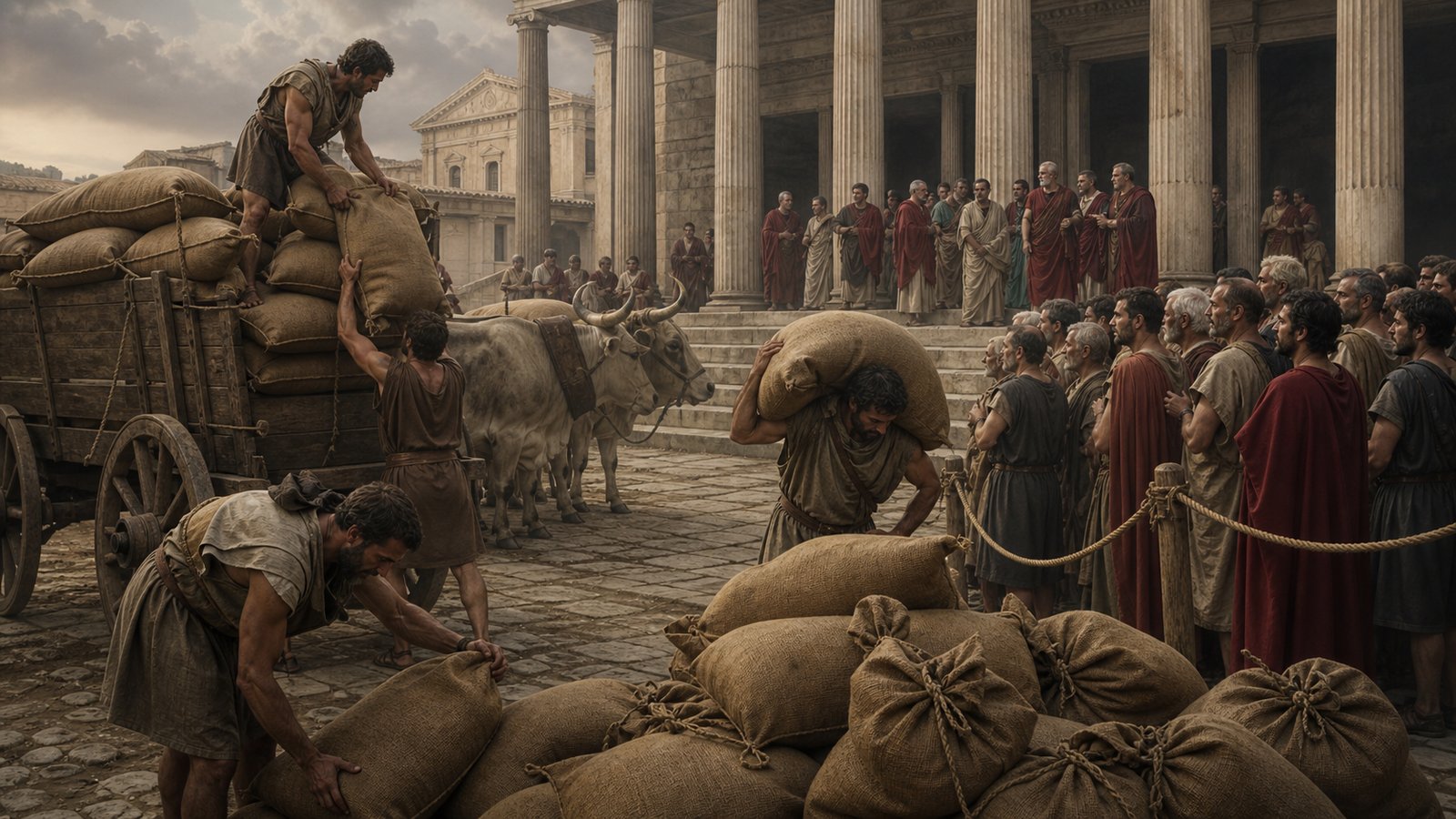
The sacks never needed to speak. Their presence fixed the argument in a concrete object that no faction could explain away. Had no grain arrived, senators might blame shortage on war or transport. Once grain was present, distribution became a deliberate choice. The issue was no longer whether Rome possessed food but who could decide the terms under which Romans received it.
What One Shipment Reveals About Republican Power
Plutarch wrote biography, not a neutral transcript, and his Coriolanus is shaped as a proud soldier whose anger repeatedly outruns political judgement. We should not treat every sentence of reported speech as verbatim. We can still follow the institutional and material structure he records: an Italian purchase, a Syracusan gift, a waiting crowd, a Senate debate, a demand against the tribunate, and an attempted summons.
The episode complicates the familiar picture of Roman grain as a later imperial tool. Long before emperors staged generosity, Roman writers could imagine food distribution as a test of civic status. The question was not simply whether the poor would be fed. It was whether accepting or receiving relief implied obedience, whether the Senate could use provisioning to revise the constitution, and whether tribunes could turn information into resistance quickly enough to stop it.
The distinction between the purchased and donated shares also prevented a simple argument about cost recovery. Rome had paid for part of the cargo, but Gelo had supplied another part as a present. Some senators could therefore recommend free distribution without claiming that every sack had appeared without expense. Marcius answered neither quantity separately. He treated the whole arrival as an occasion to judge the plebs, which made his constitutional condition look broader than an accounting decision.
Older senators anticipated danger before the crowd moved. Their resistance did not depend on affection for the tribunate; Plutarch says they suspected the outcome of Marcius’s course. That detail makes the crisis more than a collision of fixed classes. Experience divided the aristocracy too. Some recognized that a chamber could formally possess a shipment yet lose control of the city by deciding its use provocatively.
Coriolanus lost control of the moment because he treated need as weakness to exploit. The crowd understood the same shipment as common relief, while some senators understood the gifted share as something that should remain a gift. Between those positions lay the republic’s fragile claim to be one city. Plutarch’s grain cargo exposes the seam: Rome could move food across seas more easily than it could decide what citizens owed one another when the sacks reached the forum.
Sources
Plutarch, Life of Coriolanus, sections 16–18; Plutarch’s Lives, Clough translation, “Coriolanus.”