
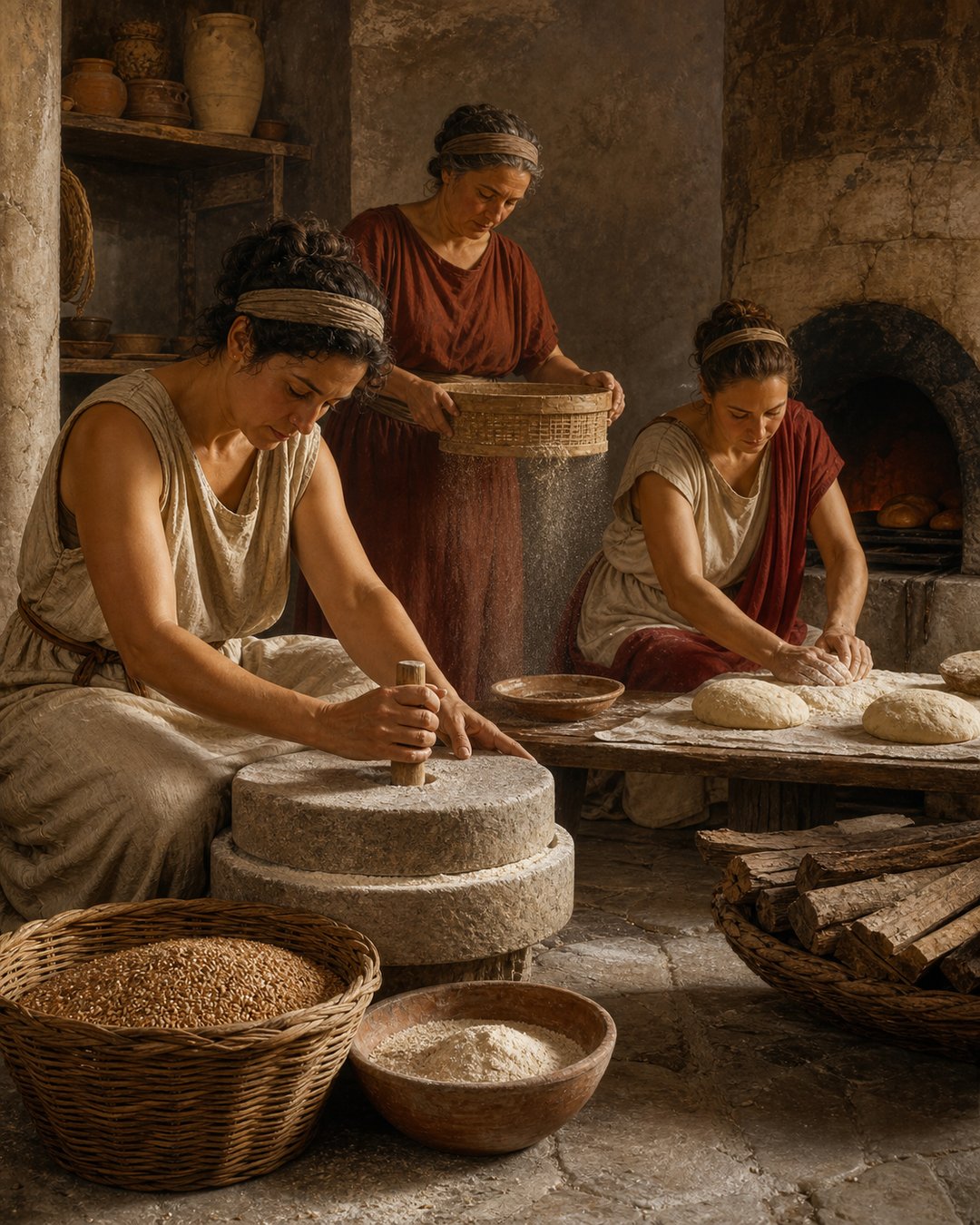
Rome did not discover bread when it discovered the baker. Pliny the Elder draws a distinction that is easy to miss: the food was ancient, but the specialist trade was not. He says there were no bakers at Rome until the war with King Perseus, more than five hundred and eighty years after the city’s foundation. Before that point, Romans still ground grain, handled meal, shaped dough, and ate loaves. The work simply belonged to other hands and other social arrangements.
Pliny assigns ordinary breadmaking to women in the household. For affluent people, he preserves a report from the jurist Ateius Capito that cooks could make bread. Those cooks, he adds, were hired from the market for an occasion in the old period rather than maintained permanently among household slaves. The person called a pistor originally had a narrower identity: the pounder of spelt. The later baker inherited a word rooted in the hard work that came before the loaf.
A Date That Divides Food from Occupation
Pliny’s chronology uses the war with Perseus as a hinge. That war ended in the second century BCE, and his “more than 580 years” is an ancient calculation tied to Rome’s foundation date. We do not need to treat it like a modern labor census to see what the passage is doing. Pliny believed the professional baker could be dated, and he believed that date came surprisingly late.
The claim separates a product from a profession. Bread can be common without a person publicly defined as “the baker.” A city can consume enormous quantities of grain while milling, sifting, mixing, and heating remain distributed across households, hired help, and workers named for one stage of production. The arrival of a trade means those stages have been gathered into a recognizable service.
That service did not erase the agricultural chain behind it. The field still had to be cut and threshed, a sequence explored in the Roman harvest’s separation of grain. What changed in Pliny’s story was the urban end. The city began to recognize breadmaking not merely as something families did, but as work another person could sell under a durable occupational name.
Women Made the Daily Loaf Visible Only at Home
Pliny’s brief phrase about women carries much of the story. Household bread was necessary, repetitive labor, but it did not create the same public identity as a bakery. Grinding, measuring water, tending leaven, controlling heat, and cleaning equipment filled time even when no signboard announced the work. The absence of professional bakers therefore does not mean an absence of skill.
It means skill was organized inside domestic life. Pliny even remarks that women still performed the task among many peoples in his own day. His comparison makes the older Roman arrangement legible to his readers: they could look beyond Rome and see a living version of the household pattern he placed in the past.
The distinction also warns against telling urban history only through occupations preserved in labels. Once pistor meant baker, inscriptions and shops could make the trade visible. Earlier breadmakers were less likely to appear through that professional category. Yet every meal depended on them. The historical record grows louder when labor moves into a named market role; the work itself may be much older than the evidence’s volume.
The Pistor Began with the Sound of Pounding
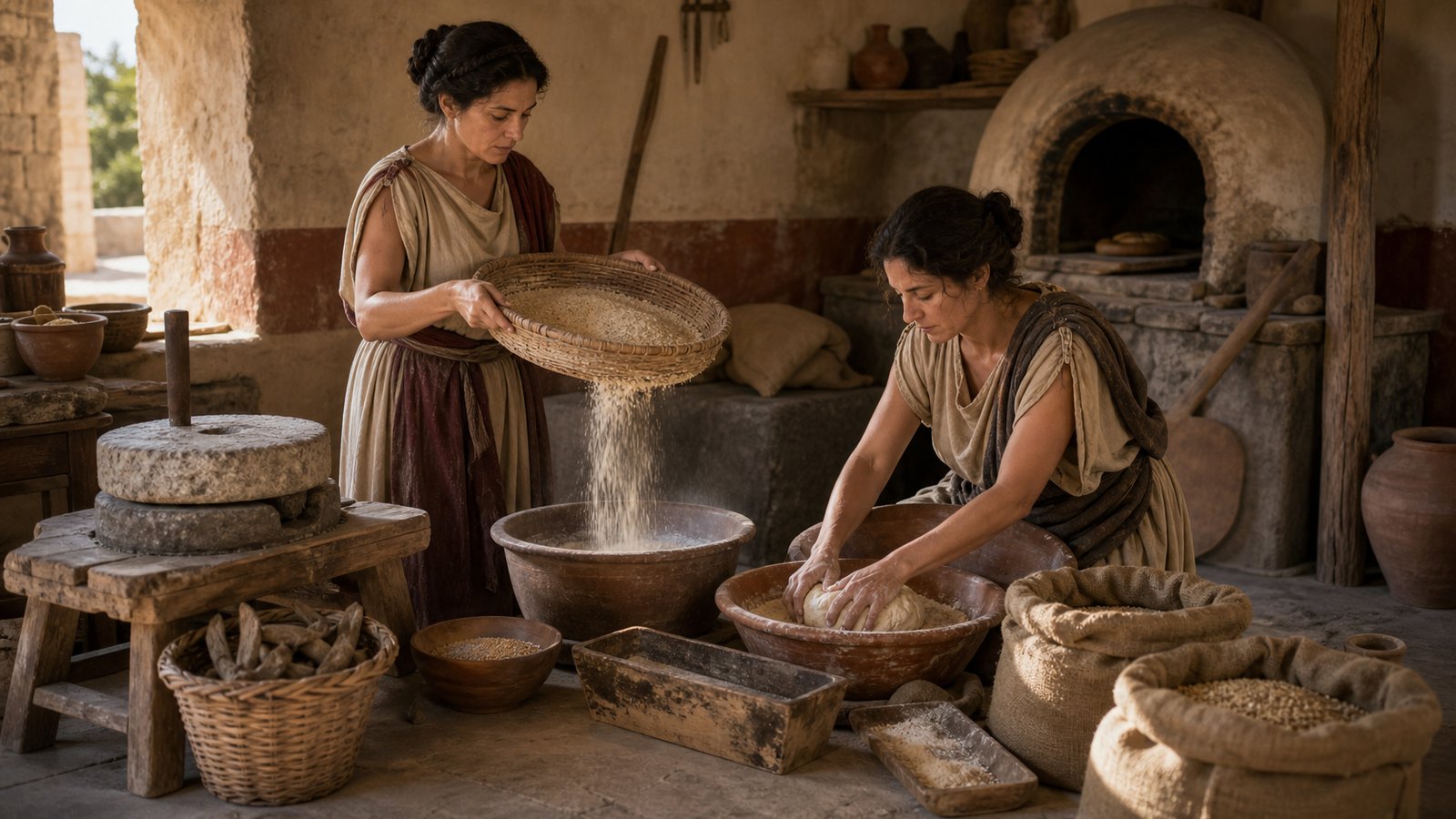
Pliny links pistor to pounding spelt. His etymology makes the word carry a physical action: repeated blows breaking grain before dough could exist. Whether every later baker still pounded grain personally is not the point. The occupational title remembered a stage of processing that had once defined the worker.
This older meaning helps us imagine production as a chain rather than one craft. Someone obtained grain, someone pounded or milled it, someone sifted the meal, someone mixed and leavened it, and someone controlled the baking surface or oven. A later bakery could combine those tasks under one enterprise. In the earlier arrangement, names and workers could remain attached to individual stages.
Pliny’s reference to the artopta, usually rendered as a bread-tin, gives the chain an object. He cites a line associated with Plautus but immediately notes scholarly disagreement about whether the line really belonged to the playwright. That hesitation is useful. It shows an ancient author not merely repeating a convenient prop, but exposing uncertainty in the textual evidence he used to date bread equipment and language.
Sieves Carried Their Own Geography
The chapter ends by moving from Roman labor to regional sifting tools. Pliny says Gauls employed a horse-hair bolter. Spanish communities made sieves and meal-dressers from flax or a related fibrous material, while Egyptians used papyrus and rushes. The loaf’s texture depended on an object whose material reflected local plants, animals, and craft traditions.
Sifting looks modest beside an oven, yet it governs what reaches the dough. Mesh catches coarse particles and lets finer meal pass. Different fibres demand different techniques of twisting, stretching, and mounting. Pliny’s list compresses several material economies into one kitchen operation: horse hair in one region, tough plant fibre in another, wetland plants along the Nile.
The list also prevents us from imagining one universal “Roman” bakery kit. Rome could professionalize bread without forcing every province to use the same sieve. A shared food existed alongside regional tools. The same contrast appears in storage, where rules about a pantry’s supply mattered even though containers and ingredients varied; see the Roman pantry’s one-year boundary.
Mesh quality would affect both labour and expectation. A coarse screen left more husk and larger particles; repeated passing could produce a finer meal at the cost of additional time. This does not let us assign one texture to every fibre Pliny names, but it does reveal why a source discussing bakers pauses over sieves. Bread was not only transformed by heat. Its character was decided earlier, through a sequence of sorting choices that could be felt in the hands and seen in the flour.
The tools also joined food history to repair work. Horse hair could break, rushes could dry, and woven fibre could loosen. Screens had to be maintained and replaced. Professionalization gathered not just recipes but a minor ecology of supporting crafts around repeated production. A bakery required dependable access to mill surfaces, baskets, screens, vessels, fuel, and water before a customer saw a loaf.
A Bakery Repackaged Existing Skills
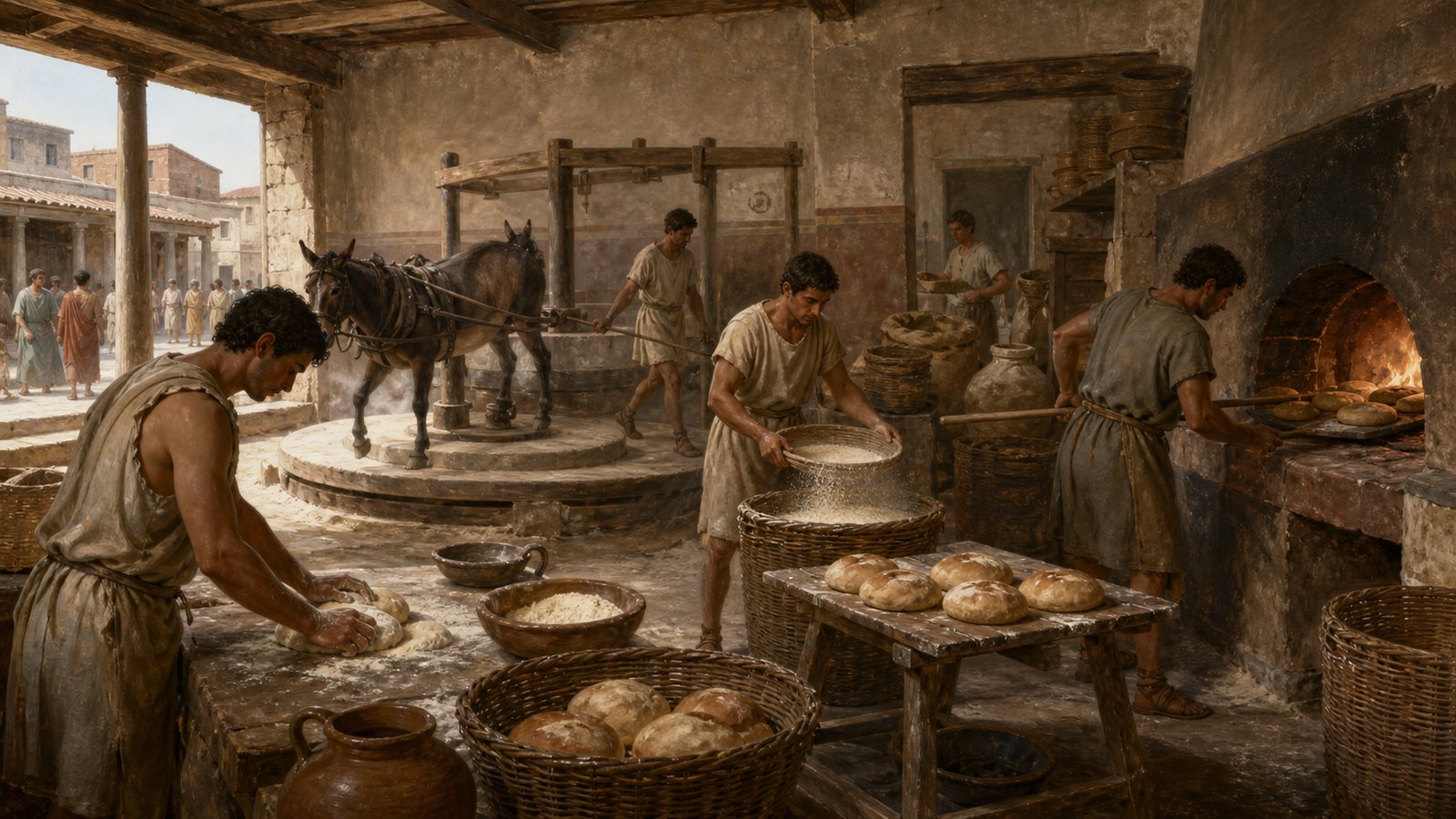
Pliny’s story is not a simple march from primitive home to advanced shop. Households already knew how to produce bread. Women carried much of that knowledge. Pounders processed spelt. Cooks served wealthy clients, sometimes hired from the market for a particular occasion. Toolmakers supplied tins, mills, sieves, and other equipment. Professional baking reorganized those capabilities into a trade that the city could recognize and buy repeatedly.
That reorganization changed visibility. The household loaf disappeared into routine consumption. The baker occupied a public economic position. A task once embedded in gendered domestic obligation could now also be priced, commissioned, and associated with a shop or workshop. Both systems could coexist; Pliny’s late date describes the appearance of the profession, not the instant extinction of home baking.
The five-hundred-and-eighty-year claim lingers because it reverses an assumption. We tend to infer that an old food must have produced an equally old specialist. Pliny asks us to hear the pounding before the profession: centuries of bread, innumerable skilled hands, and only later the stable urban figure called the baker.
The shop did not invent the loaf. It made an old sequence of actions newly visible as a continuous business, with its own public name, equipment cycle, and place in the city’s daily exchange.
Sources
Pliny the Elder, Natural History, Book 18, chapter 28.