
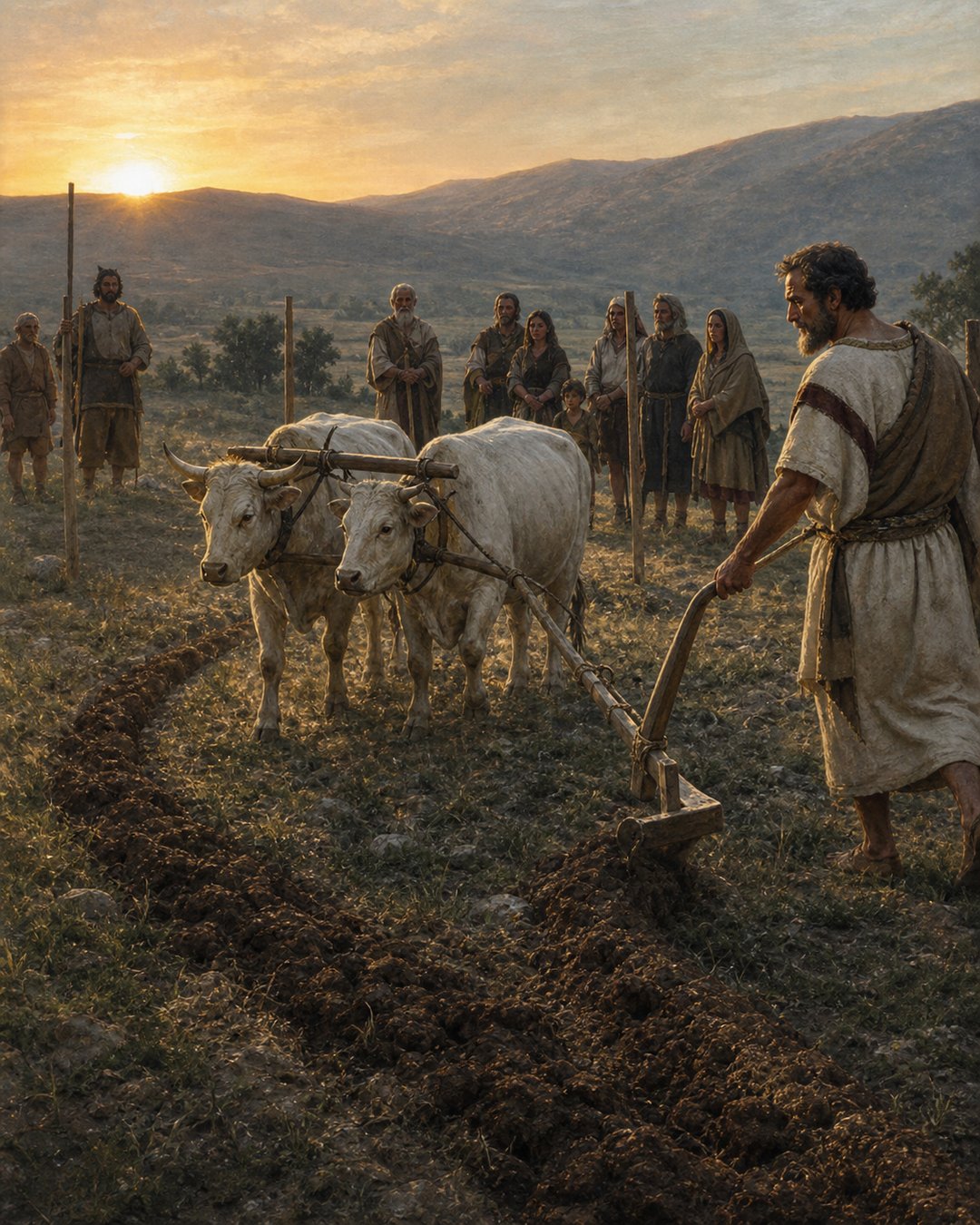
A Roman town boundary began with an agricultural tool. Varro says communities in Latium followed an Etruscan rite in which a bull and a cow drew a plough around the intended settlement. The founder turned the cut earth inward. The trench and its bank established the beginning of ditch, wall, and protected urban ground.
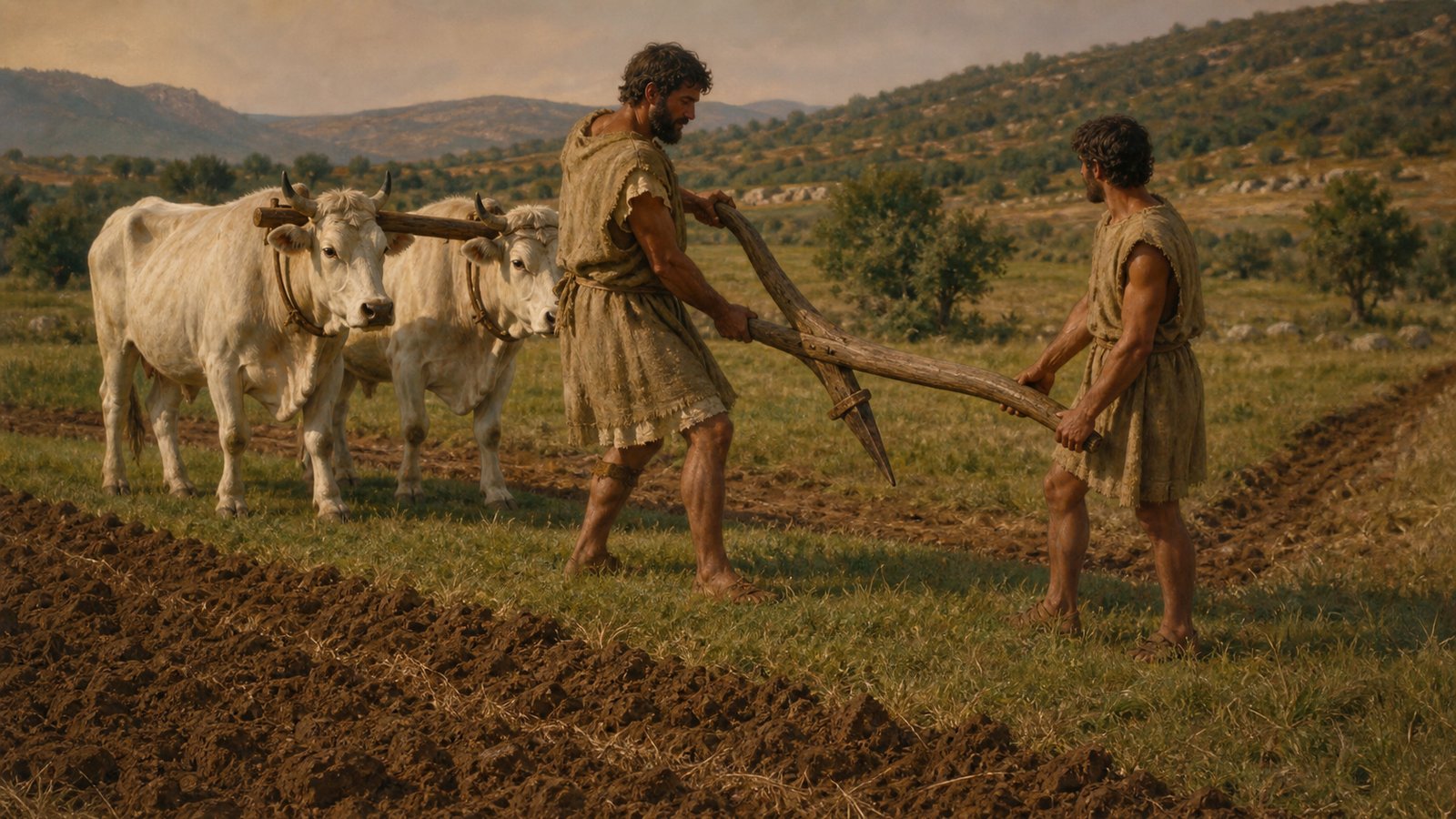
The line could not remain unbroken. People, carts, animals, and armies needed passages. At the chosen openings, the plough was lifted and carried across before it entered the soil again. Varro even connects the Latin word for gates, portae, with portare, to carry.
Whether his etymology satisfies modern linguistics is less important than the physical picture it preserves. A gate was not merely a hole cut later through a completed wall. In the founding performance, it appeared as a deliberate interruption. The boundary acquired force through continuity; access existed because the ritual makers openly stopped that continuity in measured places.
A Bull and Cow Drew More Than a Farm Furrow
The rite borrowed the movement of cultivation but changed its purpose. A plough usually opens ground for seed. Here yoked cattle pulled it around a future community on an auspicious day. The action transferred familiar labour into the creation of civic space.
Varro specifies a bull and cow, a paired team that made the circuit more than an improvised survey. The animals, date, and direction belonged to a rite associated with Etruscan practice. Founding required correct performance because the resulting line separated areas that would not be treated alike.
The implement was likely an ard rather than a heavy modern mouldboard plough. Its wooden body and point scratched and opened the soil as the team advanced. The physical result did not need to resemble the later defensive ditch. It needed to make the intended circuit visible and to turn each step of the route into an action witnessed by participants.
Romans often made distance meaningful by repeating a controlled operation. a bronze ball used to count Roman miles linked measured progress to an object dropped at each interval. The founding plough worked around a perimeter instead of along a road, but it likewise converted movement into an ordered spatial claim.
Inward Earth Made the Settlement Legible
Direction mattered. Varro says the founder turned the soil toward the inside. The cut left a trench outside and deposited earth on the settlement side. He associates the trench with fossa and the bank with murus, wall. A small agricultural furrow thus contained the diagram of a much larger defence.
Moving the earth inward also identified which side belonged to the new urban body. Without that gesture, a line in open ground could remain ambiguous. The bank gave observers an inside; the hollow supplied an outside. Later builders could enlarge the distinction with masonry, rampart, ditch, and towers.
The rite did not construct a defensible wall by itself. Cattle and a wooden plough could not raise the fortifications required against attack. Its work was prior and classificatory. It designated the path whose later material form would protect houses, shrines, assemblies, markets, and stores.
Varro’s explanation of the pomerium places protected space in relation to the wall. He connects the term with ground behind or alongside the wall, a zone marked by religious and public meaning rather than ordinary ownership alone. The founding circuit therefore helped organize rules before the final stones were in place.
Lifting the Blade Created Lawful Openings
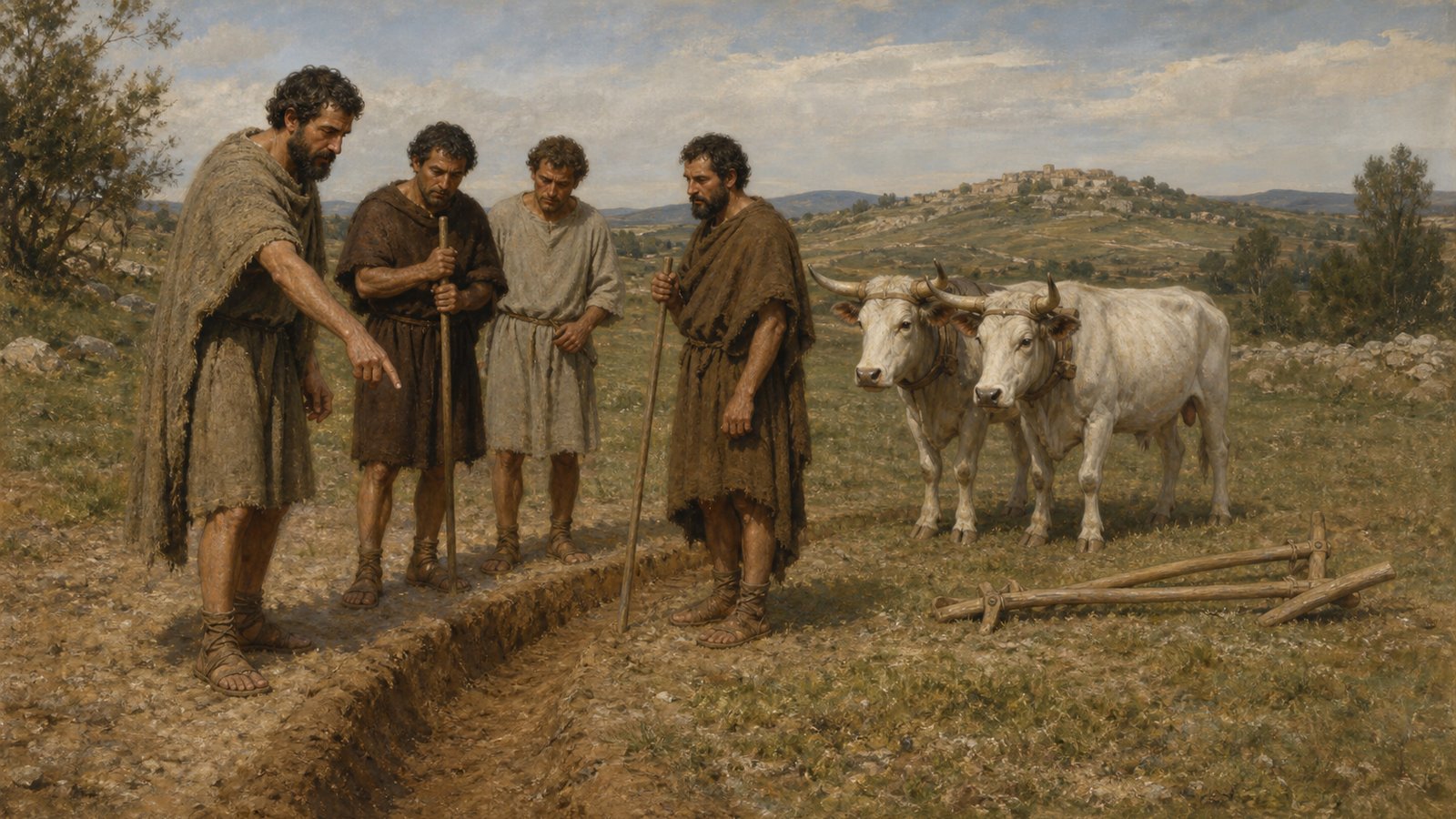
A wall without entrances would be complete and useless. Yet cutting a passage anywhere after the rite would weaken the idea of a bounded whole. The lifted plough solved that tension during the first circuit. Where a gate was planned, attendants carried the implement so its point stopped cutting. The break was intentional from the start.
The gesture is striking because it created absence through effort. Keeping the point in the earth was the easy continuation. Several people may have needed to steady or lift the implement while the cattle crossed the selected width. The unmarked ground became visible as an exception precisely because the furrow resumed beyond it.
Varro uses this action to explain portae. Ancient writers often built etymologies from resemblance and cultural memory, and not every derivation remains accepted. His account still shows how educated Romans imagined their gates: as places carried over when the boundary was born.
That origin made entrances different from damage. A breach breaks a defensive line against the community’s will. A gate interrupts it by design and places movement under supervision. Hinges, doors, guards, roads, customs, and ceremony would later occupy the opening, but the plough had already classified it as permitted passage.
The Furrow Joined Religion, Surveying, and Defence
It is tempting to separate the ritual from practical town planning. Varro’s scene does the opposite. The circuit needed a chosen route; the route had to respond to terrain; gates needed alignment with roads; inward soil announced the settlement side; and the future wall required a continuous defensible logic. Religious performance made those planning choices public and memorable.
The result could also support political authority. Someone directed the team, chose the auspicious moment, and controlled where the tool left the ground. A founder did not merely discover a natural boundary. He enacted one before witnesses and connected it to inherited Etruscan knowledge.
Sacred objects elsewhere in Roman tradition worked through controlled duplication or custody. the eleven copies made for Rome’s sacred shield protected one object by organizing many similar ones. The founding furrow protected a space by organizing continuous and interrupted ground. Both stories turned ritual precision into a civic safeguard.
Varro’s brief linguistic discussion cannot tell us that every Roman or Latin town reproduced an identical ceremony. It presents a learned Roman explanation of a recognized foundation practice. Archaeology may reveal walls and gates, but the first shallow cut and its exact performance rarely survive for excavation.
The loss of that first surface does not make the rite irrelevant to the later city. A stone curtain may be rebuilt on a slightly altered line; a gate may be widened; a suburb may spread beyond the old circuit. The founding account still supplies a language for discussing which ground began as inside, where crossing was intended, and why the wall’s edge carried more than a builder’s convenience. Varro’s interest in words captures how a remembered action could remain attached to urban institutions long after the original furrow had vanished.
The sequence also disciplined expansion in imagination. First came an auspicious day and chosen circuit. Then the team cut, the soil moved inward, and the tool rose at specified openings. Only after those distinctions could ditch, bank, masonry, road, and gatehouse enlarge them. The rite did not replace surveying or construction; it arranged their meanings. A route through open earth became a civic perimeter because participants knew when the blade must remain down and when it must be carried.
Even the animals contributed to that ordered pace. The bull and cow did not race around an abstract line. Their bodies gave the circuit duration, turns, strain, and visible continuity. Spectators could follow the formation of the boundary as an event rather than encounter it later as a completed barrier. The settlement was declared through work performed in real time.
The account matters because it gives movement to words that later look abstract. Ditch, wall, boundary, and gate begin with cattle stepping forward, soil rolling to one side, and a wooden point leaving the earth. The town becomes imaginable before it becomes monumental.
At each gate, the founder acknowledged that a city needed both separation and exchange. The plough marked where ordinary ground ended. Lifting it marked where controlled movement could begin.
Sources
Varro, On the Latin Language, Book 5, section 143.