
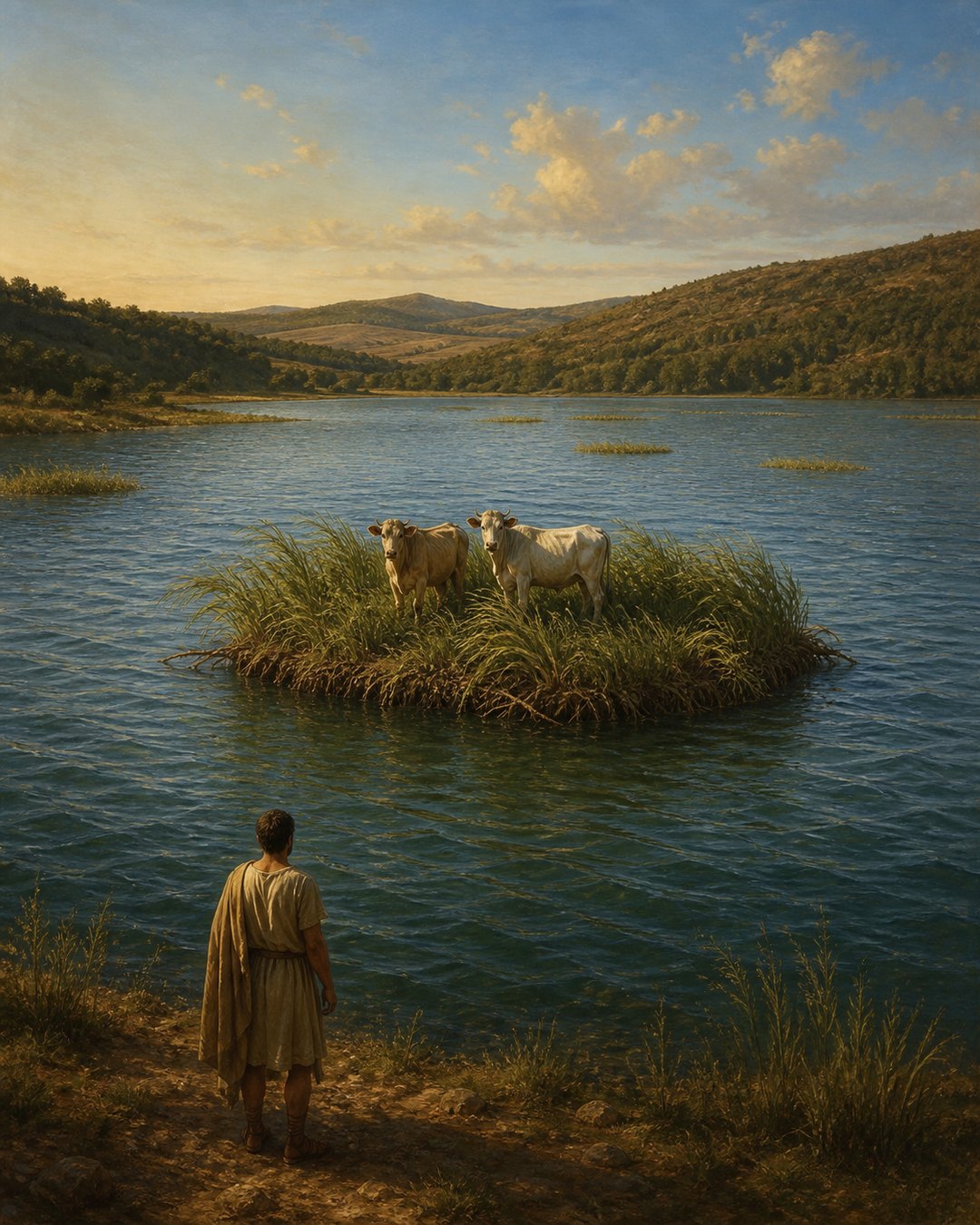
A grazing animal does not inspect the legal border between water and land. It sees grass at the edge of a lake, lowers its head, and steps forward. At Lake Vadimon, Pliny the Younger says, that ordinary movement could end with the animal looking up to find water on every side.
The grass grew on islands that floated. While one pressed against the bank, cattle mistook it for an extension of the shore. Wind then pulled the vegetated mat away. The animals did not understand when they had left solid ground, and Pliny says they were equally unaware of the moment they returned, after the drifting island reached another point on the bank.
This is the sharpest scene in a letter built from careful looking. Pliny measures the lake’s roundness, notes its color and sulphurous smell, studies the plants and shallow roots, and watches the islands collide, separate, cluster, and travel. His marvel is not a monster or divine apparition. It is a boundary that moves while every object upon it still looks familiar.
A Visit Near Ameria Began with an Overlooked Wonder
Pliny introduces Lake Vadimon as a rebuke to the Roman appetite for distant marvels. If the place had been in Greece, Egypt, or Asia, he suggests, it would already have been celebrated, read about, and inspected. Its position in Italy made it easier for educated travelers to overlook.
He reached it through a family visit rather than a formal expedition. His wife’s grandfather had encouraged him to inspect estates near Ameria. During the walk, someone pointed out the nearby lake and repeated extraordinary stories about it. Curiosity converted an estate tour into a field observation.
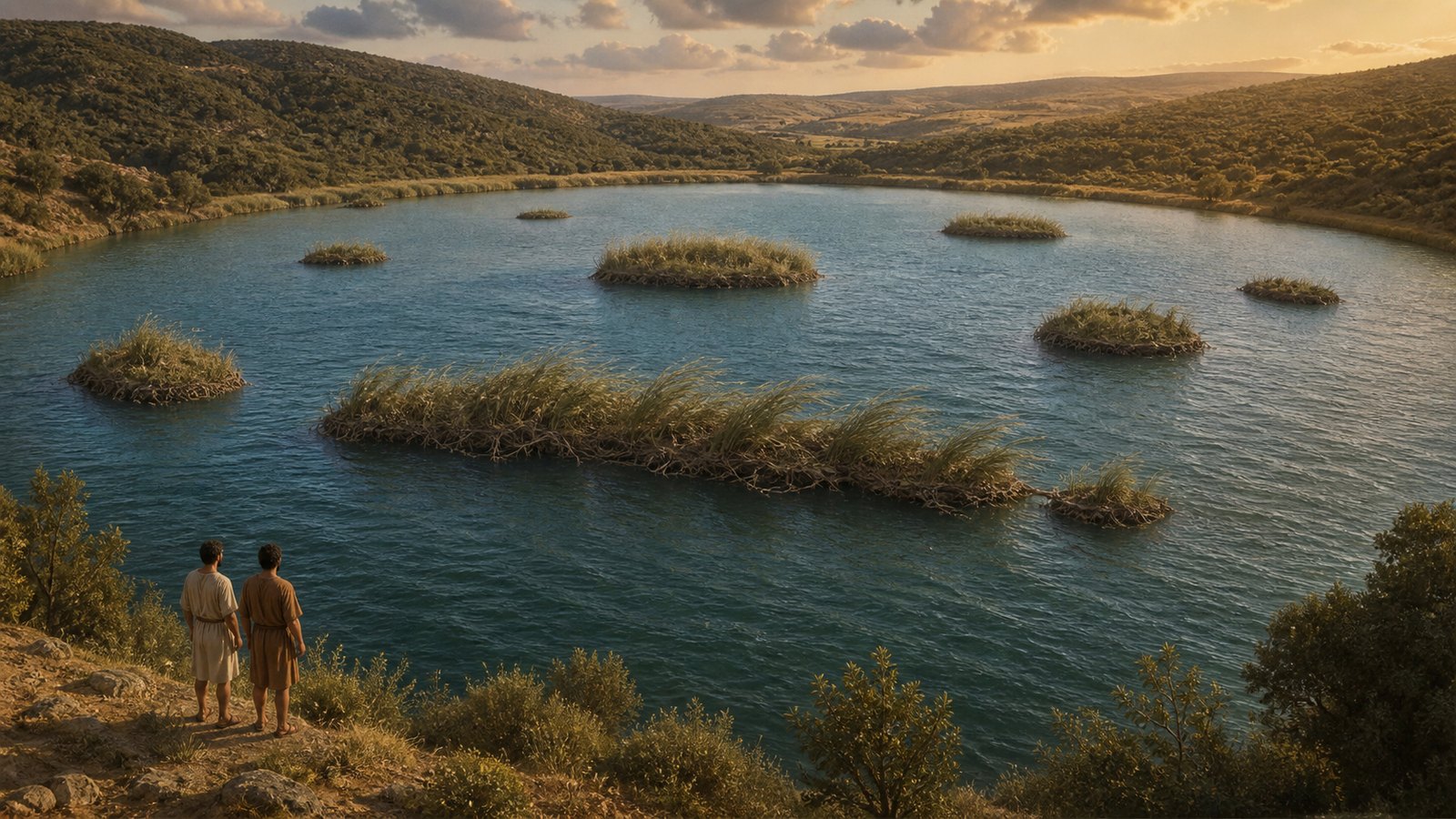
The first surprise was geometry. Pliny calls the lake perfectly circular, like a wheel laid flat on the earth. Its edge had no bays, indentations, or obvious irregularities. Every measurement appeared equal, as if people had excavated the basin according to a plan instead of encountering a natural body of water.
Its appearance added to that sense of design. The water was clear, with a blue-green color that Pliny regarded as sharper than ordinary azure. It smelled of sulphur and had a medicinal taste. He credits it with strengthening fractured limbs, a claim that belongs to Roman experience and belief rather than modern medical guidance.
The lake was not huge, but it was broad enough for wind to break its surface into waves. That detail matters because wind supplied the force that reorganized what Pliny saw. The basin’s fixed circular rim enclosed a collection of mobile surfaces.
Sacred Water Kept Boats Out but Not Islands
No boat was permitted on Lake Vadimon because the water was sacred. The ban made the lake’s own moving islands even more striking. Human-built hulls stayed ashore, while root-bound platforms traveled across the surface without crews, oars, or sails.
These were not bare pieces of soil. Reeds, rushes, and other plants associated with marshy edges covered them. From a distance, the vegetation made each island resemble a low part of the bank. Its top offered the visual signals of stable ground: stems, grass, and enough grazing surface to attract cattle.
Beneath that growth, Pliny observed shallow roots. He compared the underside with a ship’s keel and says it could be seen both above and below the waterline. The comparison gave his reader a familiar mechanical shape for an unfamiliar living structure. A woven mass of roots and vegetation could float because it extended into the water without being fixed to the deep bed.
Each island had a distinct size and outline, yet their sides were smooth. Pliny explains that finish through motion. The islands repeatedly struck the shore and one another, wearing away projecting edges. Their rounded surfaces were therefore not merely a feature to list. They were physical evidence of previous collisions.
The scene invites comparison with Caligula’s engineered vessels on Lake Nemi, where timber, anchors, pumps, and bronze fittings made floating structures deliberate artifacts. Vadimon reversed that relationship. Its ship-like forms were plants and roots, and the sacred rule forbade people from launching the object that Pliny used to explain them.
Wind Reassembled the Shoreline Again and Again
The islands did not move as a single fleet. Sometimes wind joined several into a chain, making them look like one connected piece of land. At other times the same force dispersed them across the lake. Pliny even reports single islands moving separately while the water appeared calm.
Size shaped the temporary formations. Small islands could cling to larger ones like little boats under tow. Large and small might seem to race, choose different courses, or gather in one corner. Pliny’s language lends intention to the movement, but the observations beneath the metaphor remain concrete: contact, separation, direction, clustering, and changes in speed.
A cluster altered the visible size of the lake. When several islands gathered against one section of the bank, their vegetation became an apparent addition to the shore. Open water shrank in that corner. When wind dispersed the mass, the lake recovered its old outline.
The basin was still round, but its usable visual boundary changed. One day a patch of reeds belonged to open water; later it seemed to belong to land. Only when the islands floated in the middle did the whole fixed circumference remain easy to see.
This continual rearrangement distinguished Vadimon from the Fucine Lake works that resisted Claudius’s attempt at drainage. At Fucine, imperial labor tried to force a large lake through a tunnel and discovered that engineering could misjudge water. At Vadimon, no ruler had to intervene for the map to change. Wind moved small pieces of apparent shore across the enclosed surface.
Cattle Discovered the Island Only After Departure
Pliny’s cattle provide an accidental test of the floating ground. An island drifted against the bank. Its reeds and grazing plants aligned with the vegetation on land. An animal crossed the seam because nothing in the immediate surface announced danger.
As the wind changed, the contact broke. The island moved into open water with the cattle still feeding upon it. Only then did the animals become frightened. The instability was not necessarily felt as a sudden collapse; the alarming fact was the ring of water that had appeared around what still looked and felt like ground.
The episode shows why the islands could remain a local marvel even when their physical ingredients were ordinary. Reeds, roots, mud, wind, and waves needed no supernatural actor. Combined, however, they created a platform that violated everyday expectations. Grass implied land, yet grass could travel.
Return was as subtle as departure. Wind eventually drove the island to another section of shore. The cattle stepped off, but Pliny says they did not know the instant when they reached land any more than they had recognized the first transition. The seam became visible only from a wider viewpoint than the animal possessed.
Pliny’s own position is therefore part of the story. Standing outside the drifting mat, he could compare island, water, and bank. The cattle supplied movement and fear; the observer supplied sequence. Together they turned a curious patch of vegetation into a demonstration of how scale changes knowledge.
The Outlet Vanished Underground and Returned What Entered
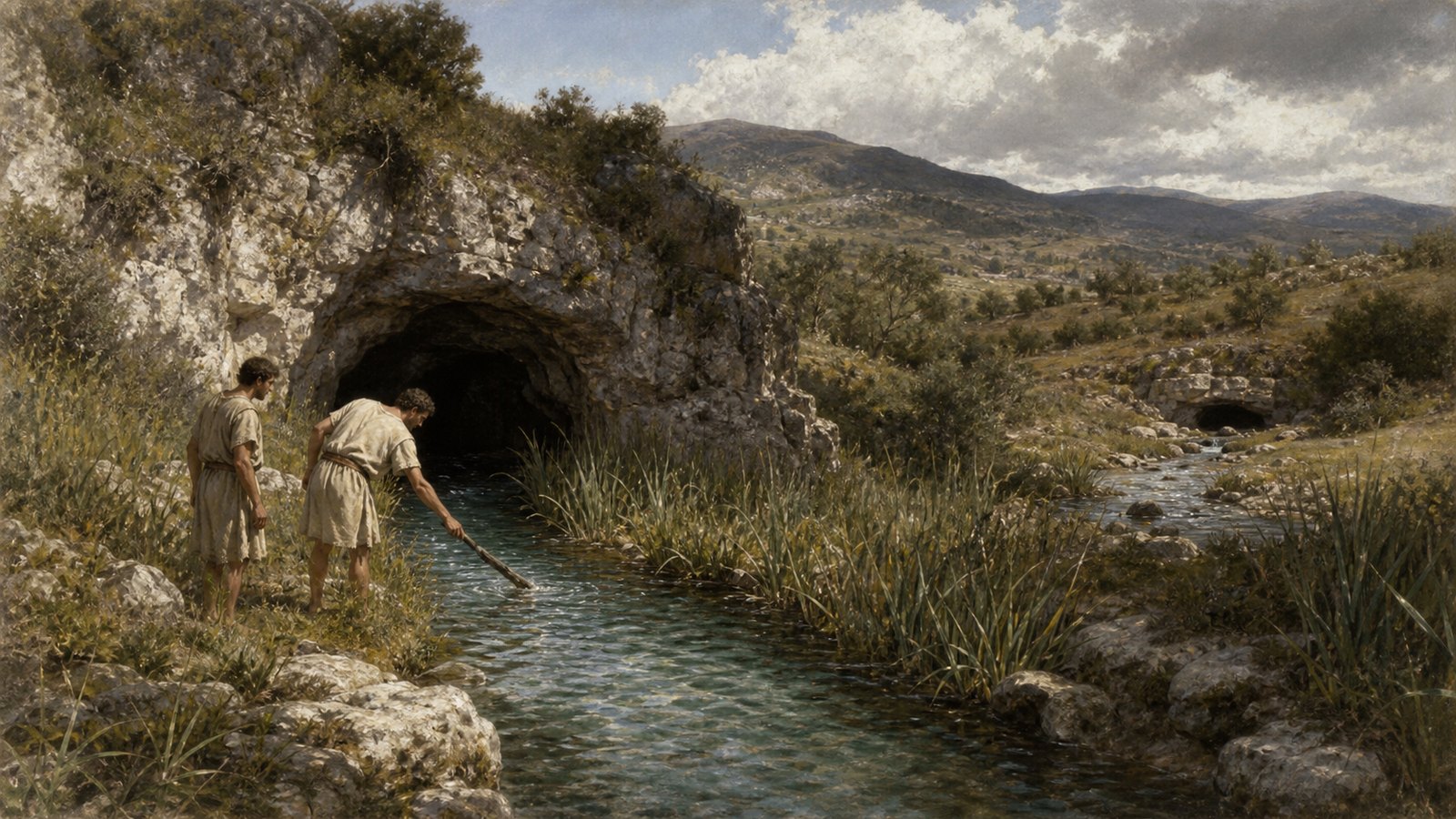
The lake’s edges were mobile, and its outlet also refused to follow an obvious surface route. Pliny says water left Vadimon as a river, ran above ground for a short distance, and then disappeared into a cave. It continued at depth before emerging again farther on.
He adds a simple test. If someone threw an object into the current before it went underground, the river preserved it and cast it up again at the outlet. The claim links two visible points through an invisible channel. What vanished from sight was not necessarily lost.
That observation completes the letter’s pattern. Stable-looking ground could move. Water that vanished could continue. A perfectly shaped lake could be natural, while islands within it behaved like crafted boats. Pliny repeatedly starts with appearance and then follows the sequence that unsettles it.
He closes by telling his correspondent that these details should be as new and pleasurable to him as they had been to the visitor. The pleasure came from nature, but also from method: go to the place, look at its shape, notice repeated movement, and test where the water travels.
Lake Vadimon became memorable because its boundaries would not stay intellectually still. The circular basin held its form. Everything inside challenged the first reading of that form. Reeds became vessels, shoreline became cargo, cattle became passengers, and a disappearing river returned evidence from darkness.
Sources
Pliny the Younger, Letters, 8.20.