
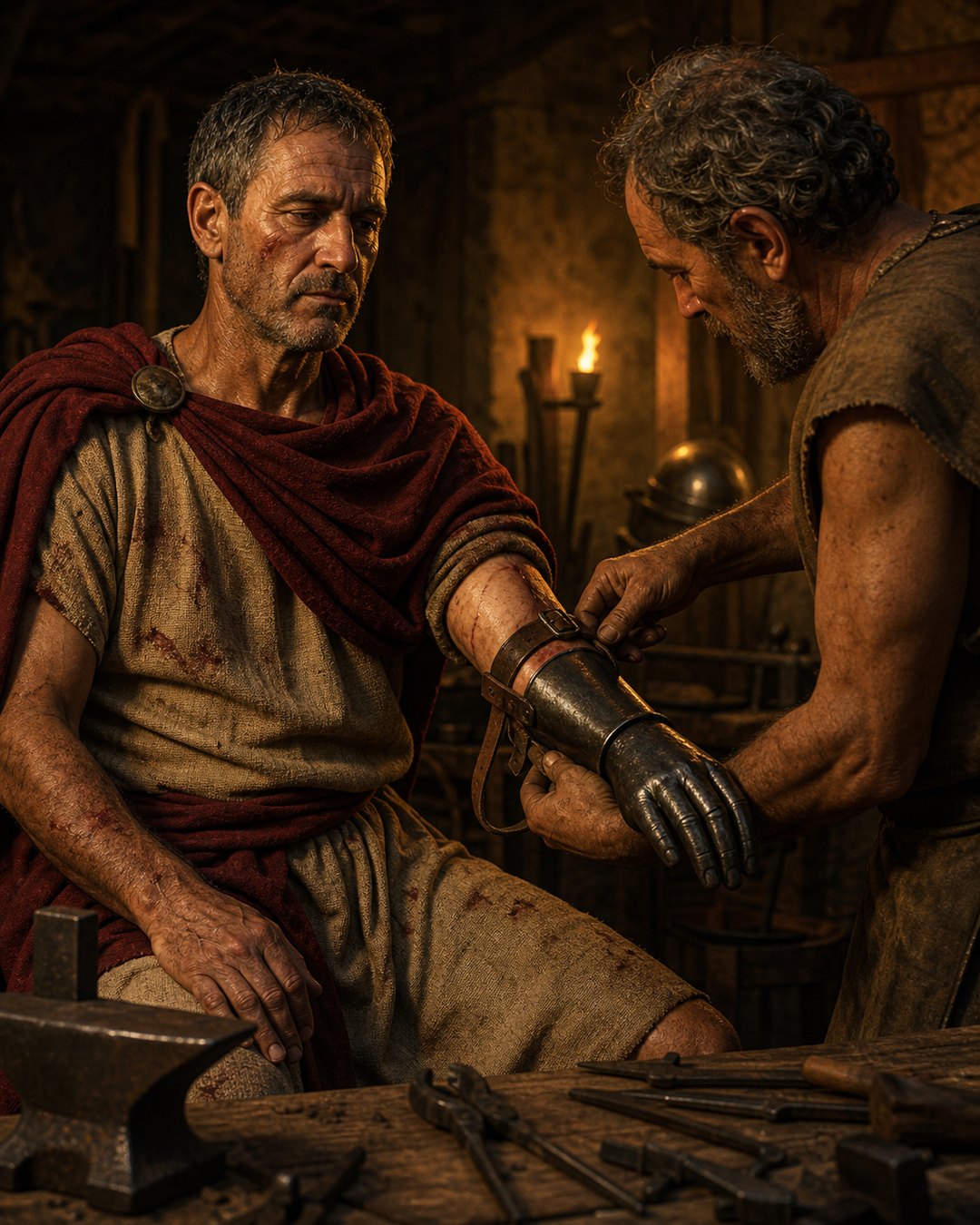
Marcus Sergius carried a battle record that could be counted on his body. Pliny the Elder reports twenty-three wounds in two campaigns, a lost right hand, damaged limbs, two captures by Hannibal, and twenty months in chains. Sergius still returned to service. He fought with his left hand and later used an iron replacement on the right.
That sequence is extraordinary, but the end of Pliny’s account makes it more than a catalogue of injuries. Sergius eventually spoke as a praetor because colleagues wanted to exclude him from sacred rites on account of his impairments. The veteran’s damaged body had acquired two incompatible meanings. It could be read as proof of sacrifice for Rome or as a ritual disability.
Pliny knew the story through that defense speech, not through a technical description of the device. His portrait therefore reveals less about hinges and straps than many modern summaries imply. It reveals how Sergius used remembered campaigns, captivity, and an iron hand to argue that bodily loss should strengthen rather than cancel his civic standing.
Pliny Counted the Damage Before He Named the Device
Pliny introduces Sergius among examples of exceptional human endurance. He says no living person surpassed him, then immediately places the glory under a family shadow: Catiline, the later conspirator, was Sergius’s great-grandson. Honor could accumulate across generations, and it could also be stained by them.
The older soldier’s record begins brutally. In his second campaign he lost his right hand. Across two campaigns, Pliny says, he received twenty-three wounds. Their effect was not confined to the missing hand; he could scarcely use either hands or feet. The account insists on continuing impairment rather than a neat recovery.
Sergius nevertheless served in further campaigns with a single enslaved attendant. Pliny calls attention to the mismatch between capacity and expectation: this was an invalided soldier who kept returning to military life. The attendant is one of the passage’s most concrete details because it prevents the story from becoming a solitary superhuman legend. Continued service still required support.
Roman military memory often compressed a career into visible actions. Valerius and the raven became a story about a single combat and a name. Sergius’s memory works differently. It accumulates losses until survival itself becomes the narrative engine.
Hannibal’s Captive Escaped Twice and Returned Again
The enemy in Pliny’s version is not anonymous. Sergius was captured twice by Hannibal and escaped twice. One stretch of captivity lasted twenty months, continuously in chains and fetters. The duration matters because it changes escape from one lucky opening into the end of prolonged confinement.
Pliny’s wording belongs to praise, and his numbers should be presented as the ancient author’s report rather than as a modern service file. Yet the structure of the claim is clear. Sergius’s status as a veteran was built not only from victories but from capture, restraint, survival, and return.
He then fought on four occasions with his left hand alone. Two horses were killed under him during the service Pliny recalls. The passage does not provide a chronological itinerary for every incident, so a responsible reconstruction should not force the captures, wounds, horses, and battles into a precise order the source does not give.
What Pliny does give is recurrence. Sergius did not overcome one wound and resume an uninterrupted career. His story repeatedly crosses the boundary between combatant, captive, disabled survivor, and combatant again. Each return makes the later argument over exclusion sharper.
The repeated rebuilding of military capacity has a practical echo in Scipio’s daily camp-building drills. That army trained by doing the same demanding sequence again and again. Sergius’s repetitions were personal and involuntary, but they likewise turned endurance into something demonstrated through action rather than claimed in the abstract.
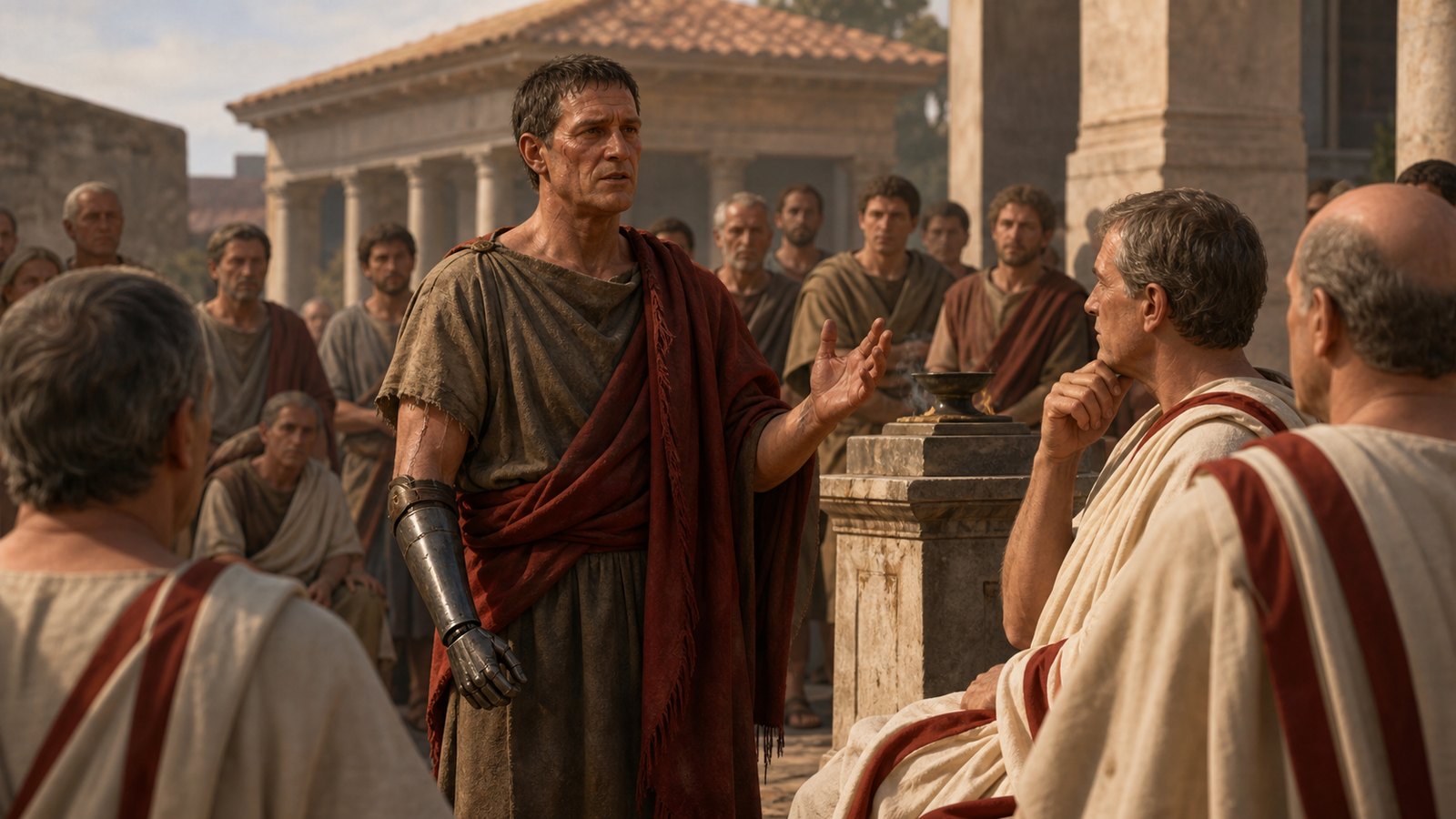
The Iron Hand Restored a Role, Not a Natural Limb
Pliny says Sergius had a right hand made of iron and attached to the stump. That is the whole surviving technical description in this passage. It does not identify an artisan, explain the fastening, list moving parts, or say the replacement copied every movement of a hand.
The safest interpretation begins with function. The device helped mark a return to the military role from which the loss might have removed him. Pliny follows the iron hand with renewed action: Sergius fought, raised the siege of Cremona, defended Placentia, and took twelve enemy camps in Gaul.
Those feats do not prove that the iron hand grasped every object independently. It could have supported a specific task, stabilized equipment, protected the stump, or presented a restored martial silhouette. The ancient text does not decide among those possibilities. An image of an elaborate clockwork prosthesis would therefore invent evidence the source never supplies.
A plain iron fitting is more historically honest and more revealing. Sergius did not need the device to erase the injury. The metal made the injury materially present while helping him resume a public identity associated with fighting. Its value lay in what it allowed him to do and signify, not in perfect imitation.
The article’s center is therefore not “Rome invented a modern prosthetic hand.” That claim would collapse a brief ancient report into a technological lineage it cannot support. Pliny records one named person, one iron replacement, and a set of later deeds. The evidence is powerful precisely because it is specific and limited.
A Praetor Had to Defend His Place at Sacred Rites
Sergius’s later office brought the bodily argument into civic space. Pliny says the information came from an oration Sergius delivered while praetor. His colleagues attempted to exclude him from sacred rites because of his infirmities.
The conflict changes the meaning of everything before it. The wounds were not only obstacles survived in youth. They remained politically and ritually active. Other officeholders could point to the impaired body and argue that it disqualified him from part of the role.
Sergius answered with biography. Twenty-three wounds, Hannibalic captivity, left-handed fighting, dead horses, the iron hand, defended cities, and captured camps became evidence in a dispute over belonging. The speech made military suffering legible as civic credit.
Pliny’s source was interested in persuasion, so the account may preserve the sharpened form in which Sergius presented his own career. That does not make it useless. It tells us how a Roman veteran wanted injuries interpreted before peers: not as private tragedy and not as ritual contamination, but as the durable marks of public service.
The argument also exposes a limit in Roman admiration. A culture could celebrate wounds and still let impairment trigger exclusion. Praise did not automatically create access. Sergius had to contest the unfavorable reading through a formal speech from within office.
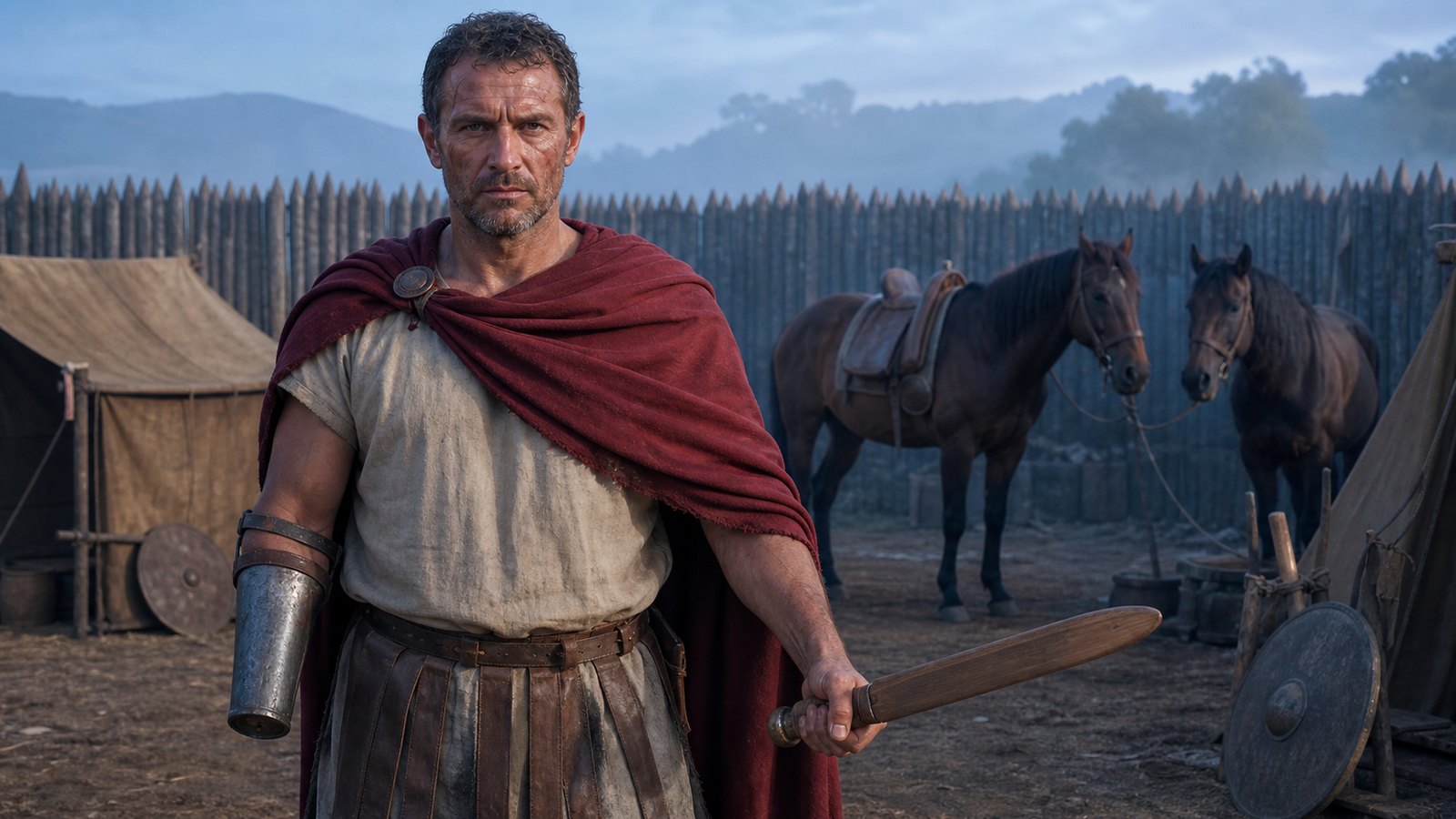
His Body Became an Archive with Rival Readings
Pliny ends in the language of crowns and fortune. He imagines how many honors Sergius might have gained under more favorable circumstances and contrasts personal valor with the disasters of the Hannibalic War. At Trebia, Ticinus, Lake Trasimene, and Cannae, survival itself could eclipse the normal rewards of victory.
That framing helps explain the intensity of the portrait. Sergius accumulated deeds in an era when Roman defeat made conventional triumph scarce. His body stored a history that public monuments and victory crowns could not fully express.
The iron hand sat at the meeting point of those rival readings. To opponents, physical difference could justify exclusion from sacred action. To Sergius, the same metal completed the evidence that he had repeatedly returned to Rome’s service after losses few citizens could imagine.
Modern readers should keep Pliny’s rhetoric visible. The figures and feats reach us through ancient praise and through a speech of self-defense. But skepticism need not flatten the story into nothing. The passage securely shows Romans debating whether severe impairment canceled civic fitness, and it shows one veteran answering with the history written on his body.
Sergius’s achievement was not that iron made him whole in a modern medical sense. It was that he forced colleagues to confront what his injuries meant. The right hand was gone. The iron substitute did not hide that fact. It helped turn loss into continued action, and continued action into an argument for honor.
Sources
Pliny the Elder, Natural History, 7.29. Specialist study: Ancient Historical Tradition about Marcus Sergius Silus.