

A Roman field could enter a city courtroom in one hand. Not as a map, a deed, or a written survey, but as earth: one clod lifted from the land that two people claimed. Before the praetor, that rough sample could stand for the whole disputed property.
Aulus Gellius explains the practice while investigating the phrase ex iure manum consertum, “to lay on hands according to law.” The words came from an older procedure in which rival claimants physically asserted control over the thing at issue. That worked differently when the disputed place lay close enough for a magistrate to attend. It became cumbersome as Roman territory stretched outward and praetors faced crowded business.
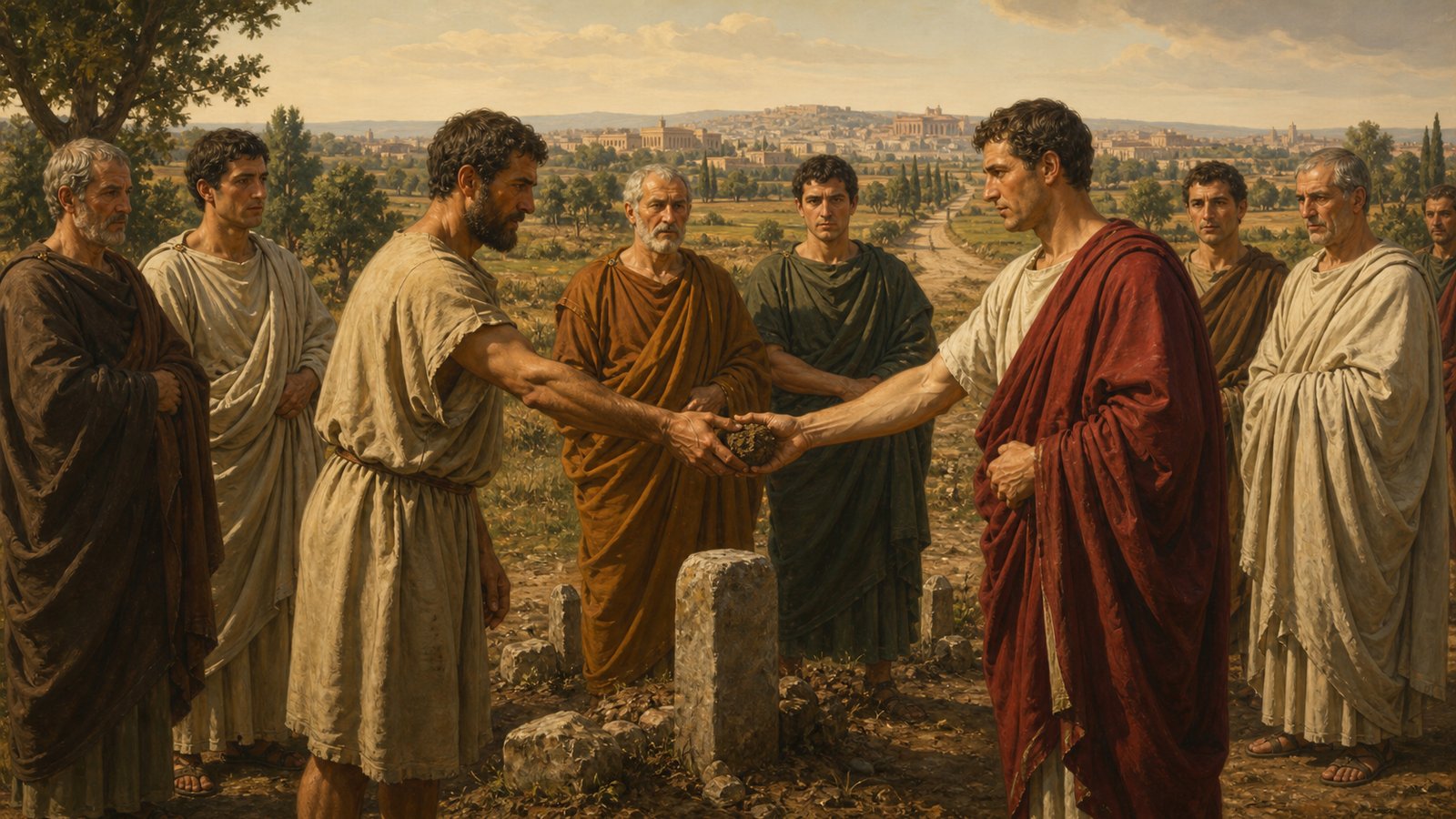
The clod preserved physical contact while shrinking the distance. The opponents still went together to the field. They still touched the contested earth. But instead of dragging the court across Italy, they carried a legally meaningful fragment back to the court.
A Grammarian’s Refusal Opened the Legal Puzzle
Gellius begins with an encounter rather than a statute. He asked a Roman grammarian of high reputation what the old phrase meant. The man looked down on the question and said that he taught grammar, not law. Ask him about Virgil, Plautus, or Ennius, he replied, but take legal advice elsewhere.
Gellius then caught him inside his own boundary. The phrase did occur in Ennius. He quoted lines from the Annals, a work the grammarian was supposed to command. The exchange is comic, but it establishes the chapter’s larger point: Roman literature and Roman institutions could not be divided as neatly as the specialist wanted.
Old legal language remained embedded in poetry and public speech. Gellius insists that people living among business and civic affairs should not be ignorant of common legal expressions. His curiosity is practical as well as antiquarian. The words were ancient, yet he says they were still commonly used when claims were made before a praetor.
That tension gives the story its shape. A formula could outlive the literal conditions that first made it sensible. To understand the words, Gellius had to recover not only a dictionary meaning but a vanished choreography of magistrate, opponents, place, touch, travel, and substitute earth.
Other early Roman disputes could turn on the dangerous precision of language. One claimant supposedly lost by naming cut vines when the required formula spoke more broadly of trees. The clod procedure shows the complementary problem: how to preserve a formula’s material logic when Rome itself had grown too large for its original staging.
The Old Claim Required Hands on the Thing Itself
Gellius glosses manum conserere as laying hold of and claiming a disputed thing through a prescribed form of words. A field is his main example, but he allows that the object could be something else. The essential idea joined speech to controlled physical action.
He connects the procedure with the Twelve Tables and quotes the demand that laying on of hands occur in the magistrate’s presence. The rule made a claim tangible. The parties did not discuss an abstract property identified only through distant description. They confronted the thing and each other under official observation.
Such contact did not mean that Roman courts accepted a brawl as proof of ownership. The action was formalized. Hand, object, opponent, and formula belonged to a legal performance whose force came from being recognized and supervised. Physical seizure was translated into a civil claim rather than allowed to become private violence.
The magistrate’s presence was therefore crucial. Touch alone could show possession or aggression, but not a lawful contest. The praetor placed the rivals’ gestures within a process that could suspend force and carry the disagreement toward judgment.
Gellius’s quotation from Ennius depends on this difference. The poet spoke of restitution demanded not through legal forms but through war and the sword. By invoking the courtroom phrase, Ennius could contrast symbolic, regulated power with genuine bloodshed. The old procedure was physical, but it existed precisely to prevent physical conflict from deciding the title.
Expansion Made Literal Procedure Impractical
The difficulty emerged from scale. Gellius says that when Italy’s boundaries extended and praetors became heavily occupied with legal business, it was hard for them to travel to distant places to settle claims. The old requirement assumed a geography in which official presence at the object was manageable. Territorial growth broke that assumption.
Imagine the costs hidden in a literal application. A praetor would have to leave the city, postpone other hearings, travel roads of uncertain length, reach a particular boundary, watch the parties perform the claim, and return. One contested farm could consume days from a magistrate responsible for many disputes.
The parties faced burdens too, but their journey could not simply be abolished. If neither claimant touched the property, the procedure would lose the material encounter encoded in its name. The adaptation therefore separated the necessary journey from the unnecessary traveller. The opponents went; the praetor stayed.
Gellius calls the change a product of silent consent and says it ran contrary to the Twelve Tables. That description is more interesting than a tidy story of formal repeal. Practice adjusted because administration demanded it. The inherited words remained, while agreement around their performance shifted.
Roman law often appears to modern readers as a collection of polished rules, but procedure lived through calendars, distances, workloads, and available bodies. A magistrate’s crowded day could reshape how an ancient command was enacted. Institutional capacity was not background. It was one of the forces making law workable.
The Clod Made Representation Material
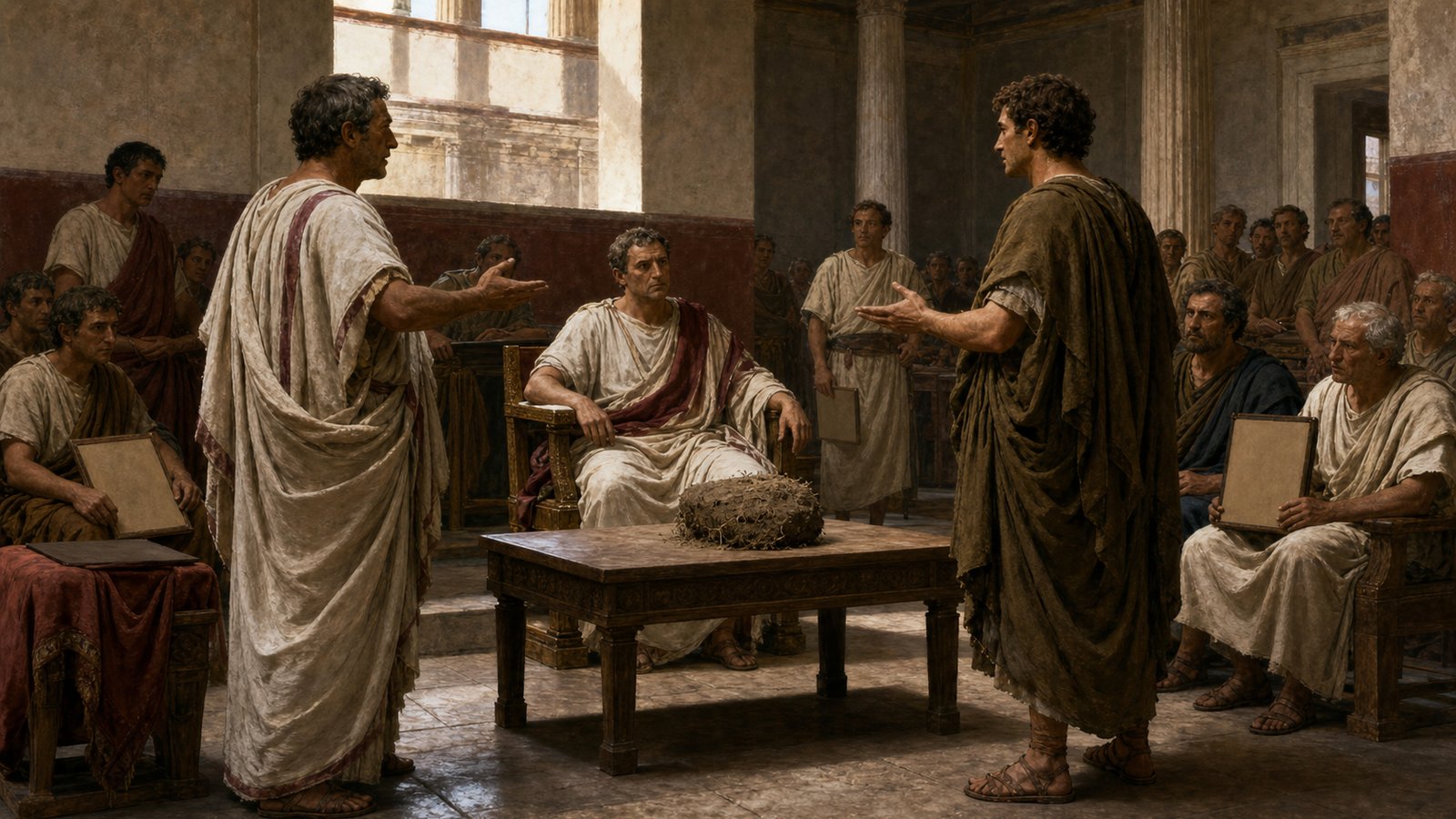
Under the adapted practice, one litigant summoned the other to the disputed place. They went together to the field and brought some of its earth back to the city. Gellius offers a single clod as the example. Before the praetor, they claimed that clod as though it were the entire field.
The sample was powerful because it was both less than the land and genuinely part of it. A verbal description could be mistaken. A model could be fabricated. Earth taken from the field carried physical continuity with the object while remaining small enough to transport.
The joint journey also constrained the symbol. One party could not quietly scoop soil from anywhere and declare it representative. Gellius’s account has the opponents go together. Their rivalry accompanied the sample from the boundary to the magistrate, giving each a chance to contest where it came from.
Once in court, the clod compressed acres into a surface that hands could reach. Boundaries, crops, paths, water, buildings, and neighbours disappeared from view, yet the central act of competing possession remained possible. The legal fiction did not deny the field’s size. It selected the smallest piece capable of carrying the claim.
The transformation resembles other Roman attempts to make standards publicly inspectable. Pompeii’s measuring table put official cavities for goods into stone where buyers and sellers could test quantities. The clod was not a measuring instrument, but it performed a related move: an unwieldy dispute became a material object that public procedure could handle.
A Symbol Preserved Contact Without Preserving Distance
It would be easy to treat the clod as decorative courtroom theatre, a quaint survival after law had become more sophisticated. Gellius’s explanation points in the opposite direction. The symbol answered a concrete administrative failure. It allowed a practice founded on contact to continue when literal official travel no longer scaled.
The adaptation also preserved memory. Every time litigants invoked the old phrase and handled representative earth, they repeated the outline of a procedure in which the magistrate had once stood at the disputed thing. The words carried an earlier Rome inside a later territorial system.
Yet continuity did not mean stasis. The praetor’s body was removed from the field. The field was reduced to a fragment. Silent agreement supplied what the old text had not authorized explicitly. Roman legal life held the inherited rule and the practical workaround together.
Gellius recovered that layered history because a grammarian dismissed three words as somebody else’s subject. His answer moved from poetry to the Twelve Tables, from formal seizure to geographic expansion, and from a distant property to earth on a courtroom surface.
The clod’s smallness was its achievement. It kept the rival hands, the contested thing, and the magistrate within one legal scene without pretending that the whole field had crossed Rome’s gates. Procedure did not erase distance. It engineered a substitute that made distance governable.
One handful of soil could not prove who owned the land. It could do something more basic and necessary: bring the absent object within reach of a lawful contest, so a sword did not have to settle what the praetor could hear.
Sources
Aulus Gellius, Attic Nights, 20.10.