
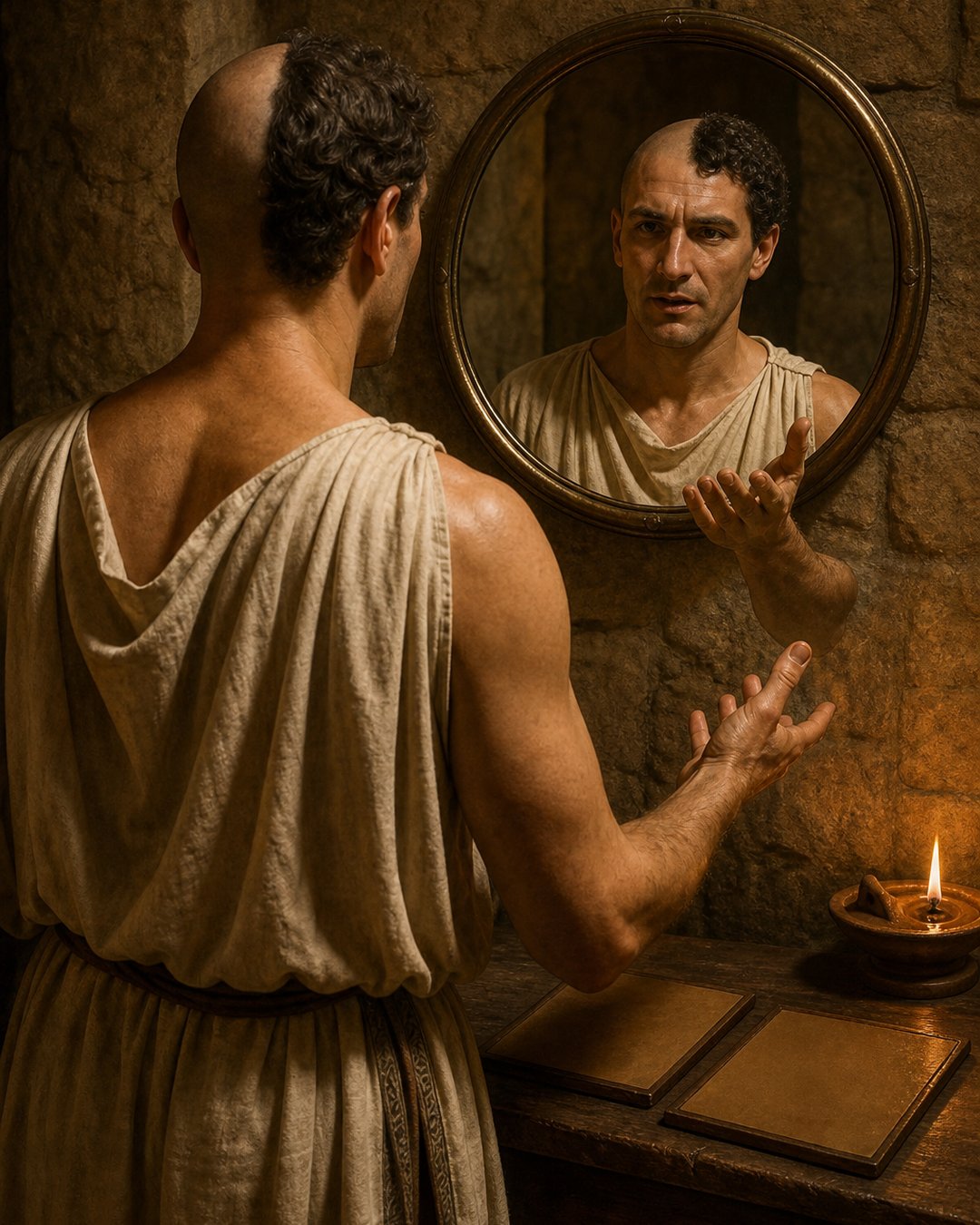
Demosthenes built a room beneath the ground and turned embarrassment into its lock. He shaved the hair from only one side of his head, then withdrew to practice. If restlessness tempted him toward the street, the unfinished appearance made going out costly. Plutarch says he sometimes remained below for two or three months.
The half haircut is memorable because it looks absurd. Its function was serious. Demosthenes had already discovered that knowing what to say did not guarantee that an audience would hear it as intended. His voice weakened, his breath broke sentences apart, and crowds laughed at speeches whose formal arguments had become hard to follow.
Isolation gave him time, but the training was not simply endless repetition of one prepared text. He rebuilt conversations into arguments, revised phrases he had heard, practiced delivery, tested breath under physical strain, used pebbles against indistinct speech, and watched his body in a mirror. The haircut belonged to a larger system that separated public failure into parts he could train.
A Laughing Assembly Exposed More Than One Weakness
Plutarch does not begin the training story with effortless talent. When Demosthenes first addressed the people, interruptions and laughter met him. His periods ran long. Arguments seemed strained. A weak voice, indistinct pronunciation, and short breath disturbed the sense by breaking sentences where the thought required continuity.
Those failures interacted. A long sentence demands breath and control. If air fails midway, emphasis lands in the wrong place. If diction blurs, a carefully arranged distinction disappears. If the speaker presses harder to recover, delivery may become harsher and the structure even less clear.
The public setting offered no quiet diagnostic pause. An assembly registered failure through clamour. Demosthenes could either dismiss the crowd as incapable of appreciating his thought or accept that persuasion included what listeners actually received. Plutarch’s account makes him choose the second path.
Roman readers would have recognized the same distance between written intelligence and a working public voice. Cicero later treated his own harsh delivery through controlled exercise and a different speaking rhythm. Both stories make physical performance part of political craft rather than an ornament added after composition.
Demosthenes therefore faced a bundle of problems, not one defect. Argument, sentence design, breath, articulation, volume, gesture, and timing all had to meet in the same moment. His later routine worked because it gave those elements different forms of practice.
An Actor Made Delivery Visible by Repeating the Same Words
The decisive lesson came through Satyrus, an actor. Demosthenes complained that hard work brought him less attention than performers and undisciplined speakers received. Satyrus asked him to recite a passage from tragedy. After hearing it, the actor delivered the same words with appropriate feeling and arrangement.
The text had not changed. The effect had. Plutarch says the speech appeared to Demosthenes like another thing, and he became convinced that action gave ornament and grace to oratory. Practice in declamation had little value if the speaker neglected delivery and the disposition of words.
Satyrus’s demonstration provided a controlled comparison. Two performances shared a script, so the difference could not be blamed on subject or vocabulary. Voice, pacing, emphasis, posture, and emotional direction had changed what the words did in the listener.
That did not reduce oratory to theatrical display. It showed that thought reaches an audience through a body. A proposition must be audible. A contrast needs timing. A climax requires enough breath to arrive intact. Gesture can clarify the direction of an appeal or distract from it.
The lesson redirected effort. Demosthenes did not abandon argument for performance; he stopped pretending they were separable. The underground room became a place where content and delivery could be rejoined before another crowd tested them in public.
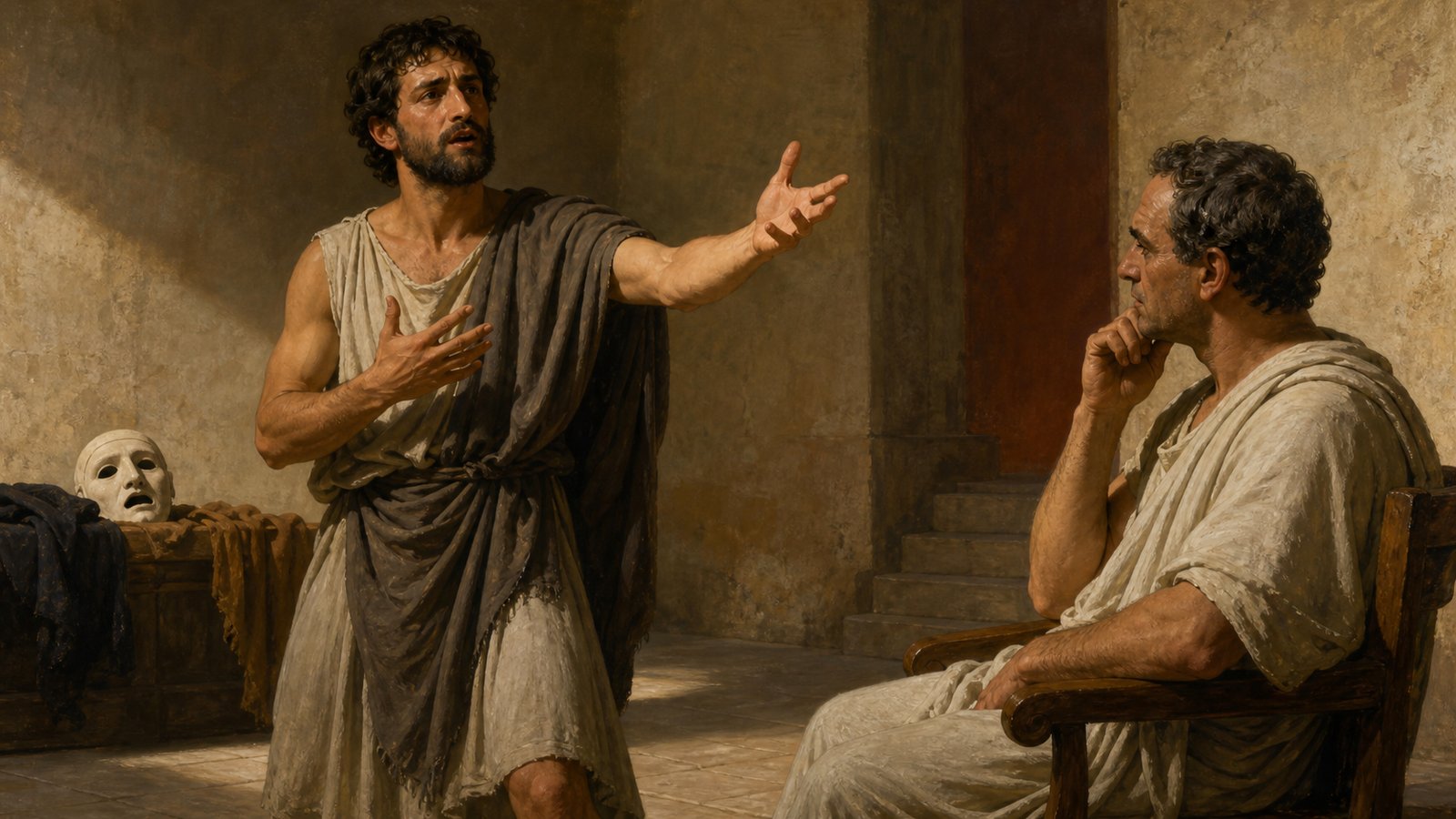
The Half-Shaved Head Turned Shame into a Constraint
A study creates opportunity, not discipline. Its door still opens. Demosthenes’s asymmetric haircut made leaving harder without requiring a guard. Plutarch explicitly says shame was meant to keep him from going abroad even when he strongly wished to do so.
The mechanism was social. Nothing physically prevented him from walking outside. He anticipated the looks, questions, and ridicule that half a haircut would attract. That future discomfort outweighed the immediate urge to abandon practice. He attached a visible cost to distraction.
The story also shows that his routine was designed around an honest estimate of his own weakness. A heroic biography might claim that pure determination kept him working every day. The haircut admits that intention fluctuates. Demosthenes built a condition that would still operate when enthusiasm did not.
Plutarch says he descended without exception to form his action and cultivate his voice. The room removed the assembly’s noise and the street’s demands. Lamp, walls, and repeated performance narrowed attention. Critics later mocked his prepared arguments as smelling of lamp-wicks, but the insult confirmed how strongly audiences associated him with labor before speech.
His method belongs beside stories in which practical intelligence appears through arrangement rather than status. Protagoras was supposedly noticed because a carefully tied load revealed how he organized physical work. Demosthenes organized his own behavior with equal bluntness: if the street competed with the study, he changed the terms of leaving.
Every Conversation Became Material for Reconstruction
Withdrawal did not cut practice off from public life. Plutarch says Demosthenes made interviews, conversations, and business outside the starting point for work. After parting from associates, he went below and reconstructed the exchange in order, including arguments used for each course.
This habit turned ordinary encounters into case studies. A reply that came too late could be supplied in retrospect. A weak phrase could be replaced. The sequence of claims could be reduced into propositions and periods, exposing where an argument had wandered or where a listener had found an opening.
He treated other speakers the same way. Speeches he heard were reorganized, corrected, and given alternative expressions. He reconsidered words spoken against him and words he had used against others. Practice therefore ranged beyond polishing a single set piece. It trained the capacity to see structure inside live disagreement.
Retrospective reconstruction also connected memory to preparation. The actual conversation had already ended, so revision could not win that exchange. Its value lay in the next one. Repeated across many encounters, the study gathered a private archive of decisions about sequence, wording, objection, and response.
This explains why he resisted speaking entirely unprepared. Plutarch says he did not deny using writing and rehearsal, and defended preparation as deference to the people. Taking an audience seriously meant refusing to offer it whatever happened to occur first.
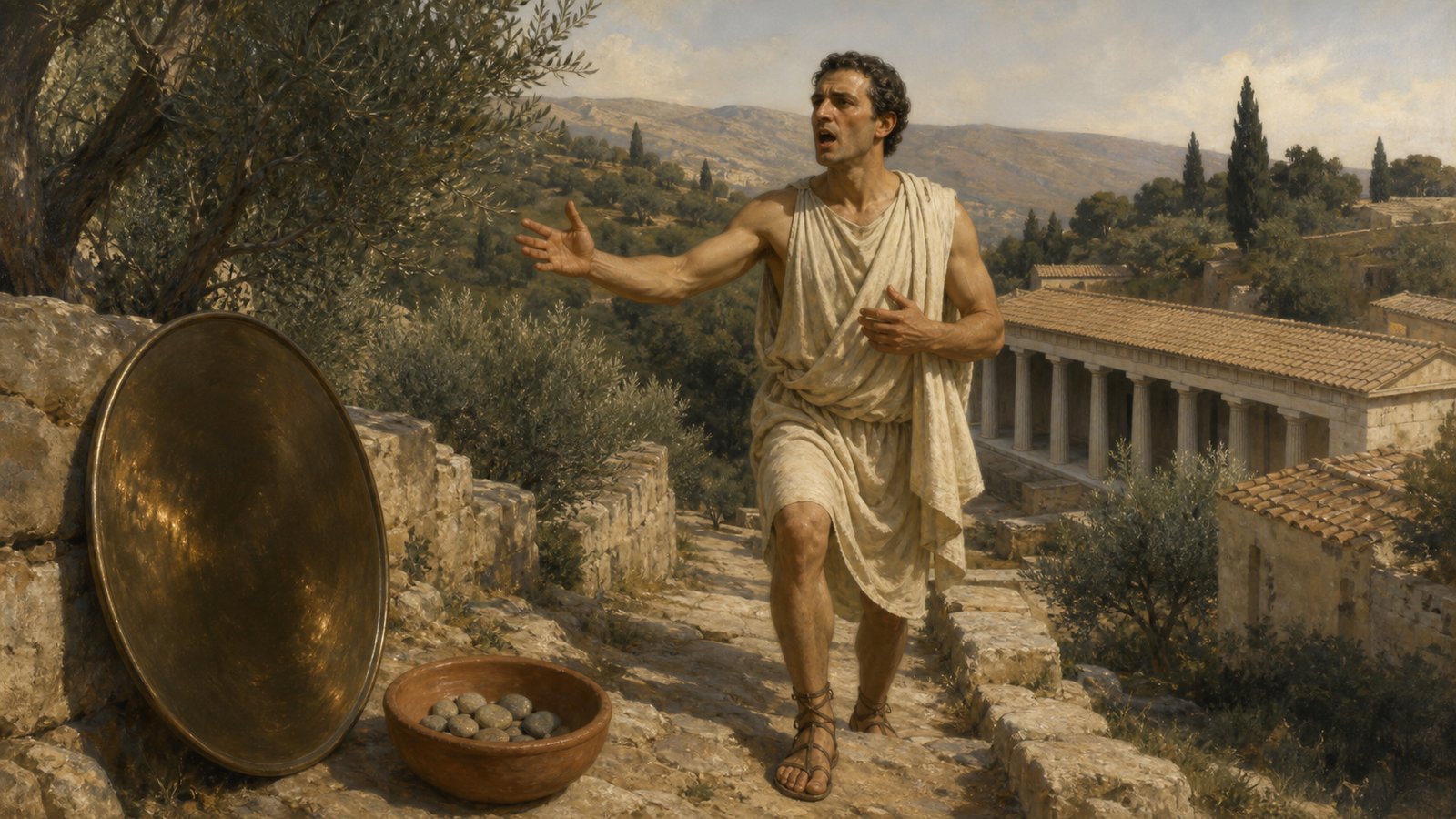
Pebbles, Slopes and a Mirror Trained Separate Channels
The most famous exercises target physical limitations one by one. Plutarch says Demosthenes recited with pebbles in his mouth to work against indistinctness and lisping. He spoke while running or climbing steep places to exercise the voice, and practiced speeches or verses within a single breath.
These claims come through ancient biography and should not be copied as modern speech therapy. Their logic is still clear. Resistance in the mouth heightened the demand for articulation. A slope raised the cost of breath. A long phrase made control measurable: either the line survived to its end or it broke.
A large mirror supplied another kind of feedback. Sound alone cannot reveal a lifted shoulder, restless hand, collapsed stance, or expression detached from the words. By declaiming before his reflection, Demosthenes became audience to the visible part of his own delivery.
The exercises divided a complex performance into channels, then returned them to a complete speech. Breath trained on a slope had to support phrasing in the assembly. Articulation practiced under resistance had to become clear without pebbles. Gesture corrected in the mirror had to feel natural when attention moved from reflection to crowd.
The half haircut made time available for this cycle. The underground room gave repetition a stable place. Satyrus had shown what delivery changed; conversations supplied arguments; physical drills attacked voice and breath; the mirror made action inspectable. No single device created the orator.
Plutarch’s portrait endures because improvement appears as engineering rather than magic. Demosthenes accepted that talent had reached an audience badly, identified the points of failure, and built pressures that made practice difficult to escape. Half his hair disappeared so the rest of the work could remain underground until it was ready to face the noise.
Sources
Plutarch, Life of Demosthenes, 7–8, 11.