
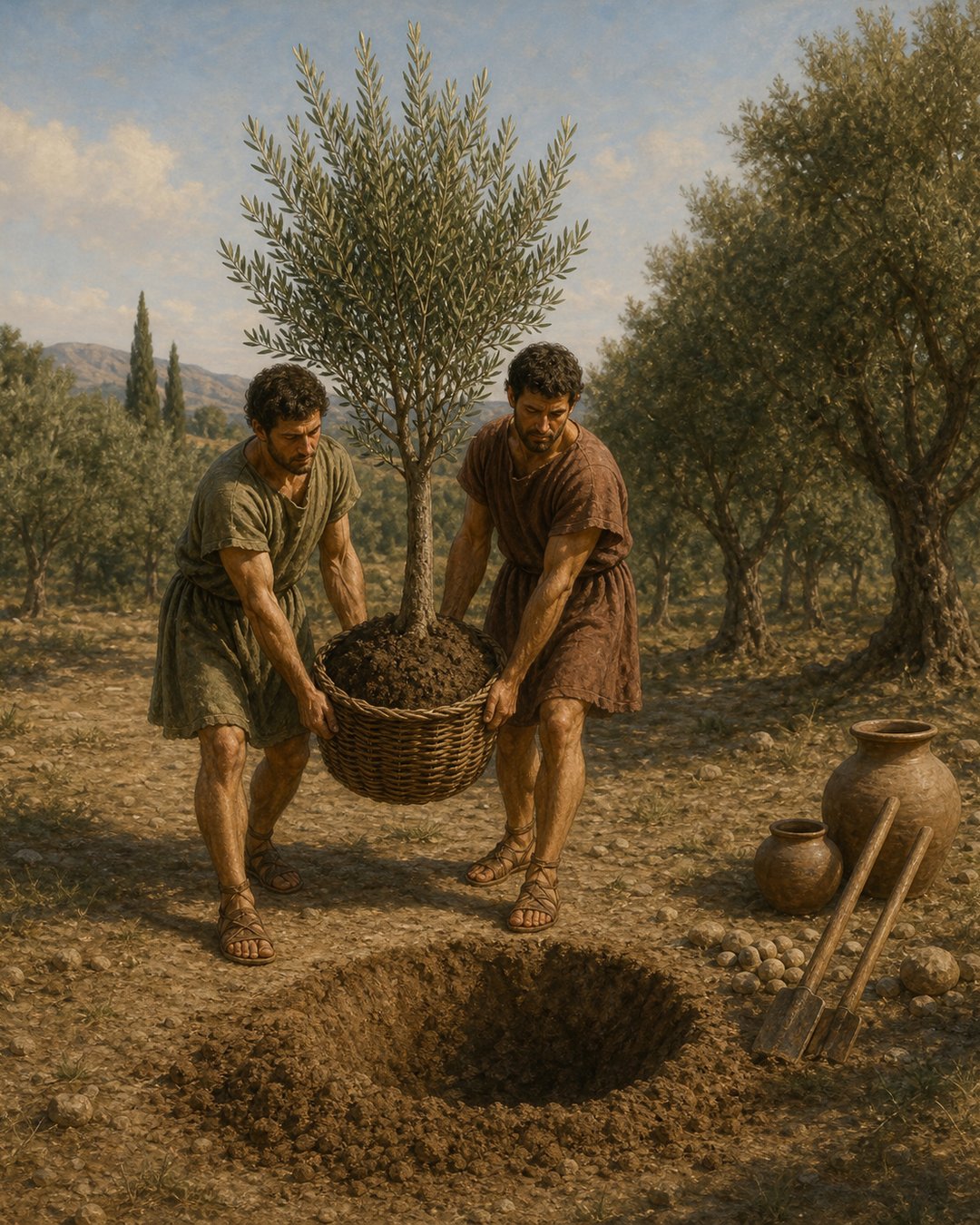
A young tree at the edge of a Roman nursery carried two landscapes at once. Its crown stood in the air of the road ahead, but its roots still needed the ground it was leaving. Pliny the Elder preserves Cato’s practical answer to that problem: move the tree in a basket, keeping as much of its native earth packed around the roots as possible.
The basket was only one part of a larger operation. In Natural History 17.16, Pliny gathers advice from Cato, the Carthaginian agricultural writer Mago, Greek specialists and unnamed growers. Their recommendations do not agree on every measurement or orientation. They do agree that transplantation creates a dangerous interval. A tree has been separated from the conditions that sustained it but has not yet established itself in new ground.
Roman horticultural writers tried to control that interval from both ends. The destination could be chosen and prepared months before a spade touched the roots. During removal, soil could remain attached. Wind and dry air could be avoided. At the new pit, drainage, depth, orientation and packing all mattered. Transplanting appears not as a single act of digging and replanting, but as a chain in which each stage could preserve or waste the work of the one before it.
The destination had to deserve the tree
Pliny begins with compatibility. A tree should move into soil similar to its old ground or into something better. A warm, early-ripening site was not good preparation for a cold, backward one. Nor did he recommend the reverse journey as a casual improvement. The warning treats local growth as an adjustment between plant, soil and climate that relocation could abruptly disturb.
This is different from imagining a tree as an object that can simply be carried wherever space is available. The new plot had to answer the conditions of the old one. A grower who ignored that relationship might blame the specimen when the more important change lay under and around it.
Pliny’s chapter belongs to the same intensely practical agricultural world as the methods that joined fruit trees by grafting, but its narrative engine is the opposite. Grafting creates a new union on a living stock. Transplanting breaks an established union with place and then tries to rebuild it before exposed roots lose their capacity to recover.
The recommendation also reveals why the move had to be planned before extraction. Once the tree was out, the grower could no longer improve the destination at leisure. Every delay increased exposure. Selection of the new ground was therefore part of root protection even though it happened at a distance from the roots themselves.
Mago wanted the empty hole to wait through weather
Preparation could begin a year in advance. Mago recommended digging the planting hole early enough for sun and rain to work upon it. Pliny describes the ideal pit as old enough to acquire a thick coat of grass. The empty space was not wasted ground. It was being opened to a season of heat and moisture before receiving the tree.
If circumstances did not allow that long wait, Mago offered a compressed method. Fires could be made in the middle of the holes about two months before transplantation, just after rain had fallen. The advice tried to reproduce preparation through heat when a full cycle of exposure was unavailable. It does not require us to claim modern soil science for Mago. In his system, however, a freshly cut pit and a seasoned one were not equivalent.
Dimensions changed with the earth. In hard or clay soil, Mago prescribed three cubits each way, with another palm on a slope. He wanted the cavity shaped like a furnace chimney: narrower at its mouth than at the bottom. In black earth, Pliny reports a shallower quadrangular form, two cubits and a palm deep. The pit was designed for the ground encountered, not copied from one universal template.
That specificity turns advance preparation into diagnosis. A grower had to identify hard clay, black earth, wet ground or a declivity before deciding the geometry. The hole recorded an interpretation of the site. By the time the tree arrived, choices about width, depth and shape had already been made.
Wet ground required a floor that could drain
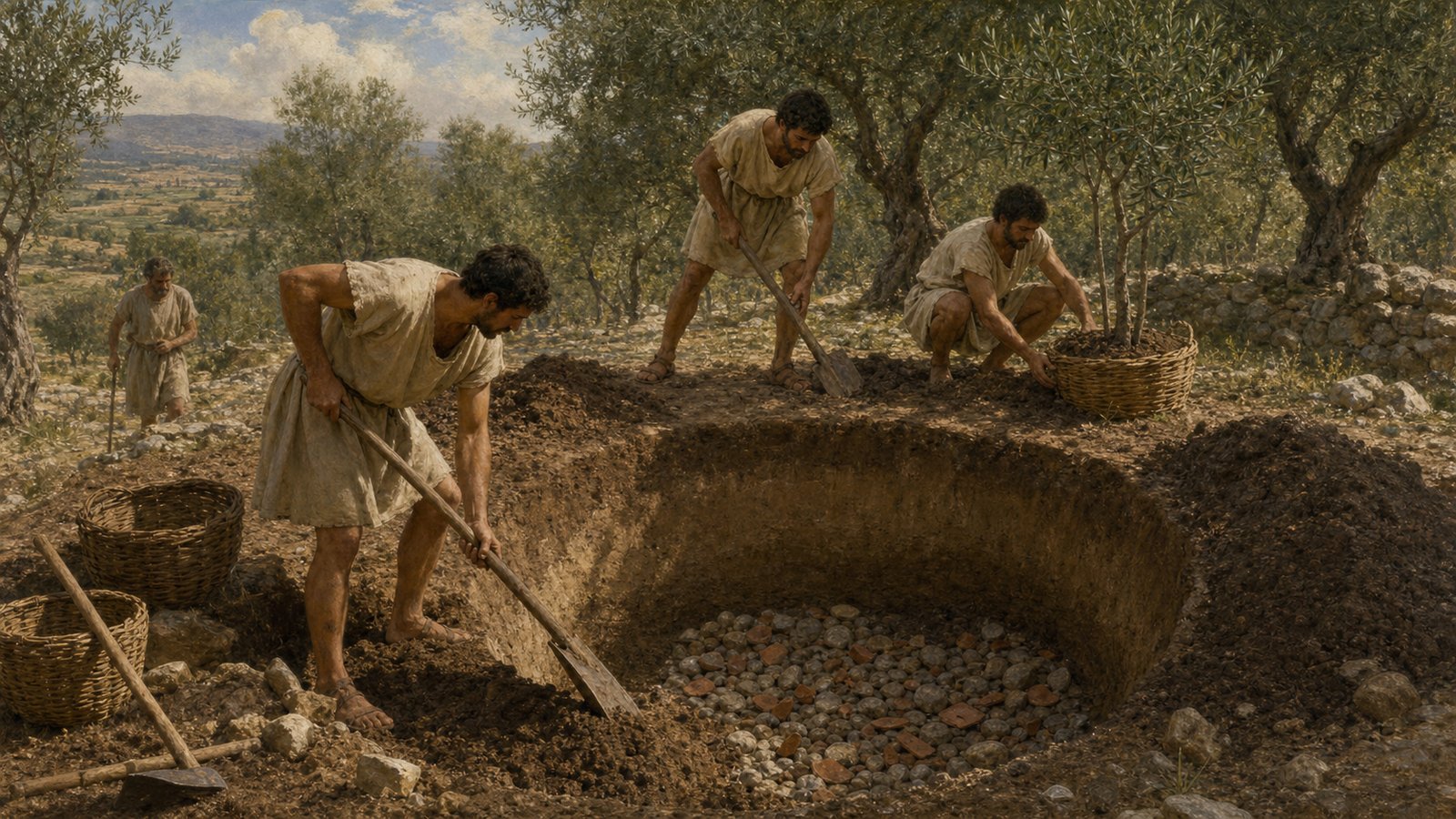
Cato’s instructions for watery soil become almost architectural. The opening was to be three feet wide, the bottom narrower, and the depth four feet. Stones could pave the base. If stones were unavailable, green willow stakes could take their place; lacking those, a layer of twigs a foot and a half deep could be used.
Other growers preferred potsherds or round pebbles at the bottom. Pliny explains their reasoning: those materials allowed moisture to pass while retaining what the tree needed. Flat stones, by contrast, were rejected because a continuous hard face might obstruct roots pushing into the earth. Gravel represented a middle course between the positions.
The disagreement is useful because it shows practitioners reasoning about two dangers at once. Stagnant wetness could be harmful, but stripping all moisture away would not help a newly planted tree. The bottom of the pit had to remain permeable. Broken ceramics and rounded stone created gaps without laying a sealed pavement beneath the root system.
Roman technical writing often becomes clearest when it names a physical compromise. a separate recipe for protecting an exposed terrace from frost and damp also treats durability as a sequence of materials rather than one miraculous ingredient. Here the problem was alive and growing: drainage had to work without becoming a barrier.
The compass mark became an argument, not a rule
Some growers marked the bark before removal so the tree could keep the same southern aspect in its new position. Their fear was that reversal would expose the former north side to southern heat and leave the former south side vulnerable to cold north-eastern winds. Orientation, in this view, had become part of the tree’s history.
Pliny does not present the mark as uncontested wisdom. He observes that Cato would surely have mentioned it if he considered it important. He then reports a directly opposite practice for vines and figs: turn the old north side toward the south and the old south side toward the north. Supporters thought reversal would thicken the foliage, protect fruit from dropping and improve the plant for climbing.
Most people, he adds, were careful to turn a heavily lopped side toward the south. Pliny again objects. That placement could expose the cut area to splitting under excessive heat. His own preference was to face it toward the sun’s position at the fifth or even the eighth hour. The chapter therefore preserves a debate among working rules rather than smoothing them into one official method.
This matters to the larger mechanism. Roman growers recognized directional exposure, but they disagreed about how to use it. The bark mark did not eliminate judgment. It gave the planter information about the tree’s previous position, which still had to be weighed against pruning, wind and the desired shape of the new growth.
The basket protected the most vulnerable minutes
Pliny’s sharpest warning concerns time in the open. Roots should not remain exposed to air long enough to dry. Ground should not be worked around them while a north wind blew, and roots should not lie uncovered under winds arriving from the broad arc between north and southeast. Trees could die from this treatment while the grower remained ignorant of the cause.
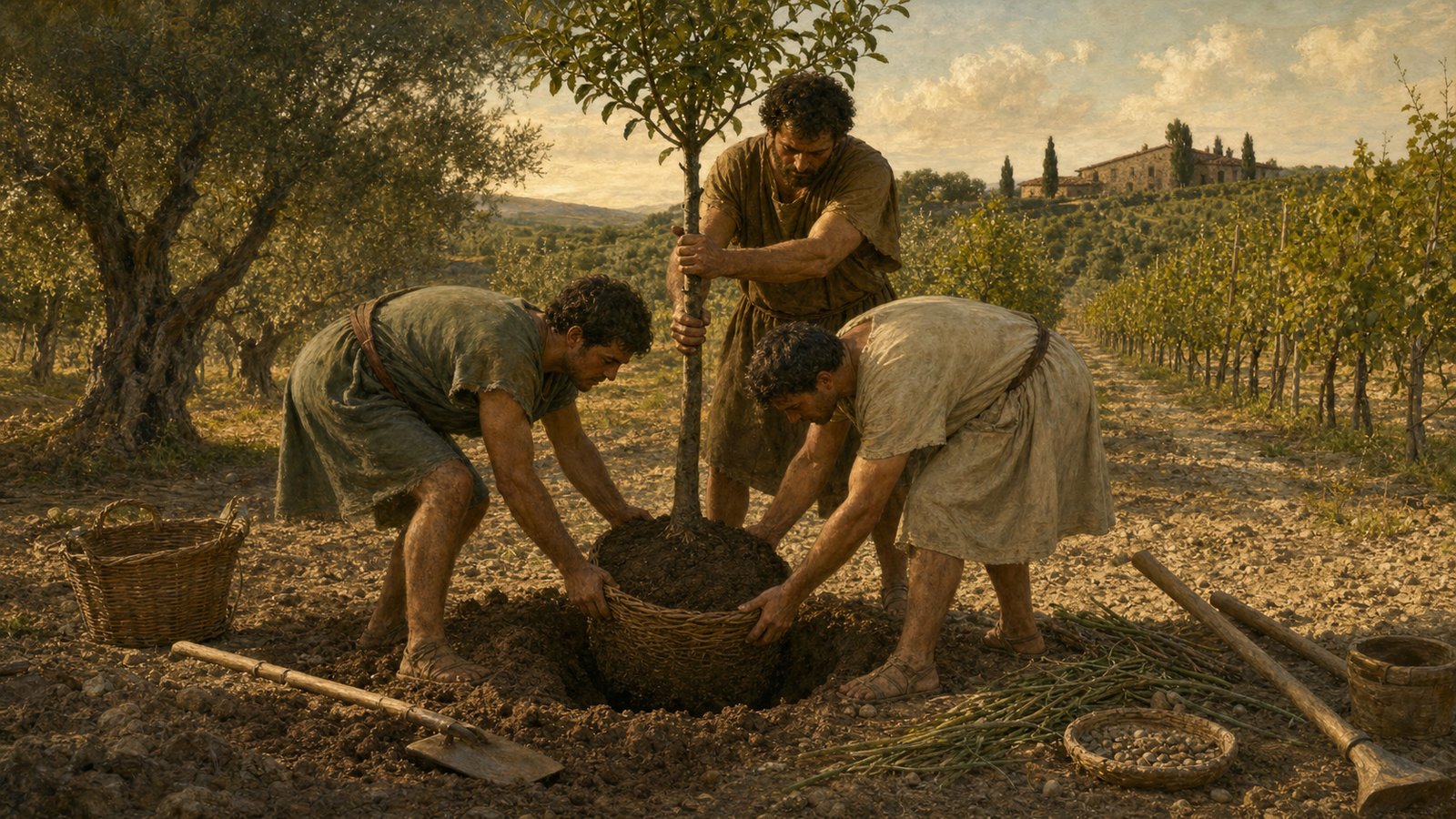
Cato rejected wind and rain during the operation. He wanted as much original earth as possible to adhere to the root mass, with clods packed around it. The young tree could then be conveyed in a basket. Pliny pauses to call this a highly desirable method. The container held more than a plant: it preserved a small volume of the old site through the journey.
The resulting scene is easy to picture without inventing a dramatic accident. Workers loosen the tree, keep the roots clothed in earth, settle the mass into woven support and carry it toward a hole prepared before that morning. If the clods fall away, the basket has failed its purpose even if the trunk arrives unbroken. Transport quality was measured below the visible crown.
At the destination, Pliny required the roots to be placed with care and the tree to stand exactly at the centre of the hole. He also records Cato’s insistence on ramming earth around the roots. Arrival did not end vulnerability. Empty pockets, rough placement or a tilted centre could compromise all the earlier precautions.
The chapter’s many measurements can make it look like a catalogue of isolated tricks. Read in sequence, they describe continuity. Comparable soil reduces the shock of the new site. A seasoned pit prepares the receiving ground. Drainage gives roots a workable base. Native clods and a basket preserve moisture and contact in transit. Weather discipline limits desiccation. Central placement and packed earth restore support.
A transplanted Roman tree was never literally unchanged. Its underground network had been cut, its setting replaced and its orientation reconsidered. The goal was not to pretend that no rupture occurred. It was to carry enough continuity through the rupture for growth to resume.
Sources
Pliny the Elder, Natural History, 17.16; Cato the Elder, agricultural precepts reported by Pliny; Mago, agricultural precepts reported by Pliny.