
Fifty pounds of flax in the sheaf did not become fifty pounds of dressed fibre. Pliny the Elder gives fifteen pounds as a fair return after combing. The missing thirty-five pounds make the craft easier to understand than a finished fold of pale linen does. Manufacture was a controlled loss of seed, moisture, skin, broken matter and coarse tow.
The process began with two signs in a field: swelling seed and a yellow cast. Workers pulled the ripe stalks up by their roots, tied them into bundles that filled one hand and arranged them to dry. Later they forced the buoyant stems under sun-warmed water. A loosened coat signalled the moment to remove them. More sun, a wooden mallet, stone and iron teeth followed.
Pliny’s description in Natural History 19.1–3 does not treat linen as the simple product of a useful plant. The plant had to be taken apart repeatedly. Water softened one boundary, impact broke another, and combing selected the inner fibre from the outer coat. Even after spinning and weaving, soaking and heavy beating continued. Soft cloth emerged not from gentleness, but from a disciplined alternation of wetting, drying, pressure and blows.
The field supplied stalks, not cloth
Pliny begins with flax’s range of use. It served life on land and also moved across the sea as sail. He marvelled that fine stems, rising only a little above the earth, could catch winds when spread above ships. The contrast between a small seed and a large sail gave him a favourite kind of natural wonder.
Yet he immediately denied that the stem worked in its native strength. To become tissue, flax had to be rent, tawed and beaten until it approached the softness of wool. His violent verbs are not decorative. They summarize a production chain in which the useful part was hidden inside a structure built to keep a plant upright.
Flax was mostly sown in sandy soil after one ploughing. It grew quickly: spring sowing could be followed by a summer harvest. Pliny also says the crop injured the soil considerably. Speed above ground therefore carried a cost below it. The workshop depended on a plant that moved fast through its field and then slowly through many stages of preparation.
This is a different problem from the spindle whorl that kept twist moving after a hand released it. Spinning manages prepared fibre. Pliny’s first concern is how a standing crop becomes material that a spinner can use at all.
Six drying days also gathered the seed
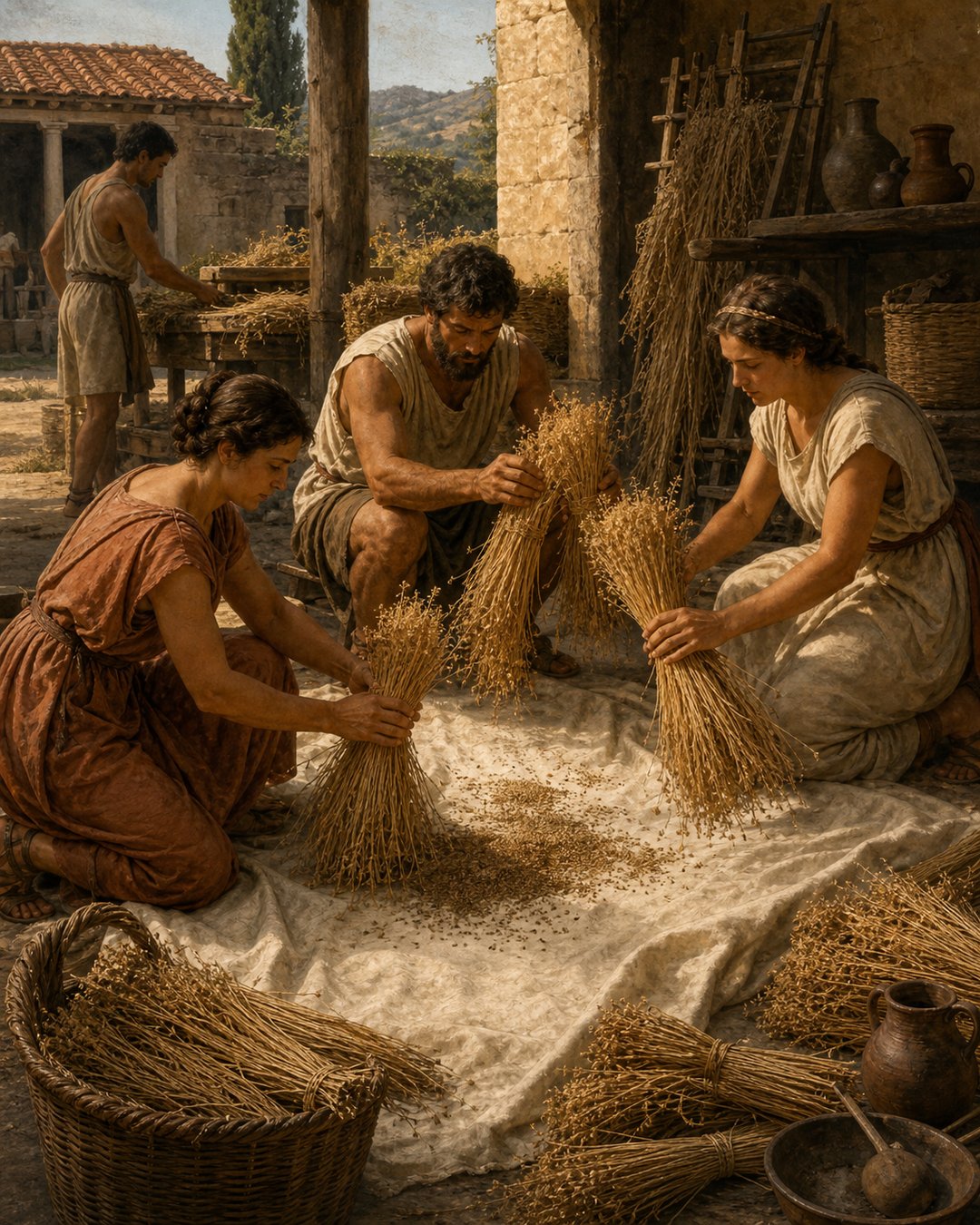
Ripeness was visible in the swollen seed and yellowing plant. Workers did not cut the stalks at ground level. They pulled them up by the roots, preserving the full length, and made small sheaves sized to fill the hand. The bundle’s scale tied the field operation to what one worker could grip and arrange.
On the first day the sheaves hung with roots upward. For the next five days, their heads leaned against one another. This geometry created a hollow middle where loosened seed could fall. Drying and collection happened together rather than in separate equipment.
The sequence made orientation do work. Roots up exposed one end on day one. Heads inclined inward during the following five days directed seed to a shared centre. Nothing in the description requires a large machine, but it does require attention to time and placement. A careless heap could dry unevenly and scatter a useful secondary product.
Linseed had medicinal uses in Pliny’s account, and he notes food and sacrificial contexts as well. The seed was not merely waste removed before fibre processing. Its collection belonged to the value of the harvest. The first major separation therefore produced two usable streams: seed in the middle and stalks ready for the next treatment.
Warm water had to defeat buoyancy without going too far
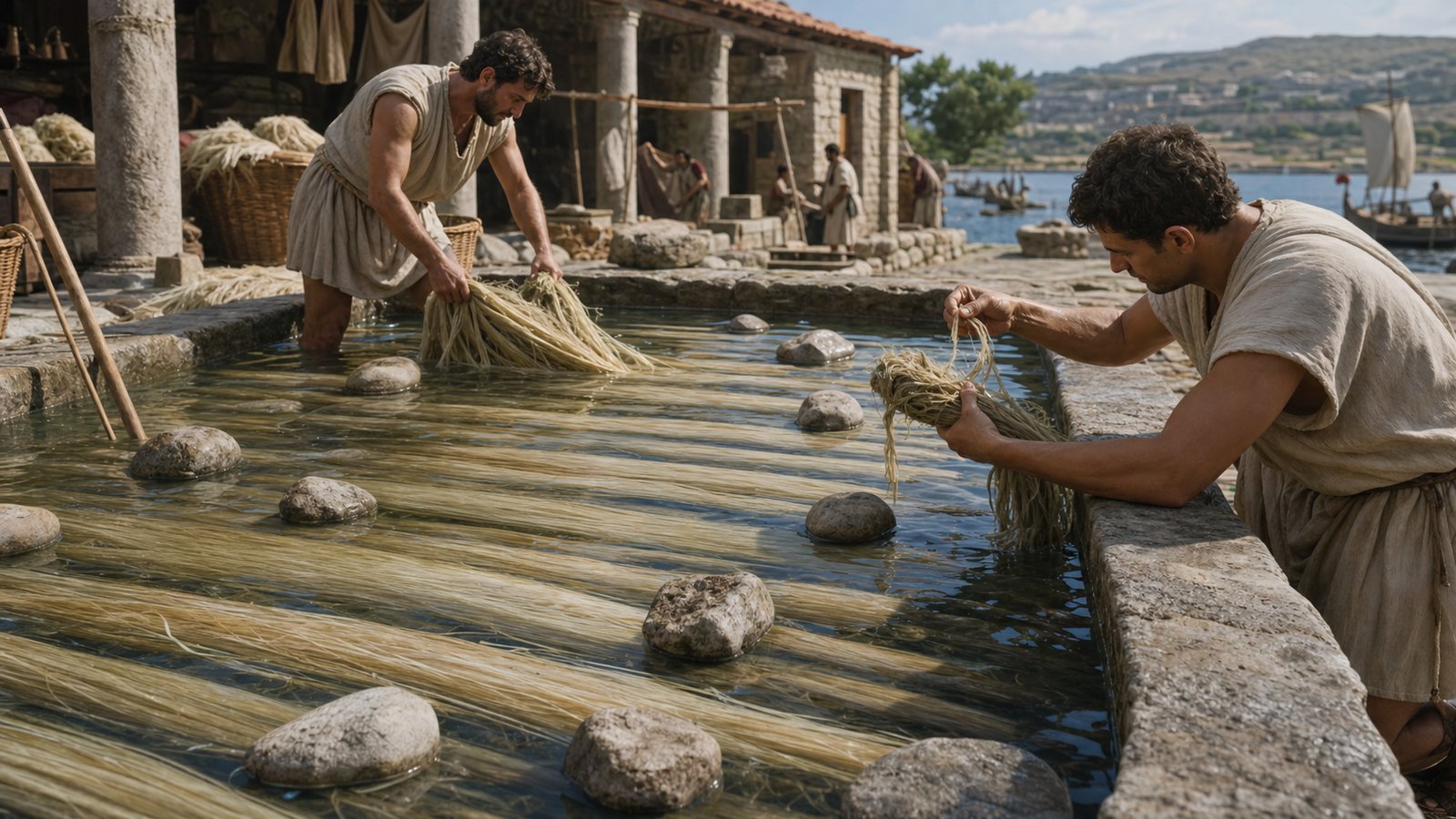
After the wheat harvest, the stalks went into water warmed by the sun. They would not stay there by themselves. Pliny calls flax exceptionally light and buoyant, so weights pressed it below the surface. The workshop used mass to hold the crop inside the condition needed to loosen its coat.
The operation had an observable stopping point. When the outer coat loosened, steeping was sufficient. The source does not supply a fixed number of hours or a measured temperature. It supplies a physical sign. Workers had to test the material and remove it when one layer had yielded without pretending every batch obeyed a clock.
Modern labels can make this stage sound automatic. Pliny’s details restore its practical tension. Water had to be warm enough through the sun, stalks had to remain submerged despite their buoyancy, and the coat had to loosen before the material moved on. Too little treatment would leave the outer layer bound; careless delay risked surrendering control of the fibre.
The stalks then returned to sunlight with their heads downward. Wetting did not directly produce workable flax. It prepared a boundary for another drying. The craft repeatedly changed the material’s condition because the next tool worked best on what the previous stage had altered.
Stone, mallet and iron teeth selected the inner fibre
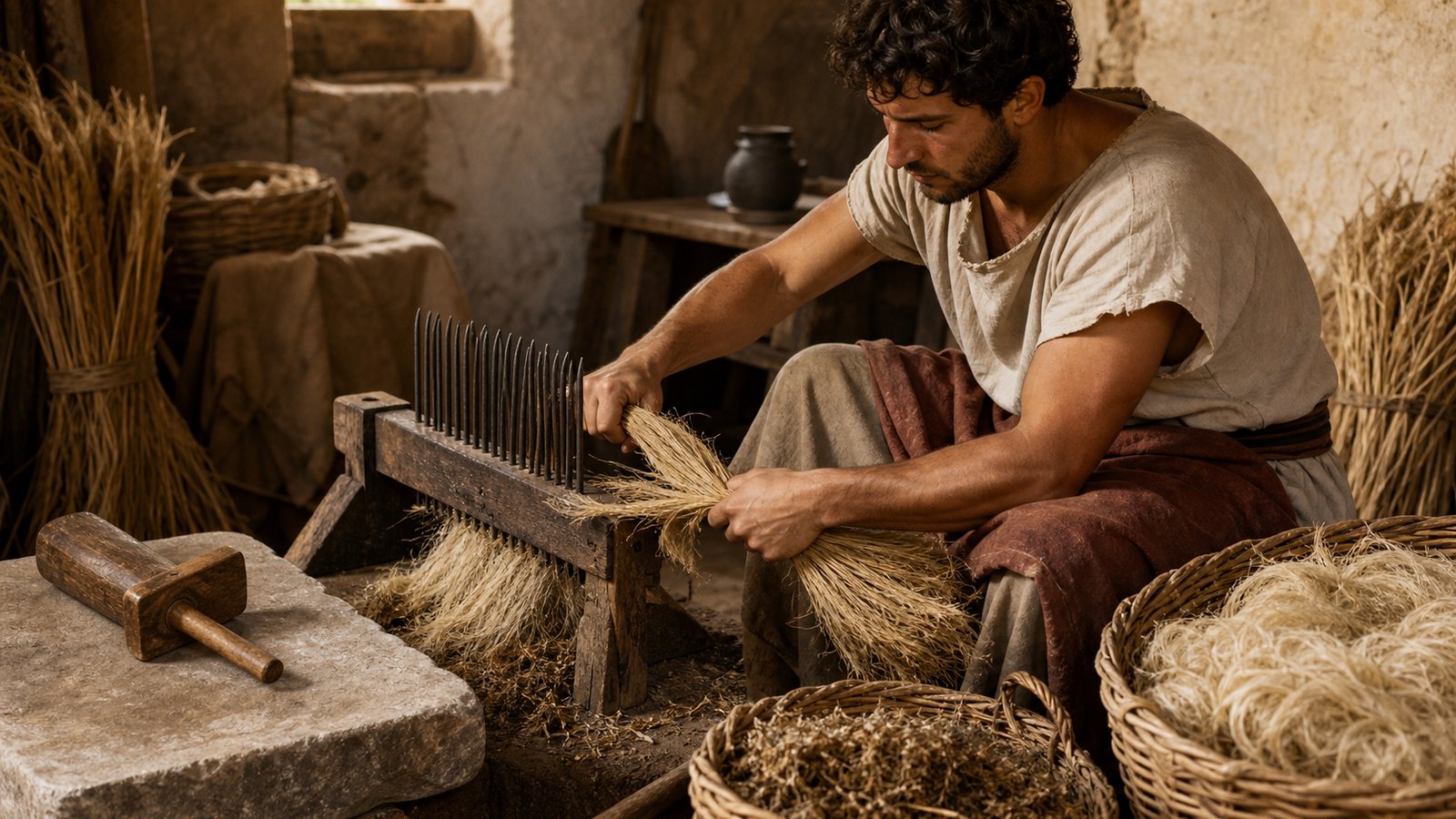
Once thoroughly dry, the stalks were beaten on stone with a tow-mallet. Impact broke and loosened what steeping had prepared. The coarse material nearest the outer coat was called stuppa. It was inferior to the inner flax, but not useless: Pliny says it commonly became lamp wicks.
Iron hatchels continued the separation. Their teeth combed out the remaining skin and aligned the fibres while removing coarse matter. The inner material could then be judged by whiteness and softness. Quality became visible only after multiple layers had been taken away.
The famous ratio appears here. Fifty pounds in the sheaf yielding fifteen pounds of combed flax was a fair return. More than two-thirds of the starting mass no longer counted as dressed fibre. The number warns against reading a harvest weight as a textile supply. Fields produced whole plants; spinners received a selected fraction.
Selection did not mean simple disposal. Seed had already been gathered. Coarse stuppa fed flames in lamp wicks, while husks and outer coats could heat furnaces and ovens. The valuable inner fibre followed one path, and rejected layers entered other systems of light and heat. Subtraction at the comb created redistribution across a household and workshop economy.
Beating continued after spinning and weaving
Pliny describes spinning as honourable work even for men, a pointed comment about the craft’s status. The combed fibre became thread, but finishing still had not ended. Spun thread was soaked in water and beaten on stone to make it more supple.
Weaving likewise did not mark the final blow. Finished tissue was beaten again with heavy maces. Pliny says the rougher the treatment, the better the result. His statement captures the paradox running through the chapter: softness and flexibility were achieved by repeated force applied at the correct stage.
The chain sits before the loom’s management of tension across growing cloth and before any later cleaning or fulling. Field, drying yard, steeping water, stone, mallet and iron comb had already determined how much fibre reached the spinner and what condition it was in.
A bolt of linen could hide this history because the operations aimed to remove their own evidence. Seed capsules, coat and husk were absent from the pale surface. Individual blows disappeared into softness. Pliny’s fifty and fifteen pounds put the vanished material back into view. Roman flax manufacture was not one transformation but a sequence of measured disappearances, each making the remaining fibre more capable of holding together.
Sources
Pliny the Elder, Natural History, 19.1–3.