
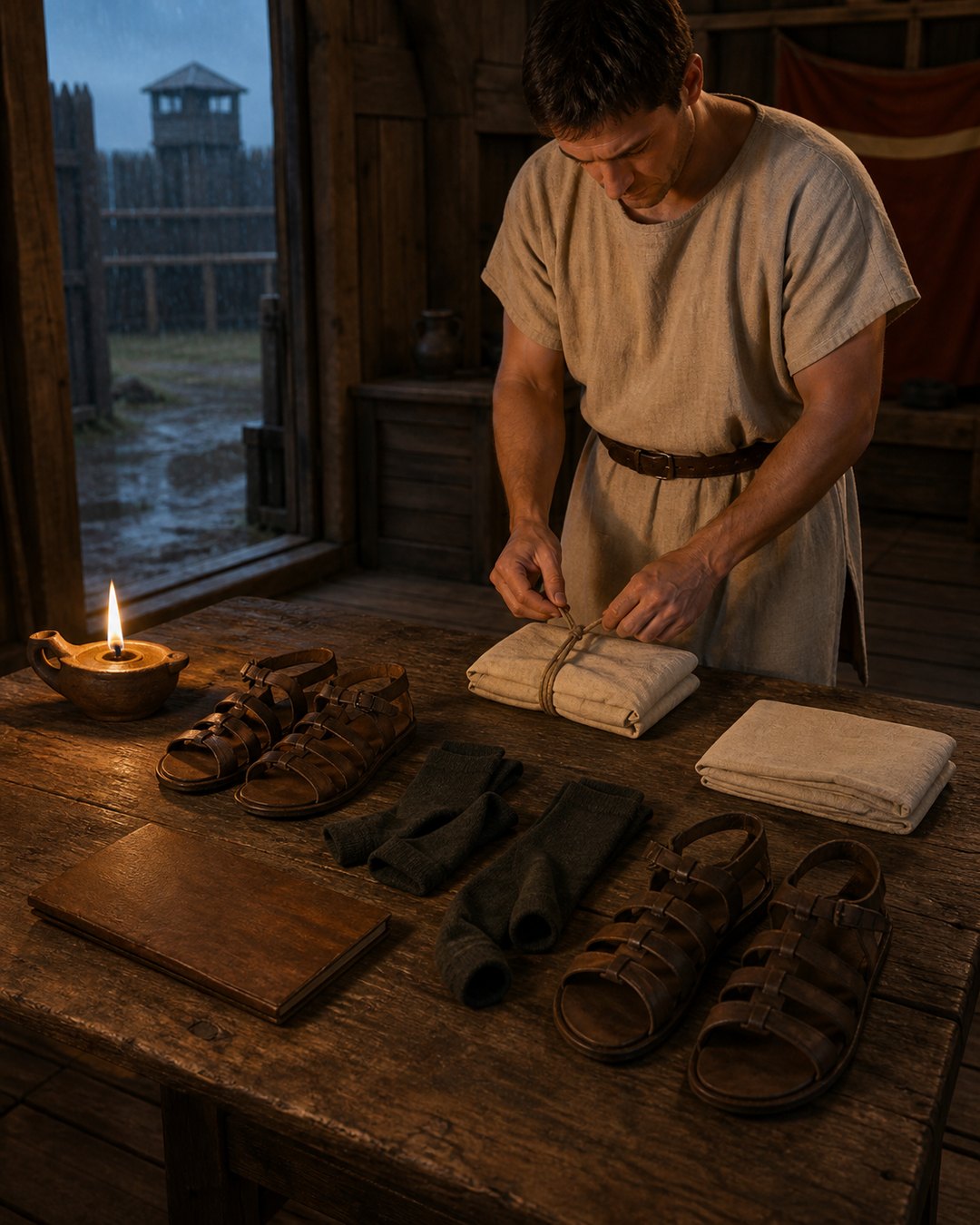
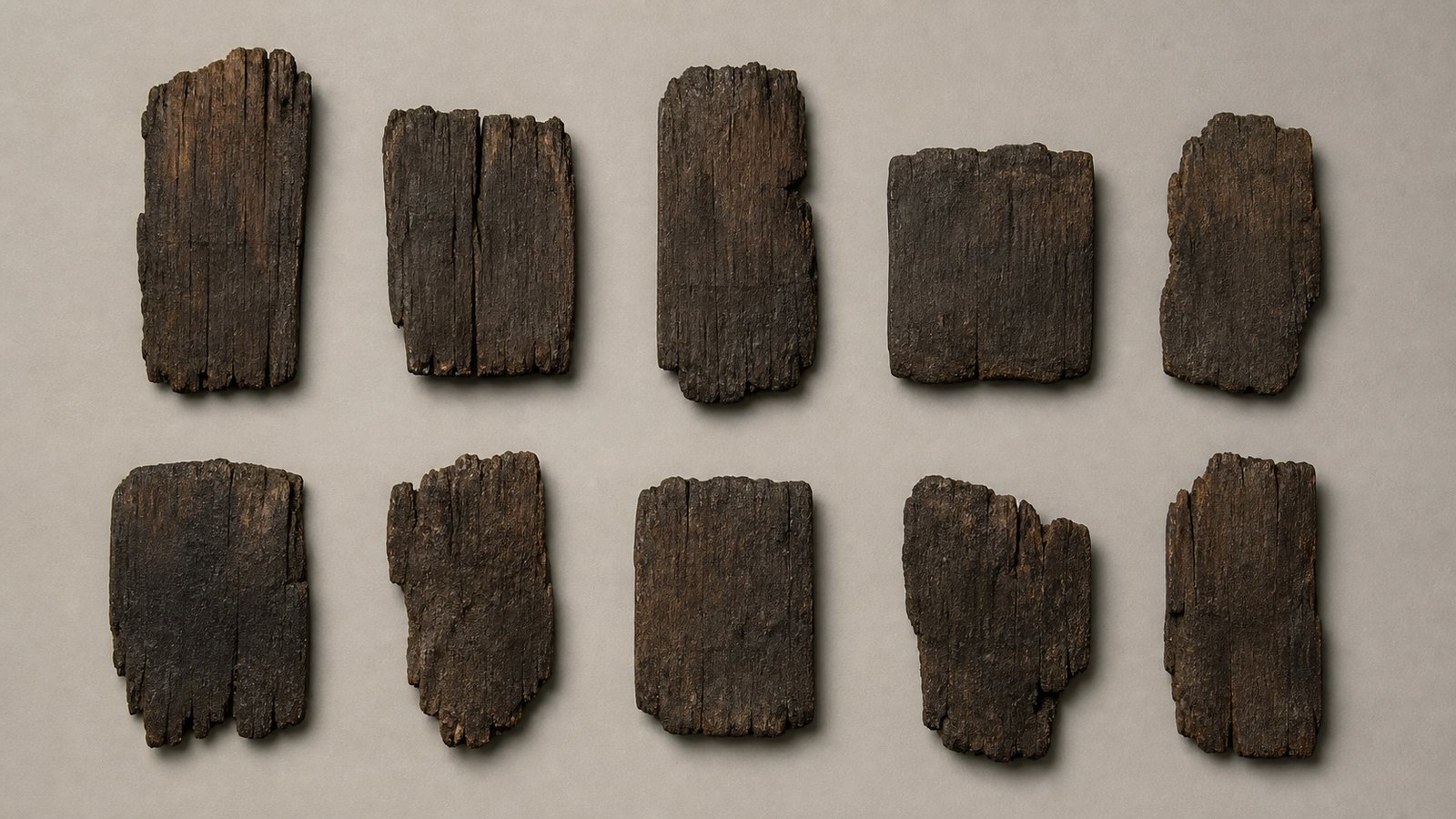
The most quoted words on Vindolanda Tablet 346 are the easiest ones to smile at: socks, sandals and underpants. They survive in an ink letter from the Roman frontier, broken across ten pieces of thin wood. The familiar objects seem to pull an ancient parcel straight into the present.
Yet the tablet is valuable precisely because it does not give us a neat, complete list. The sender’s name is lost. The recipient is not securely preserved. Even the verb behind “I have sent” is restored cautiously. Quantities disappear at damaged edges, names lose letters, and the reason for the dispatch remains unstated.
What remains is still unusually concrete. Clothing was counted in pairs. A person named Sattua was attached to the socks. Sandals appear twice. The closing lines greet Elpis, Tetricus and all the recipient’s messmates. A practical shipment and a social circle occupy the same small document. Tablet 346 shows frontier provision not as an anonymous system but as something carried through named relationships, while every break warns us not to invent the missing conversation.
Ten Fragments Kept One Private Message Legible
Roman Inscriptions of Britain catalogues the object as an ink writing tablet made of wood. It came from Vindolanda and was found during the 1973–75 excavations. Its present museum registration is British Museum 1980,0303.35, with inventory number 15. The catalogue classifies the text as a private document rather than an official strength report, legal instrument or public dedication.
The proposed date is about AD 104–120, and the question mark attached to that range matters. The dating depends on archaeological context and site period rather than a surviving consular date in the message. The object belongs to a well-studied frontier sequence, but its exact moment cannot be reduced to one confident day or year.
Ten fragments are enough to preserve parts of two columns and a closing greeting, but not enough to restore the original sheet without gaps. The document therefore works at two scales. As an artefact, it is a damaged wooden support whose broken edges define what can be read. As a message, it is a parcel note that once assumed its sender and recipient already understood far more than they needed to write down.
Claudia Severa’s Vindolanda invitation preserves a date, an invitation and a brief addition in her own hand. Tablet 346 offers a different kind of intimacy. It has no recoverable occasion, but ordinary clothing and the names of companions let a supply exchange surface through the damage.
Clothing Nouns Survived Better Than the Journey
The translation begins inside a broken sentence. The editors cautiously supply a form meaning that the sender had sent something to the recipient. What follows includes pairs of socks associated with Sattua, two pairs of sandals and two pairs of underpants. Later, two pairs of sandals appear again.
Those nouns establish the contents more securely than they establish the circumstances. Nothing in the surviving text says that the recipient complained of cold feet, had worn out a previous pair or requested a standard issue. It does not identify a merchant, price, wagon, courier or route. A parcel is visible; its logistics are mostly not.
This distinction prevents a good object from becoming a stock frontier story. Vindolanda’s northern setting makes warm clothing seem intuitively appropriate, but intuition is not a line on the tablet. The document supports a narrower and stronger claim: someone in this community used a private message to account for wearable items passing between people.
The pair was the practical unit for both socks and sandals. Underpants were also counted as pairs in the translation. Enumeration reduced soft, movable possessions to a form that could be checked. If the damaged verb really is “I have sent,” the list helped sender and recipient recognize what should arrive even though we cannot recover what prompted it.
Two Sandal Entries Preserve a Small Editorial Problem
Sandals occur once beside the socks and underpants, then again in a later damaged line. Repetition might look like a copying mistake or a duplicated modern transcription. The editors instead suggest that the second pair came from someone else. They flag this as an explanation, not as a statement written plainly in the surviving Latin.
That cautious note is a useful model for reading fragmentary evidence. The visible sequence needs interpretation because two similar entries appear in one short list. A second contributor would explain the structure, but the missing words prevent certainty. The proper article does not erase that gap simply because a clean story would be easier to tell.
Sattua supplies another point where a name meets an object. The editors judge Sattua to be a personal name and compare it with a brand found on a leather patch. That comparison strengthens the reading of the letters; it does not prove that Sattua made the socks, owned a workshop or personally carried the parcel. The secure relationship is grammatical and textual: the surviving phrase connects the socks with Sattua.
The tablet’s small uncertainties accumulate without making it useless. Instead, they show how scholarly reconstruction works. Letter shapes suggest a restoration, parallels make a name plausible, grammar limits possibilities, and damaged fibres stop the process. Each conclusion carries a different weight.
Messmates Turn the Inventory into a Social Document
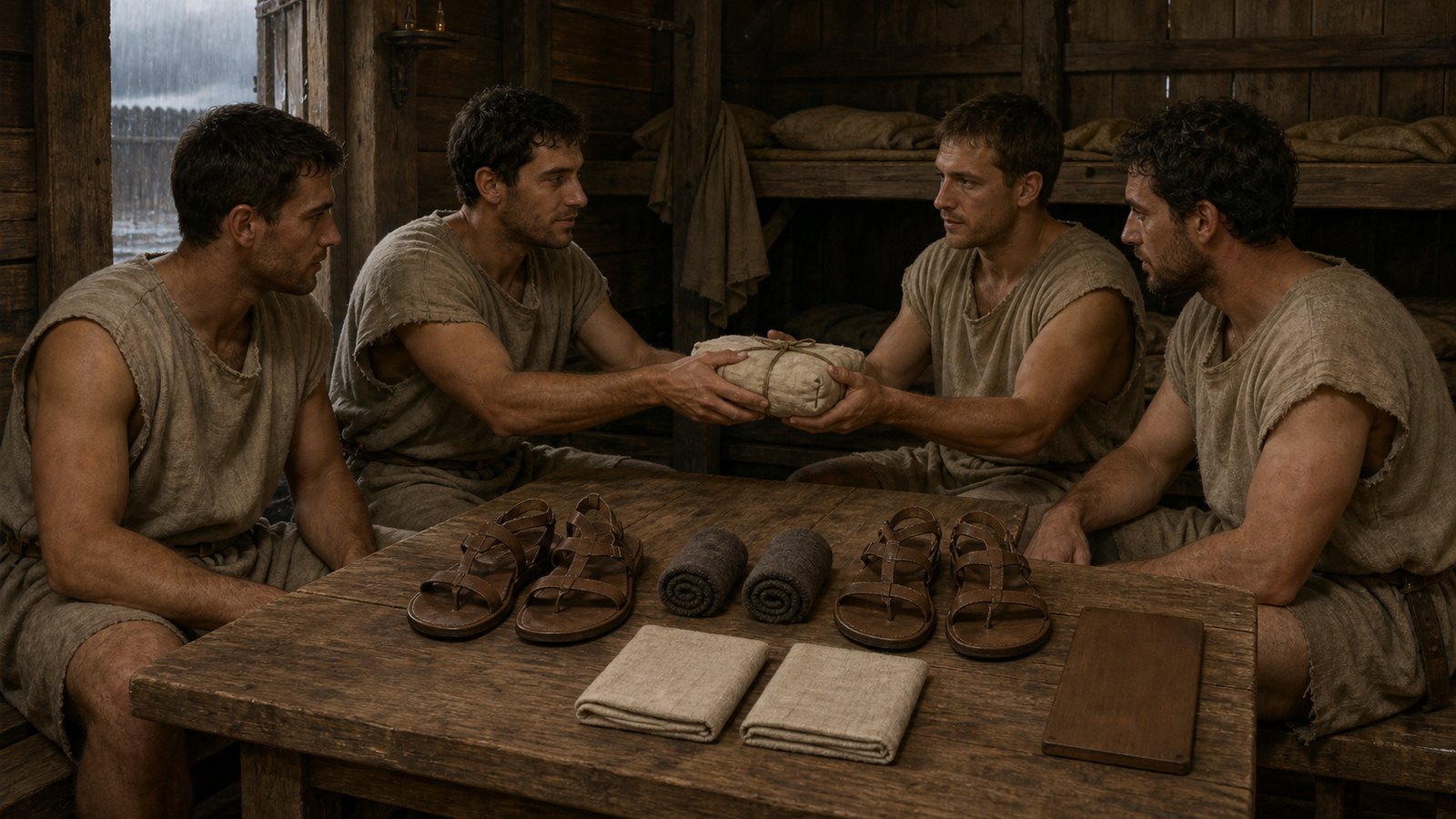
The second column shifts from things to people. Several names are incomplete, but Elpis and Tetricus remain visible in the edited translation. The sender then greets all the recipient’s contubernales, the messmates with whom he lived, and wishes that the recipient share the greatest good fortune with them.
This closing changes the meaning of the list. Socks and sandals did not move toward an isolated consumer. They entered a shared environment whose members could be named collectively. The sender expected the recipient to pass on greetings around that group, using one message to maintain several relationships.
A contubernium is often explained through military organization and shared quarters, but Tablet 346 does not preserve the recipient’s rank, unit or duty. “Messmates” is the careful translation because it catches the social arrangement directly named in the text without filling the document with a complete service record that has not survived.
the Vindolanda strength report that counted absent personnel views a frontier unit through administrative categories and totals. Tablet 346 works from the opposite direction. Its count concerns personal clothing, and its collective appears in a greeting. Both documents make groups legible, but one serves official accounting while the other closes a private exchange.
The Missing Words Are Part of the Evidence
It would be easy to make Tablet 346 answer questions it never asks. Who requested the garments? Were they gifts, purchases or replacements? Did one person receive all of them? Why did the sandals appear twice? Was Sattua a sender, supplier or owner? The fragments allow possibilities, not final answers.
The document’s strongest scene is therefore not an invented courier crossing rain or a shivering soldier opening a package. It is the surviving text itself: a sequence of clothing nouns followed by damaged names, a collective greeting and a wish for good fortune. Those elements were ordinary enough for the original correspondents to leave unexplained. Their very compression is what makes them revealing.
The museum object also joins two forms of preservation. Damp archaeological conditions kept thin wood from vanishing completely, while editorial comparison turned faint strokes into a cautious text. The resulting translation openly marks uncertainty. Question marks, brackets and notes are not obstacles between reader and Roman life; they are the record of how far the evidence permits us to go.
Underwear attracts attention because it breaks the marble-statue image of Rome. The more durable lesson is about connection. Clothing needed to reach a person, contributors needed to be distinguished, and greetings needed to circulate among messmates. The tablet carried all three tasks without treating them as separate systems.
Ten fragments cannot restore the whole parcel or the whole relationship. They do preserve enough to show that material support and social support travelled together. Socks, sandals and underpants made the message practical. Sattua, Elpis, Tetricus and the messmates made it personal. The gaps keep that conclusion honest.
Sources
Roman Inscriptions of Britain, Tab.Vindol. 346, Ink Writing Tablet.