
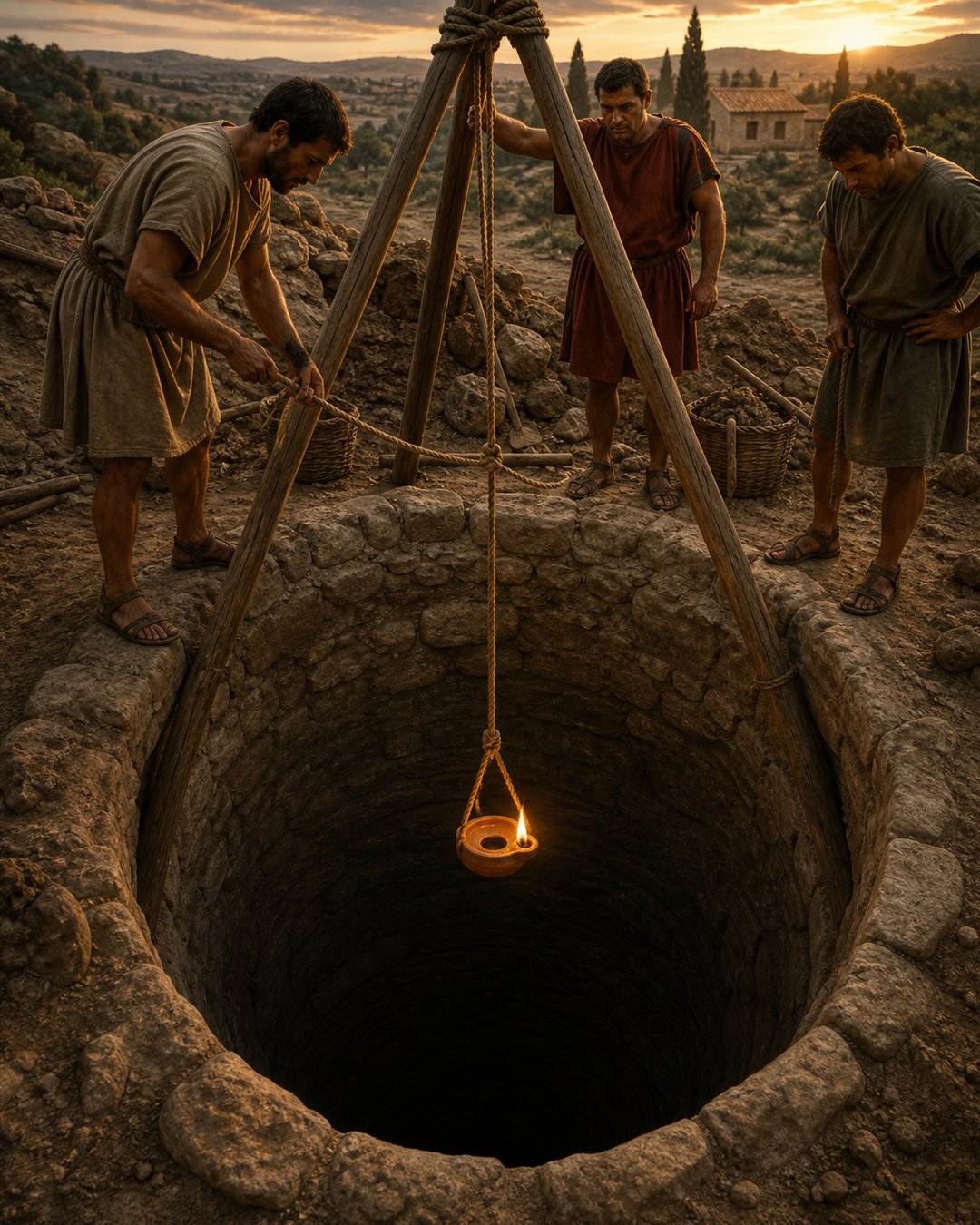
Vitruvius begins his well-safety instruction with the moment a worker should not descend. Air can rise through fissures into a deep excavation, he writes, and the resulting exhalation can stop a digger’s breath. Anyone who fails to escape quickly may die below.
His precaution is small enough to fit in one hand. Before sending a person down, lower a lighted lamp. If it continues to burn, Vitruvius permits the descent. If the flame goes out, the crew is not told to try again with a tougher worker. They are to dig air shafts beside the well, one on the right and one on the left, so that the vapours can leave.
The explanation belongs to ancient natural philosophy, not modern gas chemistry, and a flame is not an adequate modern confined-space instrument. The procedure is still revealing. Vitruvius places a cheap indicator in danger before a human body, makes failure a stop signal, and attaches that signal to a construction response. The lamp is not just illumination. It is the first moving part in a safety decision.
The Danger Arrived Through the Ground Before the Water
Book 8 of On Architecture follows water from discovery to delivery. In chapter 6, Vitruvius turns from aqueduct routes to wells and cisterns. A well may reach a hidden supply where a channel cannot, but excavation opens a vertical space into earth that also carries what he calls great currents of air.
Vitruvius imagines those currents rising through porous fissures in a “pregnant” state. At a well face, they meet workers whose nostrils and breath are exposed. His vocabulary is premodern, yet the physical warning is direct: the atmosphere in the shaft can incapacitate and kill before the digger can climb out.
The passage does not name a dead worker, town or particular well. It reads as technical instruction derived from a recognized class of accidents. That lack of a dramatic victim keeps attention on recurrence. The hazard belongs to the work itself, not to one unlucky story.
Nor does Vitruvius advise judging the shaft by smell. The dangerous exhalation is identified by what it does to breath and flame. A worker at the rim needs an observable test before entering the space where observation may come too late.
A Flame Went Down Before a Person Did
The sequence is explicit: lower a lighted lamp. The lamp separates testing from exposure because it can be watched from above while the worker remains outside the shaft. If the flame keeps burning, Vitruvius treats that result as permission to descend.
Roman oil lamps extended work beyond daylight, but illumination is only part of this lamp’s job. A well might be tested at noon. What matters is the flame’s response to the atmosphere, not the amount of light it adds to the bottom.
The source does not specify the lamp’s shape, fuel, cord knot, depth or waiting time. It does not tell us whether the crew repeated the test at intervals as digging continued. Reconstructing a standardized kit or inspection form would go beyond the text. The secure procedure has two states: burning and extinguished.
That simplicity made the test legible. A flame visible below meant one action; its disappearance meant another. The worker did not have to interpret a subtle colour change or estimate an odor. Yet modern readers should resist turning practical clarity into universal reliability. Different harmful atmospheres affect combustion and people in different ways, and Vitruvius supplies no modern concentration threshold.
The order of the instructions is as important as the objects. The lamp is lowered before Vitruvius authorizes a man to descend. When the light fails, the very next named work is excavation of the side shafts. He does not place a human inspection between warning and ventilation. That tight sequence is the article’s firmest evidence for a safety procedure: indicator first, entry conditional, corrective work after failure. Anything more elaborate—special inspectors, repeated readings or a fixed test depth—would have to come from evidence outside this passage.
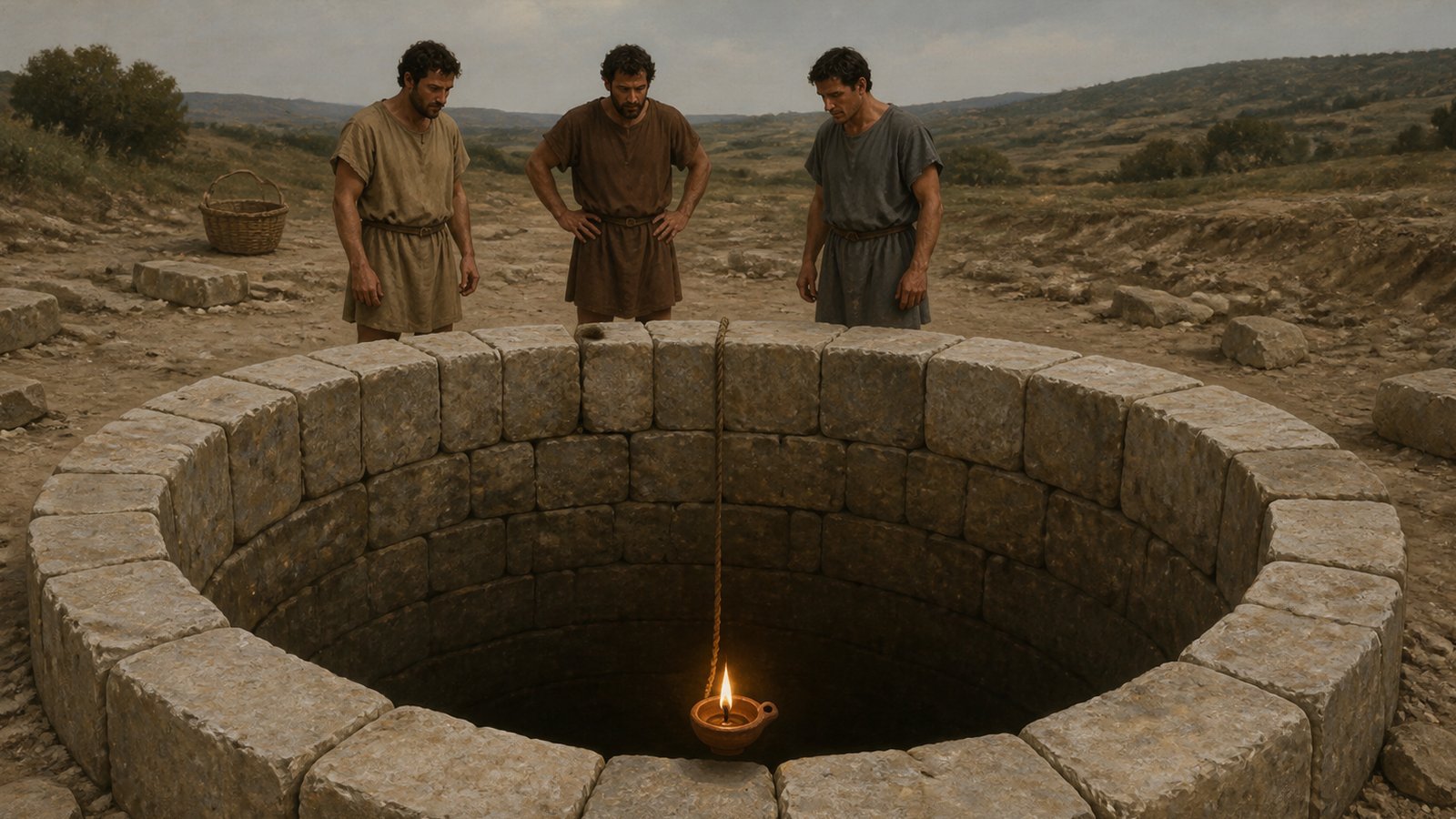
An Extinguished Lamp Changed the Worksite
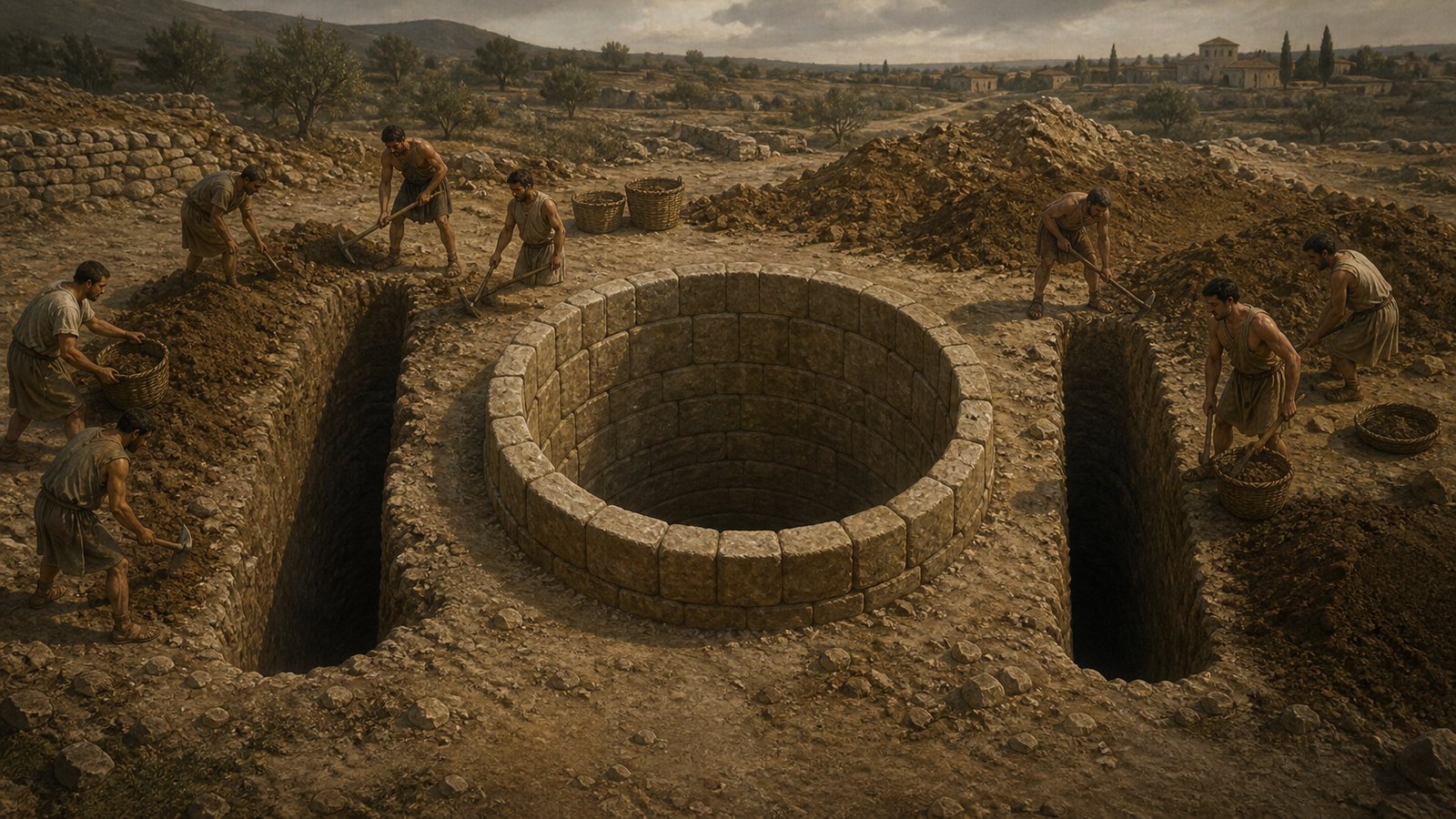
Failure redirects labor. Vitruvius orders air shafts to be dug beside the well on its right and left. The crew therefore transforms one vertical excavation into a small system of openings. The dangerous space is not abandoned immediately, but access is postponed while ventilation is built.
He compares the side shafts to nostrils. Vapours that had accumulated in the main well can be carried away through these additional paths. The bodily metaphor makes the engineering easy to remember: the excavation needs ways to breathe before a person can breathe inside it.
The paired placement matters. “Right and left” is more specific than a vague demand for air. It suggests that ventilation must be arranged around the well rather than improvised at the same opening used for descent and spoil removal. The central shaft keeps its water-seeking purpose while adjacent shafts take on the atmospheric problem.
Vitruvius does not describe fans, bellows or powered extraction in this passage. Air movement follows from openings. We should not add equipment because it would make the scene look more ingenious. His actual answer is expensive in another currency: more excavation, more time and more exposed ground before the original work can continue.
Reaching Water Did Not End the Construction Rules
Once the air shafts are complete and water is reached, Vitruvius says to build a wall around the well without blocking the vein. Safety and supply remain connected. A lining that stabilizes the excavation must not seal the very path through which water enters.
This instruction turns the well into a negotiated structure. Earth has to be held back, water has to be admitted, and air has to be released. Maximizing one function blindly could ruin another. A completely closed lining would defeat collection; a single unsupported hole could endanger the worker; an unventilated shaft could become lethal before either problem was solved.
Vitruvius also proposed bodily and material tests for judging spring water. The lamp procedure follows the same broad habit of turning invisible qualities into observable effects. A spring leaves traces on bodies, vessels and boiled residues; a well atmosphere reveals itself through a flame.
Neither method should be mistaken for modern laboratory analysis. Their historical importance lies in the chain from observation to decision. Vitruvius wants the builder to test, compare a result with a rule, and alter the work accordingly.
A Cistern Was the Alternative to a Bad Excavation
Vitruvius does not insist that every water problem end in a deeper well. If the ground is hard or the veins lie too deep, he turns to water collected from roofs or higher ground and stored in cisterns. The design changes source rather than demanding unlimited digging.
His cistern instructions become material and numerical. For signinum work, he calls for the cleanest sharp sand, lava broken into pieces no heavier than a pound, and strong lime. The given proportion is five parts sand to two parts lime. The trench and walls are then compacted through a separate construction sequence.
This alternative clarifies what the lamp test belongs to: not a romance of conquest over depth, but a menu of water-supply choices. The well is acceptable only while ground, atmosphere, lining and water vein can be managed. Hardness or depth may push the builder toward collection; a failed flame pauses descent and demands ventilation.
The strongest lesson is procedural restraint. The flame is sent where the worker might die. When it fails, the correct response is not courage but redesign. Vitruvius did not know the chemistry a modern safety team would measure, and his lamp could not provide the protection modern confined-space work requires. He nevertheless preserved an engineering instinct that is easy to recognize: let an indicator take the first risk, and believe the warning before a person enters.
Sources
Vitruvius, On Architecture, 8.6.12–15.