
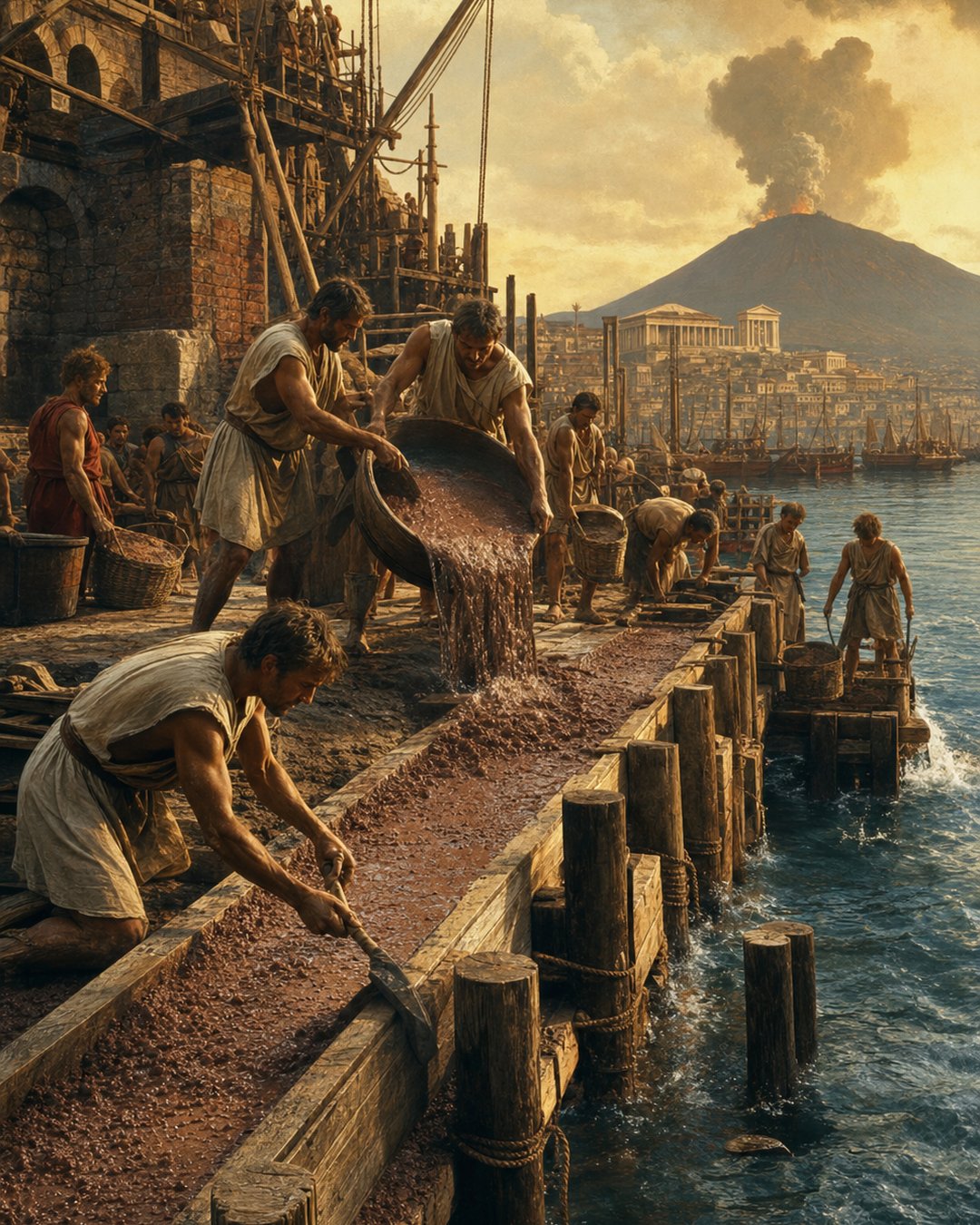
Roman concrete did not outlive the empire because Romans had a single secret recipe whispered from mason to mason. The better answer is less magical and more interesting. They used local materials, especially volcanic ash, in ways that matched the demands of harbors, vaults, walls, baths, and monuments. Some structures survived because chemistry, craft, environment, and imperial ambition happened to reinforce one another.
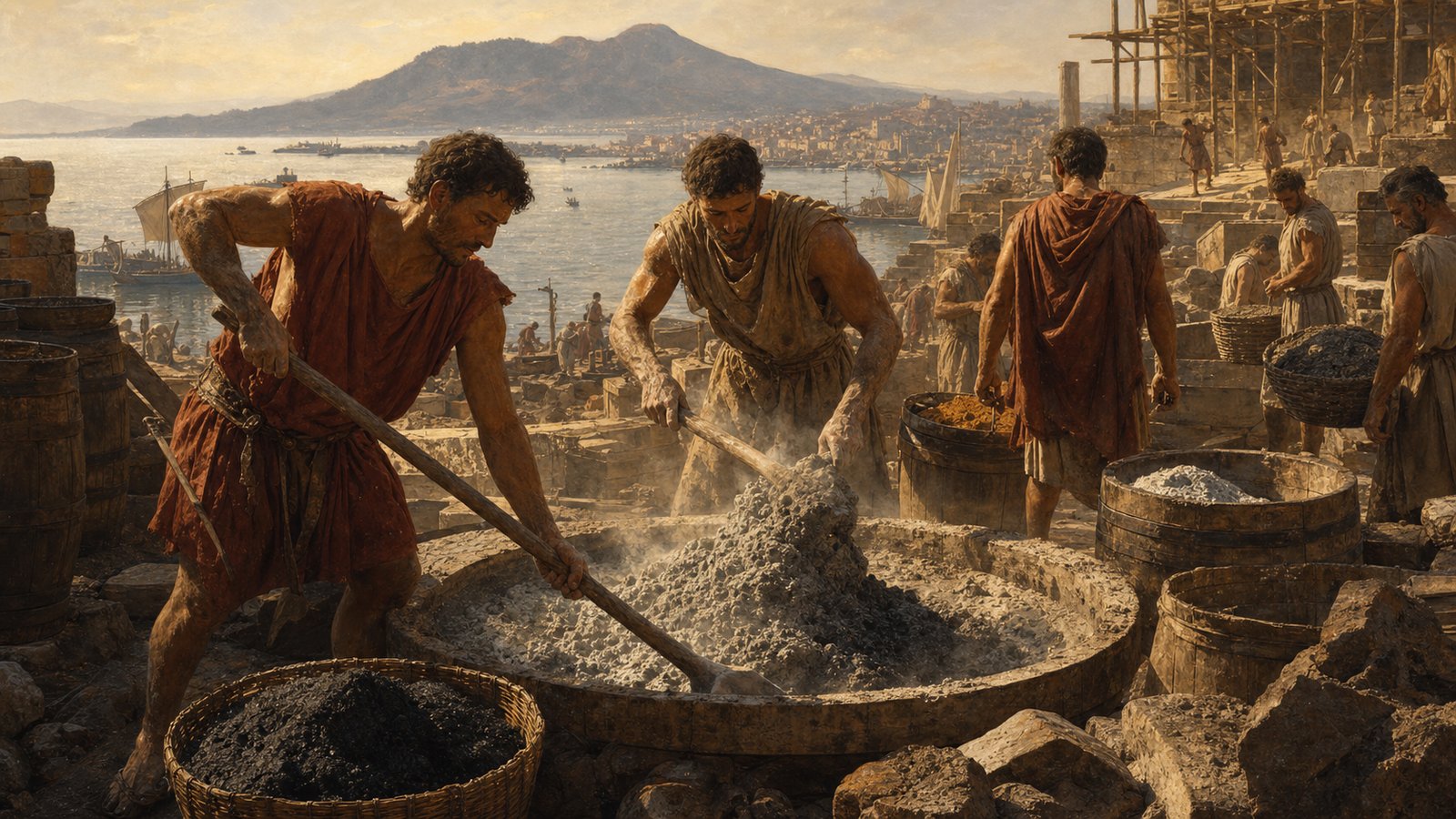
The Latin term often used for Roman concrete is opus caementicium. It was not modern Portland cement. It was a family of building practices using lime mortar, aggregate, rubble, formwork, and sometimes pozzolana, the volcanic ash that could help mortar harden in wet conditions. The result was not universal immortality. Many Roman buildings collapsed, were stripped, or were rebuilt. But enough survived to make the material feel almost uncanny.
Vitruvius points to volcanic powder, not magic
Vitruvius, writing under Augustus, gives one of the clearest ancient clues. In On Architecture, he describes a powder from the region around the Bay of Naples that, when mixed with lime and rubble, produces strong work even in water. That detail matters because it shows Romans noticing a material property tied to place. The famous durability was not only an abstract formula. It began with a landscape.
Pozzolana changed what builders could attempt. Ordinary mortar hates the sea. Roman hydraulic mixtures could turn water from a destroyer into part of the hardening environment. In harbor works, that was revolutionary. A pier or breakwater was not simply resisting waves; in some cases its chemistry interacted with seawater over time.
The sea punished bad building quickly
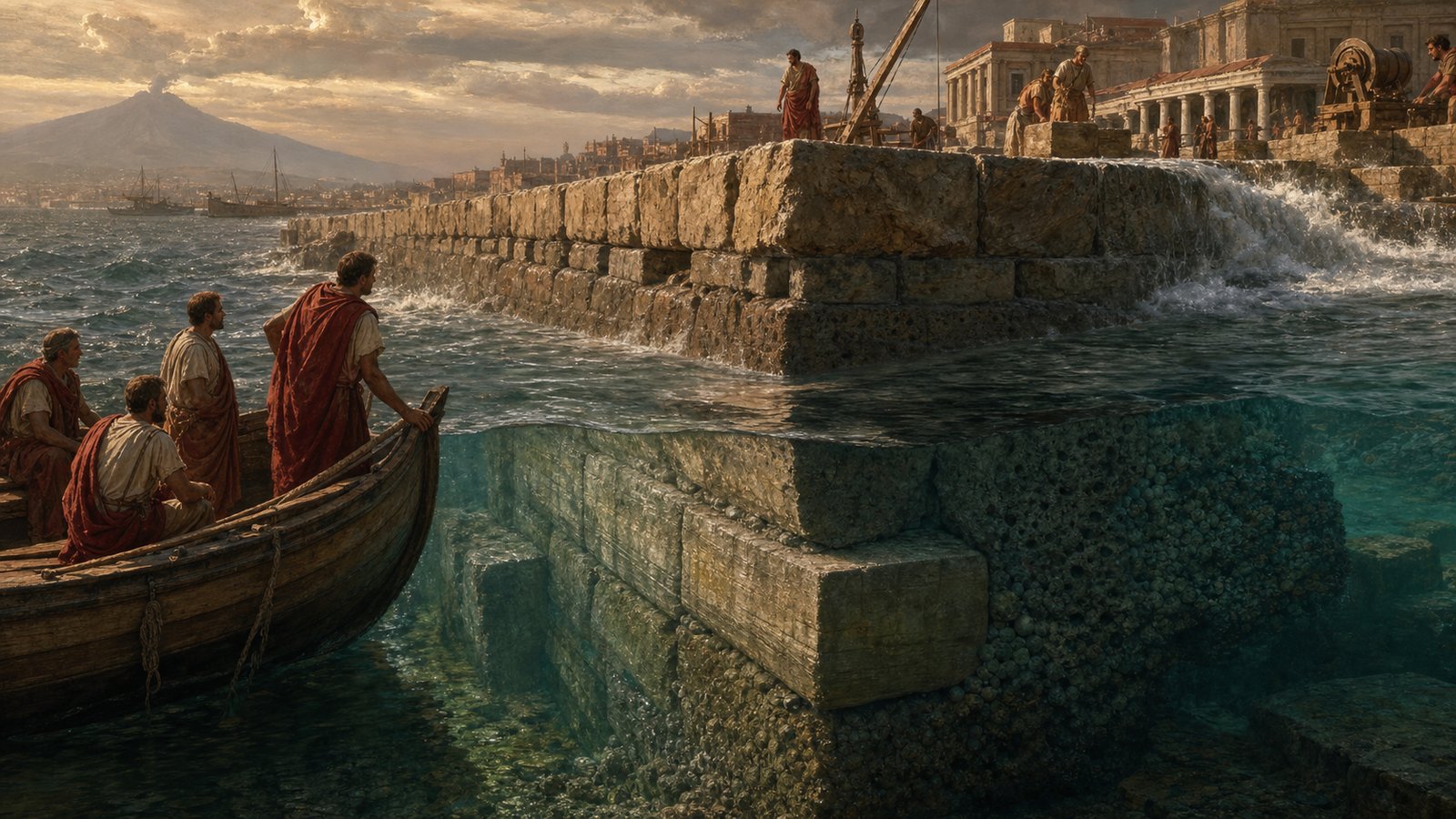
Marine construction is a brutal test. Waves, salt, currents, and impact expose weakness. A pretty wall can survive on land while a harbor structure fails fast. Roman success in some maritime settings therefore deserves attention. It was not only that Romans poured concrete. They poured the right kind of material in places where other materials struggled.
Modern studies of Roman marine concrete have identified durable mineral reactions involving seawater and volcanic ash. The exact scientific language is modern, but the ancient lesson was practical: certain mixes endured. Builders did not need a laboratory theory to observe that a pier held, a breakwater worked, and a harbor could be extended into difficult water.
The Pantheon proves scale, not just survival
The Pantheon is famous partly because its unreinforced concrete dome remains astonishing. But it should not be treated as the only evidence. Its importance is that Roman builders used concrete not merely as filler, but as a structural tool that could shape space. Vaults, domes, bath complexes, and amphitheaters all depended on the ability to build mass, curve, and span in new ways.
Concrete let Rome make architecture feel imperial. Stone blocks had prestige, but concrete could create interiors and volumes that earlier building systems handled less easily. The material helped turn power into rooms, vaults, and urban experience. A citizen entering a bath or temple did not need to know the chemistry to feel the scale.
Durability depended on labor and systems
It is easy to romanticize the material and forget the organization behind it. Concrete required quarrying, burning lime, moving aggregate, managing water, building wooden forms, placing rubble, and coordinating teams. Roman building was a social technology as much as a chemical one. Roads, harbors, baths, and monuments emerged from administrative will and human labor.
That matters because the empire did not survive as a political system merely by having strong walls. It survived for centuries by repeatedly turning resources into infrastructure. Concrete was one tool in that larger habit. The material made certain ambitions possible, but ambition put the material to work.
Not all Roman concrete was immortal
The survivals can mislead us. We mostly see what endured. Countless walls, floors, piers, and buildings disappeared because they were poorly built, robbed for stone, damaged by earthquakes, neglected, or exposed to conditions their materials could not handle. Roman concrete was impressive, but it was not a spell against time.
That caution actually makes the surviving examples more meaningful. They show a technology used well in particular settings. The best Roman concrete was durable because ingredients, environment, and technique matched. The empire’s ruins are therefore not proof that Romans solved building forever. They are proof that ancient craft could be sharply adapted to local material reality.
The empire vanished; the chemistry kept working
The phrase “Roman concrete outlived the empire” sounds like a paradox. In one sense it is simple. Political systems fall; minerals do not follow imperial calendars. A harbor wall or dome can keep bearing weight long after the authority that commissioned it has vanished. That is part of the emotional power of Roman ruins.
The stronger lesson is that Rome’s material culture was not primitive imitation of modern engineering. It had its own logic. Vitruvius’ volcanic powder, pozzolana from the Bay of Naples, seawater reactions, skilled labor, and public ambition all belonged to that logic. Roman concrete endured where Rome understood what it was asking the material to do.
The ruins preserve choices, not just material
Every surviving Roman structure is also a record of decisions. Builders chose where to use local stone, where to pour mass concrete, where to face walls with brick or stone, and where the expense of a durable mix was worth it. Those decisions were practical, not mystical. A harbor, bath complex, or dome demanded different answers from a rural wall or temporary structure.
This is why Roman concrete should be understood as part of an engineering culture. Vitruvius gives words to that culture, but thousands of unnamed workers made it real. They handled wet mortar, carried aggregate, built wooden forms, and learned from places where structures failed. Durable material was inseparable from repeated craft.
The survival of concrete after the empire also changes how ruins speak to us. They do not say that Rome conquered time. They say that some Roman builders solved specific problems with unusual intelligence. The empire’s politics passed away, but the mineral consequences of those choices remained locked into domes, walls, piers, and foundations.
The important caution is that a famous Roman story should never be reduced to a single prop. Elephants, concrete, a rebel queen, or four emperors can become convenient shorthand, but shorthand is where the history starts rather than ends. The fact sheet forces the stronger reading: named people, dates, places, materials, and ancient testimony all have to carry the interpretation. That keeps the article from turning into a modern slogan placed on an ancient scene.
Seen that way, the episode becomes less familiar and more useful. It shows Roman power as something made from logistics, labor, fear, law, memory, and administration. Those forces were concrete enough to leave ruins and stories behind, but unstable enough to keep surprising the people who thought they controlled them in practice.
Sources & Further Reading
- Britannica, concrete
- Britannica, pozzolana
- Vitruvius, On Architecture, 2.6
- University of Utah, Roman concrete
- Britannica, Pantheon
- Portus Project, Roman maritime engineering
- Vitruvius, On Architecture, 2.5-6
- Britannica, Roman architecture
- Britannica, cement