
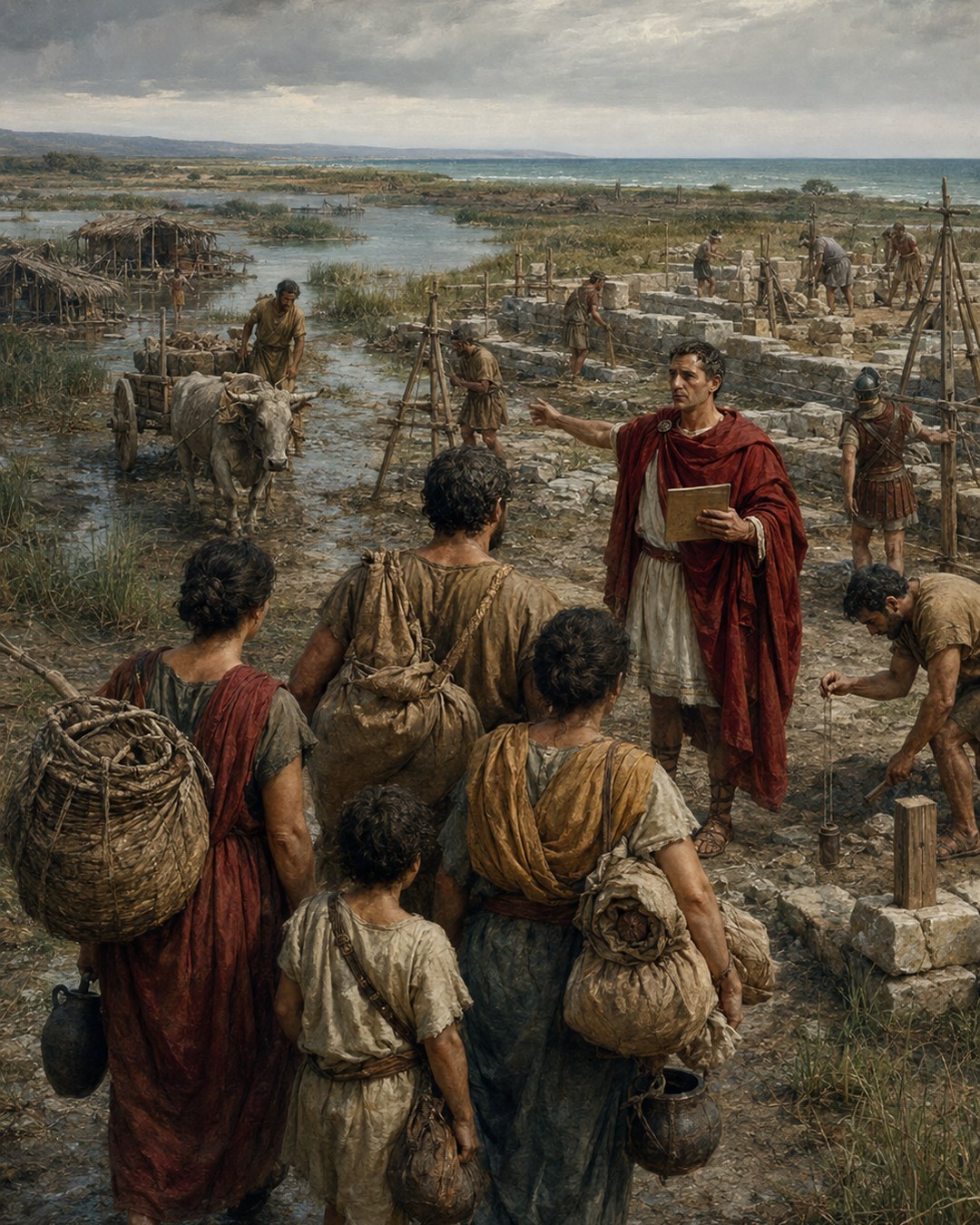
Salapia did not repair its way out of an unhealthy site. It moved. Vitruvius says the inhabitants of the old Apulian city were continually unwell beside a stagnant marsh, so they petitioned Marcus Hostilius for permission to seek a healthier place.
What followed was more than an evacuation. Hostilius bought an estate near the sea, asked the Roman senate and people to authorize the relocation, marked out new walls and assigned land to the citizens. Then he opened a connection between the lake and the sea, turning the water beside the new settlement into a harbour.
The distance was four miles. In that short span, Vitruvius compresses an entire urban project: environmental diagnosis, public petition, land acquisition, political permission, surveying, household resettlement and hydraulic work.
Salapia appears in On Architecture 1.4 because it proves a rule. A city’s health began before its buildings. Site, air and drainage could decide whether walls protected a population or trapped it beside the wrong water.
A Stagnant Marsh Made the Old Site the Problem
Vitruvius had been explaining where a new city ought to stand. Low, misty places exposed to unhealthy conditions worried him, but he did not condemn every wet landscape in the same way. Marshes with drainage toward the sea could behave differently from enclosed stagnant water.
His account belongs to ancient environmental medicine. Stagnant marshes without outlets, he says, became putrid and released heavy, pestilent vapours. That is Vitruvius’s causal model, not a modern account of pathogens or mosquitoes, and it should remain attributed to him.
Salapia supplied his example. The old city stood in Apulia, with foundation traditions reaching either to Diomedes returning from Troy or to Elpias the Rhodian. Vitruvius does not pause to decide between those founders. The condition of the inhabitants matters more to his architectural lesson.
They were continually out of health. The phrase turns illness from an isolated outbreak into a property of location. If the air and trapped water made the site itself harmful, another building inside the same boundary could not solve the first mistake.
The archive’s examination of the tests Vitruvius proposed for a Roman spring shows the same planning instinct at the scale of water supply. Salapia expands it to the city. Before monumental design came the harder question of whether people should remain there at all.
The Inhabitants Began with a Public Petition
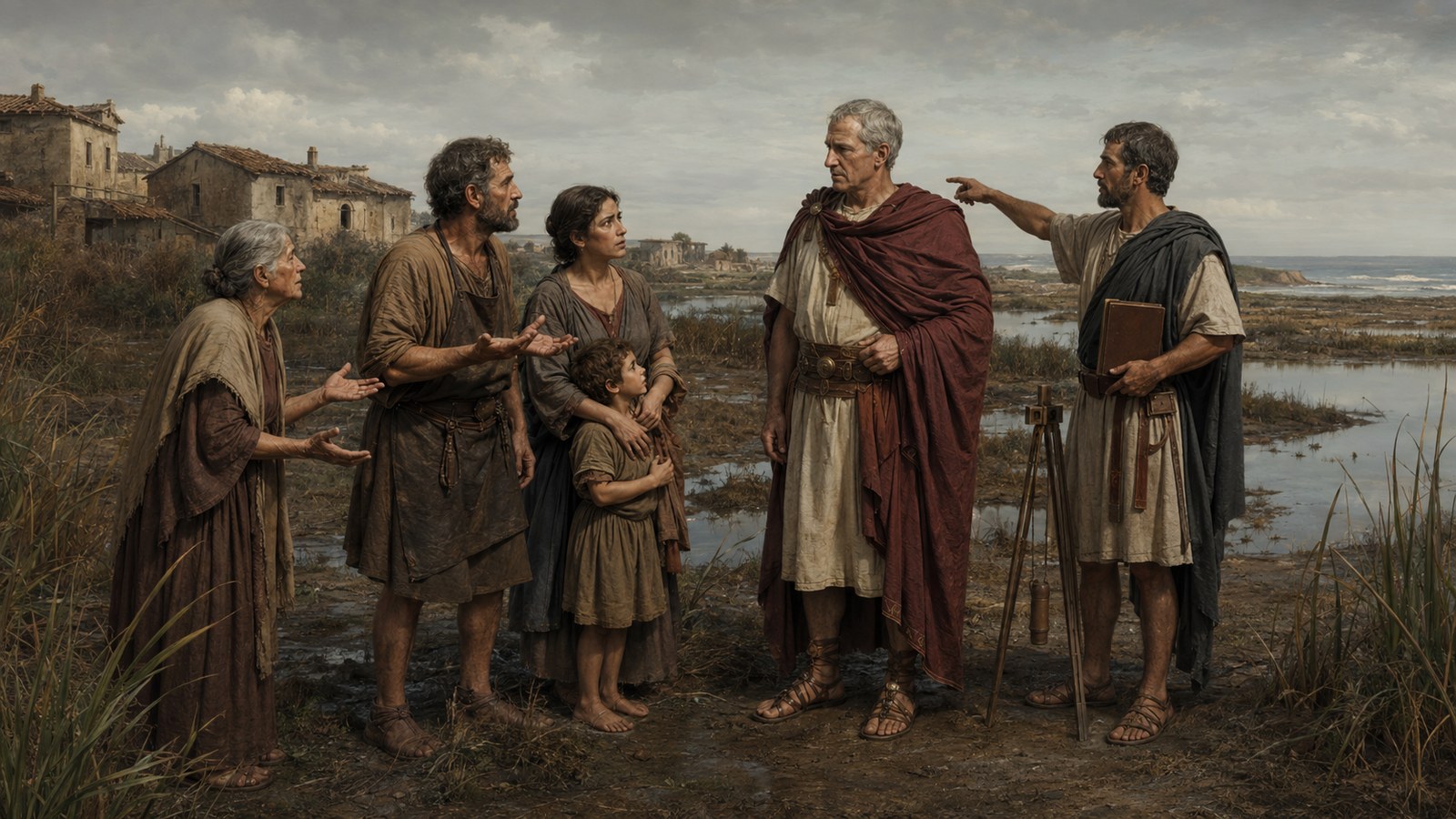
Vitruvius does not give Salapia a silent rescuer. The inhabitants applied to Marcus Hostilius and petitioned him publicly. They sought his consent to search for and select a more wholesome location.
That sequence gives the population agency while also revealing dependence. Recognition of the problem began locally, but moving a city required someone who could assemble land and carry the proposal into Roman public authority.
Hostilius responded without delay and, in Vitruvius’s approving language, with judgment. He bought an estate on a healthy site close to the sea. Purchase made the alternative concrete. The plan was no longer simply to leave the marsh; it had ground on which walls and homes could be measured.
He then sought permission from the senate and Roman people for the relocation. The detail prevents us from imagining an informal migration in which households drifted toward better soil. A recognized city, its territory and its civic arrangements could not simply be picked up by private preference.
The source does not preserve the debates in Rome, the price of the estate or the exact legal form of approval. It does preserve each threshold: local petition, Hostilius’s consent, purchase and authorization. The move advanced by turning complaint into a sequence of decisions.
New Walls and Citizen Plots Made the Move Physical
Once the site was secured, Hostilius laid out the walls. In Vitruvius’s narrative, the boundary comes before the city is described as inhabited. Surveying the enclosure transformed open land into a future civic space.
He also assigned a portion of the soil to every citizen at a moderate valuation. This is the social core of the relocation. Moving walls without redistributing places to live would have moved the city’s outline but not its people.
Vitruvius gives no map of streets, temples or markets. Instead he records allotment. Each citizen’s share tied household rebuilding to the public plan, while valuation acknowledged that land transfer had an economic structure.
The four-mile distance now becomes more than a measurement between dots. Families had to shift homes and routines from an old settlement with inherited associations to a newly divided estate. The source does not describe carts, demolition or the fate of every old building, so those details should not be invented.
What can be seen is a city being remade through boundaries and portions. The walls established a collective perimeter; the assignments made room for individual citizens inside it. Roman planning joined the two scales.
One Cut Changed a Lake into a Harbour
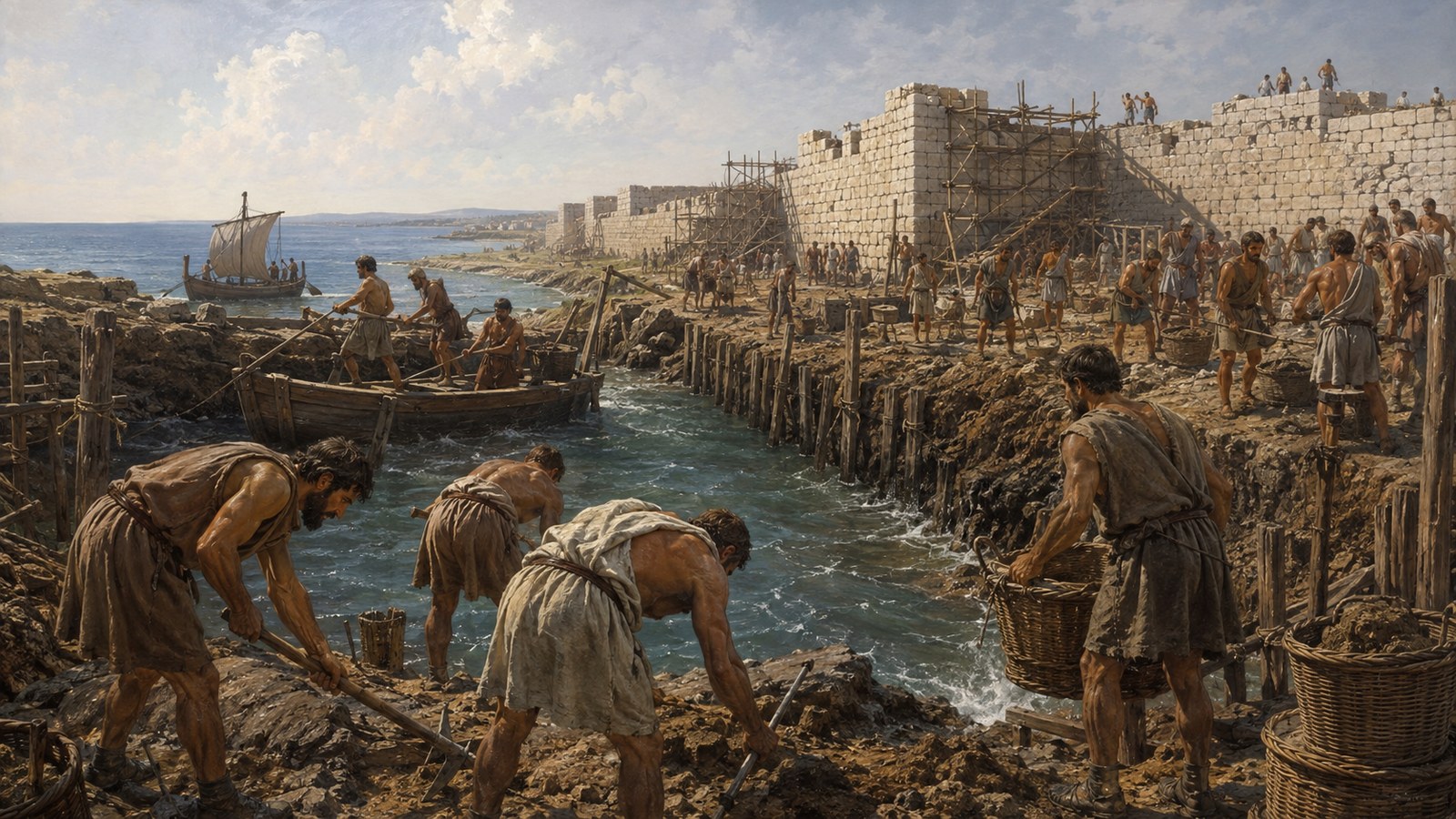
Hostilius did not merely turn his back on the old waters. He opened a communication between the lake and the sea. Vitruvius says the work converted the former into an excellent harbour for the city.
The channel is the mechanism that completes the story. Stagnation had helped define the old site as harmful in Vitruvius’s account. Connection made water circulate and at the same time created access for vessels.
This was not an aqueduct bringing drinking water over a distance. Nor was it simply drainage intended to erase the lake. The intervention altered the relationship among lake, sea and settlement so that an environmental liability became transport infrastructure.
Vitruvius’s next chapter explains why that mattered. A chosen site needed not only good air and provisions but roads and river or sea navigation for merchandise. Salapia’s new harbour answered the commercial side of healthy placement. The people did not escape illness only to become isolated.
The logic differs from Ostia’s role in making imperial exchange reachable. Salapia was not Rome’s giant maritime gateway. Its harbour belongs to a local relocation, where the same engineering act could improve water movement and preserve economic connection.
Four Miles Reassembled a City rather than Replacing It
Vitruvius ends by saying the Salapians now occupied a healthy situation four miles from their ancient city. The people retain their name. The city’s identity crossed the distance even though its site did not.
This distinction matters for understanding relocation. Salapia was not described as destroyed and succeeded by a wholly unrelated foundation. Its inhabitants petitioned, received allotments and re-established their civic space within new walls.
Marcus Hostilius stands at the center because he connected actions that no single household could complete: buying the estate, obtaining public permission, drawing the walls, distributing land and cutting the channel. Yet the first movement in the account still belongs to the inhabitants who publicly asked to leave.
The episode also shows the range of what Vitruvius considered architecture. His lesson includes air, marshes, law, property and navigation before it includes decorative orders. A city was a working arrangement between bodies, ground, water and routes.
Salapia’s four miles therefore measure a change in system, not merely location. On one end lay stagnant water and recurring sickness as Vitruvius understood them. On the other stood allocated plots, authorized walls and a lake opened to the sea. The successful city began when planners admitted that the old site itself could not be repaired.
Sources
Vitruvius, On Architecture 1.4.12 and 1.5.1.