
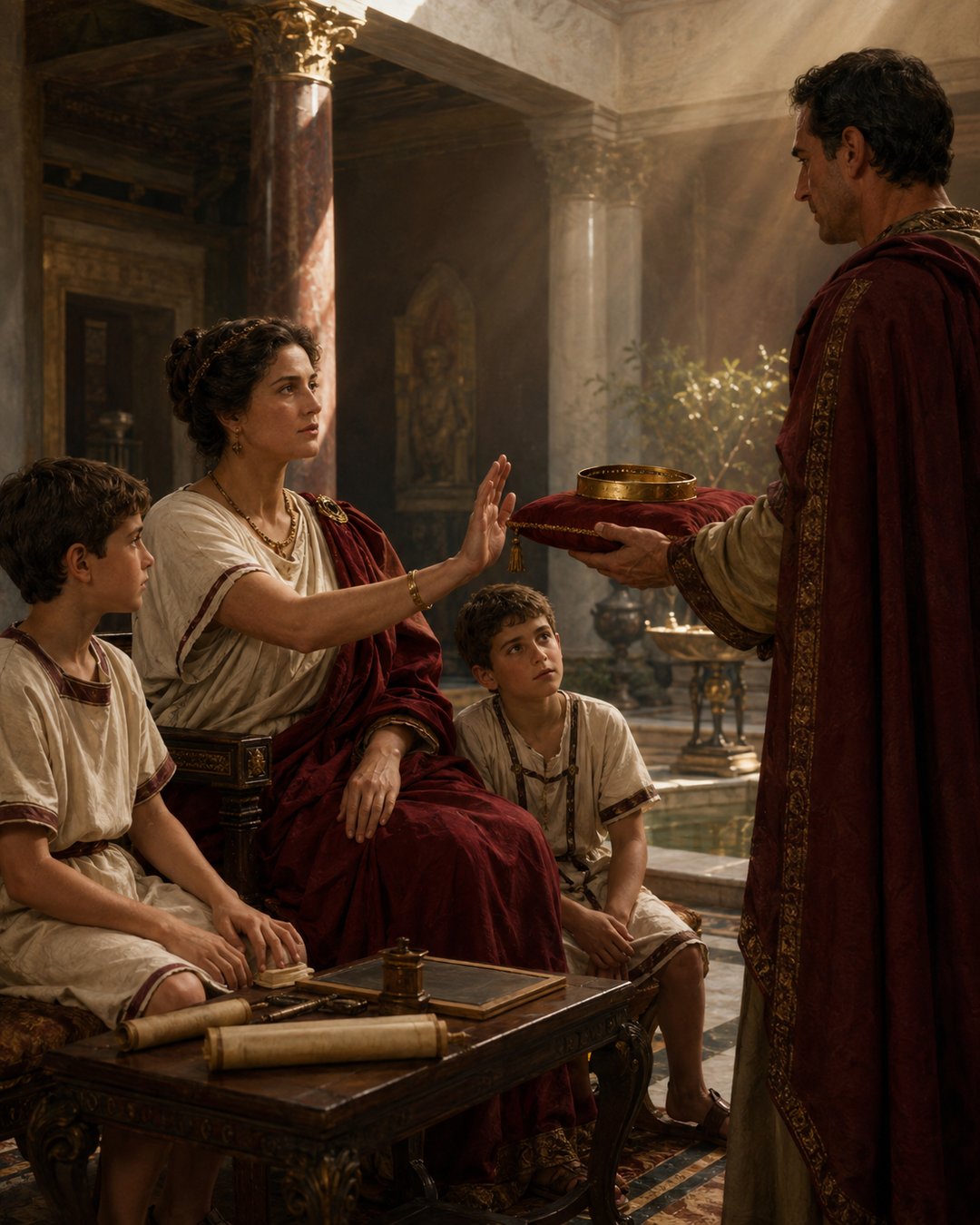
A king offered Cornelia marriage and a share of his crown. She refused. Plutarch places that choice after the death of her husband, when she had taken charge of twelve children and the family estate, and before the education of the two sons who would become the Gracchi.
The offer from Ptolemy makes a dramatic scene, but its importance lies in what it interrupts. Cornelia could have entered a royal household. Instead, Plutarch says, she remained a widow. Most of her children died; three survived: a daughter who married Scipio the Younger, and the brothers Tiberius and Gaius.
Roman political memory usually meets those brothers in the Forum, amid land legislation, tribunates and violence. Plutarch begins earlier. He makes their mother’s household management, refusal and educational care part of the explanation for the men they became.
This is not a simple tale in which a perfect mother mechanically produces two identical sons. Plutarch immediately stresses the brothers’ different temperaments and speaking styles. Cornelia’s work created continuity, not uniformity.
Death Left Twelve Children and an Estate in Cornelia’s Hands
Cornelia’s husband, Tiberius Sempronius Gracchus, had occupied the heights of Roman public life. Plutarch lists a censorship, two consulships and two triumphs. He had married into another commanding family: Cornelia was the daughter of the Scipio who defeated Hannibal.
Plutarch surrounds his death with a prodigy. A pair of serpents, male and female, was found on the couple’s bed. Soothsayers allegedly warned that killing the male meant death for Tiberius, while killing the female meant death for Cornelia. The husband chose the male, and, as Plutarch carefully phrases the tradition, died soon afterward.
The omen is a reported story, not an administrative record. Its literary function is clear. It introduces the marriage as a bond marked by deliberate sacrifice, then leaves Cornelia carrying responsibilities that had belonged to a household led by a triumphant magistrate.
She took charge of the children and the estate. Those two objects belong together. An elite Roman family’s education, marriages, property and public prospects depended on sustained management. Widowhood did not withdraw Cornelia from consequential action; it changed the arena in which she acted.
Plutarch praises her as discreet, magnanimous and an excellent mother. Such language reflects an ancient biographer’s moral frame. Beneath the praise, however, sits a practical fact: twelve dependants and a major estate required years of decisions.
Ptolemy’s Proposal Put an Alternative Future on the Table
The royal proposal sharpened the choice. Plutarch does not identify every diplomatic detail, nor does he preserve a speech in Cornelia’s voice. He says that Ptolemy sought her hand and offered to share his crown.
That was not merely an invitation to remarry another Roman senator. A Ptolemaic marriage could have moved Cornelia into the orbit of a Hellenistic court. The children and property already under her care make the offer more than a romantic anecdote: it presented a different geography, rank and household structure.
Cornelia refused and remained a widow. Plutarch gives no invented declaration about her motives, so the result must carry the argument. Her life continued within the Roman family whose future she was already managing.
A related article about Turia’s marriage and survival during civil danger shows how Roman family memory could turn a woman’s choices into a public moral record. Cornelia’s record came through biography rather than a husband’s inscription, but it likewise ties household loyalty to political consequence.
A crown can make refusal look effortless only in retrospect. In the sequence Plutarch creates, the refusal closes one path and intensifies another. Cornelia’s standing would be invested in the children who remained with her, not in a new royal partnership.
Only Three of the Twelve Reached the Next Chapter
Plutarch compresses loss into a sentence. Cornelia outlived most of the twelve children. Three survived: one daughter and two sons. The daughter married Scipio the Younger; the sons were Tiberius and Gaius.
The number changes the emotional scale of the biography. Cornelia is not simply introduced beside two already-famous reformers. She is placed in a household repeatedly reduced by death, preserving and educating a small surviving line.
Her daughter’s marriage kept the family connected to the Scipionic world from which Cornelia herself came. The sons carried their father’s name into public life. Maternal ancestry, paternal office and new marriage alliances converged in the same household, but none guaranteed a peaceful political future.
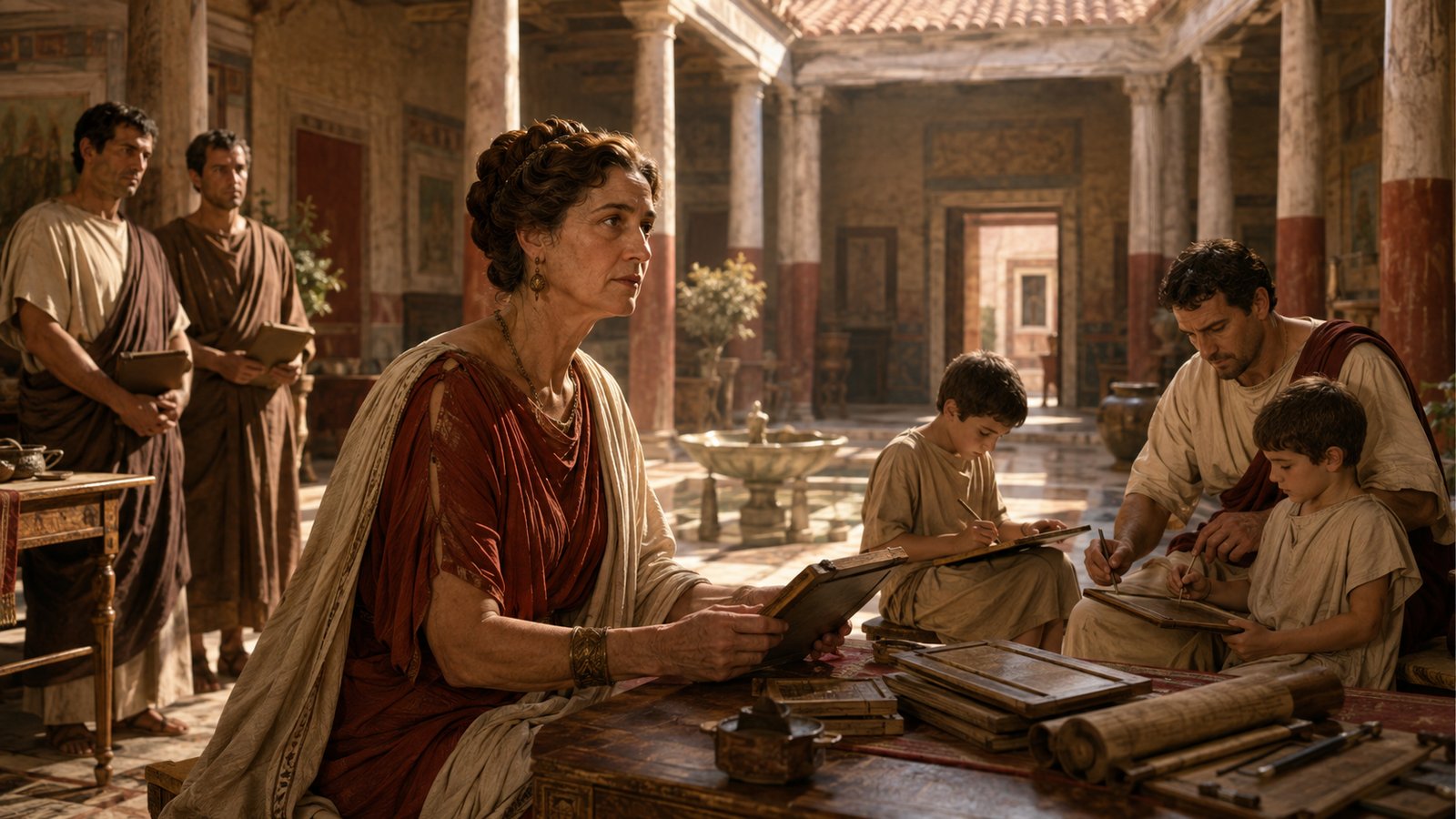
Plutarch says Cornelia reared the brothers with scrupulous care. He then records a striking judgment: although Romans agreed that nature had endowed them richly, their virtues seemed to owe even more to education.
That sentence makes education causal without making it magical. Instruction could shape eloquence, discipline and ambition. It could not abolish the brothers’ different dispositions or determine how every political conflict would end.
Education Produced Two Public Voices, Not One Copy
Plutarch moves from Cornelia’s educational care directly into comparison. Tiberius was gentle and sedate; Gaius was high-strung and vehement. Their shared courage, self-command, generosity and eloquence did not prevent sharp differences in action.
He renders the contrast physically. Tiberius stood composedly in one place when addressing the people. Gaius moved about the rostra and pulled his toga from his shoulder. One body concentrated authority through stillness; the other made motion part of persuasion.
The site’s article on the flute player who checked Gaius’s speaking pitch follows that energetic voice in public performance. Plutarch’s family preface asks readers to see the training behind it while still recognizing a temperament unlike his brother’s.
This is the strongest reason not to reduce Cornelia to a slogan about motherhood. Her influence appears in sustained preparation. The sons remained distinct people who carried shared formation into different rhetorical and political styles.
Education in an elite Roman house joined literature, memory, social expectation and the rehearsal of public conduct. Plutarch does not give Cornelia a classroom timetable. He gives her care the weight of an explanation accepted by observers of the brothers.

The Rejected Crown Became Part of a Roman Political Origin
Cornelia’s story survives because later writers read the private architecture of a public dynasty. The crown, the widowhood, the children and the education form a chain. Remove any link and the opening of Plutarch’s paired lives changes shape.
Yet the chain should not become prophecy. Cornelia did not know the full course of both tribunates at the moment she rejected Ptolemy. Plutarch writes with knowledge of what followed, selecting early decisions that made the later careers intelligible.
His opening also distributes achievement across generations. The father contributes office, military honor and name. Cornelia contributes continuity after death, management under pressure and formation. The children then act in a Republic whose conflicts neither parent could control.
The proposal from Ptolemy matters because it gives Cornelia a visible alternative. She was not simply trapped in a Roman widow’s role. Plutarch imagined a crown within reach and preserved her refusal as an active choice.
When the brothers finally step onto the rostra, their mother’s work has already occupied the first chapter. Before Rome judged the Gracchi as politicians, their household had survived bereavement, refused a royal detour and trained two very different voices for public life.
Sources
Plutarch, Life of Tiberius Gracchus 1–2.