
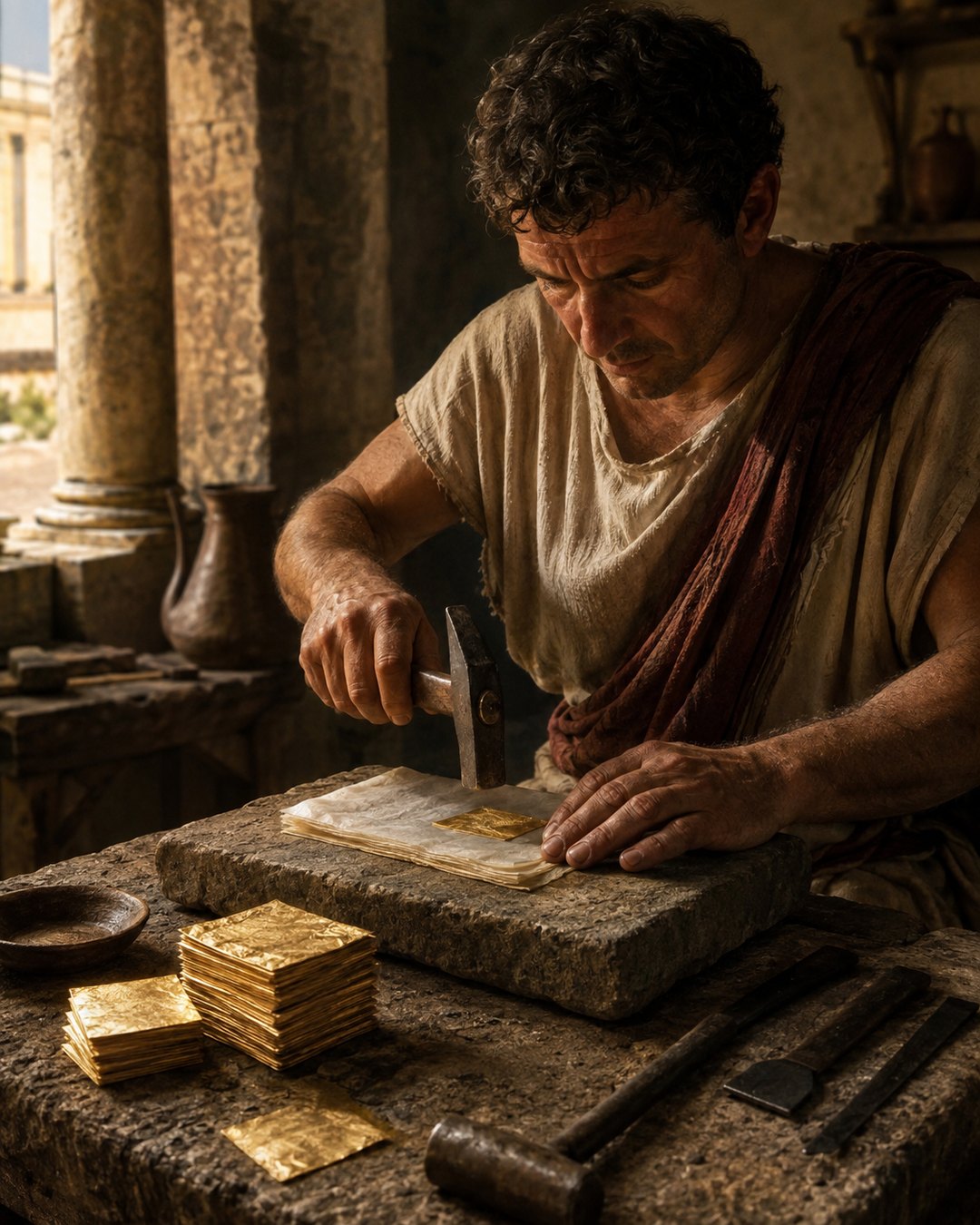
Place one ounce of gold in the workshop and its weight seems to set a hard limit. Pliny offered another measure. Hammered and divided, that ounce could become seven hundred and fifty leaves or more, each a square four finger-widths on either side.
The metal had not multiplied. Its visible reach had. What began as a compact mass became hundreds of surfaces thin enough to cling to stone, wood or bronze.
This is the central trick of gilding: preserve the colour and brilliance by surrendering thickness. A costly material could announce itself across an object far larger than the gold from which its skin was made.
Pliny’s numbers turn wonder into workshop arithmetic. The claim does not merely praise gold as beautiful. It explains why gold could dominate a room, statue or garment while contributing surprisingly little bulk.
Hammering Exchanged Thickness for Reach
Gold’s ductility allowed an artisan to flatten it without immediately breaking it into useless fragments. Repeated blows spread the same material outward. Each stage reduced thickness and increased area.
Pliny calls gold unmatched in how widely it can be extended and how many times it can be divided. His ounce-to-leaf ratio gives that property a scale a reader can picture: not one large plate, but hundreds of manageable squares.
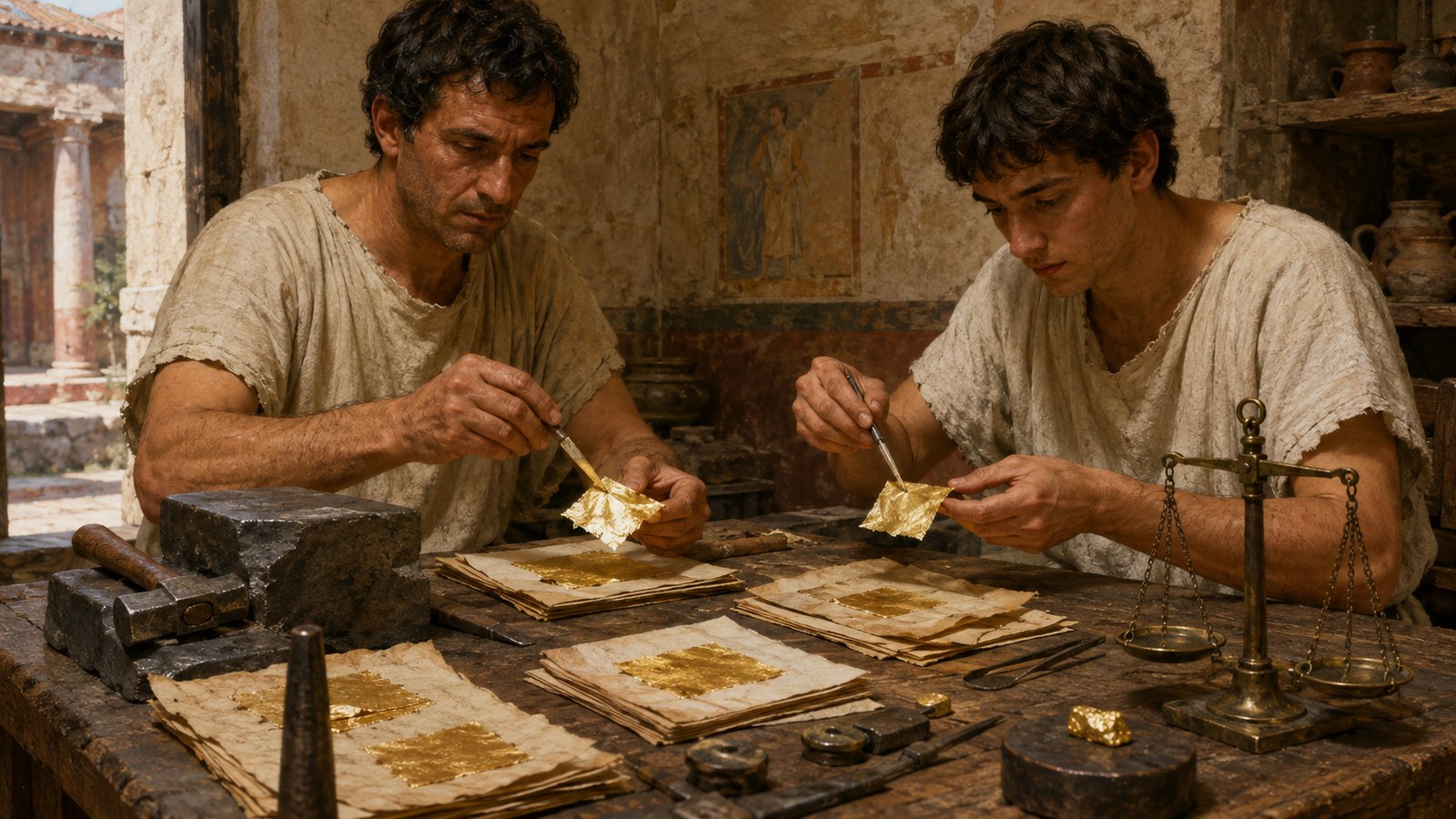
The finger-width measurement keeps the account close to the hand. These were leaves sized for handling and application, not an abstract sheet of infinite thinness. An artisan could lift, place and overlap them across a prepared surface.
The process demanded control because the useful result sat between two failures. Too thick, and the ounce covered less ground. Too thin or roughly handled, and the leaf tore, folded onto itself or vanished against a tool.
Pliny does not provide a complete hammering manual. He does not name every protective layer, hammer weight or sequence of blows. The secure point is material conversion: exceptional extension allowed one measured ounce to become at least seven hundred and fifty measured leaves.
Named Grades Preserved Differences Inside Thinness
Not every leaf was treated as identical. Pliny says the thickest kind was called Praenestine. He connects the name with a statue of Fortuna at Praeneste whose gilding was remembered for holding faithfully.
The next kind bore the name quaestorian. These labels show that thin gold still had hierarchy. Thickness affected handling, coverage, durability and cost, so workers and buyers needed language for distinctions invisible at a casual glance.
A thicker leaf uses more metal over the same area, but may tolerate burnishing and exposure better. A thinner leaf extends an ounce farther. The choice balances economy against the behaviour required from the finished surface.
The Fortuna association also made endurance part of reputation. A named place and cult object supplied evidence that a kind of gilding could remain convincing. Material quality travelled through memory as well as measurement.
This is different from simply displaying a heavy gold vessel. In Marcus Aurelius’s auction of palace gold and luxury goods, objects could be weighed, sold and converted into military funds. Gold leaf used low mass to create high visibility, making the surface seem richer than the underlying object.
Stone and Wood Required Different Adhesion
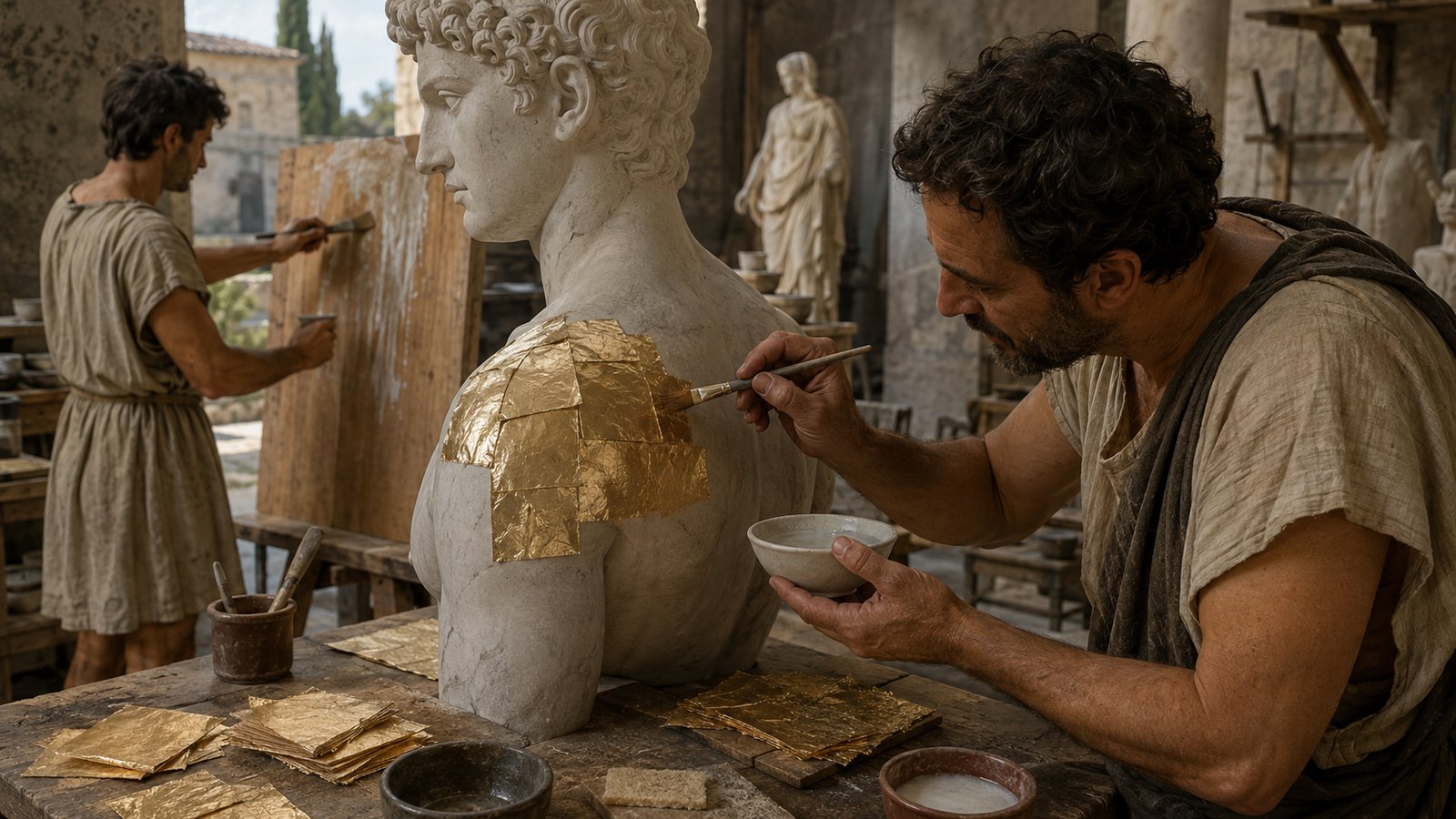
A leaf cannot transform an object if it will not stay attached. Pliny moves from the properties of gold to the preparation of its support.
For marble and other things that could not be made hot, he specifies egg white. For wood, he gives a prepared glue. The change of binder acknowledges that the substrate matters as much as the foil.
Gold may resist corrosion, but marble does not absorb and flex like wood. A successful layer depends on the relationship among metal, adhesive and base. The same leaf could fail when the preparation beneath it was wrong.
Application also changed how the object was perceived. A viewer saw gold, but most of the volume remained stone or timber. Gilding made a composite appear materially unified from a distance while the workshop knew it as several carefully joined layers.
Pliny describes a more complex route for bronze involving mercury and repeated treatment. That procedure should not be romanticized; mercury is dangerous, and the passage is historical evidence rather than instruction. Its presence nevertheless shows that Roman gilders adjusted technique when metal had to meet metal.
Gold Kept Its Signal While Losing Its Mass
Thinness would be less useful if exposure quickly destroyed the colour. Pliny emphasizes gold’s resistance. It produced no rust or verdigris that reduced its quality or weight, and he says it withstood salt and vinegar.
He contrasts its cleanliness in use with other metals that leave marks on the hand as material wears away. A gold surface could remain visually stable even when reduced to a delicate layer.
That durability protected the message of gilding. The object beneath might be ordinary relative to the surface, but the surface continued to signify divine honour, political status or wealth as long as it remained attached and bright.
Gold therefore offered two advantages that seem opposed. It could be beaten almost out of substance, yet it retained the qualities by which viewers recognized it. The workshop exploited both.
Readers can compare that controlled visibility with the mixed materials of a Roman grooming kit, where gold joined specialised woods and small tools. In gilding, the precious component could dominate the eye while occupying only the outermost fraction of the object.
Leaf Was Only One Way to Stretch Prestige
Pliny says gold could also be drawn and woven like wool, even without wool. He recalls seeing Agrippina the Younger in a military cloak made entirely of woven gold at the naval spectacle staged by Claudius.
The garment carried the same material logic in another direction. Instead of covering a rigid statue or panel, worked gold became flexible enough to move with cloth and body.
The spectacle joined imperial theatre to metallurgical display. Water, ships and performers created the large event, while Agrippina’s cloak concentrated light around a seated figure. The garment advertised the workshop’s ability to make metal behave unlike a heavy object.
Whether leaf covered Fortuna or thread formed a cloak, the artisan’s achievement was redistribution. Gold’s rarity remained; what changed was the amount of space over which rarity could be seen.
Pliny’s seven hundred and fifty leaves expose the economics beneath splendour. A patron did not need a statue of solid gold to make gold command the viewer. An ounce could be divided until thickness nearly disappeared, then attached in squares across another material.
Each square also made large work divisible among hands. An artisan could prepare a limited patch of binder, place a leaf, burnish it and continue. Coverage advanced piece by piece while the patron experienced the finished field as one continuous golden skin.
The finished surface concealed that calculation. Light joined the seams, and the eye encountered apparent abundance. Behind it stood a hammer, measured squares, named grades and the careful choice of what would make a weightless-looking skin hold.
Sources
Pliny the Elder, Natural History 33.19–20.