
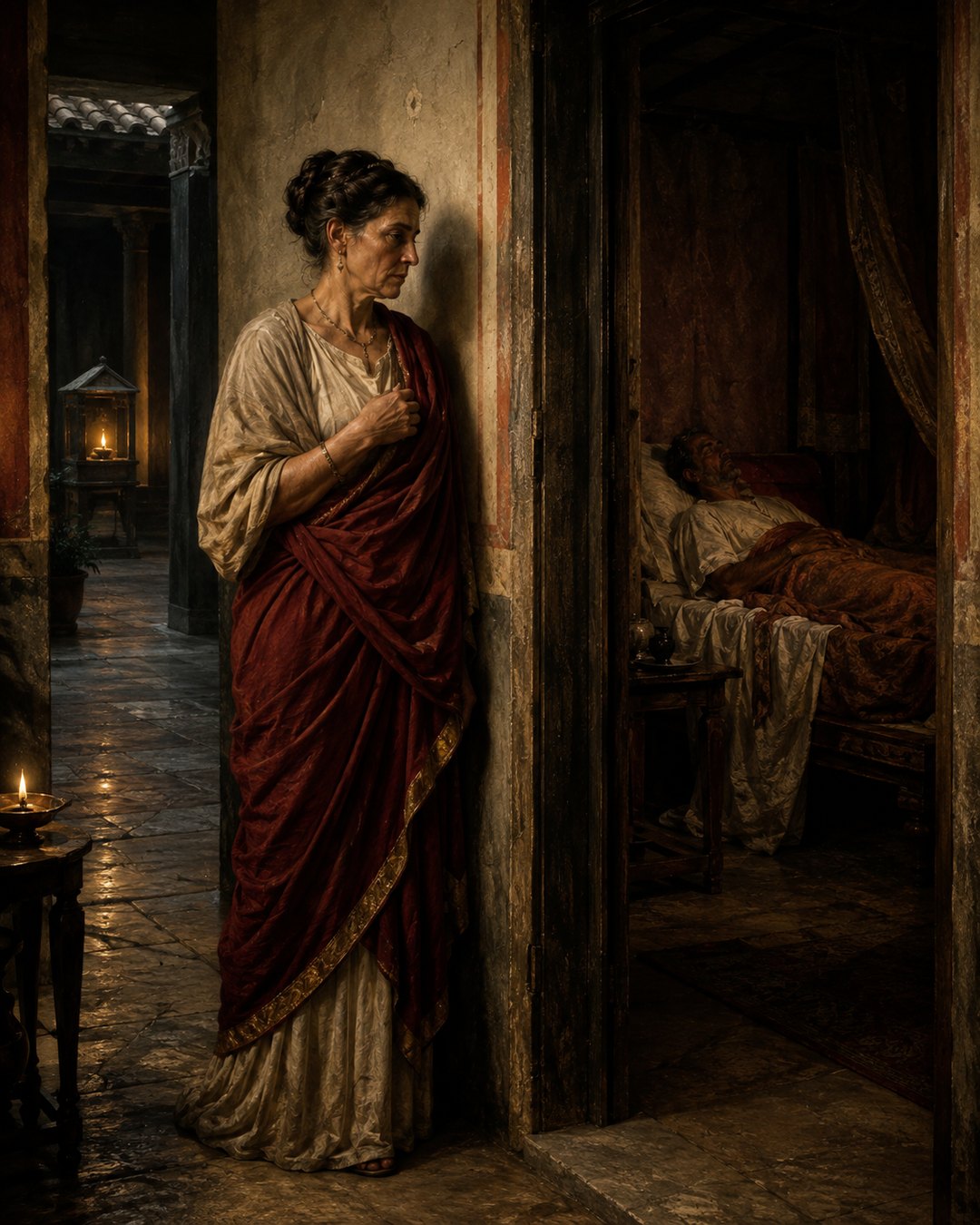
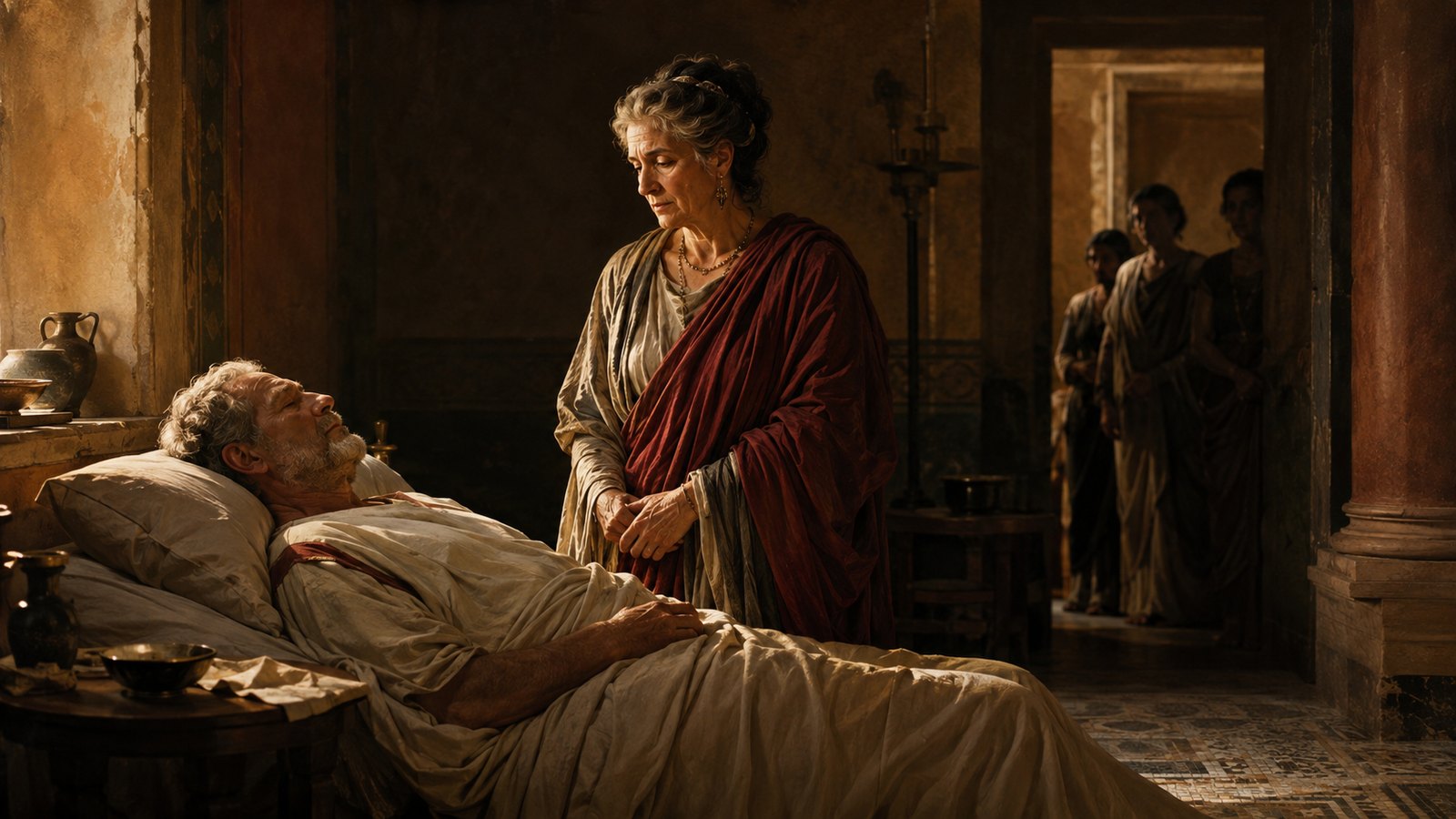
Caecina Paetus lay dangerously ill and kept asking about his son. Arria answered that the boy had slept well, eaten well and seemed stronger. The boy was already dead.
Pliny the Younger says Arria arranged the funeral without allowing the news to enter her husband’s room. When grief became impossible to contain, she stepped outside, wept, mastered her face and returned. The sickroom received composure; the corridor held what she refused to make Paetus bear.
This is not the episode that made Arria famous. Roman memory fixed on the later moment when she wounded herself, handed Paetus the weapon and told him the pain did not hurt. Pliny insists that the quieter acts were no less brave.
His letter reconstructs a habit rather than an instant. Arria repeatedly decided what fear, news and suffering could be allowed to control. Long before the dagger, that discipline had been rehearsed at a domestic threshold.
A Mother Managed Two Crises at Once
The illness of husband and son created demands that could not be reconciled. Arria could not save the boy, and she believed the knowledge of his death might endanger Paetus. She therefore separated the crises.
She took charge of the funeral while continuing to visit the sickbed. Pliny’s account does not turn her into someone without grief. It depends on the opposite: she felt enough to weep, but chose the place and moment in which her tears became visible.
Every return required a performance precise enough to survive a husband’s questions. Her replies were concrete. The boy had rested; he had eaten; he was improving. Each answer protected Paetus while forcing Arria to carry knowledge alone.
The arrangement gave architecture a moral role. A doorway divided concealment from release. On one side stood the patient and the face he needed to see. On the other stood a bereaved mother with no audience to reassure.
Pliny learned these details through Fannia, Arria’s granddaughter. The story had moved through women of the family before it entered his letter. What survived was not merely a public slogan but the remembered choreography of leaving, grieving and returning.
The Famous Sentence Was Only the Last Lesson
Later retellings often compress Arria into three words: Paete, non dolet, “Paetus, it does not hurt.” Pliny knew the scene, but his reason for writing was that other acts risked being overshadowed by it.
A final gesture is easy to monumentalize. It can be carved into one pose: the wounded wife, the hesitant husband and the weapon passed between them. A sickroom offers no such simple emblem. Its courage must be repeated through hours of questions and returns.
Pliny therefore changes the scale of heroism. He asks his reader to notice endurance before climax. Arria’s last example to Paetus becomes intelligible because she had already practiced controlling the evidence of pain.
The Roman admiration embedded in the letter is not a command for modern readers to celebrate suicide. It records an elite moral world in which voluntary death could be framed as resistance to dishonour and imperial punishment. Historical explanation should preserve that distance rather than turn tragedy into advice.
Readers can compare this family construction of courage with the Stoic whose body showed fear before reason recovered. Both stories distinguish an involuntary response from the judgment that follows it. Arria wept; her remembered discipline lay in deciding what she did next.
A Fishing Boat Refused the State’s Separation
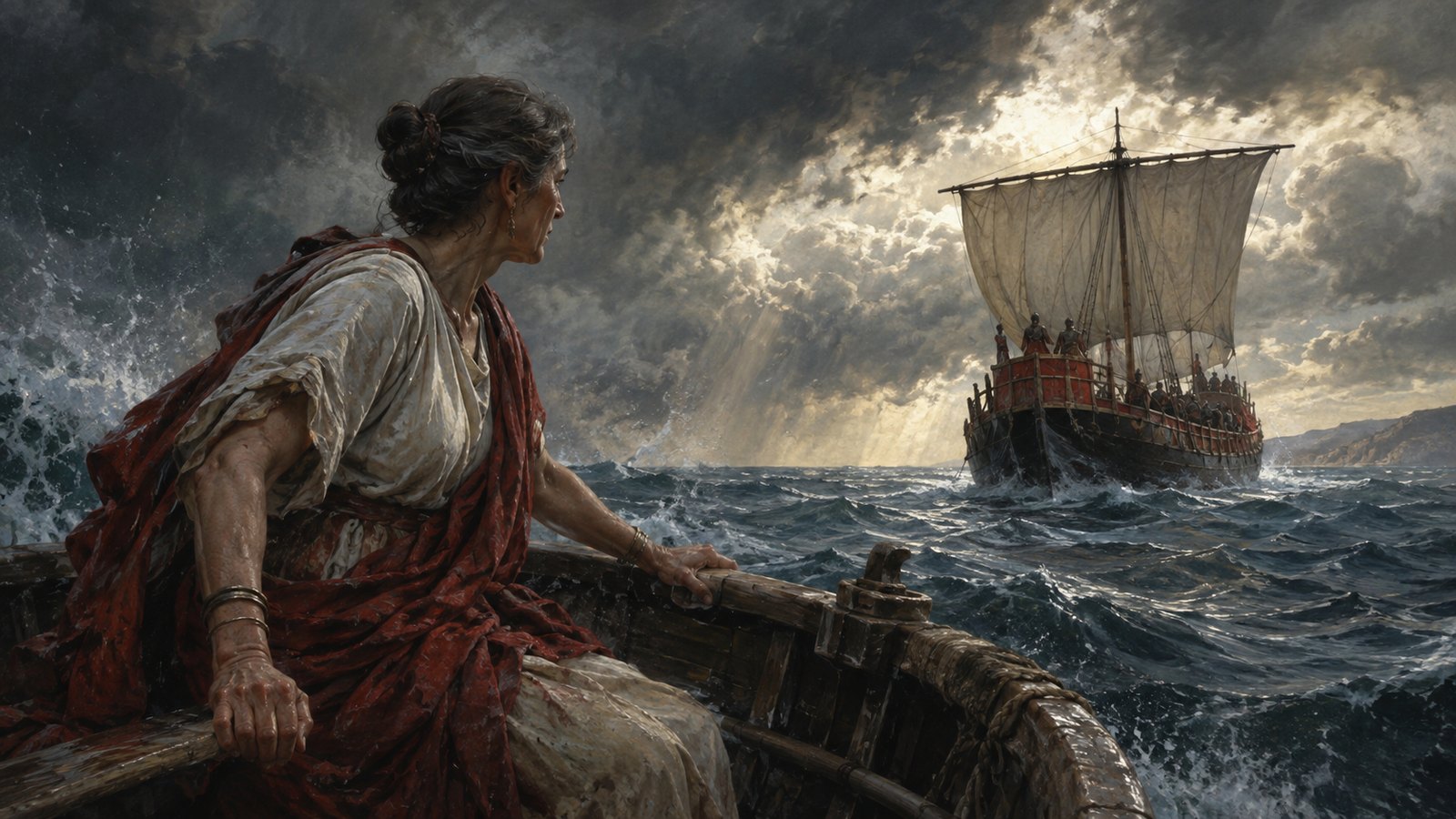
After Paetus became entangled in Scribonianus’s failed revolt against Claudius, imperial custody moved the conflict out of the house. He was put aboard a ship. Arria asked to go with him, arguing that a man of his rank would need attendants and that she could perform their work alone.
The request was denied. She did not accept the denial as the last word. Pliny says she hired a fishing boat and followed the larger vessel from Illyria.
The image matters because it reverses the apparent distribution of power. The authorities controlled the prisoner, transport and destination. Arria controlled whether physical separation would become abandonment. A small hired craft was enough to preserve her decision.
Pliny supplies no romantic catalogue of waves or storms in the letter itself, so the crossing should not be enlarged into an invented adventure. Its force lies in the contrast he does give: official ship ahead, fishing boat behind, refusal converted into movement.
The act also continues the threshold pattern. In the sickroom Arria controlled what entered. At the shore she refused to let a prohibition determine who could follow. Domestic discipline became political persistence without changing its central object: remaining responsible for Paetus.
Family Arguments Tested the Cost of Consistency
Arria’s relatives did not simply watch. They tried to prevent the course she had chosen. Her son-in-law Thrasea used the strongest personal comparison available: if he were condemned, would she want her daughter to die with him?
Arria’s answer depended on duration and quality. If her daughter had lived with Thrasea as long and harmoniously as Arria had lived with Paetus, she said she would want the same. The answer shows how she converted a shocking decision into a rule about shared life.
That rule belonged to Arria’s moral reasoning, not to every Roman household. Other spouses survived condemnation, exile and bereavement. Pliny preserves an exemplary biography shaped by admiration, and exemplary stories sharpen consistency more readily than ordinary life does.
When relatives watched her closely, Arria struck her head against a wall, fell, recovered and warned them that stopping an easy death would only make her seek a difficult one. The scene is harsh evidence of determination and of the family’s inability to contain it.
A different family memory appears in the inscription for a wife who protected her husband through political danger. Both place marital loyalty under pressure, yet one survives in stone and the other through a chain of remembered speech.
Pliny Preserved the Work Behind the Monument
The famous wound gave artists and moralists a single visible action. Pliny’s letter restores the preparation concealed behind it: a funeral managed alone, tears kept outside a room, a refused passage answered by a smaller boat, and arguments met without retreat.
His structure makes courage cumulative. Each episode changes the reader’s understanding of the next. By the time Arria offers Paetus an example with her own body, the act is not sudden theatricality but the terminal expression of a practiced identity.
The letter also reveals who made that identity durable. Fannia supplied family knowledge; Pliny selected and ordered it; later readers elevated one phrase. Biography emerged from choices about which rooms, journeys and sentences deserved transmission.
Arria’s most revealing boundary may remain the sickroom door. It separated honest grief from protective deception, private collapse from public steadiness, and a dead child from a father too ill to hear the news. Crossing it required her to rebuild the face she had lost outside.
That repeated return explains why Pliny resisted letting one quotation consume the woman. The dagger sentence was memorable because it compressed her ethic. The sickroom showed its cost. Arria did not claim that pain was absent; she decided where pain could appear, whom it could burden and whether it would change the action she believed duty required.
Sources
Pliny the Younger, Letters 3.16; historical introduction to Pliny’s Letters, chapter 4.