
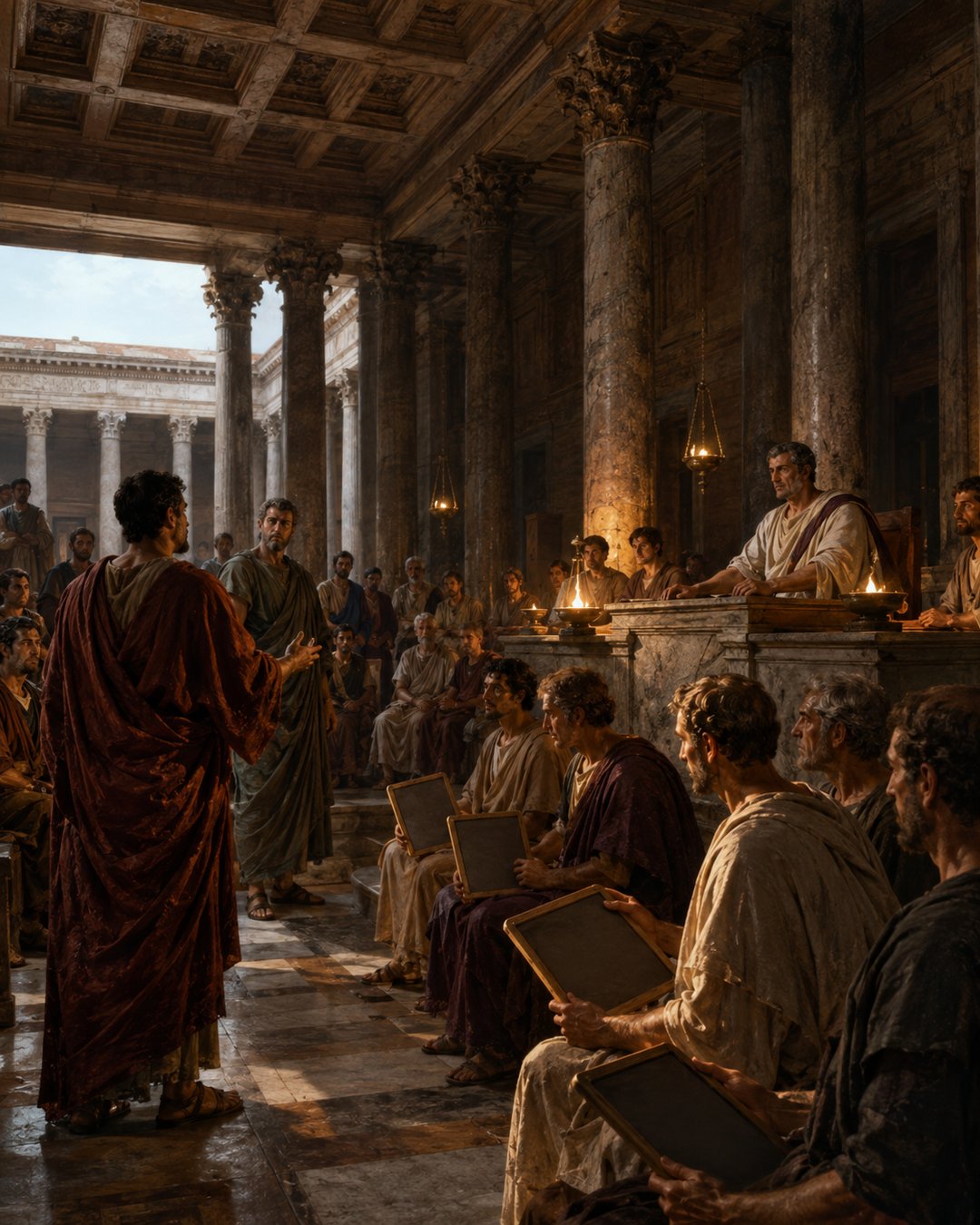
Thirty days of the Roman legal year had been consumed by honorary games. Suetonius says Augustus returned them to the courts so claims for damages and disputed property would not collapse or drift into another delay.
More days alone could not decide more cases without people to hear them. Augustus added a fourth jury division for smaller sums and enrolled jurors at thirty, five years younger than the earlier threshold.
Then the staffing reform met resistance. Many citizens tried to escape jury duty. Augustus compromised: each division could take an entire year off in rotation, and courts stopped sitting in November and December.
The episode exposes government as a contest over capacity. A ruler could legislate time and eligibility, but a functioning court still depended on citizens willing to occupy the benches.
Games Had Taken a Month from Litigation
Suetonius introduces the thirty days as an answer to procedural loss. Actions for damages or on disputed claims could fall through or be postponed because the legal term did not contain enough usable time.
The missing days had not been empty. Honorary games occupied them. Public spectacle and adjudication competed for the same calendar, buildings, officials and audience.
Augustus’s solution was administrative rather than rhetorical. He did not merely demand faster judges. He changed the number of days on which the institution could act.
Calendar capacity can be easy to overlook because it leaves no monument. Yet a hearing that cannot be scheduled might as well lack a judge. Restoring thirty days altered how many disputes could reach a decision before deadlines intervened.
The change sits beside other cleanup in Suetonius’s account. Old treasury debt records were burned because they enabled blackmail, and stale accusations that served only private hostility were removed. Each measure reduced ways in which unresolved claims could remain useful to predators.
A Fourth Panel Brought Small Claims into View
Augustus added a new jury division known as the ducenarii, drawn from a lower property level than the existing panels. Suetonius assigns it cases involving trifling amounts.
“Trifling” describes the value from an elite narrator’s perspective, not necessarily the importance to litigants. A small monetary dispute could still matter intensely to a household or trader.
A separate panel matched personnel to scale. Major cases did not need to compete with every modest claim for the same jurors, while smaller disputes gained a recognized route instead of being crowded out.
The reform illustrates how categories produce capacity. By dividing work, the system could process a wider range of cases without pretending that each demanded identical status.
Readers can compare this civic sorting with the municipal procedures preserved in the bronze law of Irni. Both reveal Roman law below the level of famous trials: offices, panels, thresholds and assigned routes made adjudication possible.
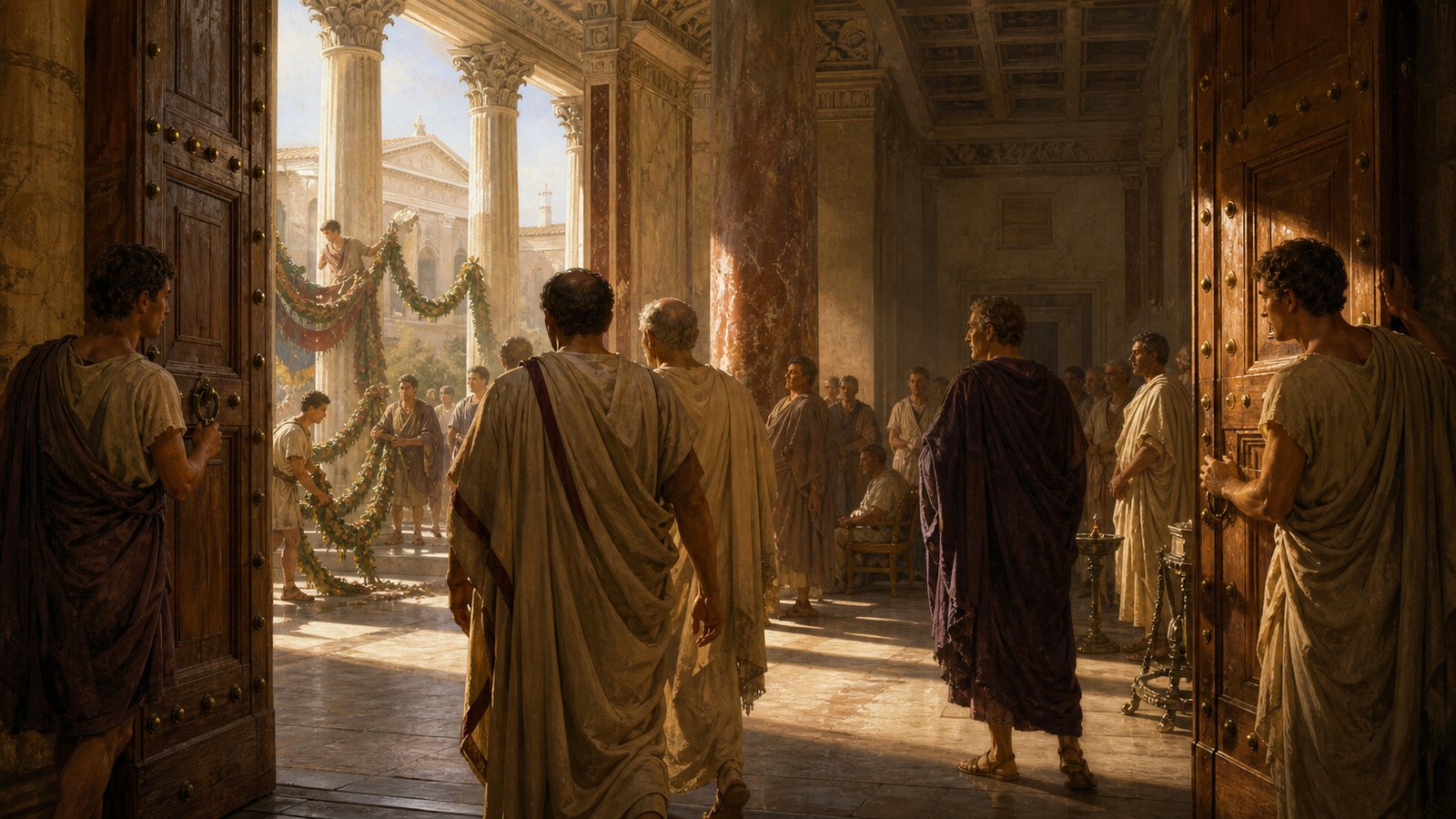
Younger Jurors Expanded the Pool, Then Asked for Relief
The minimum enrollment age fell to thirty, five years younger than it had been. That single change opened another band of property-qualified men to service.
It also shifted burden into an earlier part of adult life. Jury duty competed with business, family obligation, travel and political ambition. Suetonius says many tried to evade it.
Augustus did not answer with limitless compulsion. Reluctantly, in the biographer’s telling, he granted each division a full year’s exemption in rotation. The relief was collective and predictable rather than a collection of private excuses.
November and December also became court-free. The result complicates the image of an emperor simply adding time. He restored thirty game days, then accepted a seasonal recess and rotating rest because personnel could not be treated as an inexhaustible resource.
The system balanced throughput against participation. Too little court time delayed justice; too much compulsory service encouraged avoidance. Reform had to survive the behaviour of the people assigned to carry it.
Augustus Put His Own Body into the Schedule
Suetonius says Augustus administered justice regularly and sometimes continued until nightfall. The claim presents personal endurance as part of the principate’s legal image.
Illness did not always cancel the hearing. A litter could be placed on the tribunal, or Augustus could hear matters while lying down at home. These scenes are biographical theatre, but they also make a practical point: central adjudication followed the ruler’s physical availability.
The emperor’s body became court infrastructure. When he could not sit conventionally, furniture and location adapted around him.
Such flexibility contrasted with the regularized panels. Ordinary litigation needed repeatable staffing; imperial hearing could bend protocol around one person. Augustus’s system combined institutional expansion with highly personal intervention.
That combination also shaped appeals. Citizen cases were referred annually to the city praetor, while disputes between foreigners went to former consuls assigned provincial business. Delegation prevented every appeal from ending at one couch or tribunal.

A Third Tablet Created Room Between Guilty and Innocent
In a forged-will case, all signers faced exposure under the Cornelian law. A simple pair of ballots for condemnation and acquittal could not distinguish deliberate forgery from a signature obtained through misrepresentation or misunderstanding.
Suetonius says Augustus gave the jurors a third tablet. It allowed pardon for those shown to have been deceived.
The extra physical option changed the verdict space. Without it, compassion might require acquitting everyone or law might condemn people whose participation lacked informed intent. A third outcome let jurors separate the architect of fraud from a misled witness.
This does not prove that Augustan justice was uniformly gentle. Suetonius is selecting anecdotes to characterize the ruler as conscientious and lenient. The stories belong to an imperial portrait and must be read with that purpose in mind.
Even so, the ballot detail is valuable. Procedure can create moral distinctions or erase them. Jurors cannot record a nuance that their authorized choices do not permit.
A related problem appears in the rule that delayed punishment during pregnancy. In both cases, law maintained a penalty while procedure changed how it reached a particular body.
Reform also meant controlling backlogs, people and choices. Suetonius groups these measures because they support a portrait of Augustus restoring order. The list should not be mistaken for a complete code or a neutral performance report.
Its pieces nevertheless fit together. Burning obsolete debt records removed tools of blackmail. Clearing stale accusations reduced weaponized uncertainty. Thirty restored days attacked delay. A fourth panel and younger jurors expanded capacity. Rotating exemptions preserved cooperation. Delegated appeals distributed work.
The emperor’s own long hearings supplied an exemplary center, while the third ballot showed a willingness to modify the available judgment when a binary choice concealed meaningful differences.
None of these interventions eliminated conflict. More court days could generate more demand. Broader jury eligibility produced evasion. Leniency could depend on imperial discretion. Administrative repair creates new edges even as it smooths old ones.
The thirty days remain the clearest measure because they reveal what law needs before doctrine matters. A valid claim requires a date, a room, a panel and enough time to be heard.
Augustus’s courts were shaped by festivals, age thresholds, property divisions, annual rotations, winter recesses and the health of one ruler. Justice did not move through an abstract state. It moved through a calendar crowded with other claims.
By reclaiming a month from games, Augustus made litigation visible as scheduled labor. The reform’s later compromises show the limit of command: time could be declared available, but people still had to be persuaded or compelled to fill it.
Sources
Suetonius, Augustus 32–34.