
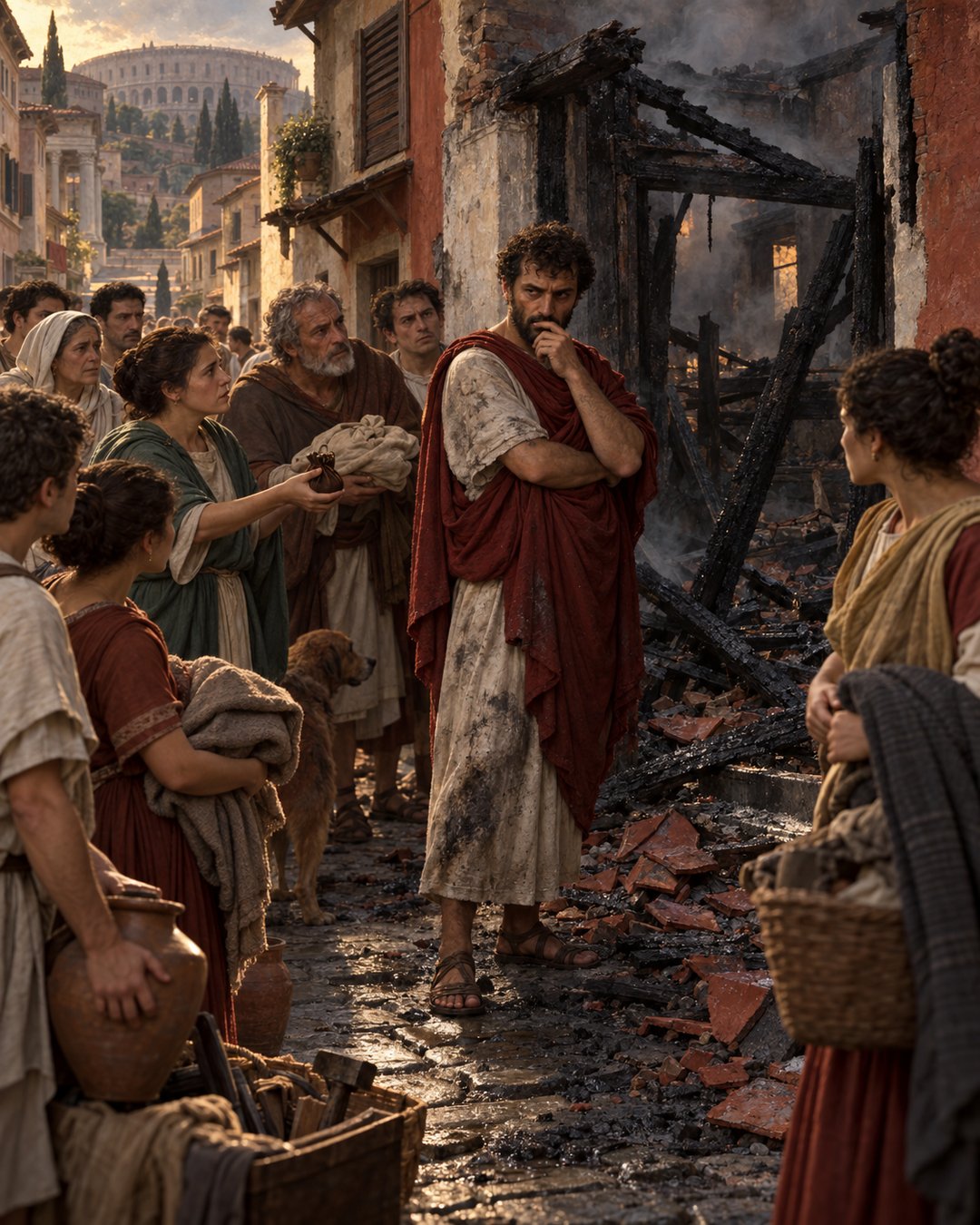
Tongilianus had bought a house for two hundred. Then the building disappeared in what Martial calls an accident all too frequent in the city. A collection followed. Its value reached ten times the first figure.
That is enough for Martial. “I ask,” the poet says, can Tongilianus not appear to have burned his own house? The accusation closes Epigrams 3.52 after only four lines. No witness enters, no flame is described and no magistrate weighs evidence. Purchase, fire and collection are placed so tightly together that arithmetic performs the prosecution.
The epigram is often made to sound like a neat report of Roman fire insurance fraud. Its wording is more interesting and more limited. Martial says that money was contributed or collected after the loss. He does not name an insurer, policy or premium. The poem reveals a social mechanism of relief and a satirist’s suspicion, not a surviving insurance contract.
Two Numbers Built the Entire Accusation
The first line gives the purchase with ducentis, “for two hundred.” Latin can omit the monetary unit when context supplies it, and translators commonly understand the figure on a sesterces scale. The safest point is the relationship Martial actually writes: the house has a stated purchase value, and the later contribution is described as deciens, ten times.
Martial does not show Tongilianus negotiating the purchase or enjoying the property. The passive opening—“a house had been bought for you”—moves directly to the amount. That figure becomes a benchmark waiting for the third line.
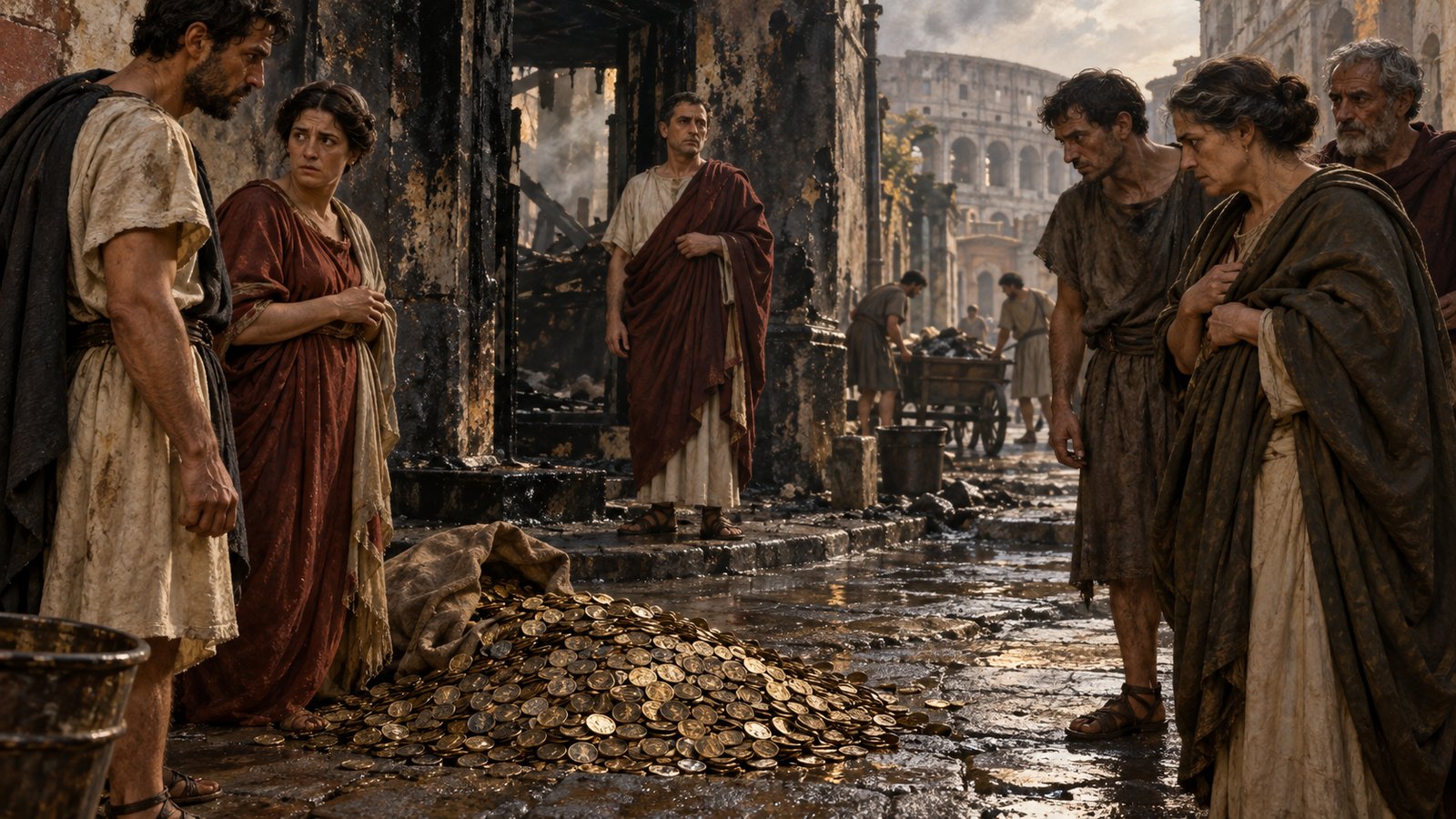
When conlatum est deciens arrives, readers do the comparison before the poet asks his question. Whatever precise accounting convention lies behind the compressed numbers, the relief visibly dwarfs the price introduced at the start. The house is gone, yet Tongilianus appears richer in relation to its stated cost.
Another Lost Eagles piece follows a Pompeian receipt that fixed an auction balance at 38,079 sesterces. That document closes a real account through names and totals. Martial’s two figures do the opposite: they open a gap where suspicion can grow.
An All-Too-Frequent Accident Needed No Long Description
The second line calls the loss a casus, a mishap or accident, then sharpens it with nimium … in urbe frequens: all too frequent in the city. The final line confirms that fire is the disaster Martial expects readers to infer.
He can leave the physical scene undescribed because urban fire already carries a familiar logic. Closely built property, fuel, cooking and heating made flame a recurring civic threat. The epigram does not identify the house as an apartment block, specify its materials or locate it on a named street. Supplying those details would turn a compact barb into invented reportage.
The phrase “all too frequent” does two jobs. It makes the initial loss plausible enough to attract help. It also provides concealment. If houses often burn, one more burned house may pass first as misfortune rather than design.
The wider danger appears in the way Roman apartment buildings turned fire into a public problem. Martial chooses a narrower lens. We do not watch a district organize against flames; we watch neighbors or associates respond to one man’s loss, then reconsider him when the sum becomes visible.
Contributed Money Was Not Automatically an Insurance Payout
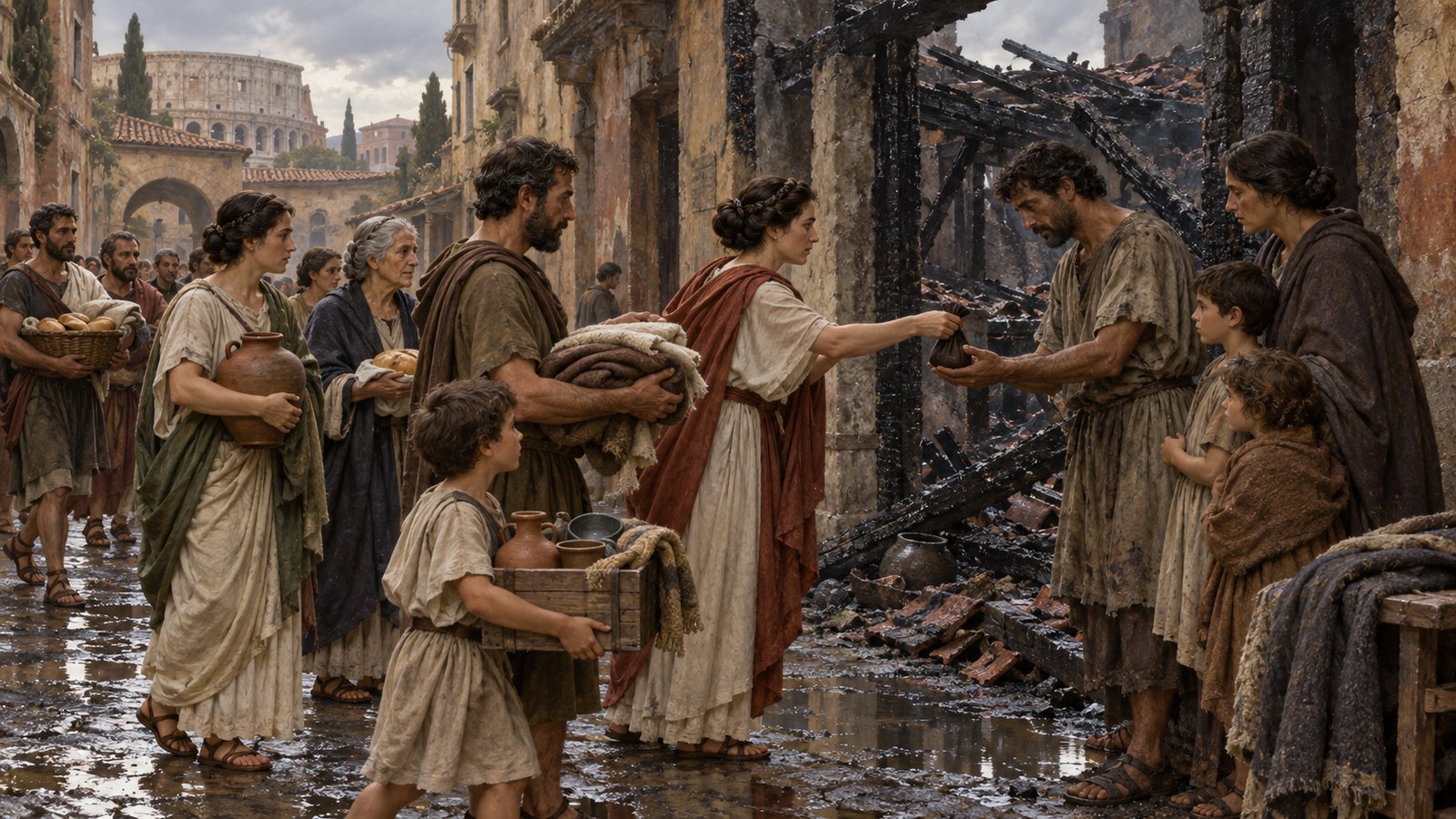
Conlatum est says that a contribution was brought together. The impersonal form keeps the contributors offstage. Martial does not tell us whether they were friends, clients, patrons, neighbors or a broader circle. Their absence lets the collected total, rather than individual generosity, dominate the line.
This matters because “insurance” can smuggle a whole institution into four words. Epigram 3.52 names no company, underwriter, contract, premium or compulsory assessment. It also records no official fire compensation. The text supports a post-disaster collection whose scale provokes suspicion.
Social giving could still create incentives without resembling a modern policy. A household struck by a familiar urban disaster might receive gifts because relationships carried expectations. The epigram’s joke assumes that such a response is intelligible. It then imagines the response becoming so profitable that compassion looks exploitable.
A different fire story shows Crassus using five hundred builders to turn damaged Roman property into opportunity. There the mechanism is acquisition after other owners suffer. Tongilianus is accused of profiting from the destruction of his own house through contributions made after the event.
Martial Asked for Suspicion, Not a Conviction
The final turn begins with rogo, “I ask.” Martial addresses Tongilianus directly and repeats his name at the end, enclosing the whole sequence around the accused owner. The vocative makes the poem sound like a question delivered to his face.
Yet the decisive verb is videri, to seem or appear. Martial asks whether Tongilianus cannot be seen as having set the fire himself. He does not narrate an arrest, testimony, confession or judgment. The joke wins by making appearance feel sufficient.
That distinction protects the evidence from the epigram’s confidence. A satirical question is not proof that Tongilianus existed exactly as drawn, that the fire was deliberate or that authorities recognized a scheme. Martial specializes in turning names, types and urban irritations into concentrated social verdicts.
The poem’s order is what makes that verdict feel inevitable. If the collection had come first, it would be ordinary generosity. If the purchase price were absent, the later sum would have no comic scale. If fire were not familiar, the initial claim might attract investigation rather than sympathy. Martial arranges each premise before revealing what he wants readers to suspect.
Four Lines Turned Relief into a Reputation Trap
Tongilianus cannot answer within the poem. His house has been reduced to a before-and-after account controlled by someone else: bought for two hundred, lost in a common accident, rewarded tenfold. Martial’s question becomes the final surviving word on his motive.
That is the cruelty of the form. An epigram has no room for repair estimates, debts, the size of the property or the composition of the collection. A tenfold contrast may conceal differences in what is being counted. Satire does not pause to audit them because disproportion is the engine it needs.
The city also changes meaning across the four lines. At first, Rome is dangerous because fires are common. By the end, that familiarity is socially dangerous too: a genuine victim can be suspected because catastrophe has created a recognizable opportunity. Shared relief depends on trust, and the poem shows how quickly conspicuous gain can consume it.
Martial therefore preserves less evidence for Roman insurance than for Roman suspicion. The collection proves that a loss could mobilize money. The numbers show how a satirist framed that money as motive. The repeated name keeps the owner trapped inside the comparison, while the impersonal collection leaves every contributor outside it. The final question supplies no verdict, but after its arithmetic, Tongilianus has already lost something beyond the house: control of the story.
Sources
Martial, Epigrams 3.52.