
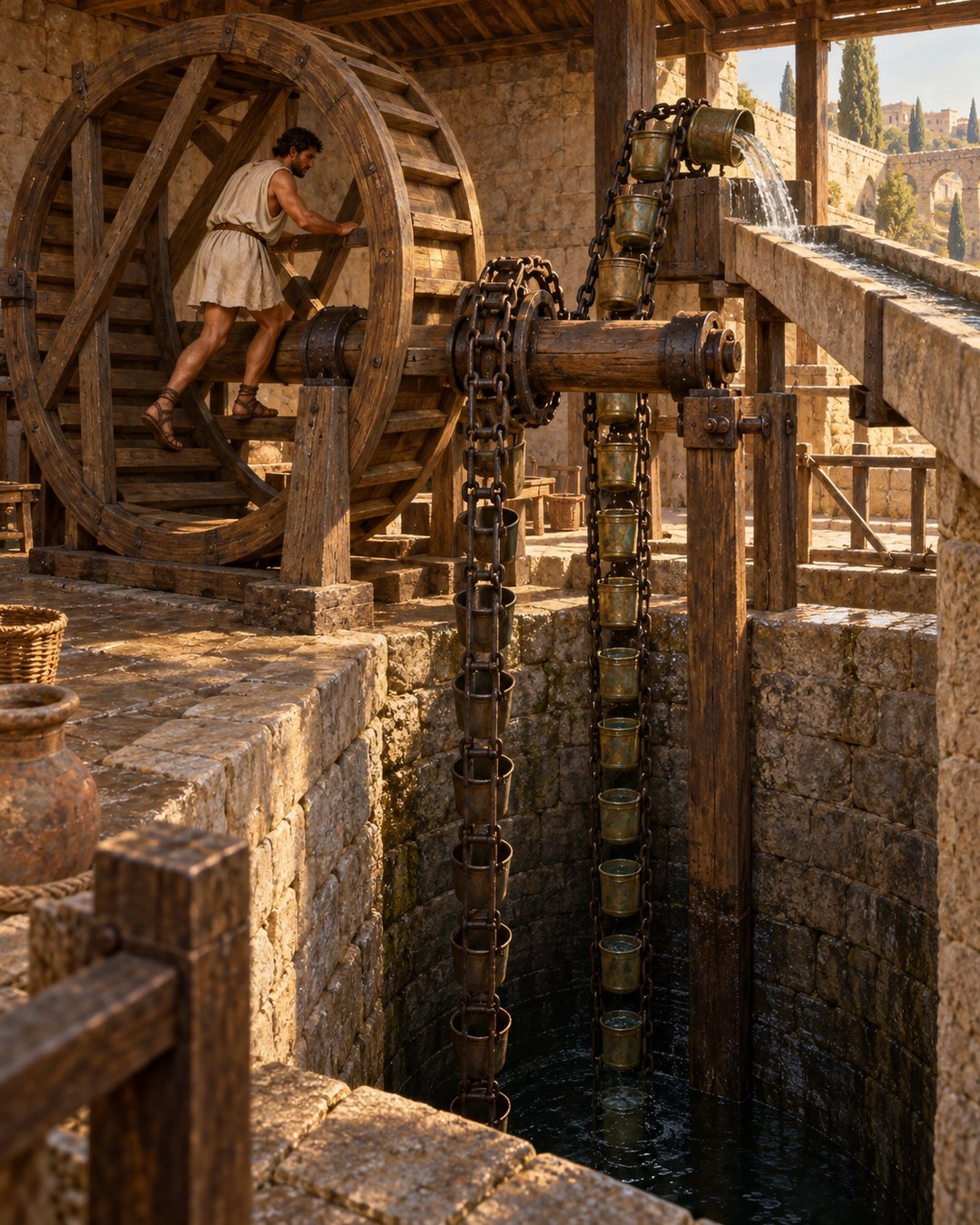
A worker kept walking inside a wooden wheel, but the water rose on a different loop. Small bronze buckets descended on a double iron chain, filled at the lower level, climbed past the worker’s feet and turned over when they crossed the axle. Their contents fell into a conduit above.
Vitruvius presents that apparatus only after describing two shorter lifts. His sequence begins with water entering openings in a wheel, then moves to buckets fixed around a wheel’s circumference, and finally separates the bucket path from the wheel itself. The source and the destination have grown too far apart for one diameter to do every job.
The clever part is therefore not merely that a wheel raises water. Rome already had several ways to convert rotation into lift. The double chain lets the containers travel lower than the driving wheel reaches, while the axle still supplies their motion. Height changes the design.
The First Wheel Carried Water through Its Own Body
Vitruvius begins the passage with a compact arrangement. A person walks a wheel attached to an axle. Openings in the front of the turning wheel receive water, and channels associated with the axle bring it into a trough. From there, he says, a plentiful flow can water gardens or dilute salt in pits.
This first description keeps collection and rotation inside the same structure. The wheel meets the water, turns under human effort and guides what it has caught toward an outlet. No separate train of hanging vessels appears. The source needs only enough lift for the wheel and its internal channels to bridge the difference.
The uses are concrete. Gardens require water delivered above the beds so it can run onward. Salt working needs water directed into pits. Vitruvius does not provide a single monumental destination. He places the machine in working landscapes where a steady transfer matters more than spectacle.
The mechanism also differs from Ctesibius’s force pump with two oiled pistons. That machine depended on alternating cylinders and valves. Here the basic action is continuous rotation: water enters, rises with the turning structure and leaves at a higher point.
Vitruvius gives no dimensions for this first wheel in the surviving description. He does, however, make the human input visible. Someone has to walk it. The motion is repetitive and directional, transforming each step into another fraction of a revolution rather than into a single heave.
A Greater Height Put Buckets around the Rim
When the water must be raised higher, Vitruvius says the apparatus has to be adjusted differently. The wheel’s diameter should correspond to the required height. Buckets are fixed around its circumference and made tight with pitch and wax.
Those sealing materials matter. A bucket that leaks during the upward arc wastes the lift before reaching the discharge point. Pitch and wax turn the perimeter vessels into containers able to survive repeated filling, climbing, tipping and descent.
People tread in the wheel to keep it revolving. At the bottom of the rotation, buckets take on water. As they rise, the same rigid circumference determines both their path and the maximum height they can reach. At the top they discharge into a conduit and return downward empty.
This is a different route through the same design problem. The first wheel received water in apertures and sent it through channels on the axle. The second carries discrete batches around its edge. Instead of water moving through the wheel’s interior, many sealed vessels travel with its perimeter.
Matching wheel diameter to height makes the limit easy to see. A larger vertical interval demands a larger circle. That can work while the site permits the necessary wheel, frame and treading space. Vitruvius then describes what happens when the desired outlet lies higher still.
The Double Chain Freed Reach from Wheel Diameter
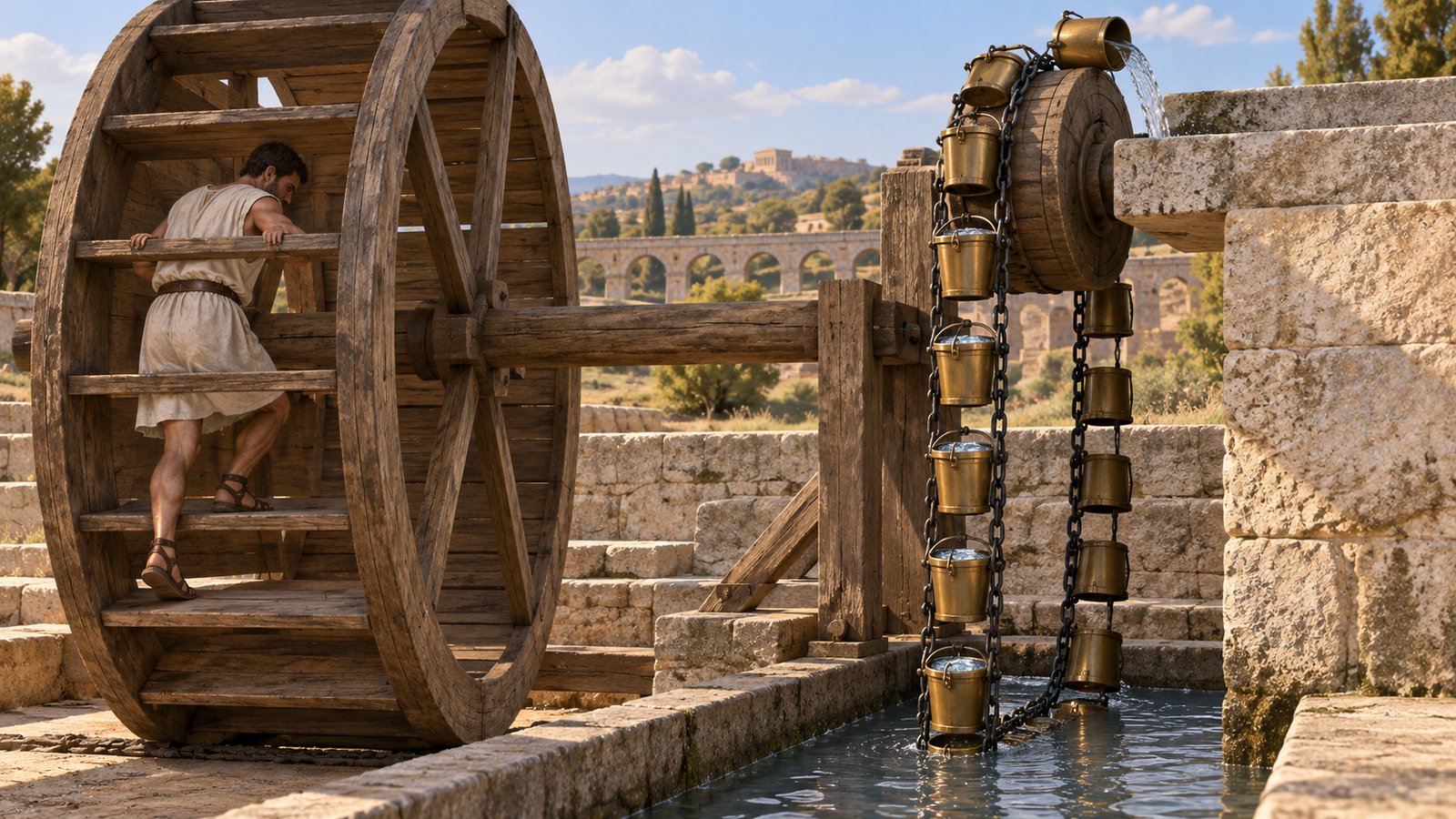
For water needed at still higher places, a double iron chain revolves on the axle. It is long enough to descend to the lower level, and bronze buckets are attached along it. The driving wheel remains above, but the water containers no longer have to sit on its rim.
That separation changes the geometry. The wheel provides torque at the axle. The chain transfers that rotation down toward the source and back up toward the conduit. Its length, rather than the wheel’s radius alone, determines how far the buckets can travel to find water.
Vitruvius’s double chain is not an ornamental detail. Two linked runs are necessary for a continuous circuit: loaded buckets rise on one side while emptied buckets return on the other. As the axle turns, the loop advances and presents one vessel after another to the same filling and discharge points.
The text specifies iron for the chain and bronze for the buckets. It also says, in the translation used here, that each vessel held about a gallon. That modern unit belongs to the translator’s rendering, so it should not be mistaken for a Roman label stamped on the machine. What matters mechanically is the repeated small load rather than one enormous container.
The treadwheel crane explored in the article on Roman cranes driven by footsteps also turns walking into rotation. Yet a crane raises a selected burden and then resets. The chain-bucket apparatus organizes an uninterrupted procession of loads, each following the same closed path.
Inversion at the Axle Completed the Transfer
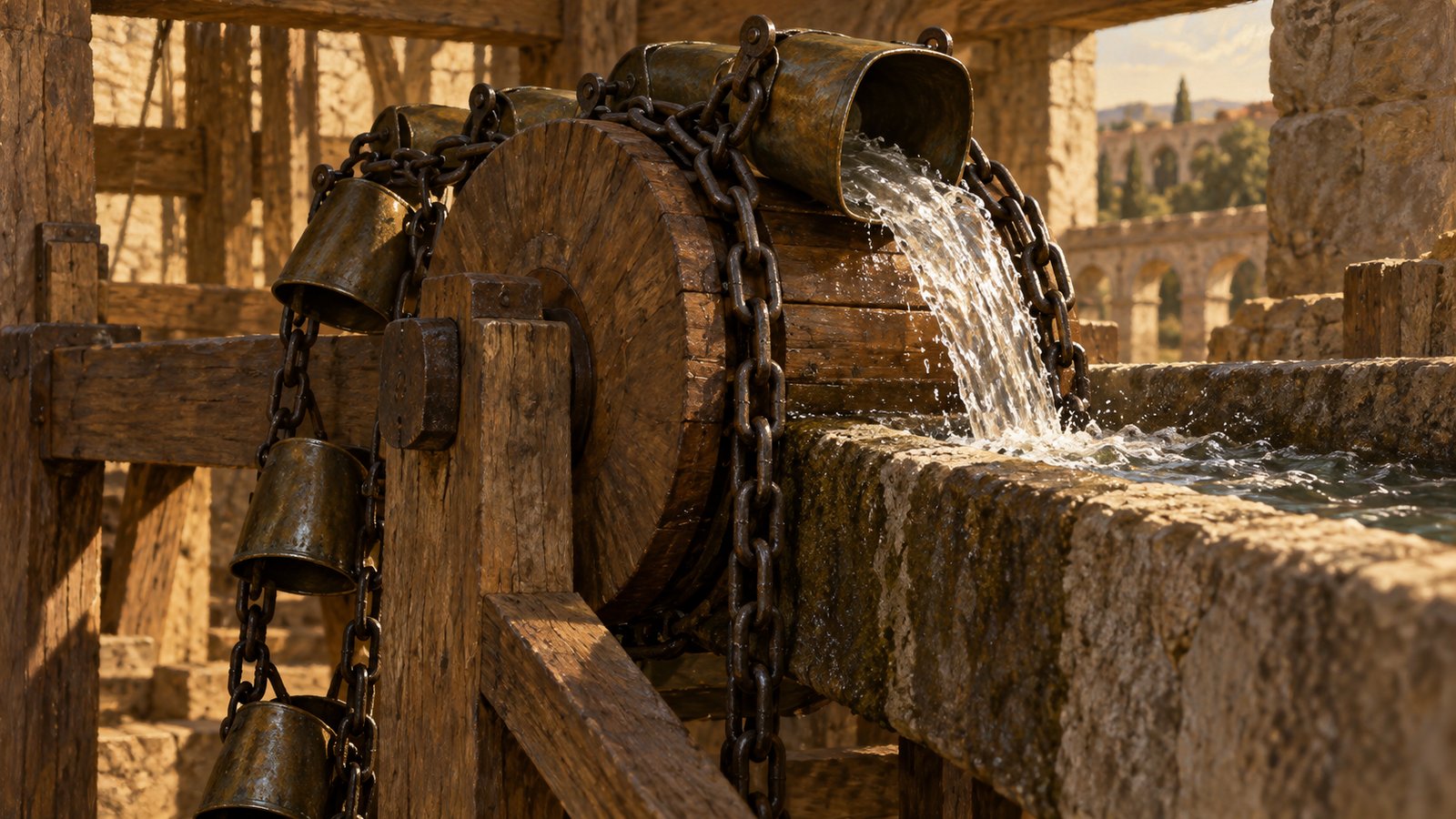
The buckets do not need a separate worker to empty them. Vitruvius says that when they pass over the axle at the top, they invert and pour into the conduits. The path itself performs the tipping action.
That detail closes the circuit. A vessel must face upward while rising if it is to retain water. It must turn downward over the crest if it is to release that water. Then it can descend empty, reducing the load on the return side until it meets the source again.
The conduit is as essential as the chain. Lifting water without receiving it at the outlet would only spill effort around the machine. A fixed channel catches the repeated discharges and converts separate bucketfuls into a usable flow toward the place Vitruvius calls higher.
The account does not describe a surviving installation, name its builders or tell us the exact distance between water and outlet. It is a technical prescription. Those omissions mean that a reconstruction should avoid pretending that one standardized Roman chain lift had universal dimensions.
What can be reconstructed is the order of operations: wheel turns axle; axle moves chain; chain carries bronze buckets; filled vessels climb; the top arc inverts them; the conduit receives their water. Every component earns its place by moving force or liquid across the vertical gap.
Three Machines Answered Three Versions of Height
Vitruvius’s sequence resists the temptation to call one mechanism the Roman solution to water lifting. He offers a wheel with receiving apertures, a larger wheel with sealed perimeter buckets, and a chain carrying bronze vessels. Each belongs to a different relation between source and destination.
The progression also shows why an apparently small design condition can reorder an entire machine. Increase the height and the wheel must grow. Increase it again and the containers leave the rim for a longer flexible circuit. Human footsteps remain the input, but the path taken by the water changes.
Unlike the ship pump that fought water inside a hull, this apparatus is not described as removing a dangerous leak. It elevates a useful supply. The goal is not simply dryness below but controlled delivery above.
The source offers no claim about who owned such machines, how often chains broke or how much water a crew moved in an hour. Those would require evidence beyond the chapter. Vitruvius instead gives something narrower and unusually legible: a design logic in which each increase in height changes the relation among wheel, containers and outlet.
At the tallest step, the wheel no longer has to touch the lower water with its own edge. Its axle can remain at the working level while the iron loop reaches down. Bronze buckets do the traveling, and gravity helps empty them exactly where the chain bends home.
Sources
Vitruvius, On Architecture 10.4.