
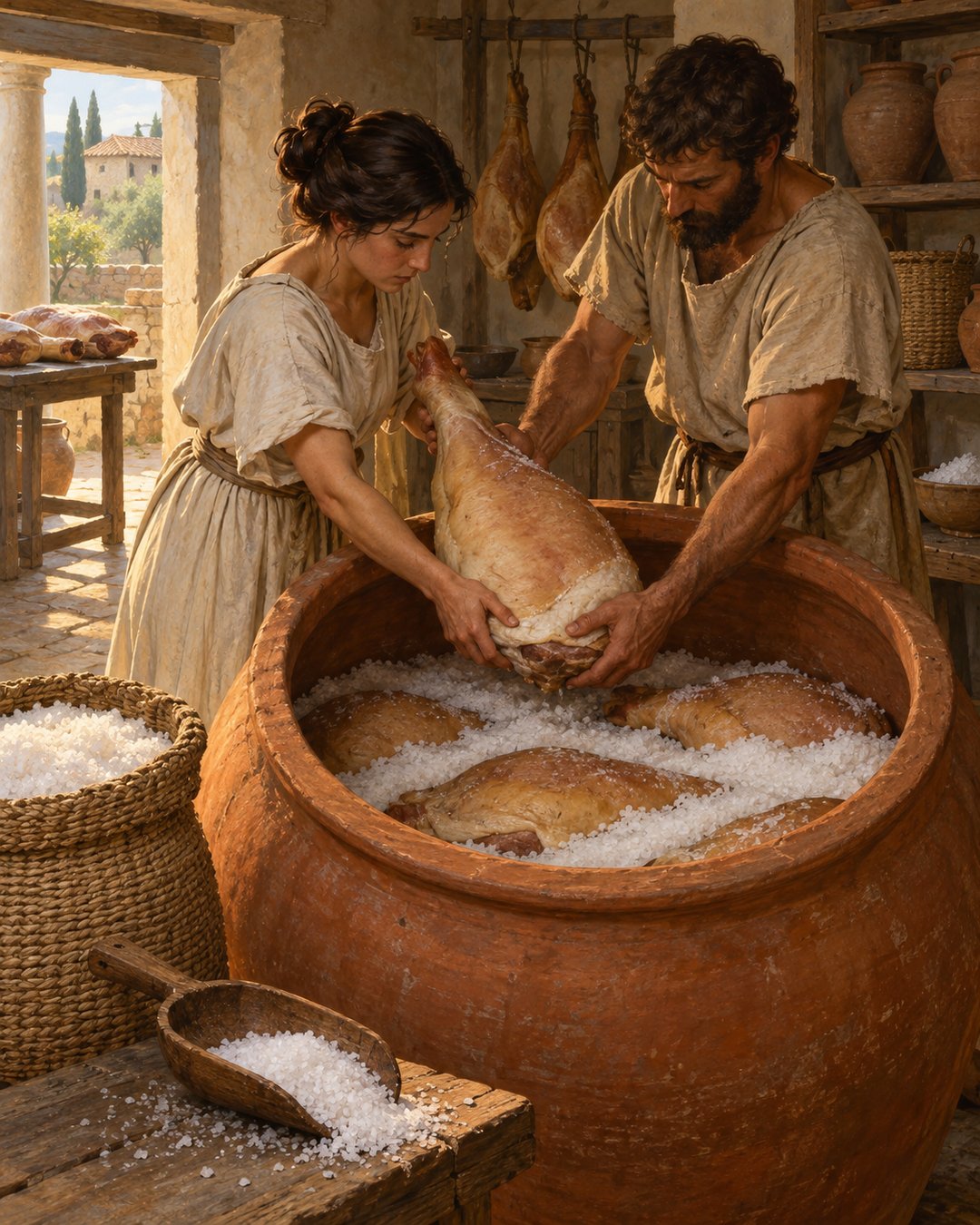
Cato’s ham recipe begins with a large vessel, ground salt and a rule about contact: meat must not touch meat.
Five days later, every piece comes out with its salt. The former top hams go to the bottom, the layers are rebuilt, and the waiting begins again.
The method is not a single act of salting. It is a schedule that moves pork through measured salt, changed position, moving air, cleaning, oil, smoke and a final surface treatment before storage.
Half a Modius of Salt Turned Quantity into a Rule
Cato introduces the procedure as a way to cure hams and Puteolan ofella, a term his translator connects with pieces of salted pork. He permits a jar or a large pot, making the vessel important but not exotic. What mattered was enough depth and width to build separated layers.
The preparation began after purchase. The hocks were cut off, and each ham received an allowance of half a modius of ground Roman salt. The ancient volume does not translate neatly into one modern kitchen measure, and surviving vessels were not perfectly uniform. Cato’s practical point is clearer than a forced conversion: salt was budgeted per ham rather than thrown in by guesswork.
That ratio linked supplies to the size of the job. A household preserving several hams could calculate whether its stock of salt was sufficient before the vessel was packed. Running short halfway through would leave the upper pieces covered differently from those below.
Salt had value beyond flavor. In this sequence it surrounded exposed surfaces and helped create conditions less favorable to decay. Cato does not explain the chemistry. He writes as a supervisor giving operations in the order they must be performed.
The ground texture also mattered to the action he describes. Salt had to spread across the vessel bottom, cover the whole surface of each ham and fill the separations between layers. Large uneven lumps would make complete coverage harder to judge.
Cato used similarly exact terms when turning produce into a sale governed by inspection. his wine-sale conditions gave a buyer three days to test whether the wine was sound. The subjects differ, but both texts make agricultural value depend on a procedure that can be checked rather than an assurance left vague.
Skin Faced Down while Salt Kept Flesh Apart
Before the first ham entered, salt was spread across the bottom of the jar or pot. The ham was then laid skin-side down and covered completely. Another went above it, also surrounded by salt.
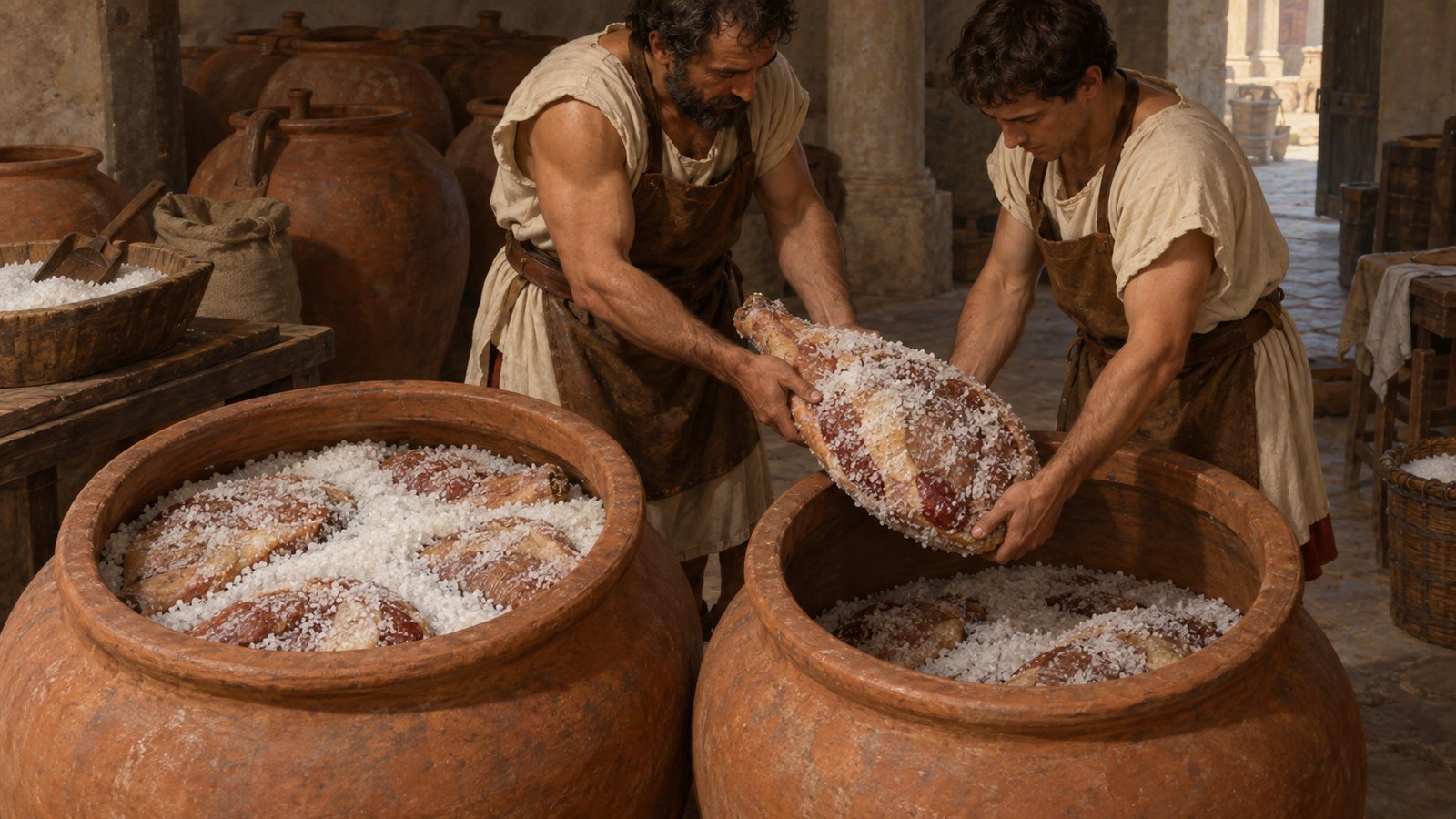
Cato adds a blunt restriction: meat must not touch meat. The stack therefore was not a compressed pile in which salt reached only the outside. Every piece required its own envelope, with contact between hams interrupted by the curing material.
The skin-down orientation gave the first layer a defined position. Cato does not offer a theory for it, so the instruction should not be decorated with a modern explanation he never supplied. Its importance lies in repeatability. Workers knew which face went toward the prepared base.
They continued until all the hams were inside. Salt then covered the top so thoroughly that no meat remained visible. The surface was levelled rather than left as an irregular mound.
These details made visual inspection possible. Bare flesh at the top signaled inadequate coverage. Two pieces pressed together signaled a missing salt layer. An unprepared bottom signaled that the first ham had been placed too soon.
The vessel thus organized the work vertically. Lower pieces carried the weight of everything above, while upper pieces sat nearer the surface. That unequal position created the reason for the recipe’s next intervention.
Roman farm instructions often made a work surface perform several jobs. Cato’s preparation of a threshing floor used olive lees and repeated packing to harden the surface and deter pests. The ham vessel likewise became working equipment: container, measuring space and boundary between carefully separated layers.
Five Days Later the Top and Bottom Exchanged Places
The first arrangement remained for five days. Cato then ordered all the hams removed with their own salt. The instruction preserves the curing material instead of treating the first interval as disposable.
Repacking reversed the hierarchy of the stack. Hams that had been at the top went to the bottom. Each piece was again covered and arranged as before.
This move addressed the fact that a stack is not one uniform location. Pressure, collected liquid and distance from the open top could differ. Cato does not quantify those differences, but he does not allow the same pieces to occupy the same positions for the entire cure.
Reversal redistributed exposure through labor. A worker had to lift every ham, preserve or recover the salt, identify the former order and rebuild it. The process could not continue correctly through neglect.
After the rearrangement, twelve more days passed before final removal. Read in sequence, the hams spent one interval in the original order and a longer interval in the reversed order. The recipe’s clock was attached to actions, not merely to a finishing date.
That timing also created moments of inspection. At the five-day turn, workers would see each covered surface while the vessel was unpacked. At final removal, every ham was handled again as the salt was brushed away.
Cato says nothing here about temperature records, humidity instruments or tasting during cure. A modern reconstruction should not insert them. His controls were the ones the text names: salt allowance, complete coverage, separation, orientation, position and counted days.
Air and a Sponge Replaced the Burial in Salt
When the second interval ended, the hams left the salt for good. Workers brushed off the crystals and hung the pieces in a draught for two days.
The environment changed sharply. Inside the vessel, salt and close packing had surrounded the meat. In the next stage, each ham hung separately where moving air could reach its surface.
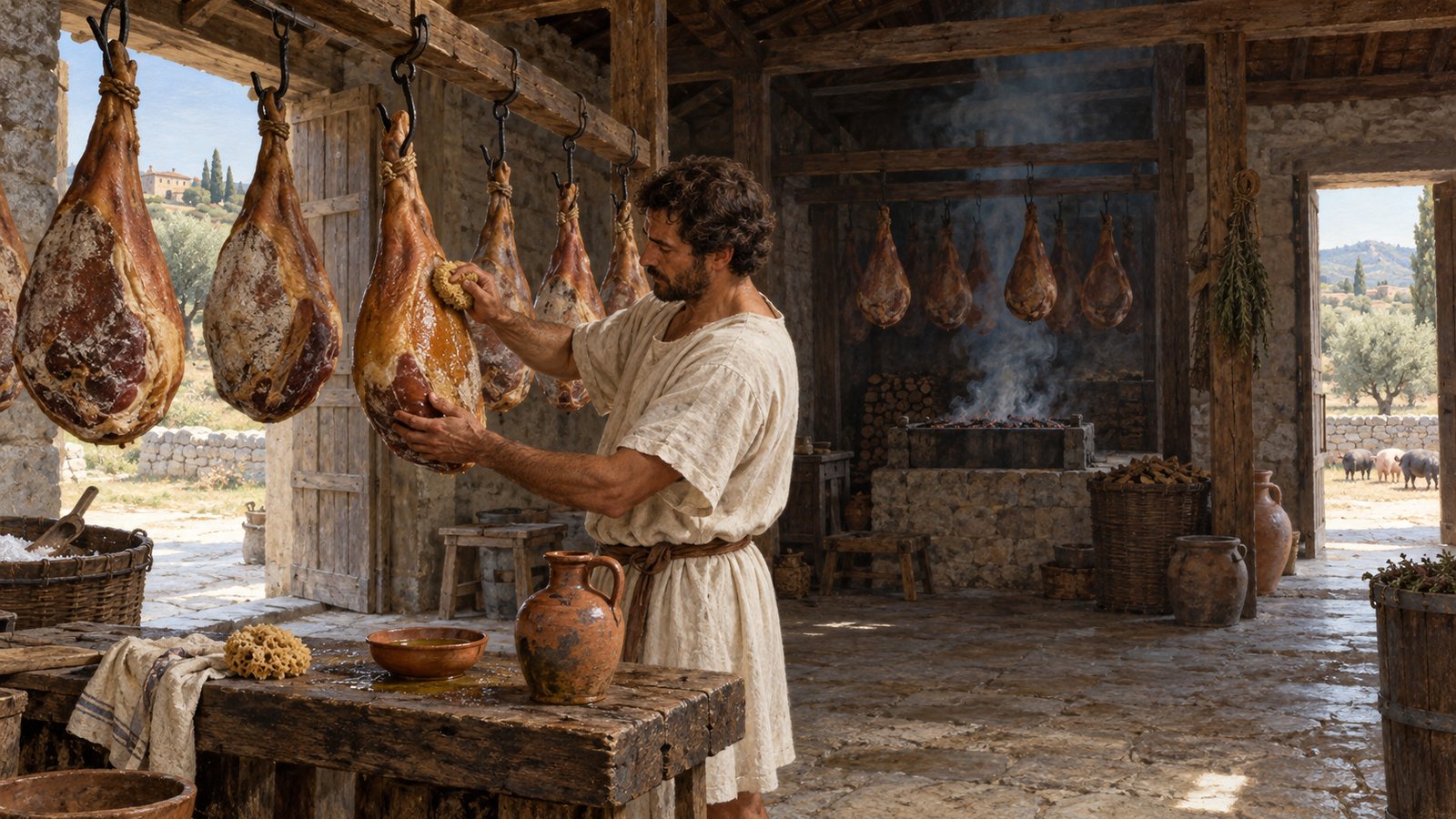
Cato again marked a transition by the third day. The hams were cleaned thoroughly with a sponge and rubbed with oil. Brushing had removed loose salt; the later sponge work attended to the exposed surface before the coating went on.
The oil was not the final treatment. It belonged between air drying and smoke. That placement shows why the recipe should not be reduced to a list of ingredients. The same material applied at another moment would not be the procedure Cato recorded.
Hanging also required infrastructure. Beams, hooks or cords had to support pieces with space around them, and the storeroom needed a current of air without exposing the food carelessly. Cato does not describe that room in this chapter, so images of the process remain informed reconstruction rather than a plan supplied by the author.
What the source does reveal is repeated surface work. Cover, uncover, brush, clean and rub are separate verbs in a short passage. Preservation depended on hands returning to the meat at each threshold instead of leaving it untouched until winter.
Two Days of Smoke Came before Oil and Vinegar
After cleaning and oiling, the hams spent two days in smoke. Cato then used another third-day instruction: take them down, rub them with a mixture of oil and vinegar, and hang them in the meat house.
Smoke was therefore bounded rather than indefinite. The text does not say to leave the hams above a fire until someone judged their color sufficient. It assigns an interval and then moves the food onward.
The final oil-and-vinegar rub created a new surface after smoking. Only after that treatment did the hams reach their longer-term hanging place.
Cato closes with the expected result: moths and worms would not touch them. The claim reflects an ancient author’s confidence in his procedure. It should not be converted into a modern guarantee, but it tells us which failure mattered to the household. A cured ham still had to survive storage pests after salt and smoke had done their work.
The sequence reveals several kinds of time. Five days led to reversal. Twelve more led to removal. Two days in a draught led to sponge and oil. Two days in smoke led to the final coating. Each wait ended with a different task.
It also reveals changing materials. Salt was abundant at the beginning and brushed away later. Air acted once the meat left the vessel. Oil appeared before smoke, then returned mixed with vinegar after smoke. The meat house received a product already altered by every earlier setting.
This is why Cato’s recipe feels more like workshop management than a modern dish. It coordinates supplies, vessel space, order of stacking and return visits by workers. The process succeeds only if someone remembers where the top was, when the interval ends and which coating belongs next.
A preserved ham was not produced by salt alone. It emerged from a chain of controlled contacts—and from refusing the wrong contact between one piece of meat and another.
Sources
Cato, On Agriculture, chapter 162.