
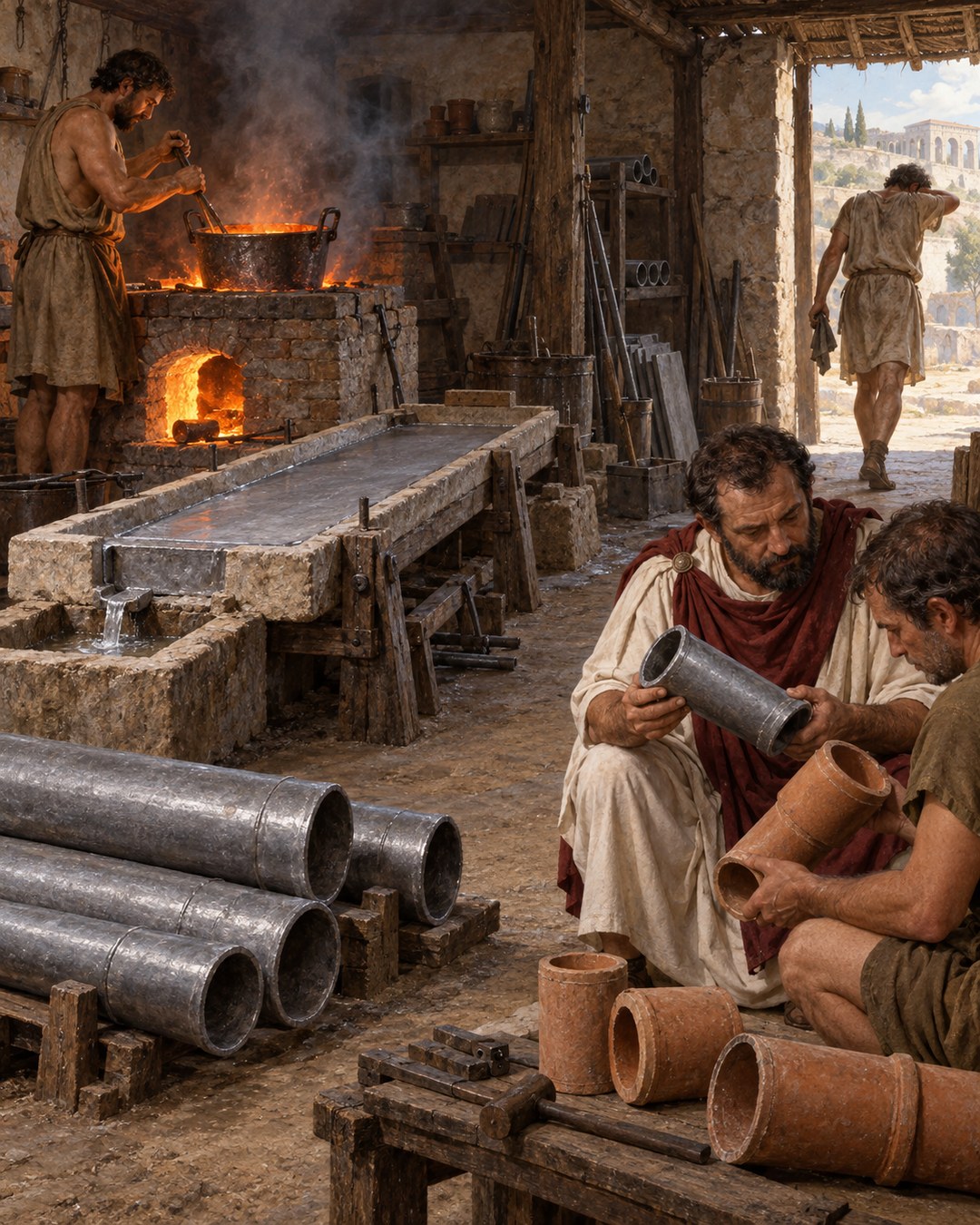
The plumbers’ faces became part of Vitruvius’s specification.
He saw deep pallor among men who smelted lead, connected it to fumes from the casting process, and carried that warning from workshop to water line.
Architecture, in his account, could not judge a pipe by strength and convenience alone.
One Water System Offered Three Material Paths
Vitruvius describes three broad ways to bring water from source to settlement. Builders could use masonry channels, lead pipes or pipes made from baked clay.
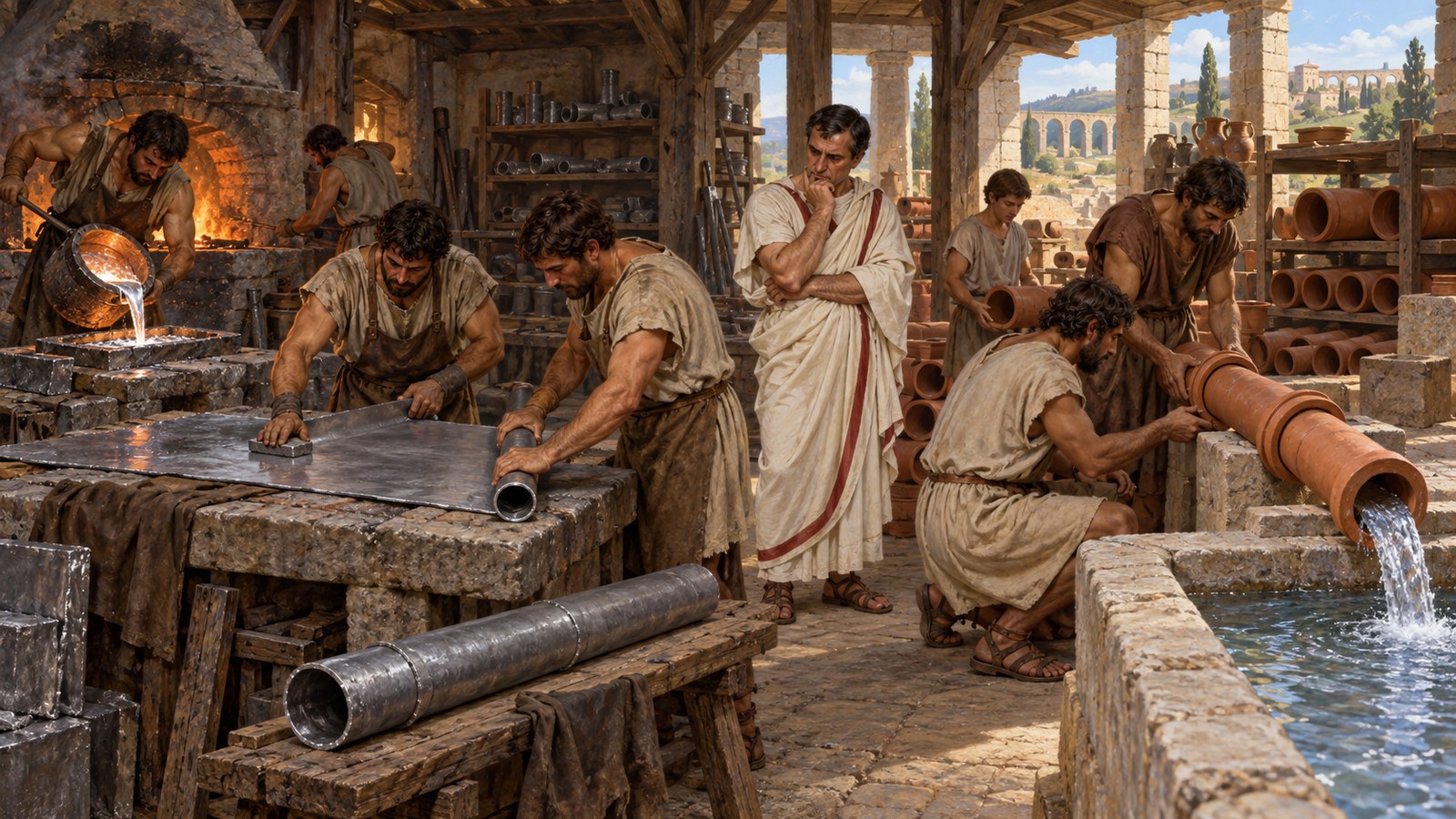
Each option joined hydraulic requirements to a different craft. Masonry conduits needed stable gradients, arches and access shafts. Lead required casting, shaping and joining metal. Clay needed potters capable of producing repeated sections that fitted without leaking.
Lead had practical attractions. A sheet could be cast to a specified width, bent into a tube and joined. Pipes could descend, cross low ground and rise under pressure where a simple open channel would require major substructure.
Metal also concentrated work before installation. A foundry could produce lengths that crews transported to the route, and the finished line did not depend on hundreds of fired sockets surviving handling. Those advantages help explain why a warning did not automatically remove lead from Roman practice.
Vitruvius explains such installations in detail. He sizes pipes by the width of the cast sheet, discusses the reservoir at the source and describes the low central run of an inverted siphon.
That technical competence makes his later objection more significant. He did not reject lead because he could not imagine how to use it. He placed a health warning inside a chapter that otherwise teaches builders to deploy it.
Clay sections worked differently. Vitruvius wanted them at least two fingers thick and formed with a tongue at one end so neighboring lengths could fit together.
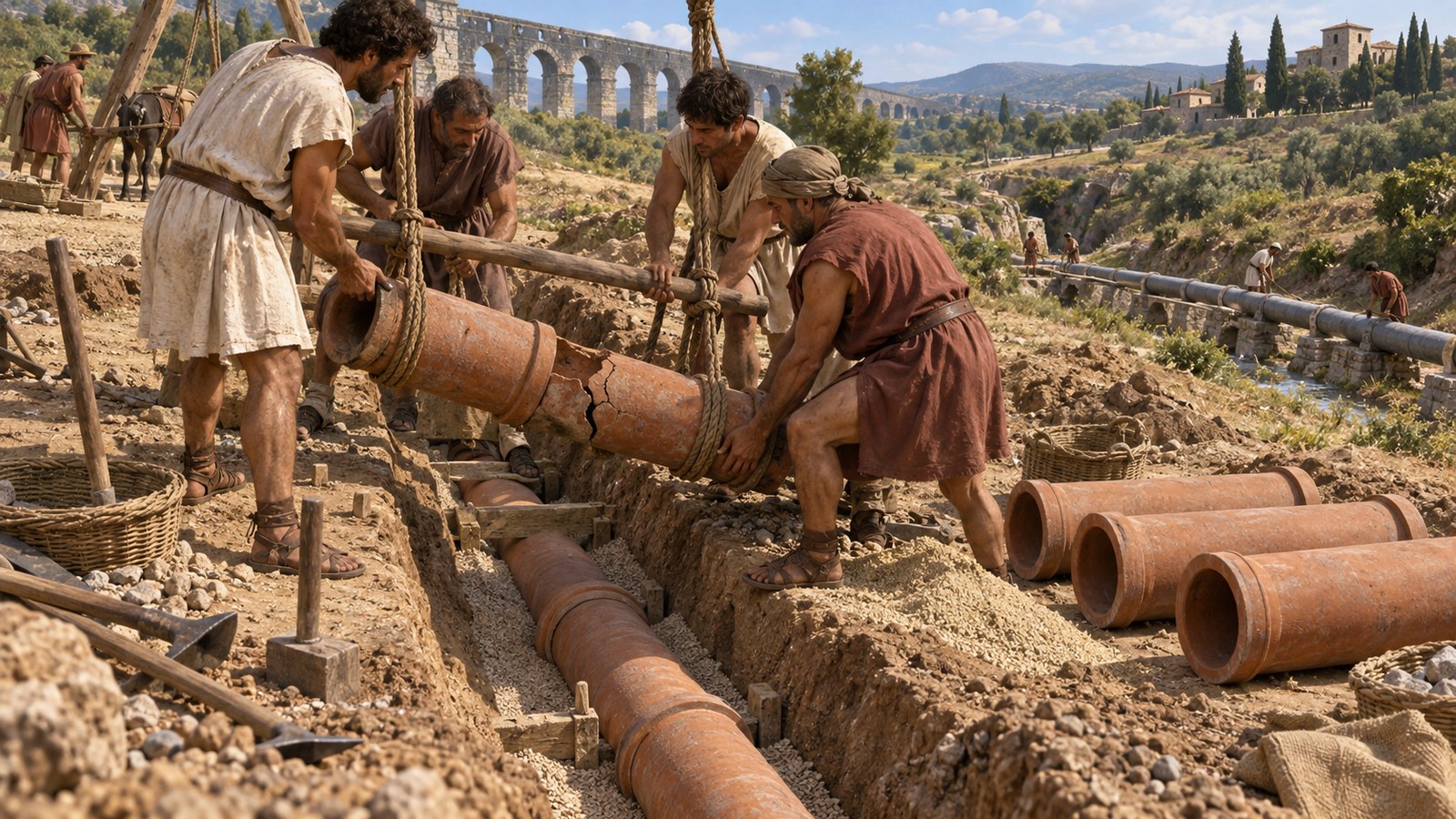
The joints received quicklime mixed with oil. Before water entered, ash was introduced so leaks would be stopped where connections were not perfectly sealed.
These instructions treat earthen pipe as engineered infrastructure, not a row of ordinary household pots. Thickness, socket geometry, joint compound, support and testing all determined whether it carried water successfully.
Stamped lead pipes could make names and water rights visible. Vitruvius asks a separate question: what did the material do to the people who manufactured and drank through it?
White Lead and Pale Workers Became Evidence
Vitruvius states his recommendation plainly: water from clay pipes is more wholesome than water conducted through lead.
His first argument begins with white lead. Because this lead-derived substance was regarded as harmful to the human body, he reasoned that the parent material could not be wholesome.
That inference does not match modern toxicology in method or precision. It does not distinguish every route of exposure, dose, water chemistry or chemical form. Yet it shows Vitruvius refusing to isolate a useful product from known harm associated with the same material.
He then turns from substance to workers. Plumbers, he says, supplied an observable example. Their natural color was replaced by deep pallor.
The Latin craft category covered people who worked lead, not only the modern household repairer suggested by the English word “plumber.” Vitruvius places these men beside smelting and casting.
He believed fumes from molten lead settled on their bodies day after day, burning away the virtues of the blood from their limbs. The physiology is ancient. The occupational observation is concrete.
Heat transformed a manageable sheet material into a source of exposure. The moment that made lead easy to cast also put workers closest to smoke and vapor.
Vitruvius did not record workshop size, exposure duration, diet, ventilation or comparison groups. Pallor could have several causes. We should not turn his paragraph into a modern clinical study.
But neither should its reasoning be dismissed because the explanation of blood was incomplete. A repeated bodily sign among people sharing a process can warn that the process deserves suspicion.
The worker’s body became a detector where no instrument measured airborne concentration. Vitruvius looked at those who handled the material most intensely and asked what their appearance implied for a conduit used every day.
Manufacturing Risk Entered the Water Decision
Vitruvius moves directly from pallor to advice: anyone seeking wholesome water ought not to conduct it through lead pipes.
His argument combines at least two exposures. Plumbers faced concentrated fumes during manufacture. Water users encountered a finished pipe. Those routes are not identical, and evidence of one does not automatically quantify the other.
The leap matters because it marks both the strength and limit of his method. He recognized material harm across a production system but lacked the tools to specify when, how quickly or at what concentration danger traveled.
His categories were practical rather than chemical. “Wholesome” gathered visible health, manufacturing experience and sensory judgment under one architectural decision. It could guide material choice even though it could not isolate lead dissolved in water from fumes inhaled beside a furnace.
Modern readers also know that lead in water depends on corrosion, chemistry, protective deposits, flow and time. Vitruvius did not. His recommendation remains notable because it errs toward another available material rather than waiting for complete explanation.
Infrastructure choices distribute risk unevenly. A householder may enjoy a convenient pipe while founders and joiners absorb the heaviest exposure. Judging only water at the outlet can erase the workshop that created the line.
Vitruvius keeps those spaces connected. His water chapter passes from source and gradient to casting, bodies, taste, wells and cisterns. The system includes labor as well as flow.
Lead also carried administrative value. It could be measured, stamped and inspected, and Frontinus later traced unauthorized distribution through pipe connections. A material might be excellent for control and still create a health concern.
Clay brought different weaknesses. Sections were brittle, numerous joints could leak, and pressure changes could break a poorly supported line. Vitruvius does not pretend that replacing metal removed maintenance.
Transport added another risk. A cast lead length could bend without shattering, while a fired section damaged on the road might be useless before reaching the trench. Choosing clay shifted effort toward careful bedding, alignment, jointing and stocks of replacements.
His own instructions therefore build repair into the design. Clay pipes were laid over a bed with space left so damaged lengths could be replaced. A health preference had to survive contact with practical upkeep.
Taste Made the Alternative Familiar
Vitruvius adds an everyday argument after the plumbers’ pallor. Water from clay pipes, he says, tasted better.
He compares the preference to elite dining. Even when tables were loaded with silver vessels, people chose earthenware for purity of taste.
The comparison moves evidence from the workshop to the mouth. Readers who had never watched lead casting could recognize a sensory distinction between materials used for food and drink.
Taste was not a laboratory assay. Pleasant water could still be unsafe, and unpleasant water could be harmless. Vitruvius uses it as supporting experience, not as a quantified proof.
The image of silver beside pottery also overturns a simple hierarchy. Expensive material did not win every functional judgment. An earthen cup could be preferred where flavor mattered, just as baked clay could be preferred where water quality mattered.
That did not make Roman water systems uniformly lead-free. Archaeology and inscriptions show extensive lead plumbing. Technical advice competes with cost, terrain, pressure, labor, habit and political choice.
Vitruvius preserves the argument precisely because builders had choices. If one material were unavoidable, observing its danger would not produce the same specification.
His chain of reasoning remains visible: harmful white lead, pale workers, daily smelting fumes, an inference about wholesomeness, and a clay alternative validated by familiar taste.
Some links in that chain are stronger than others. Together they show an architect treating occupational illness as relevant knowledge rather than a private misfortune outside design.
The pipe disappeared under streets and floors. The faces of the men who made it told Vitruvius that hidden material still had a human cost.
Sources
Vitruvius, On Architecture, book 8, chapter 6.