
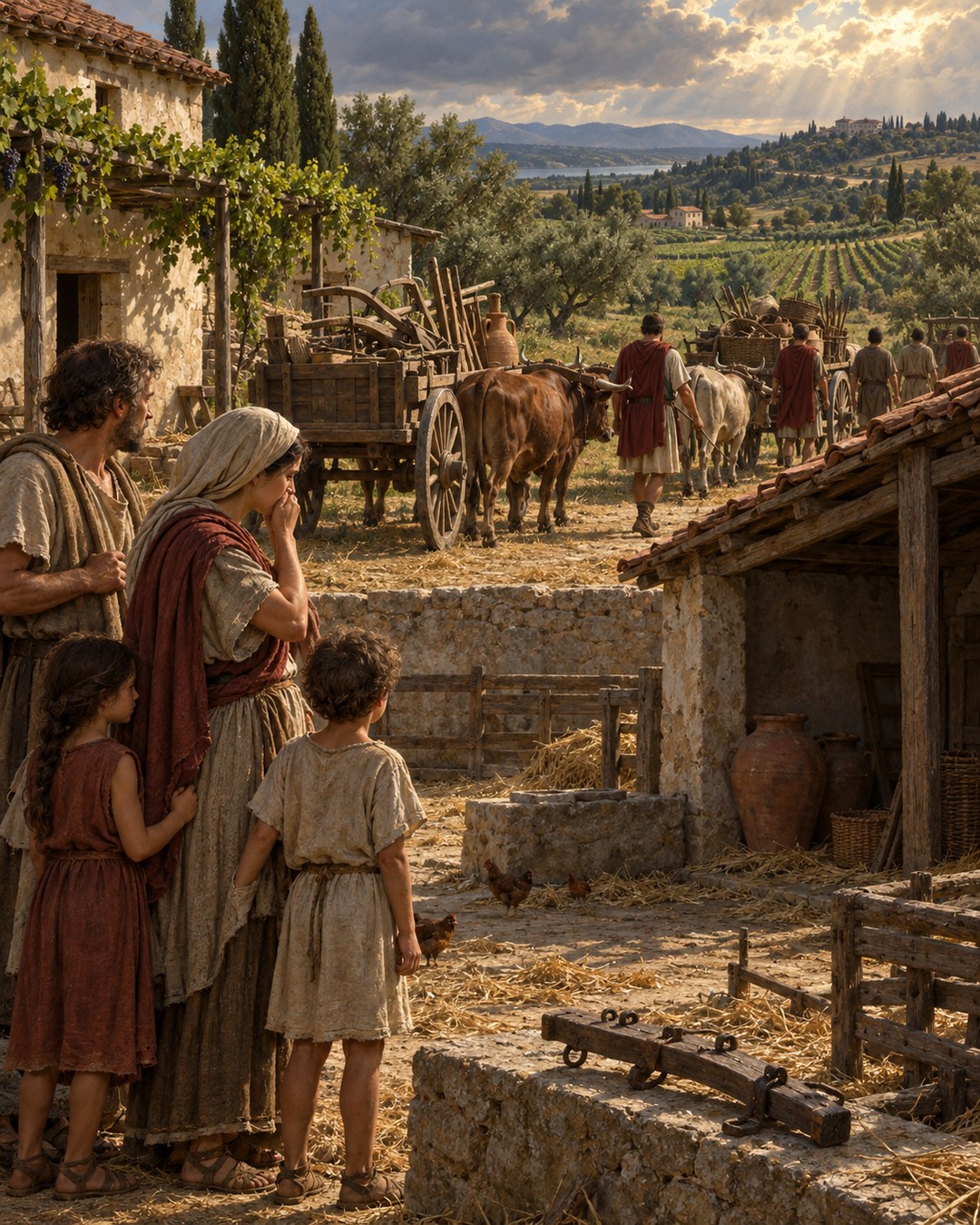
The discount began in an empty farmyard.
An estate beside Pliny’s land had once gone for more than five million sesterces. Now the asking price was three million, after the previous owner had repeatedly seized and sold the tenants’ stock.
The arrears fell, then rose again. The means of paying them were gone.
One Boundary Promised an Administrative Bargain
Pliny wrote to Calvisius Rufus because the decision involved more than price. The property adjoined his own and even ran into it.
That physical fit promised economies before a single crop was counted. Pliny could visit without a separate journey and place both properties under the same steward and nearly the same sub-agents.
He imagined supporting and embellishing one villa while keeping the second in ordinary repair. Furniture, household staff, specialist gardeners, craftsmen and hunting equipment could be concentrated rather than duplicated.
Proximity lowered the friction of ownership. Supervision, people and movable goods could cross a short boundary instead of being maintained in two distant systems.
But Pliny immediately states the counterargument. Joining the estates would expose a large share of his wealth to the same climate and the same accidents.
Scattered property offered diversification. If weather or another local disaster damaged one district, land elsewhere might escape.
The letter therefore begins with two different meanings of efficiency. Concentration reduces repeated expense; distribution reduces shared risk.
Pliny did not pretend one principle always won. He asked an adviser known for judgment in economic matters to weigh a property whose convenience could itself become a vulnerability.
The archive shows another Roman attempt to distribute danger rather than eliminate it. Cato spread maritime loans across fifty ships so no single voyage carried the whole exposure. The adjoining farm offered the opposite geometry: shared management in exchange for shared weather.
Rich Ground Had Been Stripped of Its Working Capital
The land did not look inherently poor. Pliny calls it rich, fertile and well-watered.
Its productive mix included meadow, vineyard and woodland. Timber generated moderate but steady returns.
The damage came from management. The previous owner had repeatedly seized and sold the tenants’ stock.
That action made the books look better briefly. Selling animals, tools or other operating assets reduced what tenants owed at that moment.
It also removed what they needed to continue. Pliny says the tenants were left with nothing to go on with, so arrears accumulated again.
The cycle is brutally legible. A debt prompted seizure. Seizure produced a payment. The payment destroyed productive capacity. Weaker production produced another debt.
Pliny’s account does not give an inventory of every item sold, and it should not be expanded into one. “Stock” is enough to identify the economic role: resources on the estate that allowed tenants to keep working.
The former owner treated those resources as recoverable value for yesterday’s obligation. A buyer had to treat their absence as tomorrow’s cost.
This is why fertile soil and reduced income could coexist. Land quality did not automatically supply labour, animals, equipment or solvent tenants.
The low price was not separate from neglect. It encoded neglect.

The Buyer Had to Rebuild What the Seller Liquidated
Pliny expected to provide the estate with labour. He planned to buy good slaves, and he anticipated paying above the usual price for them.
He adds a personal condition: he kept no fettered slaves, and none were on the property.
That statement does not make Roman slavery benign. It identifies the labour form Pliny refused within a system that still treated people as purchasable productive assets.
For the investment calculation, the consequence was immediate. Three million sesterces did not put the estate back into working order.
Purchase money acquired the land. Additional money had to restore the capacity that previous collections had removed.
New labour also could not instantly solve the tenant problem. The letter says the estate had been stripped of tenants and its income reduced. Relationships, knowledge of plots and the ability to survive between harvests mattered alongside bodies placed on the ground.
Pliny’s plan therefore transferred costs across ownership. The seller had converted tenant stock into short-term receipts. The buyer would pay to reconstruct the conditions for long-term receipts.
A similar separation between capital and income appears in Pliny’s arrangement for a gift whose rent was meant to fund a continuing civic purpose. Here the flow ran the other way: impaired production had pulled income and capital value downward together.
The letter never says recovery was guaranteed. Fertility made recovery plausible, not automatic.
That uncertainty is part of the bargain. A damaged operation may be cheap because a new owner sees efficiencies the old one missed. It may also remain damaged longer and cost more than the discount implies.
Three Million Still Required Borrowed Money
The price was three million sesterces. Pliny says the estate had formerly gone for more than five million.
He did not attribute the entire decline to one cause. General hard times mattered, and so did the way the property had been stripped of tenants.
That caution prevents a neat but false equation in which every lost sestertius came from one management error. Market conditions and estate-specific damage operated together.
Pliny also had to ask how he would fund the purchase. Most of his wealth was already in land.
He had some money lent at interest, but he expected no great difficulty borrowing what he needed from his wife’s mother. Her purse, he wrote, was available to him with the freedom of his own.
The prospective buyer was therefore not standing outside the credit system he was evaluating. He would use family credit to acquire a property weakened by tenant debt.
Those obligations were not equivalent. Pliny presented his borrowing source as secure and flexible, while the tenants’ arrears had provoked asset seizures. The contrast shows how the terms and power around debt determine what it does.
A loan could preserve a buyer’s opportunity. Collection could destroy a tenant’s capacity to pay.
The final decision remained with advice. Pliny laid out proximity, management savings, fertile land, concentrated risk, missing stock, labour expense, depressed value and financing, then asked Calvisius to examine any objections carefully.
His list of shareable resources makes the proposed economy concrete. It was not merely that the parcels touched on a map. One steward, nearly the same assistants, one fully maintained villa, furniture, household staff, gardeners, craftsmen and hunting equipment could serve a more compact domain. Every saving, however, depended on the damaged estate becoming usable again.
The woodland’s moderate but steady timber return offered one stable element, while meadow and vineyard still required continuing labour and care. Pliny’s description therefore separates the quality of assets from the quality of operation. Good ground can retain potential while bad collection practice drains the people and stock that turn potential into income.
Even the fall from above five million to three million must be read with that separation in mind. The former price showed what buyers had once paid; it did not guarantee that restoration would return the same value. Pliny still had to judge current income, current tenants, replacement costs and the wider hardness of the times.
The letter is valuable because it refuses to call the price alone a bargain.
Three million bought an adjoining landscape and the convenience of one steward. It also bought empty capacity, damaged tenancy and exposure to the same weather already governing Pliny’s land.
The earlier owner had made arrears smaller by making the farm weaker. Pliny could profit only if he reversed that sequence: spend first, restore work, and wait for income to follow.
Sources
Pliny the Younger, Letters, book 3, letter 19.