
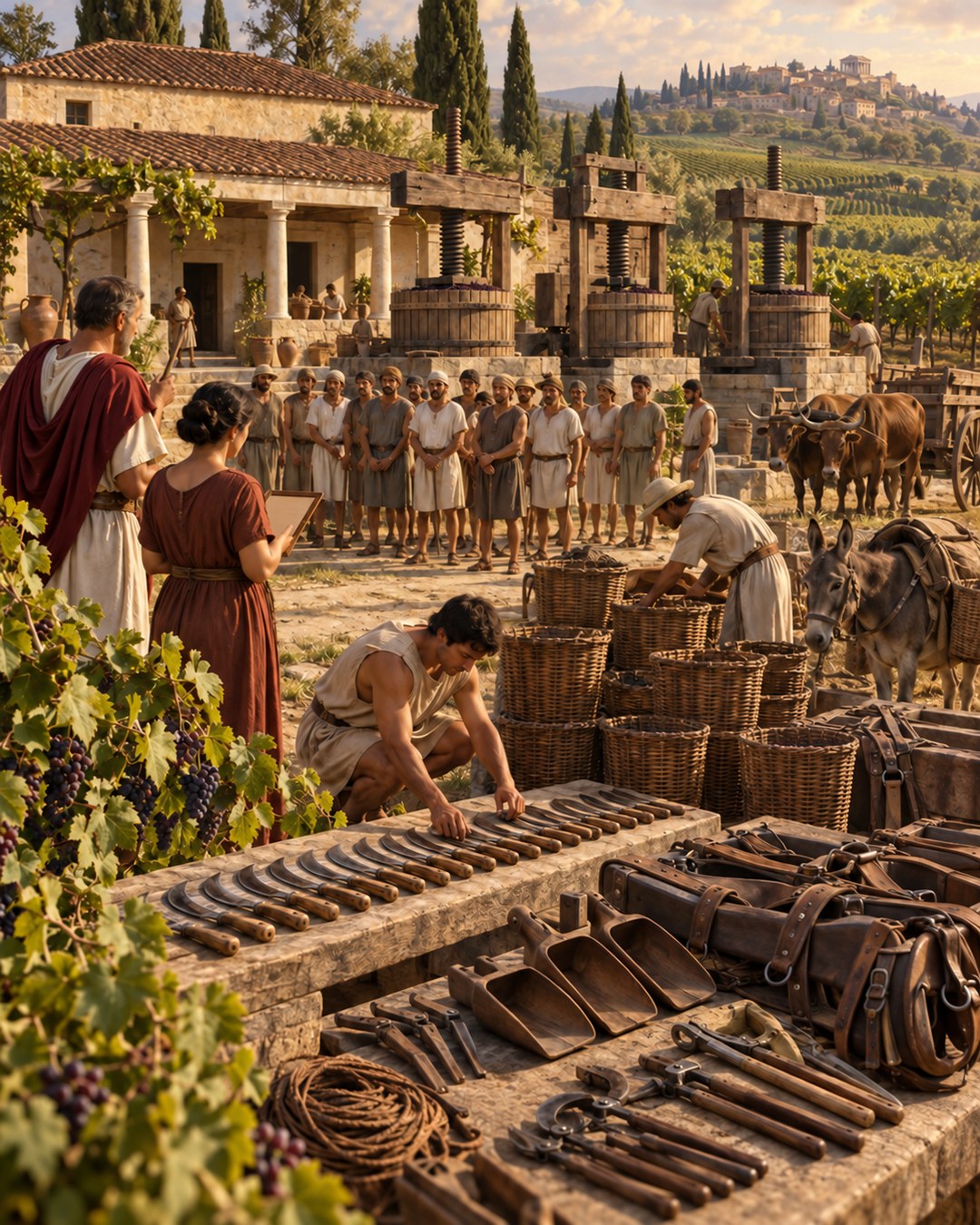
Forty grape knives waited for a harvest that three presses had to absorb.
Cato’s equipment list for a hundred-iugera vineyard moves from people and animals to vats, harness, hoes, beds and hoods.
The farm appears not as acreage but as a chain in which one missing link could stop the vintage.
Sixteen People Gave the Land a Working Shape
Cato opens the inventory with labour. A vineyard of one hundred iugera required an overseer and a housekeeper.
Below them stood ten labourers, one teamster, one muleteer, one willow-worker and one swineherd. Cato totals the group at sixteen persons.
The roles show that vines did not occupy every working hour or every skill. Someone directed the estate; someone managed its household; animals needed specialist handling; flexible willow material demanded craft knowledge; pigs belonged inside the farm economy.
The ten labourers provided the broad pool of hands. Pruning, digging, manuring, training and harvest created tasks whose intensity changed with the season.
The teamster and muleteer connected field work to movement. Grapes had to reach the presses, supplies had to cross the estate, and manure and tools had to reach the vines.
The willow-worker is easy to overlook, yet the rest of the list explains the role. Cato wanted many baskets, hampers and strainers. Woven equipment wore out under wet pulp, soil and repeated carrying. The vineyard needed the ability to maintain containers, not merely buy them once.
The swineherd confirms that a specialised vineyard remained a mixed household. Wine production dominated the plan, but food, animals and waste still circulated through the same estate.
Cato’s overseer had to coordinate these pieces over the whole year. His rules for an overseer describe responsibility that began before the workforce rose and ended after it slept. The vineyard inventory gives that responsibility a physical scale.
Counting people first made every later object legible. A knife implied a hand; a cart implied a driver and draft team; a mill implied an animal or person to turn it.
Animals and Presses Set the First Capacity Limits
The estate’s animal power consisted of two oxen, two draft donkeys and one donkey assigned to the mill.
These were not interchangeable entries. Oxen supplied heavy traction. Donkeys moved loads and powered machinery. Reserving one for the mill prevented every animal from being treated as spare transport during a busy day.
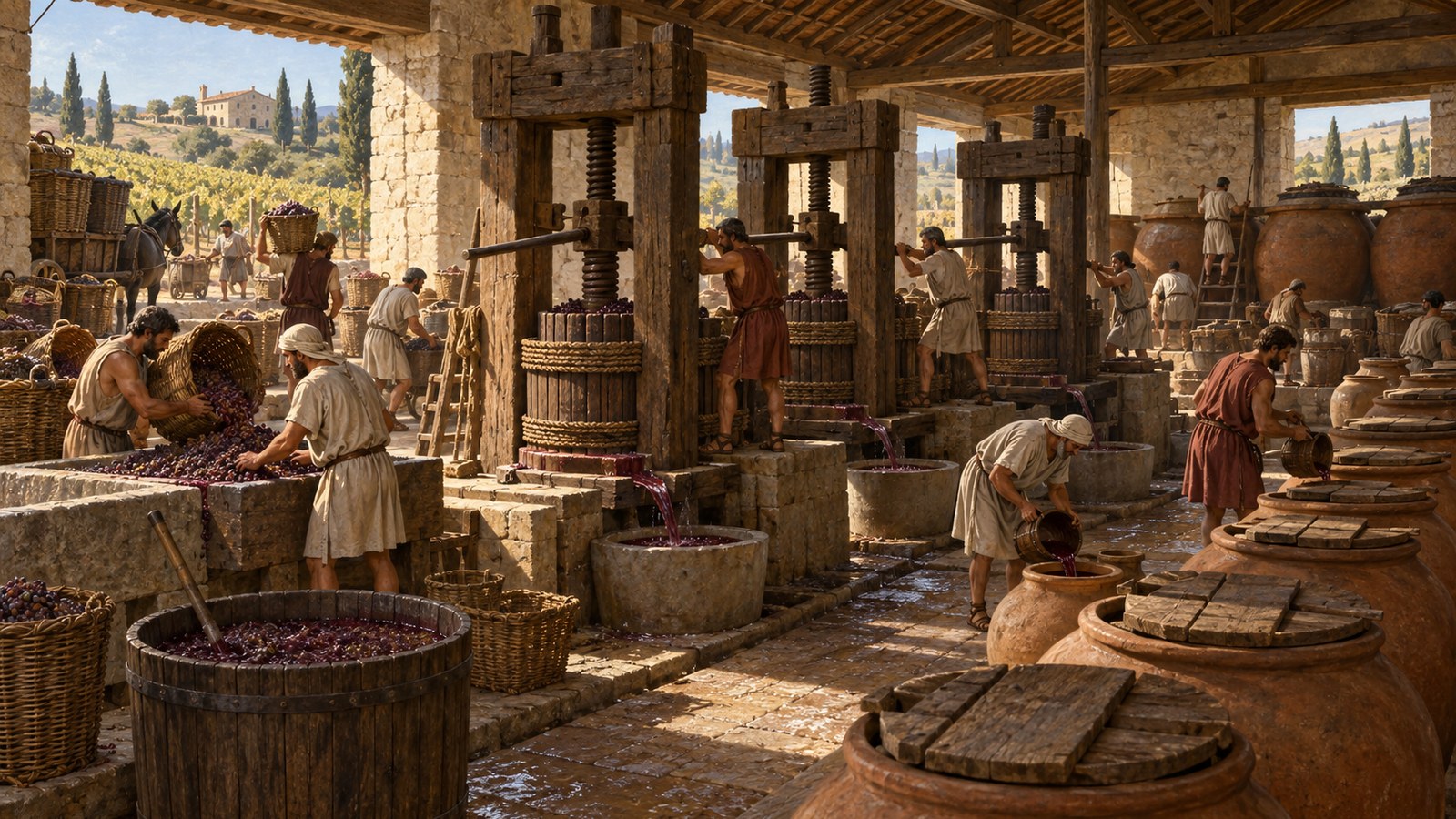
Cato then lists three complete presses. The adjective matters because a beam without ropes, fittings, collecting surfaces and trained handlers was not pressing capacity.
Harvest turns a standing crop into a flow. Fruit leaves the vines, fills baskets, reaches the press, yields liquid and residue, and moves into containers. If gathering outran pressing, grapes waited. If pressing outran storage, juice had nowhere secure to go.
The inventory therefore joins pressing to vats capable of holding five vintages of eight hundred cullei. Whatever uncertainty surrounds the practical interpretation of that large capacity, Cato’s wording deliberately looks beyond a single season.
Storage protected continuity. Vessels could remain occupied by earlier wine while the next vintage arrived. Cleaning, ageing, sale and household use did not all empty containers on the same day.
Twenty jars held grape pulp and twenty held grain, each with the necessary covers and tops. The vineyard had to protect both a processing material and its basic food reserve.
Six pots covered with Spanish broom and four amphorae of the same kind added another container form. Two funnels, three wicker strainers, three strainers for removing the flower and ten juice vessels controlled movement between stages.
None of these objects was as imposing as a press beam. Yet a clogged transfer or shortage of clean vessels could idle the press as effectively as broken machinery.
The same systems logic appears in Cato’s precise adjustment of olive millstones. Large agricultural output depended on small clearances and ordinary fittings remaining correct.
Carts, Measures, and Harness Connected the Stages
Two carts and two ploughs gave the vineyard duplicate capacity in movement and cultivation.
Cato names a wagon yoke, a vineyard yoke and a donkey yoke. Harness fitted tasks and animals rather than existing as one generic bundle of leather and wood.
A copper disk, mill harness, large copper vessel, copper cover, iron hooks and copper boiler served work that involved heat, lifting, liquid and processing.
Water pots, a watering pot, basin, small pot, wash-basin and water bucket made cleaning and handling water part of the equipment plan.
A platter, ladle, candlestick and chamber vessel move the reader abruptly from production into daily habitation. The crew needed light, food service, washing and sanitation while the vineyard operated.
Four beds, a bench, two tables, a small table, clothes chest, wardrobe and six long benches furnished the people who kept the system moving.
The iron-bound modius measure and half-modius measure tied materials to countable quantities. Grain, seed or other goods could not be managed consistently if the estate lacked durable standards.
A wash-tub, bath-tub, lupine vat and ten large pots continued the pattern. Cato did not isolate marketable wine from the maintenance of bodies, clothing, seed treatments and household processes.
Four complete ox-harness sets and three donkey-harness sets exceeded the number of working teams. That surplus suggests replacement and repair. A broken strap did not need to stop ploughing or transport while a new set was made.
Three pack saddles, three baskets for wine lees, three donkey mills and one hand mill supplied alternate modes of carrying and grinding.
The hand mill was modest redundancy. If animal power was unavailable or a small quantity did not justify harnessing a donkey, grain could still be processed.
Inventory turned resilience into objects. The estate could not eliminate breakage, but it could avoid making every worn component an emergency.
Forty Knives Reveal the Harvest Bottleneck
The tool section shifts from installations to edges, handles and containers.
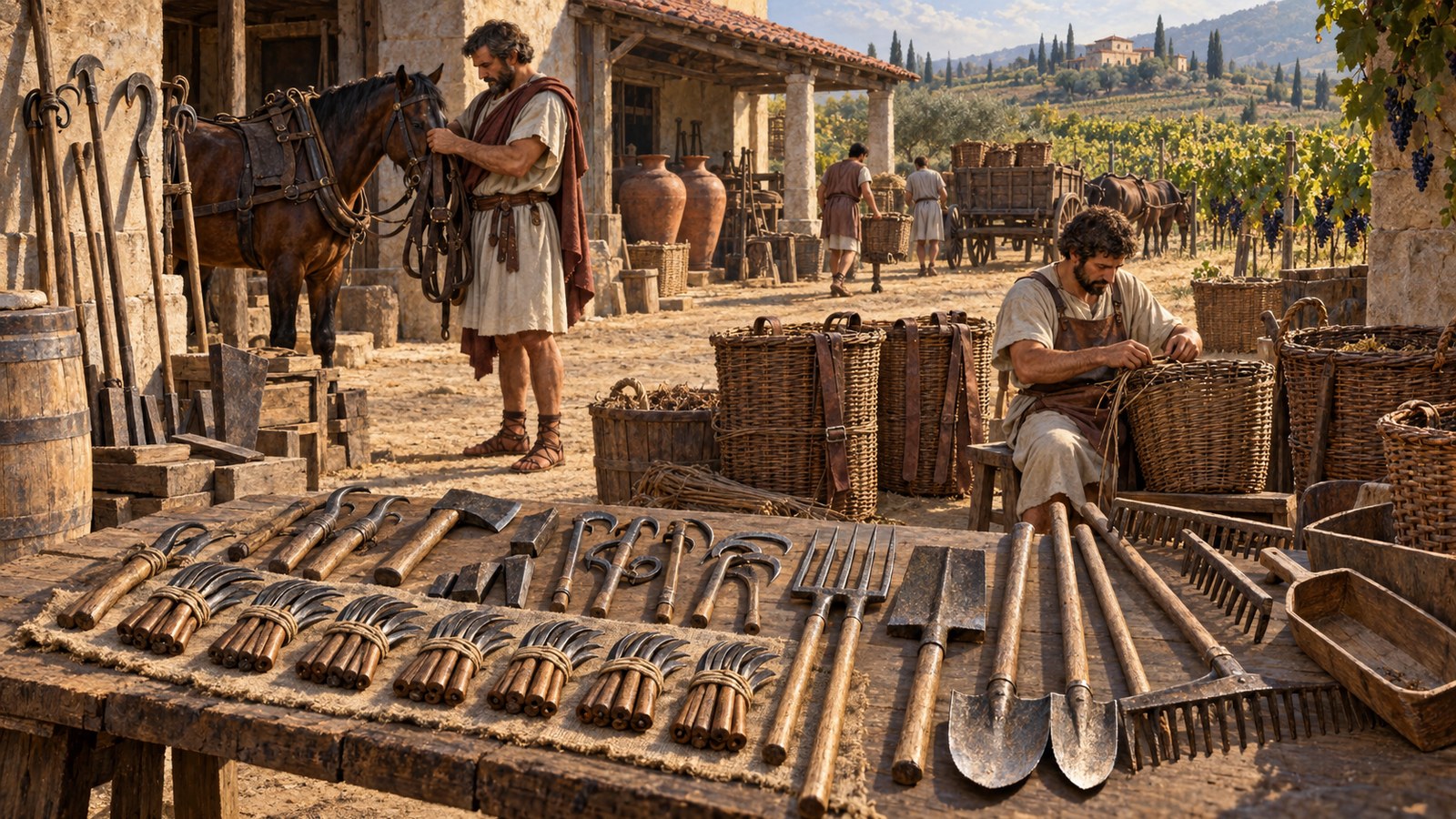
Cato specifies five rush-hooks, six tree-hooks and three pruning-hooks. Different cutting tasks met different plants, heights and materials.
Five axes and four wedges handled heavier wood. Ten forks, six spades, four shovels and two four-toothed rakes distributed digging, lifting and levelling across the crew.
Four manure hampers and one manure basket made fertility a transport problem. Manure had to be carried and placed, not simply exist somewhere on the farm.
Then comes the most conspicuous multiplication: forty grape knives.
The number is larger than the permanent workforce. It allowed many hands to cut at once, supplied replacements when blades dulled or handles failed, and may have accommodated temporary harvest labour beyond the resident sixteen.
The source does not explain which combination applied on a given estate, so the inventory should not be turned into a precise staffing schedule. It does show that Cato expected cutting tools to be numerous.
Ten broom-hooks, braziers, tongs and a poker supported clearing and fire work. Twenty Amerine baskets, forty planting baskets or troughs, and forty wooden scoops matched the knife count with devices for collecting, planting and transferring material.
The vineyard’s peak season depended on parallel work. Many cutters needed many containers; full containers needed carts; carts needed harness and animals; fruit needed presses; liquid needed strainers, vessels and storage.
The final bedding and clothing entries complete the chain: four mattresses, four coverlets, six cushions, six table covers, three napkins and six servants’ hoods.
A hood did not press grapes. It protected a worker whose labour did.
Cato’s list is austere, but not abstract. It asks whether the estate possesses enough real things for labour, movement, processing, storage, repair and rest to occur in sequence.
The hundred iugera were only the surface. The working vineyard existed in the relationship among sixteen people, five animals, three presses, generations of stored wine and forty sharpened knives.
Sources
Cato, On Agriculture, chapter 11.