
The killer was known. The argument began over everyone else.
After an enslaved man murdered Pedanius Secundus, an old Roman rule reached across the whole house.
Four hundred lives became the price of making one household an example.
One Murder Activated a Collective Sentence
Pedanius Secundus was not an obscure householder. He was prefect of Rome, one of the officials responsible for order in the imperial capital.
In AD 61, an enslaved man in his own household killed him.
Tacitus preserves two reported explanations without choosing between them. One version said Pedanius had agreed to an emancipation price and then refused freedom. Another traced the killing to sexual rivalry involving a young man desired by both owner and enslaved attacker.
Neither version changed the legal crisis that followed.
Under an old custom reinforced by senatorial authority, all enslaved people who had lived beneath the same roof could be executed when an owner was murdered by a member of the household.
The rule treated proximity as a security system. Every person in the house was expected to prevent the attack, detect its preparation, or reveal it before the owner died.
Pedanius’s establishment contained four hundred enslaved people.
That number transformed a household penalty into an event for the entire city. The question was no longer whether one murderer should be punished. It was whether hundreds who had not struck the blow should die because they had shared his roof.
The archive records a different household murder in which the building itself became part of the evidence. Larcius Macedo was attacked in his bath and left on the heated floor before surviving long enough to identify what had happened. The Pedanius case moved beyond reconstruction of a killing into a public contest over collective liability.
Tacitus does not present the four hundred as a coordinated conspiracy. The force of the later debate depends on the acknowledged innocence of many among them.
The Crowd Turned Pity into a Siege
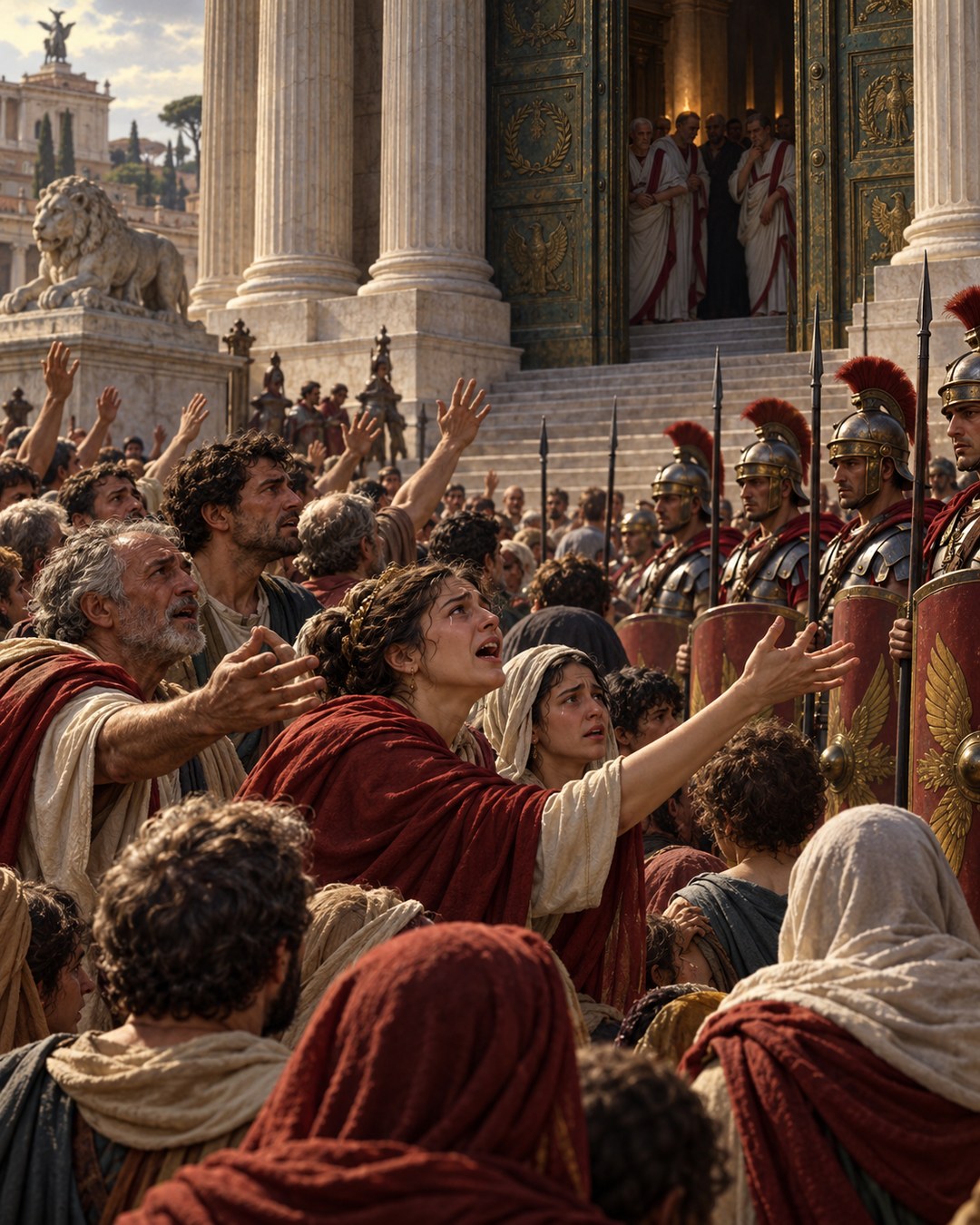
News of the sentence produced a rapid popular gathering.
Tacitus says the people were trying to protect so many innocent lives. Their assembly pushed events toward sedition, and the Senate house itself was besieged.
This was not quiet disapproval expressed after a verdict. The crowd placed pressure on the institution while senators were deciding whether the inherited rule should still govern the case.
Opposition also existed inside the chamber. Some senators protested excessive harshness.
The majority, however, believed change was unwise. For them, the scale of innocence did not disprove the rule; it tested whether Rome still possessed the will to enforce it.
The crowd and the Senate therefore measured danger differently.
Outside, four hundred threatened lives made the punishment intolerable. Inside the majority, the murder of the city prefect made relaxation appear dangerous to every household dependent on enslaved labour.
Tacitus lets the protest remain politically serious. The people did not merely mourn. They surrounded the Senate and later obstructed enforcement.
The scene also reveals a limit of elite privacy. A large Roman household could be governed as the owner’s domain until punishment exposed everyone in it to public view.
Age, sex, and individual conduct varied among the condemned. The rule flattened those differences into one address: people under the same roof.
The protest restored those differences by insisting that the group contained lives rather than a single legal unit.
Cassius Turned Fear into a Deterrence Argument
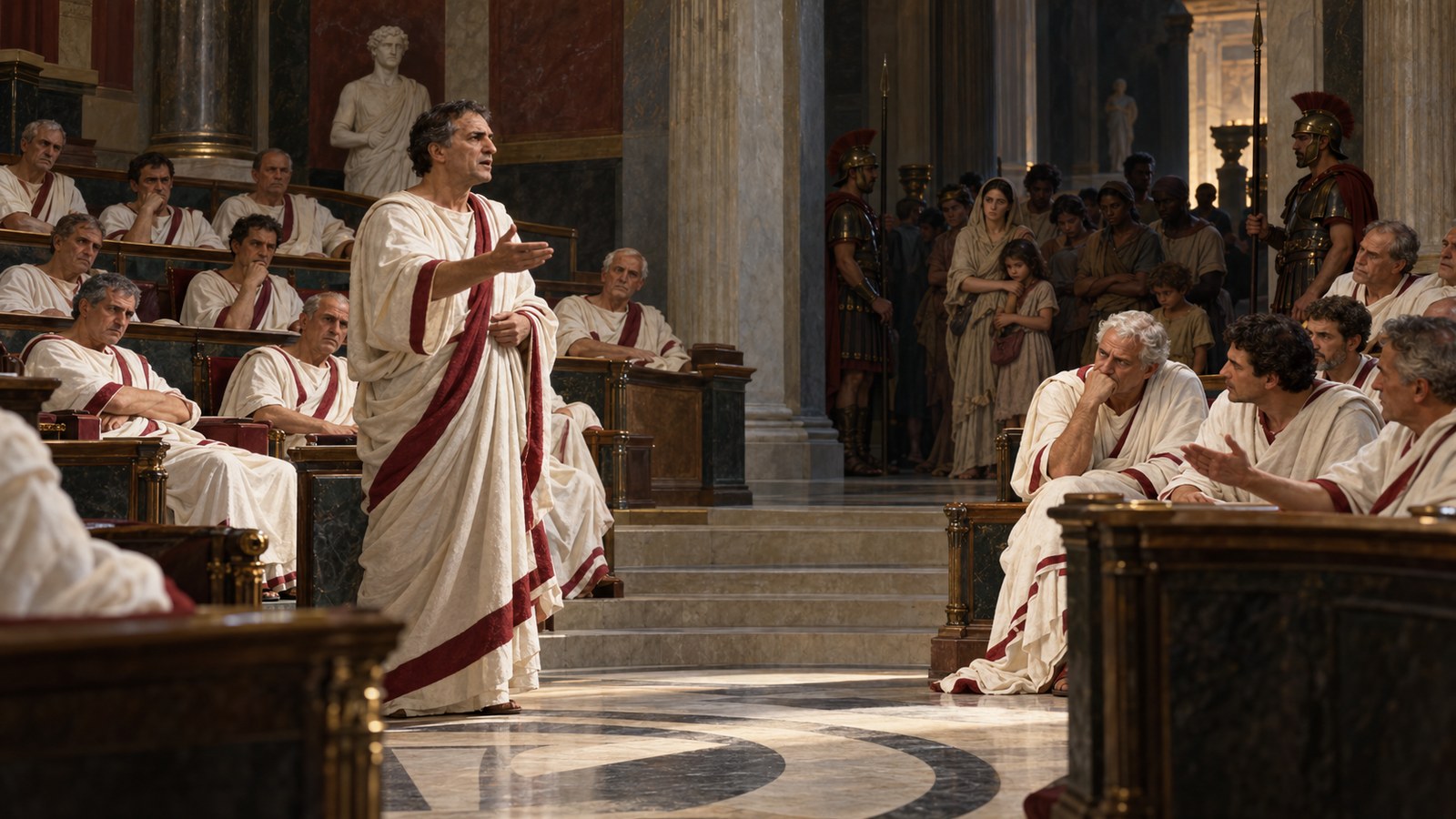
Gaius Cassius spoke for the majority.
His case began with rank. If the prefect of Rome could be murdered at home, he asked, whose status could provide safety?
He then made the number itself serve the opposite argument from the crowd’s. Four hundred household members had not protected Pedanius. If so large an establishment failed, owners could not trust size alone.
Cassius assumed that murder rarely appeared without warning. A would-be killer might utter a dangerous phrase, obtain a weapon, pass a watch, carry a light, and move through a house before attacking.
At each stage, another person might observe and report him.
The collective penalty was meant to make disclosure a condition of survival. Enslaved people would watch one another because silence could expose everyone to death.
That design demanded information even from people who might never enter the same rooms, share the same duties, or possess the same freedom of movement inside an establishment of four hundred.
Cassius also argued that Roman households now contained people from many nations, customs, and cults. In his account, fear supplied the coercive bond that shared origin no longer provided.
This was the logic of terror stated openly, not hidden beneath a claim that every condemned person had participated.
He admitted the cost. Innocent people would die.
His analogy came from military decimation. When every tenth man of a routed unit was killed, the lot could fall on brave soldiers as well as cowards.
Cassius treated that injustice as the unavoidable edge of a great deterrent example. Harm to individuals, he argued, was balanced by advantage to the community.
The comparison imported battlefield discipline into the house. It imagined enslaved residents as a unit responsible for policing itself, even though power, mobility, knowledge, and access within a household were not equal.
It also made innocence irrelevant to the mechanism. A rule designed to frighten a group worked precisely because guilt was not the only path to punishment.
Soldiers Made the Verdict Executable
No senator directly answered Cassius with a formal counter-speech in Tacitus’s account.
Instead, the chamber filled with voices citing the number of victims, their ages, their sex, and the undoubted innocence of most.
The appeal preserved individual distinctions that collective punishment erased.
It did not carry the vote. The party supporting execution prevailed.
Winning inside the Senate did not make the decision immediately enforceable. A dense crowd gathered, threatening stones and firebrands.
The state had produced a sentence but lacked a safe route along which to carry it out.
Nero intervened in two ways. He reprimanded the populace by edict, turning resistance into disobedience to the emperor. Then he stationed detachments of soldiers along the entire road by which the condemned were marched to punishment.
Military force converted the Senate’s legal decision into movement through the city.
The guarded corridor matters because it shows how much resistance remained after the vote. The old custom did not operate by automatic consent; soldiers had to separate the household from people trying to stop the sentence.
The episode ended with one further attempt to expand punishment. Cingonius Varro proposed deporting the freedmen who had been under the same roof.
Nero vetoed that measure. Tacitus explains that the emperor did not want gratuitous cruelty to aggravate a primitive custom that mercy had failed to soften.
The veto drew a boundary, but only after the central sentence stood. Freed people escaped deportation; the enslaved household did not escape execution.
Roman law could distinguish status with precision. Trajan later ruled that people raised in slavery after infant exposure could claim freedom without repaying maintenance. In the Pedanius crisis, status instead determined who remained inside an inherited collective penalty and who was spared an added one.
Tacitus’s narrative does not allow the verdict to look uncontested. It records the disputed motive, the innocent majority, pity inside the chamber, siege outside it, threats in the street, and soldiers along the road.
The Senate’s deterrence logic succeeded because imperial force overcame public resistance.
Four hundred deaths were not an accidental excess at the edge of the rule. Their scale was the instrument through which the rule threatened every other enslaved household.
The crowd understood the same mechanism and opposed it for the same reason.

Sources
Tacitus, Annals, 14.42–45.