
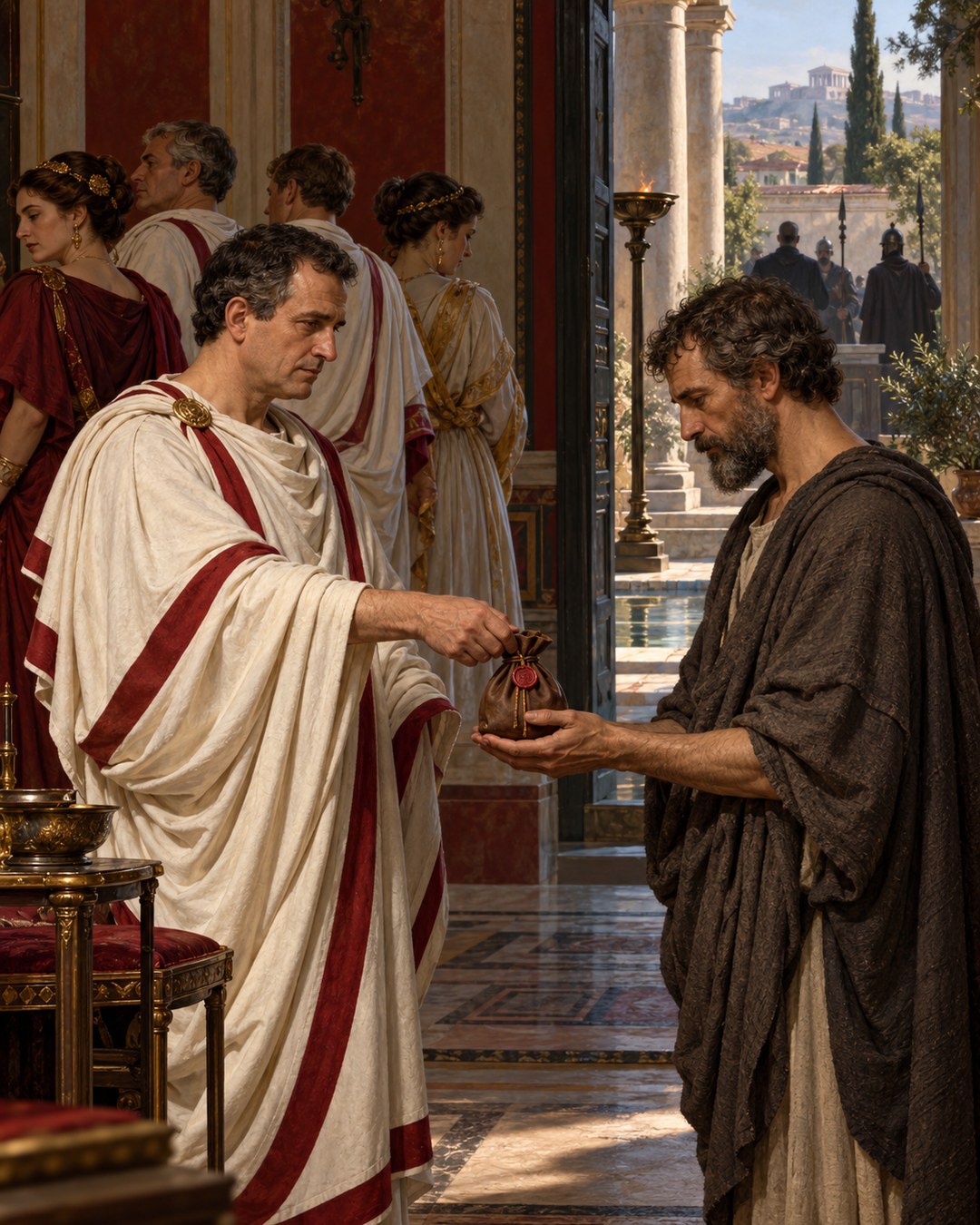
Artemidorus needed money when being seen beside him had become dangerous.
Powerful and wealthy friends stayed away. Pliny did the opposite: he borrowed the sum himself and gave it away.
Years later, the two men still disagreed about what that decision meant.
A Suburban Visit Became a Public Risk
Pliny wrote to Julius Genitor because Artemidorus had been praising him too generously.
The praise concerned a period when Domitian’s government had expelled philosophers from Rome. Artemidorus was one of the men placed under that pressure.
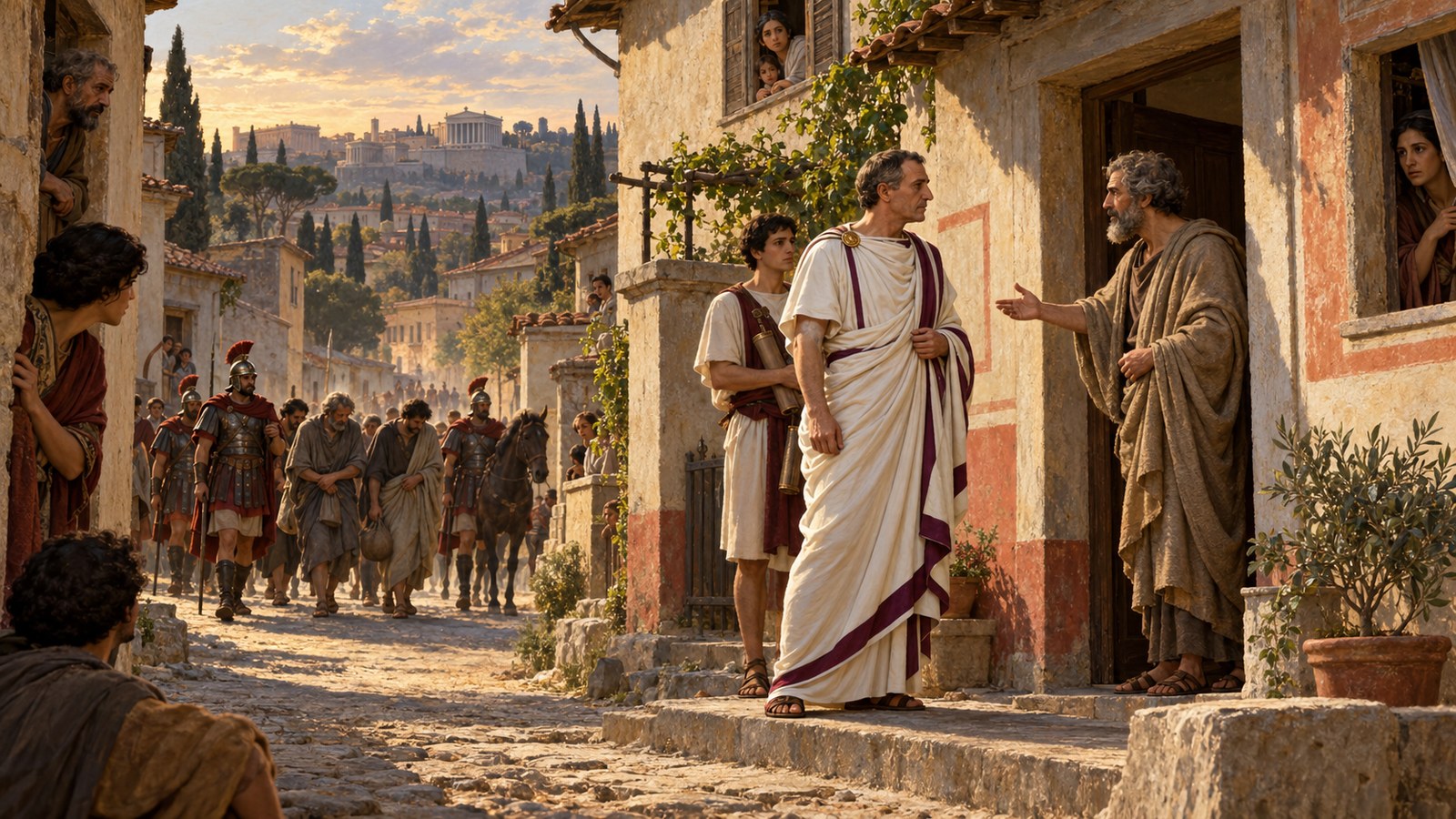
Pliny did not describe a dramatic confrontation at a city gate. He stayed with Artemidorus at his suburban residence.
That ordinary act acquired political weight from its timing. Pliny was serving as praetor, so his movements were not those of an obscure private visitor. He says the stay was widely discussed and especially dangerous because of the office he held.
The danger lay in association. A magistrate who openly visited a philosopher during an expulsion made friendship visible at the moment the regime wanted distance.
Pliny’s account does not say that guards burst into the house or that he delivered a speech against Domitian. Its force comes from the smaller choice: he crossed a threshold that richer, safer people could avoid.
The archive contains another measure of life under the same emperor. Corellius treated surviving Domitian as a final victory before illness made continued life unbearable. Artemidorus’s story catches the regime from a different angle, where a visit and a financial favour became tests of loyalty.
Pliny also knew that office increased exposure. A praetor could not plausibly claim that no one noticed where he went or whose company he kept.
He therefore presents the suburban house as a social boundary. Crossing it did not overturn the expulsion, but it refused the isolation on which the order depended.
Borrowing Made the Gift More Than Patronage
Artemidorus’s difficulty was not only political.
He needed a considerable sum to discharge debts. Pliny specifies that the debts had been incurred for honourable reasons, although he does not invent a detailed ledger for them.
The philosopher had powerful and wealthy friends who could have helped. They held back.
Pliny lacked the required cash. Instead of making inability his excuse, he borrowed the amount and transferred it to Artemidorus as a free gift.
That sequence matters. A rich patron paying from surplus would have performed generosity from strength. Pliny accepted a new obligation so that his friend could remove an old one.
The transaction redistributed risk. Artemidorus’s debt disappeared into a gift, while Pliny took responsibility for the money he had borrowed.
Borrowing also created a trail beyond the two friends. Someone had to trust Pliny with the capital before he could convert it into an unrecoverable gift. The letter does not name that creditor, but the sequence makes clear that Pliny could not simply open a chest and solve the problem from cash already at hand.
It also exposed the limits of status networks. Wealth and influence did not automatically produce help when the recipient carried political danger. The friends best equipped to intervene could be the ones with most to lose.
Pliny does not identify the lender or the exact amount. Those gaps should remain gaps. What he stresses is the contrast between the absent rich and the friend who had to borrow.
Roman elite friendship often moved through recommendation, property, inheritance, and office. Here its material proof was a purse that did not begin as Pliny’s own money.
His act did not purchase Artemidorus’s gratitude. That is precisely why Pliny is uncomfortable when the philosopher repeats the story too warmly.
Seven Punished Friends Set the Price of Loyalty
Pliny places the visit and gift inside a list of punishments.
Three friends—Senecio, Rusticus, and Helvidius—had been put to death. Four more—Mauricus, Gratilla, Arria, and Fannia—had been banished.
The arithmetic is blunt: seven people within his circle had already received death or exile.
Pliny compares those events to thunderbolts falling around him. He felt scorched, and he says there were clear indications that a similar fate hung over his own head.
The metaphor does not prove exactly what accusation was being prepared against him. It tells us how he represented the atmosphere afterward: punishment seemed close enough to illuminate every act of friendship.
This is why the suburban visit cannot be separated from the loan. Political pressure and financial need reinforced one another. Once public association became hazardous, practical support became easier to withhold.
Pliny’s list also prevents the story from becoming a fable in which courage cost nothing. He names consequences that had already reached people he knew.
The names cover both penalties and both sexes: men executed, men exiled, and women exiled. The pattern gives his fear a social geography larger than a single philosophical school, while still stopping short of claiming that every case followed the same charge or procedure.
Some members of that circle recur in stories of Stoic endurance and senatorial opposition. Yet the letter is not a collective biography. It uses the seven names to explain why helping one living philosopher felt exposed.
Against that background, Pliny’s claim is deliberately narrow. He does not say that he saved philosophy, defeated Domitian, or matched the sacrifices of the dead and exiled.
He says only that he avoided the disgrace of deserting his friends.
The sentence lowers the heroic temperature while preserving the moral line. Pliny treats abandonment as the shameful action; remaining present becomes the minimum he expected from himself.
A Friendship Begun in Syria Outlasted the Crisis
Pliny traces his judgment of Artemidorus to years before the expulsion.
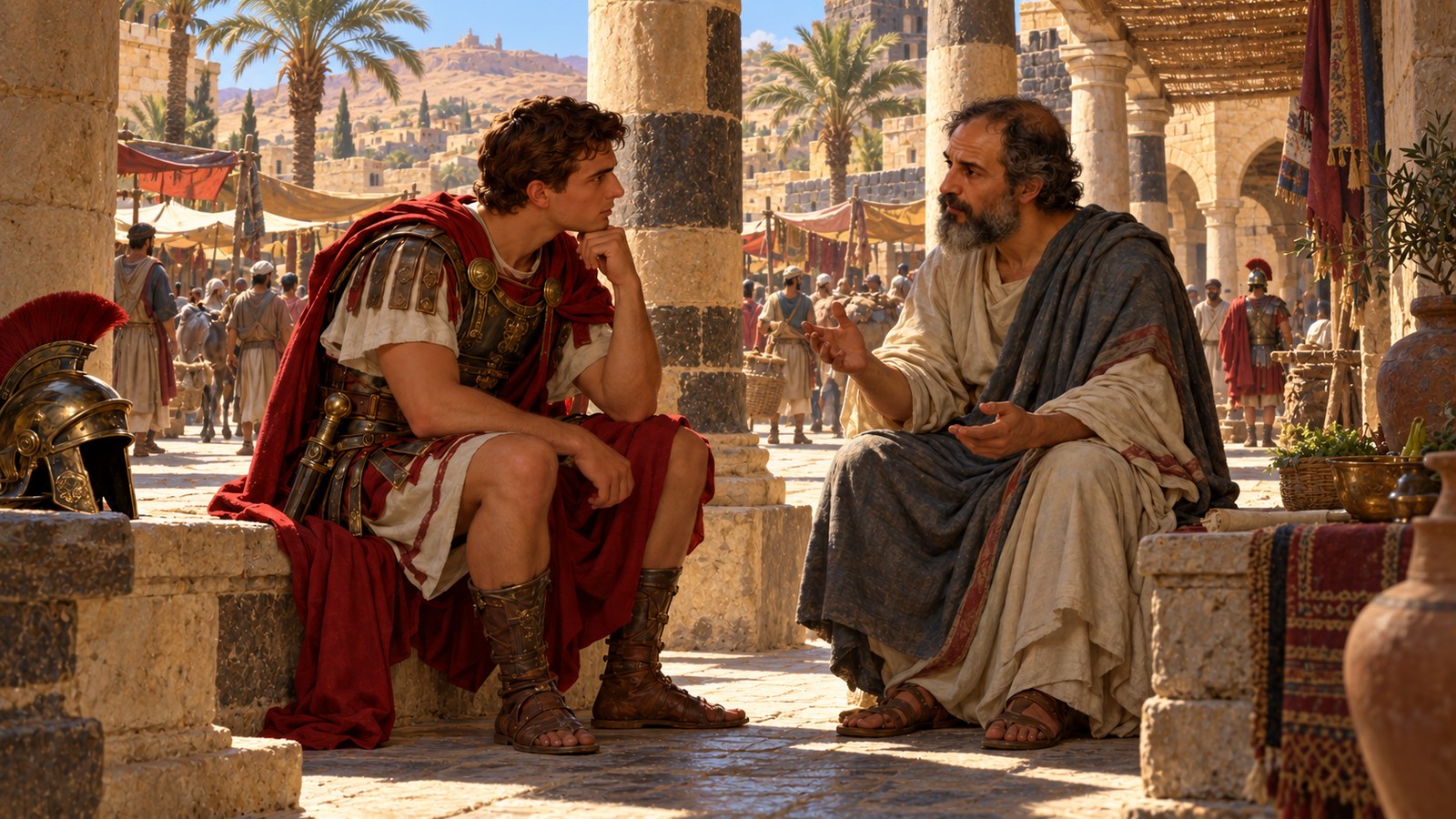
When he served as a military tribune in Syria, the two men were already close. Pliny jokes that his first sign of possessing any intelligence was his ability to appreciate the philosopher.
He calls Artemidorus either the perfect sage or the nearest possible approach to one.
The praise begins with sincerity and truth. It then becomes physical: Artemidorus endured extremes of summer and winter, did not shrink from work, avoided indulgence in food and drink, and restrained appetite and desire.
Pliny insists that these qualities, impressive in another person, were small beside Artemidorus’s greater virtues.
The link also ran through Gaius Musonius, Artemidorus’s father-in-law. Pliny had loved and admired Musonius despite their difference in age.
Musonius had many disciples from different social ranks. From that crowd he chose Artemidorus as his son-in-law.
The archive preserves Musonius’s austere standard for teaching. He argued that a philosopher’s best audience responded with silence rather than theatrical applause. Pliny’s portrait of Artemidorus uses a related measure: discipline appeared in weather, labour, appetite, and conduct.
That history explains why Pliny did not treat the debt as a sudden opportunity to display generosity. He was acting within a friendship formed through service abroad, philosophical admiration, and family connection.
It also changes the timeline of obligation. Artemidorus did not become important because Pliny helped him in Rome. Pliny helped because years of conversation and judgment had already made abandonment unthinkable.
It also explains Artemidorus’s side of the disagreement. A man whom Pliny praises for truth nevertheless overstated the merits of his friends.
Pliny calls that tendency a fault, but an honourable one. Artemidorus’s generosity operated through judgment: he assigned more virtue to friends than they believed they deserved.
The letter therefore stages a quiet contest. Artemidorus enlarges Pliny’s courage; Pliny enlarges Artemidorus’s character and reduces his own conduct to the avoidance of shame.
Neither man speaks as a detached recorder. Their mutual praise is itself evidence of how the friendship worked.
Under Domitian, officials could make association costly. Money could disappear when rich allies calculated their exposure. Exile and execution made caution rational.
Pliny’s answer was not a public manifesto. It was presence, borrowed money, and a later refusal to claim more honour than the friends already punished around him.
Sources
Pliny the Younger, Letters, 3.11.