
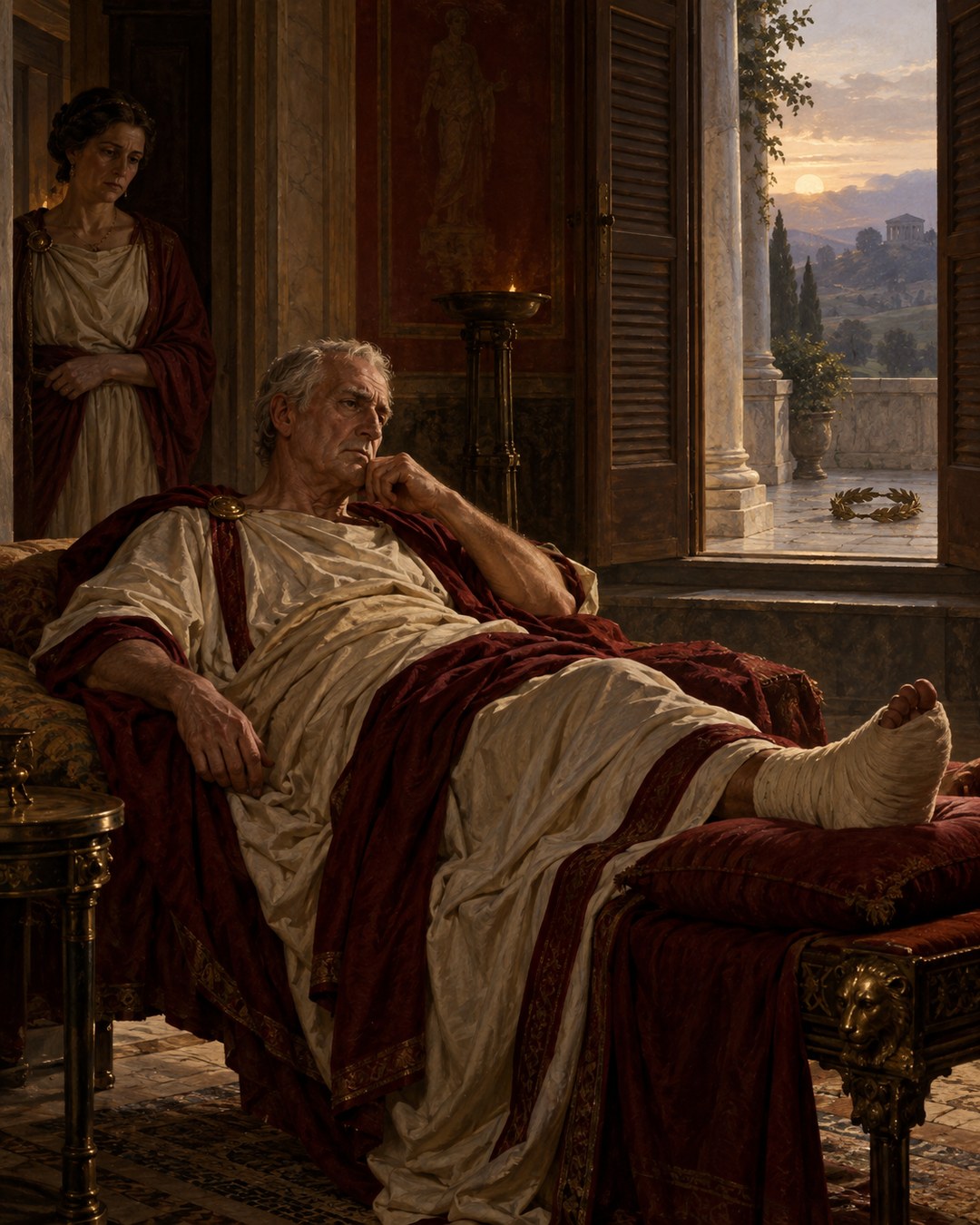
Corellius Rufus endured pain because he wanted to outlive Domitian by a single day.
He achieved that political wish. Later, when illness spread through his body, he refused food for four days and would not be recalled by his wife, daughter, doctor or friends.
Pliny admired the resolve, hurried to break it and then wrote a letter that refused to make admiration cancel grief.
An Illness Beginning at Thirty-Three Became a Lifelong Contest
Pliny announced the death to Calestrius Tiro as a personal catastrophe. Corellius was distinguished, publicly respected and surrounded by reasons to remain alive. He had a wife, daughter, grandson, sisters and many genuine friends. The force of the letter depends on that abundance: death did not come because Corellius lacked attachments.
The illness had begun decades earlier. Pliny had heard Corellius say that gout first attacked his feet when he was thirty-three. Corellius regarded it as inherited, a bodily succession passed through a family much as other qualities might be.
In the prime of life, he kept the attacks in check through restrained and disciplined living. Pliny does not give a treatment schedule or name medicines. He emphasizes a sustained regimen and the moral vocabulary through which Roman elites often described control of appetite and body.
Age changed the scale of the contest. Pain that had once remained in the feet spread through all his limbs. Pliny calls the torture incredible and the agony horrible. The language is not a clinical measurement, but it establishes why ordinary consolations about family, reputation and longevity could lose their power.
The letter must be read cautiously. It preserves Pliny’s memory and interpretation, not Corellius’s private diary or a physician’s record. Pliny shaped events for a correspondent and for the literary collection in which the letter survived. Yet his details—age at onset, movement of pain, named messengers and counted days—make the scene unusually concrete.
Another Lost Eagles story asks what courage looks like when the body reacts before judgment. a Stoic at sea turned pale during a storm before reason could assess the fear. Corellius’s episode concerns a much longer interval: not the first involuntary shock, but the will built across years of recurring pain.
Domitian Gave Endurance a Political Deadline
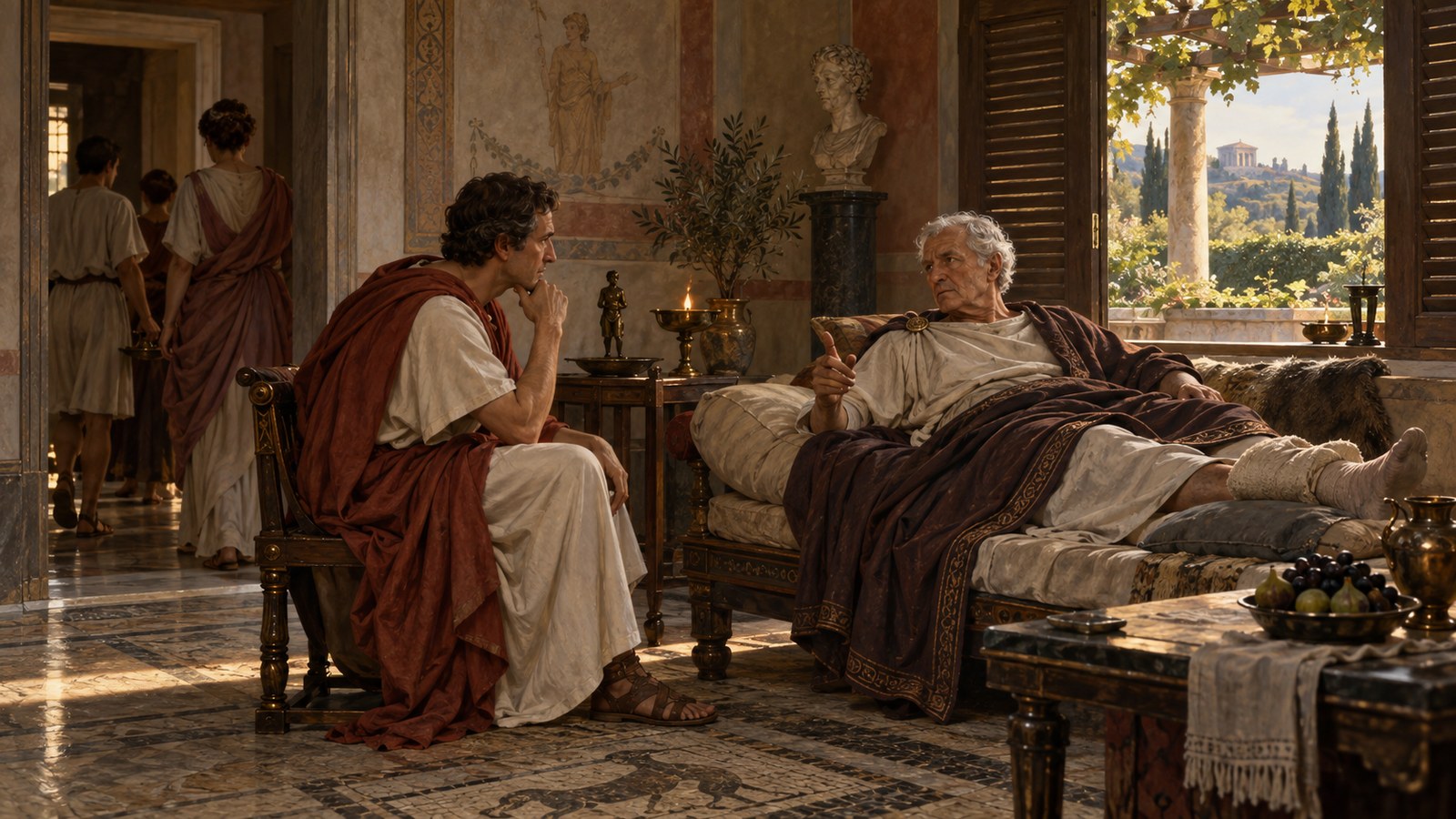
During Domitian’s reign, Pliny visited Corellius at his country house. The attendants withdrew when an intimate friend entered. Even Corellius’s wife left the chamber. The repeated privacy suggests that close conversation followed a recognized household routine.
Looking around to ensure they were alone, Corellius asked why Pliny thought he endured such pain for so long. His answer was political: he wanted to outlive “that tyrant,” even if only by one day.
The statement transformed survival into opposition. Corellius did not need to defeat Domitian in office or witness a long new era. Remaining alive after the emperor was gone would be enough to deny the ruler the final ordering of their lives.
Pliny says that, if Corellius’s body had been equal to his resolve, he would have accomplished the wish by strength alone. Instead, a god heard the prayer. Domitian died, and Corellius survived him.
The episode has often been made to sound like a polished Stoic maxim. In the letter it is more physical. The wish is spoken from a sickroom. Servants and wife leave. A friend sees pain no longer confined to one part of the body. Political time is measured against how long that body can continue.
Survival also altered Corellius’s freedom to choose. Pliny says he could then die without anxiety and as a free man should. That is Pliny’s approving formulation, not a neutral description. It joins the fall of Domitian to the removal of an obligation Corellius had set himself.
The archive preserves another quieter act of defiance from the same political atmosphere. Fannia carried a forbidden biography into exile rather than abandon its memory. Corellius’s resistance took place through duration: the body itself remained alive until the ruler did not.
After the Tyrant, Pain Reversed the Meaning of Resolve
Once the political deadline had passed, illness continued. Corellius tried to moderate it through diet, but Pliny says the condition grew worse. The discipline that had supported endurance no longer produced a tolerable life.
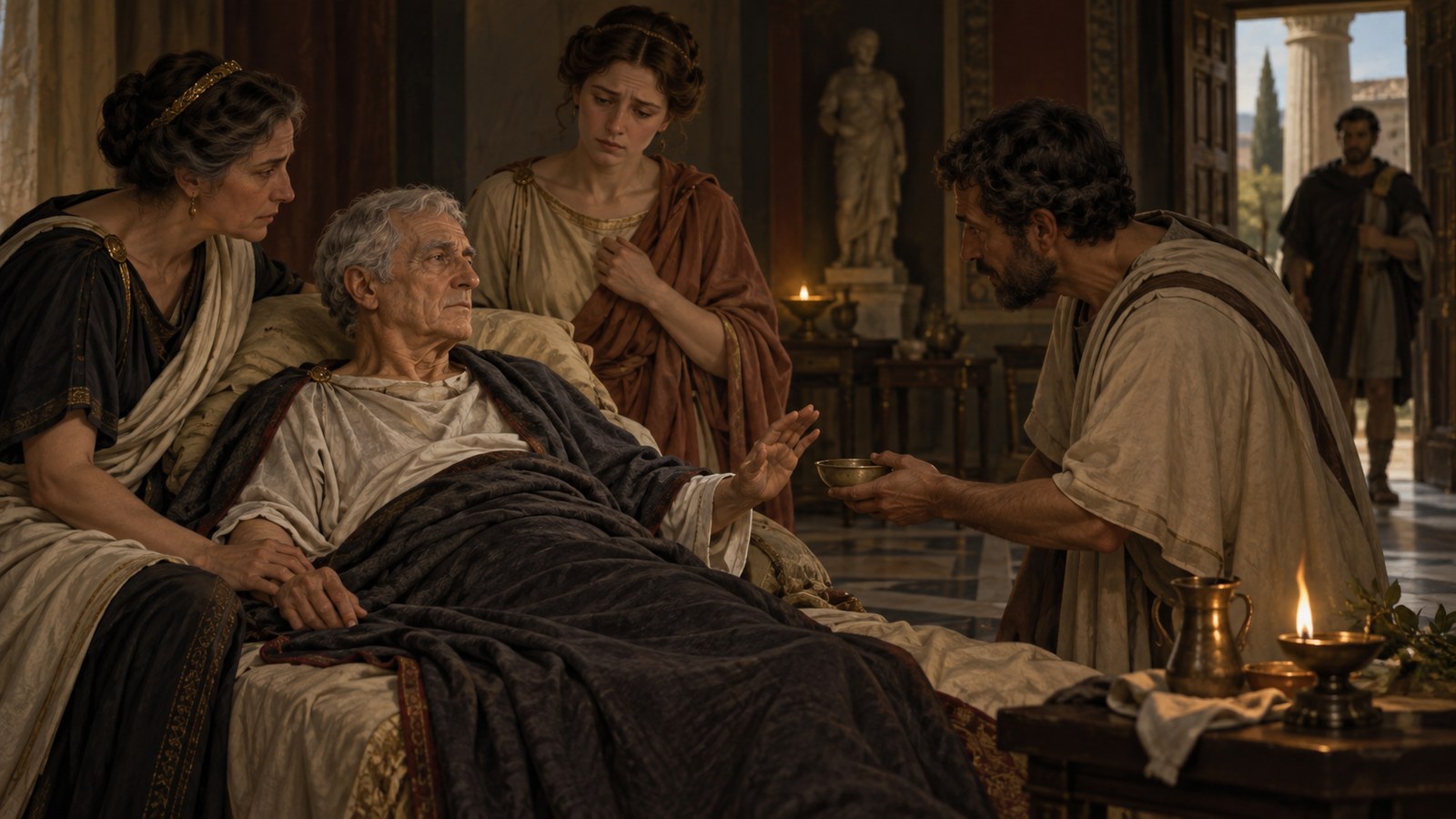
Corellius then fixed on death by refusing nourishment. Pliny counts the days—two, three, four—as if each number marked both bodily decline and the hardening of intention.
The same quality that Pliny praised in resistance to Domitian now blocked intervention by friends. Resolve had not changed its nature; its direction had changed. Earlier, it held Corellius in life despite pain. Now it held him against every argument to continue.
This reversal prevents a simple lesson about perseverance. More endurance was not automatically virtuous after the purpose Corellius had chosen for it was fulfilled. Nor did Pliny treat the decision to die as emotionally easy merely because he believed it reasoned.
The letter calls philosophical Reason a kind of Necessity for Corellius. At the same time, Pliny lists all the counterweights: family, honour, friendship and a state now prospering after Domitian. He gives the decision intellectual dignity without pretending its alternatives were empty.
Modern readers should not turn the episode into medical guidance or a universal claim about illness. It belongs to an elite Roman letter, a philosophical culture and a legal-social world different from our own. Its historical force lies in the conflict Pliny records between autonomy, suffering and obligations felt by those around the patient.
Corellius had once made an external event—the death of an emperor—the minimum horizon of his endurance. Afterward, pain supplied a different horizon, one his friends could see approaching but could not agree to accept.
Two Messengers Measured How Fast Persuasion Failed
Corellius’s wife Hispulla did not accept the decision passively. She sent their mutual friend Caius Geminius to Pliny with the news that neither her appeals nor those of the couple’s daughter had moved him.
Hispulla believed Pliny was the one remaining person who might recall Corellius to life. That phrase reveals the social network mobilized around the bed. Family had argued. A friend became messenger. Another friend was asked to supply the authority affection had not found.
Pliny rushed toward the house. Before he arrived, Hispulla sent Julius Atticus with a second message. The situation had changed during the journey: even Pliny could do nothing, because Corellius’s resolve had grown more fixed.
The two messengers turn distance into narrative pressure. The first opens a last possibility. The second closes it. Pliny remains on the road between them, moving toward a conversation that will never occur.
A doctor still offered nourishment. Corellius answered with a brief Greek word that Pliny renders as “My mind is made up.” The phrase struck him with both loss and admiration. It was not merely refusal; to Pliny it expressed a judgment completed and no longer available for debate.
The letter does not reproduce the pleas made by Hispulla or the daughter. It does not tell us what food the physician offered or describe the physical stages of four days without it. Those omissions limit reconstruction and keep attention on decisions, messages and Pliny’s late arrival.
They also expose the narrator’s helplessness. Pliny liked to present friendship as counsel, example and mutual improvement. Here, friendship receives a summons and moves quickly, yet fails to reach the room before persuasion becomes impossible.
Pliny Would Not Let Admiration End the Argument
Corellius was at the end of his seventy-sixth year. Pliny acknowledged every conventional consolation: his friend had reached old age, escaped lifelong illness, left descendants and lived to see the state he valued in better condition.
Then he rejected the emotional adequacy of those facts. He grieved as though Corellius had died young. He also grieved for himself, because he had lost the guide, philosopher and friend who helped order his own life.
This self-awareness makes the letter more than praise for a model death. Pliny knew his sorrow contained self-interest. Corellius’s absence threatened the standard by which Pliny believed he behaved well.
He asked Tiro for sympathy but explicitly refused familiar phrases about age and infirmity. Such consolations were already present in his mind and in books. Their truth did not make them strong enough to ease this particular loss.
The request for “new” and potent words is revealing. Pliny, a practiced writer with inherited philosophical language at hand, found literary resources insufficient. The friend whose death seemed rational had produced grief that reasoned commonplaces could not settle.
That unresolved tension is the letter’s real structure. Corellius’s choice appears deliberate. His illness appears unbearable. His political endurance appears admirable. His family’s resistance appears loving. Pliny’s attempt to intervene appears futile. None erases the others.
Corellius survived Domitian, satisfying the deadline that had once organized pain. He then made another decision over four counted days. Pliny could describe why, admire the fixed mind and still wish the decision had yielded.
The final portrait is not of philosophy defeating grief. It is of grief refusing to simplify a philosopher.
Sources
Pliny the Younger, Letters, book one, letter 12.