
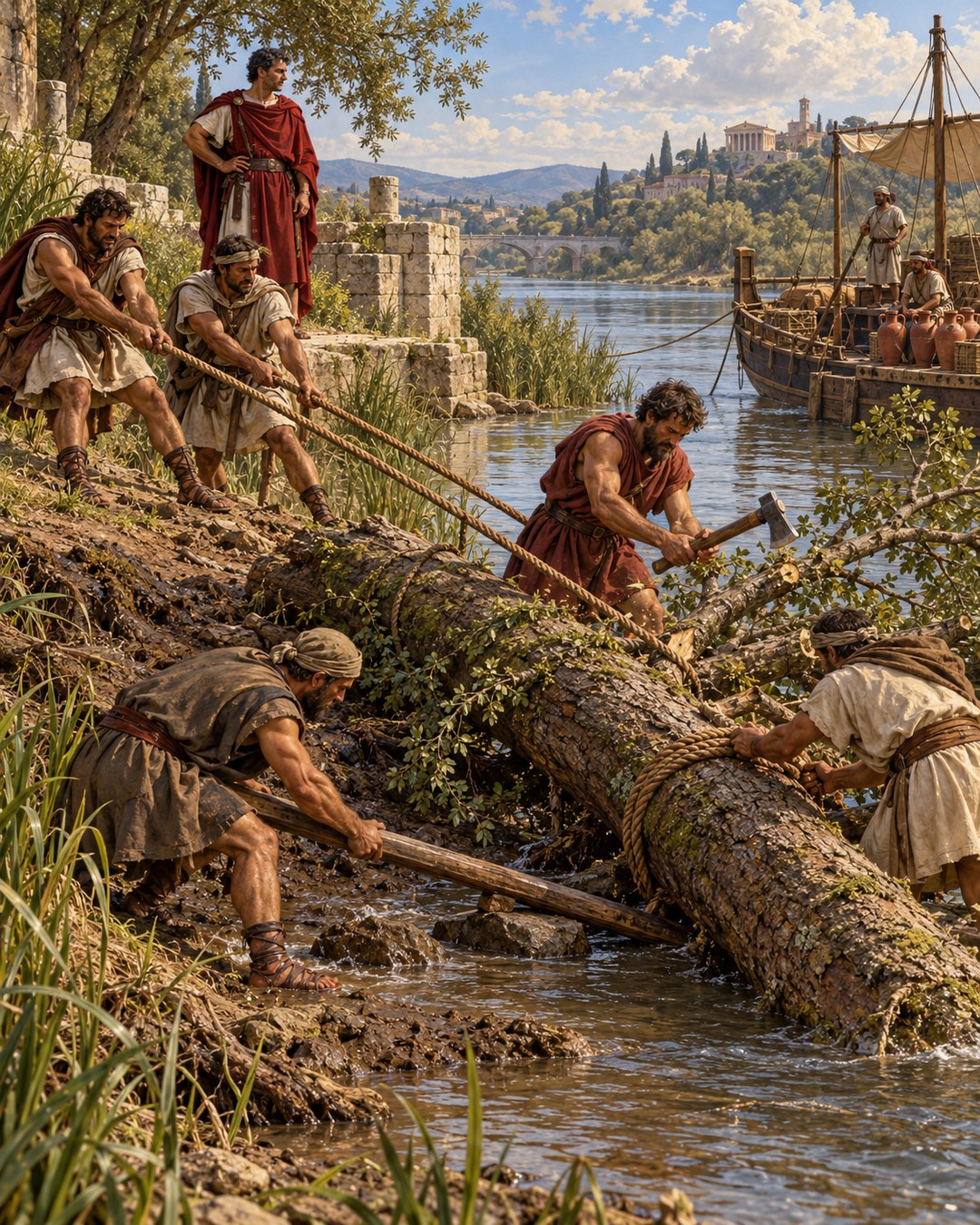
Aulus Gellius went into a library looking for one thing and found a river-maintenance contract instead. Among old praetorian edicts in the library of Trajan’s temple, a phrase caught him: public contractors who had undertaken to clear rivers of “nets” could be brought before the praetor if they failed to do the work required by their contract.
The nets were not made of rope. A companion supplied the explanation from a work on old words. Trees projecting from the banks or lodged in the riverbed were called retae because they caught and obstructed ships as a net catches what enters it. Once the term is understood, the edict reveals an entire chain of river operations in a few lines: public work was contracted out, obstructions were defined, performance was enforceable, and the practical test was whether vessels faced delay or danger.
An old edict surfaced in Trajan’s library
Gellius frames the discovery as an accident. He was sitting in the library of Trajan’s temple and looking for something else when early praetorian edicts came into his hands. He decided they were worth reading and learning. The editor’s note identifies the setting as the Bibliotheca Ulpia in Trajan’s Forum, one of Rome’s great public libraries.
That setting matters to the shape of the evidence. Gellius was not watching a clearance gang at work. He was reading an older legal text preserved among books. The river operation survives because a clause about failure required the work to be named. A contractor might be brought before the praetor and accused of not doing what the contract required. The edict therefore preserves maintenance from the enforcement end: it tells us what happened when an obligation was said to have been left incomplete.
The wording also places the work in public contracting. The people addressed had “taken” contracts for clearing rivers. The state did not need to supply every worker directly for the task to remain a public concern. The contract defined an obligation, and the praetor supplied a forum in which alleged non-performance could be raised.
The order of the clause is revealing. It first identifies a class of contractor, then names the work, then imagines the contractor being brought before the magistrate, and finally states the accusation: the promised work was not done. Gellius preserves no verdict in an individual dispute. The edict instead establishes that failure was foreseeable enough to have a reusable legal form.
The “nets” were trees
The difficult word was retae. Translated too quickly, the phrase sounded as if contractors were removing fishing nets from rivers. Gellius and those with him asked what it meant. A friend recalled book seven of Gavius’s On the Origin of Words, where the term had been explained through the objects that obstructed navigation.
Two locations are named. Some trees projected from the riverbanks. Others were found in the riverbeds. Both could meet a moving vessel. The proposed derivation compared their effect to a net: branches impeded ships and, in the source’s figurative language, netted them.
This is more specific than a general instruction to keep a river tidy. The target was an obstruction with a relationship to traffic. A tree mattered because of where it extended or lay and what it could do to a vessel. The river’s edge and channel had to be read from the perspective of passage.
The image also explains why the obsolete word generated uncertainty. Once the technical meaning had faded, “clearing rivers of nets” no longer transparently described cutting or removing trees. Gellius needed another antiquarian work—and a friend who remembered it—to recover the operation hidden inside the clause.
A contract joined clearance to accountability
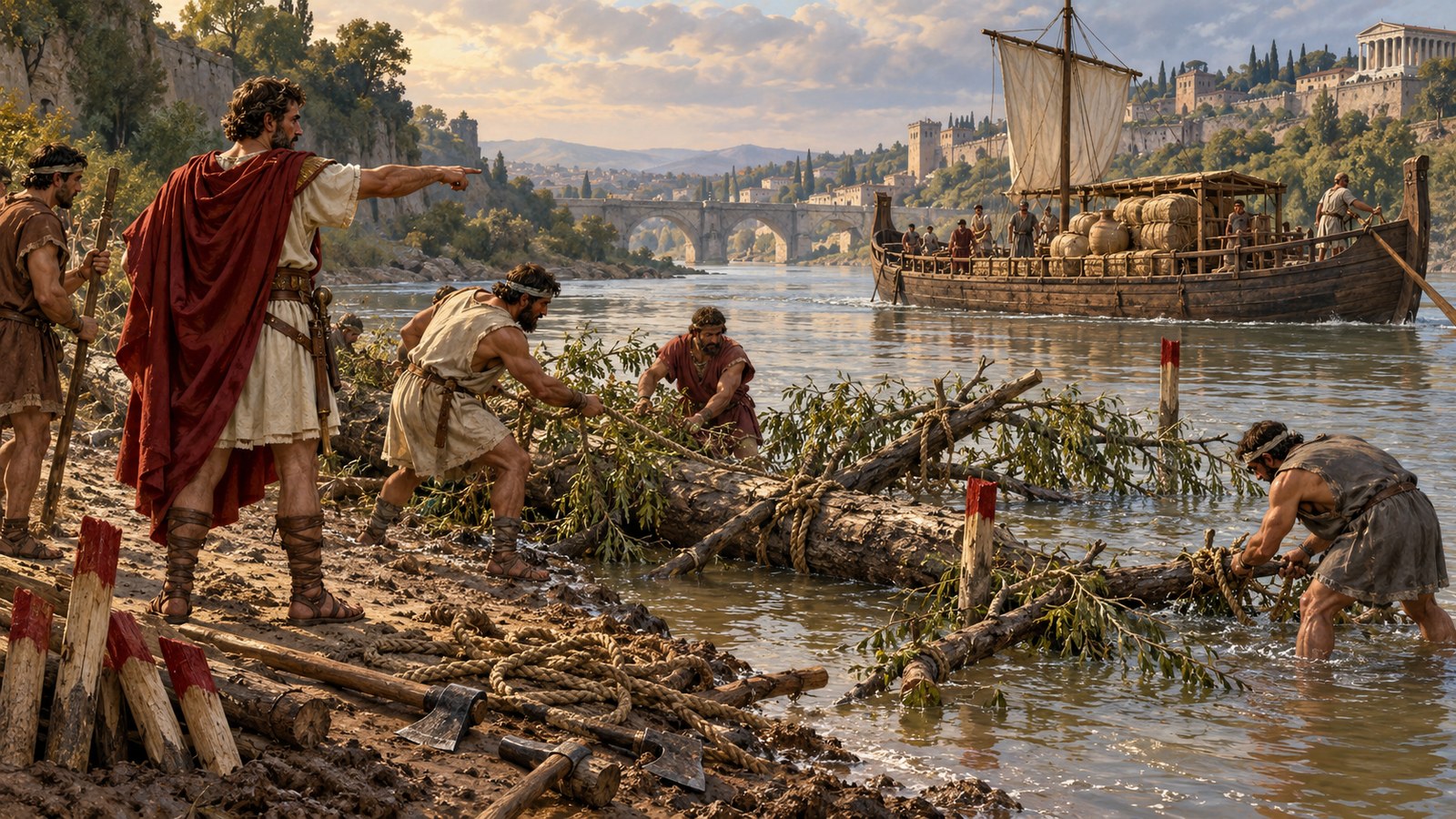
The edict’s logic is compact. A person had accepted a public contract. The contract required a defined river-clearing task. If that person was brought before the praetor and accused of failing to do it, the old wording governed the case. Gellius does not reproduce a full procurement document, price or crew list, and those details should not be invented. What he does preserve is enough to show an enforceable link between assignment and performance.
The friend’s explanation says the rivers were farmed out to be cleared of these tree “nets.” Farming out the work separates the public purpose from the method of delivery. Navigation still needed protection, but contractors carried the immediate duty. The praetorian clause made their obligation legible after a complaint.
This differs from the allocation problem in Frontinus’s hunt for water sold through secret pipes. Both stories involve public water systems and enforceable responsibilities, but one concerns distribution through an aqueduct network while the other concerns physical obstructions in navigable rivers. Shared infrastructure does not make them the same mechanism.
Delay and danger were the practical test
The final words of the explanation identify the operational outcome. Clearing the trees meant that vessels meeting branches would suffer neither delay nor danger. Those are two different failures. A blockage could slow or stop passage without wrecking a craft; a projecting or submerged tree could also put vessel and crew at risk.
The phrase keeps the article anchored to what the source says. Gellius does not provide cargo totals, channel dimensions or a maintenance calendar. He gives the obstruction, the contracted remedy and the harms the remedy was meant to prevent. That narrow chain is enough to reconstruct the practical logic without turning the passage into a complete manual of Roman river engineering.
Other Roman building stories show landscapes forcing design choices, such as the river that pushed Ceres’s portico across a road. Here the response was not a new monument. It was recurring removal: trees at the bank or in the bed had to stop acting like a net across a vessel’s route.
Because the harms were expressed from the vessel’s perspective, successful clearance could be judged by movement. The contractor’s work was not finished merely because wood had been cut somewhere. The relevant branches had to cease delaying or endangering ships.

A technical word preserved an operating system
Gellius’s chapter is brief, but its parts fit tightly. An old edict names public contractors. A failure clause brings them before the praetor. A forgotten noun identifies the physical obstruction. Gavius’s etymology turns that noun into a picture of branches catching vessels. The closing explanation states the desired result: passage without delay or danger.
The episode also shows the value and fragility of technical vocabulary. While retae remained understood, the clause pointed directly to a maintenance task. Once the word became obscure, the same sentence could be mistaken for a rule about literal nets. Gellius’s curiosity, his companion’s reading and the survival of Gavius’s explanation restored the connection between legal language and river work. The recovery depended on comparing one old legal formula with another old book rather than guessing from the familiar meaning of “net.”
What emerges is not a romantic picture of Roman trade but a practical one. Navigable water required unwanted things to be removed, somebody had to accept the duty, and failure could become a matter for the praetor. The river stayed usable through a combination of physical labor and legal accountability. One strange word lets both halves remain visible.
Sources
Aulus Gellius, Attic Nights, 11.17. Modern library identification in the LacusCurtius editorial note.